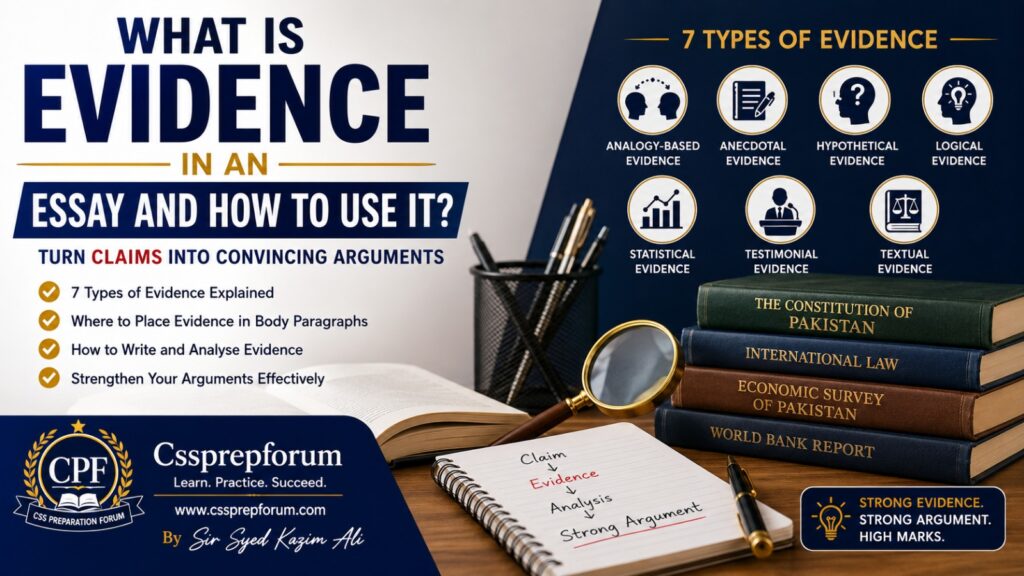
Learn what evidence means in essay writing and how it transforms unsupported claims into convincing arguments. This article explains seven types of evidence, their strengths and limitations, and how CSS and PMS aspirants can select, write, analyse, and integrate them effectively into essay body paragraphs.

What Is Evidence in an Essay and How to Use It?
Think of a lawyer standing before a judge. He may speak confidently, present an intelligent argument, and strongly believe that his position is correct. However, the judge will not accept his claim merely because it sounds convincing. The lawyer must support it with facts, records, examples, testimony, or other credible evidence. In much the same way, when you write an argumentative essay in the CSS or PMS examination, you are presenting a case before your examiner. Your arguments are your claims, and evidence is what gives those claims credibility.
This is why learning how to use evidence effectively is one of the most important parts of competitive essay writing, especially in the CSS and PMS examinations.
Over the years, hundreds of aspirants have asked me the same questions:
- What exactly is evidence?
- Why is it necessary?
- What kinds of evidence can be used in an essay?
- Where should it be placed in a body paragraph?
- And how much evidence is enough?
These questions appear simple, but the concept requires proper understanding. In my classes, I normally spend several detailed lectures teaching students how to select, place, explain, and connect evidence with an argument. Evidence should never be inserted merely to decorate a paragraph. It must perform a clear function:
It must prove or strengthen the argument being made.
This article presents the crux of those lectures in a simple and practical form. In CSS and PMS essays, evidence can take several forms. It may be a relevant fact or statistic, a finding from a credible report, a historical example, a case study, an expert opinion, a quotation from an authoritative source, or another verifiable piece of information. The form may change according to the topic, but the basic rule remains the same: your evidence must be relevant to the argument and must help prove what you are claiming.
For my students, this article should also serve as a revision of what we have already discussed in class. After reading it carefully, they should practise writing evidence-based body paragraphs and get as many of them evaluated as possible. Understanding evidence theoretically is useful; learning to use it naturally in your own writing is what ultimately matters.
Why Evidence Is Important in CSS and PMS Essays
Before learning how to write evidence, every CSS and PMS aspirant must first understand why it matters so much. The absence of evidence is not merely a stylistic weakness; it can weaken the entire logic of an argumentative essay. A competitive essay is not written simply to describe an issue or to display vocabulary. It is written to establish a position, defend that position, and convince the examiner that the argument rests on sound reasoning and credible knowledge. Evidence is what makes that possible.
A claim without evidence remains only an opinion. You may write that political instability damages the economy, that climate change threatens food security, or that poor governance weakens institutions, but unless you support such claims with relevant facts, reports, examples, case studies, statistics, or expert findings, the examiner has little reason to accept them as serious arguments. Evidence transforms what you believe into something you can defend.
This is why evidence acts as the foundation of an essay body paragraph. A paragraph may contain elegant sentences, sophisticated vocabulary, and impressive expression, but if its central claim is unsupported, the entire structure remains weak. It may look convincing on the surface, yet the moment the examiner mentally asks, “What proves this?”, the paragraph begins to collapse. In simple words, a claim tells the examiner what you think; evidence shows him why he should take that claim seriously.
Evidence also demonstrates that you have engaged with real knowledge rather than relying on general impressions. Consider the difference between saying, “Pakistan’s economy is struggling,” and supporting that claim with credible economic data from the IMF, World Bank, State Bank of Pakistan, or Pakistan Economic Survey. The first statement is something almost anyone can write. The second shows that the candidate has actually read, researched, and understood the issue. This distinction matters greatly in a competitive examination because the examiner is not looking for a candidate who can merely repeat common observations. He is looking for someone who can analyze a problem through informed and verifiable knowledge.
The importance of evidence extends far beyond the essay paper. Once an aspirant develops the habit of supporting arguments with facts, examples, and credible sources, the same discipline naturally improves performance in Current Affairs, Pakistan Affairs, and optional subjects. Such students begin to read differently. They no longer read merely to collect information; they read to collect usable arguments and the evidence required to support them. Over time, this habit sharpens both knowledge and analytical ability.
Evidence is also essential because it gives analysis something concrete to work with. A strong paragraph normally moves through a logical sequence: the topic sentence presents the argument, the bridge explains it, the evidence supports it, the analysis interprets that evidence, and the concluding sentence connects the paragraph back to the thesis. Remove the evidence, and the analysis often turns into empty explanation or repetition. There is simply nothing substantial to interpret. Therefore, evidence does not stand separately from analysis; it gives analysis its intellectual substance.
At the same time, aspirants must understand that evidence is not decoration. A quotation does not strengthen a paragraph merely because a famous person said it. A statistic is not useful simply because it contains numbers. A report does not become valuable merely because it comes from the United Nations or World Bank. Evidence works only when it directly supports the exact argument being made. Relevance matters more than impressiveness.
Why an Essay Without Evidence Becomes Weak
However, an essay without evidence quickly becomes a collection of unsupported claims. The candidate may write fluently and confidently, but if important arguments are not backed by credible facts, examples, reports, statistics, or case studies, the examiner has little reason to accept them. Strong English can improve presentation, but it cannot compensate for weak intellectual support.
The absence of evidence also makes an essay appear poorly researched. Consider the difference between saying, “Poverty is a serious problem in Pakistan,” and supporting that claim with credible data or a recognized development report. The second approach immediately gives the argument greater depth and credibility.
Without evidence, candidates also tend to repeat the same point in different words. As a result, the essay becomes longer without becoming stronger. Examiners reward argumentative quality, not the number of pages written.
It is therefore incorrect to assume that evidence is unnecessary simply because a CSS or PMS essay is not a research paper. Formal citations may not be required, but argumentative support certainly is. Facts, statistics, reports, historical examples, expert opinions, and case studies help establish the validity of your claims.
A simple rule can guide you: whenever you make an important argument, imagine the examiner asking, “What makes you say this?” If your paragraph already provides a credible answer, the argument is strong. If it does not, you are still asking the examiner to accept your opinion without proof.
Do not merely tell the examiner that your argument is correct; give him a reason to believe it.
What is Evidence?
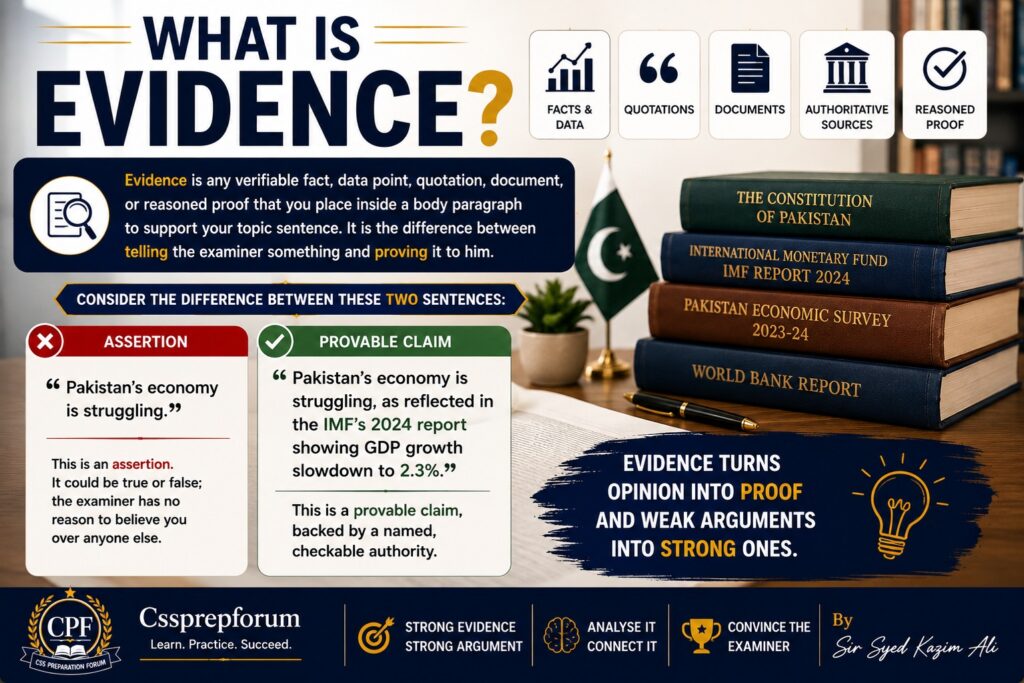
Evidence is any verifiable fact, data point, quotation, document, or reasoned proof that you place inside a body paragraph to support your topic sentence. It is the difference between telling the examiner something and proving it to him.
Consider the difference between these two sentences:
- “Pakistan’s economy is struggling.”
This is an assertion. It could be true or false; the examiner has no reason to believe you over anyone else.
- “Pakistan’s economy is struggling, as reflected in the IMF’s 2024 report showing GDP growth slowdown to 2.3%.”
This is a provable claim, backed by a named, checkable authority.
An Essay’s Body Paragraph Structure
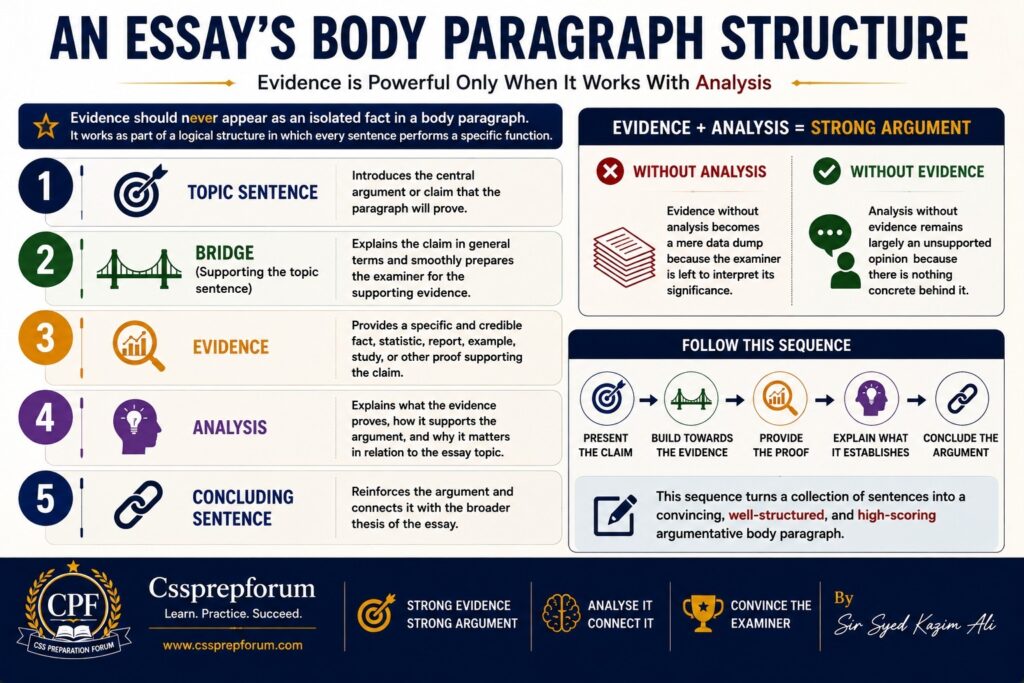
Evidence should never appear as an isolated fact in a body paragraph. It works as part of a logical structure in which every sentence performs a specific function. A strong CSS or PMS body paragraph generally develops through five interconnected parts:
- Topic Sentence
introduces the central argument or claim that the paragraph will prove. - Bridge (Supportinng the topic sentence)
explains the claim in general terms and smoothly prepares the examiner for the supporting evidence. - Evidence
provides a specific and credible fact, statistic, report, example, study, or other proof supporting the claim. - Analysis
explains what the evidence proves, how it supports the argument, and why it matters in relation to the essay topic. - Concluding Sentence
reinforces the argument and connects it with the broader thesis of the essay.
The most important point to understand is that evidence and analysis must work together. Evidence without analysis becomes a mere data dump because the examiner is left to interpret its significance. On the other hand, analysis without evidence remains largely an unsupported opinion because there is nothing concrete behind it.
Therefore, never simply insert evidence and move to the next argument. Present the claim, build towards the evidence, provide the proof, explain what that proof establishes, and then conclude the argument. This sequence turns a collection of sentences into a convincing argumentative body paragraph.
How to Write an Evidence Sentence
A strong evidence sentence should be clear, specific, and easy for the examiner to recognize. In most CSS and PMS essays, it can be written through three simple components:
- Source
identify the credible organization, report, expert, study, book, or authority from which the evidence comes. - Precise Evidence
present the specific statistic, finding, fact, example, or expert opinion that supports your argument. - Year or Context
mention the year or relevant context whenever it helps establish the evidence’s currency and credibility.
A simple formula is “According to (Source), (specific evidence), (year or relevant context). For example:
According to the Pakistan Economic Survey 2023–24, Pakistan’s literacy rate stands at 62.8%.
This structure immediately tells the examiner where the information comes from and exactly what it establishes. The wording may naturally vary according to the type of evidence, but the principle remains the same: attribute the evidence clearly, state it precisely, and provide relevant context where necessary.
In the examination hall, clear attribution becomes even more important. Since handwritten essays do not rely on formatting to make evidence stand out, phrases such as “According to…,” “A World Bank report reveals…,” “Research conducted by…,” or “As documented in…” allow the examiner to recognize immediately that the sentence contains supporting evidence.
Most importantly, do not merely write the evidence and move on. The sentence that follows should explain what the evidence proves and how it strengthens your argument.
Types of Evidence
Evidence can take several forms in argumentative or descriptive writing, but all forms of evidence are not equally reliable or equally suitable for CSS and PMS essays. Some merely help a candidate explain an argument, whereas others provide credible external support that makes the argument considerably more convincing. Therefore, a good aspirant must learn not only what each type of evidence is, but also how strong it is, where it can be used, and when it should be avoided. There are the following 7 types of evidences that can be used to support your claim in an essay.
- Analogy-Based Evidence
- Anecdotal Evidence
- Hypothetical Evidence
- Logical or Analytical Evidence
- Statistical Evidence
- Testimonial or Expert Evidence
- Textual or Documentary Evidence
1. Analogy-Based Evidence
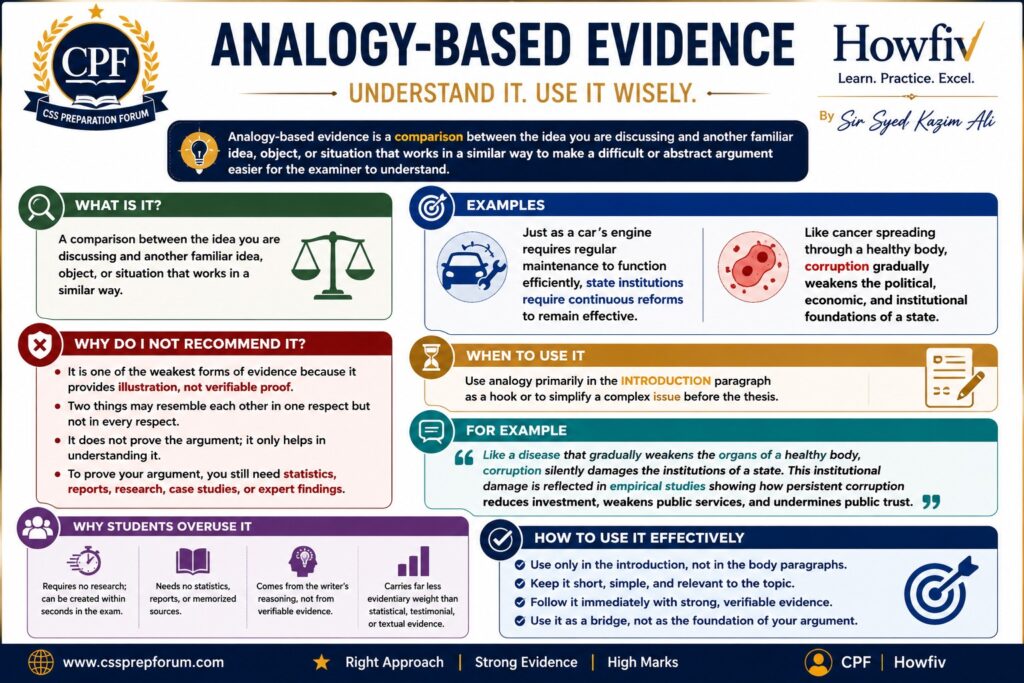
Analogy-based evidence is a comparison between the idea you are discussing and another familiar idea, object, or situation that works in a similar way. Its purpose is to make a difficult or abstract argument easier for the examiner to understand. For example:
- Just as a car’s engine requires regular maintenance to function efficiently, state institutions require continuous reforms to remain effective.
- Like cancer spreading through a healthy body, corruption gradually weakens the political, economic, and institutional foundations of a state.
In both examples, the comparison helps the reader visualize and understand the argument. However, it does not actually prove that the argument is factually correct.
Why do I not recommend it?
Analogy-based evidence is one of the weakest forms of evidence in essay writing because it provides illustration rather than verifiable proof. Two things may resemble each other in one particular respect without being similar in every respect. For instance, comparing corruption with cancer effectively communicates how corruption can spread and damage institutions, but the comparison itself does not prove the actual economic or institutional consequences of corruption. For that, you still need credible statistics, reports, research, case studies, or expert findings.
When to use it
Instead of using it as an evidence to support your claim, I recommend using analogy primarily in the introductory paragraph, where it can serve as an effective hook or help simplify a complex issue before the thesis statement.
For example
Like a disease that gradually weakens the organs of a healthy body, corruption silently damages the institutions of a state. This institutional damage is reflected in empirical studies showing how persistent corruption reduces investment, weakens public services, and undermines public trust.
Why students overuse it
Analogy is attractive because it requires no research, statistics, reports, or memorized sources. A student can create one inside the examination hall within seconds. However, this convenience is precisely its limitation: an analogy comes primarily from the writer’s reasoning rather than from independently verifiable evidence. Therefore, it carries considerably less evidentiary weight than statistical, textual, documentary, or expert evidence.
Example Paragraphs
- Essay Title: Causes of Economic Instability in Pakistan
- This paragraph discusses persistent fiscal deficits as a major cause of Pakistan’s recurring economic crises.
A major cause of Pakistan’s recurring economic instability is its persistent fiscal deficit, which functions much like a leaking boat taking on water faster than its crew can remove it. Just as a boat with an unrepaired hole cannot stay afloat no matter how hard the crew bails, an economy that spends far beyond what it collects cannot stabilize no matter how much it borrows, regardless of how frequently new loans arrive. The analogy, therefore, explains why repeated financial assistance can ease immediate pressure without necessarily preventing the next crisis. In fact, external loans and bailout packages may provide temporary financial relief, but they do not by themselves correct the structural imbalance between government expenditure and revenue. Thus, like an unrepaired leak that repeatedly fills a boat with water, Pakistan’s persistent fiscal deficit continues to reproduce the very financial pressures that drive the country into recurring economic crises.
- Essay Title: Impact of Climate Change on Pakistan
- This paragraph discusses the adverse impact of climate change on Pakistan’s economic stability.
One of the most damaging impacts of climate change on Pakistan is the gradual weakening of its economic stability. Rising temperatures, erratic rainfall, water scarcity, and extreme weather events reduce agricultural productivity, damage infrastructure, disrupt livelihoods, and impose enormous financial burdens on the state. Like a slow-acting poison that gradually weakens a healthy body before its full effects become visible, climate change progressively damages Pakistan’s economic foundations. This analogy illustrates how repeated climatic shocks silently reduce productive capacity, drain national resources, and leave the economy increasingly vulnerable to subsequent disasters. Consequently, losses accumulate across agriculture, infrastructure, employment, and public finances, weakening the country’s overall economic resilience. Thus, the continuing erosion of productive sectors and national resources makes declining economic stability one of the most serious impacts of climate change on Pakistan.
- Essay Title: Impact of Climate Change on Pakistan
- This paragraph discusses strengthening climate-resilient infrastructure as a solution to reduce Pakistan’s vulnerability to climate change.
One effective measure to reduce the devastating impacts of climate change on Pakistan is to develop climate-resilient infrastructure across vulnerable regions. Roads, bridges, drainage systems, irrigation networks, and public buildings should be designed or upgraded to withstand floods, extreme heat, and other climate-related disasters. Just as a strong roof protects a house from repeated storms rather than requiring repairs after every rainfall, climate-resilient infrastructure can protect communities and economic assets from recurring environmental shocks. This analogy demonstrates that preventive investment can reduce repeated destruction, economic losses, displacement, and reconstruction costs instead of forcing the state to rebuild after every disaster. Greater resilience would consequently protect both communities and national resources from avoidable climate damage. Thus, developing climate-resilient infrastructure can substantially reduce Pakistan’s vulnerability to the increasingly severe impacts of climate change.
2. Anecdotal Evidence
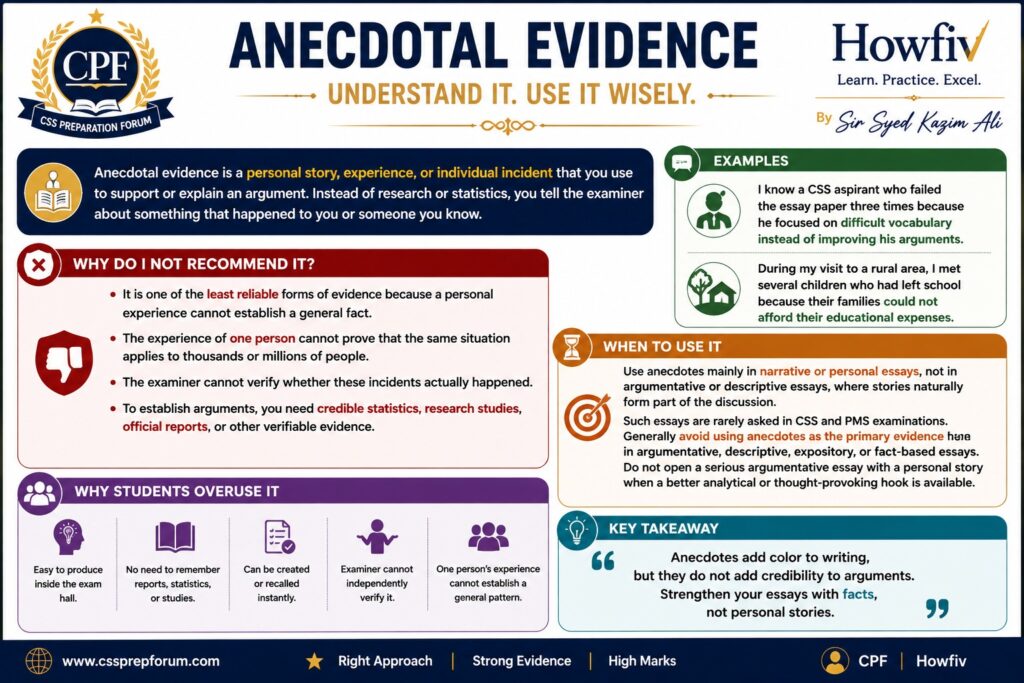
Anecdotal evidence is a personal story, experience, or individual incident that you use to support or explain an argument. Instead of providing research, statistics, or documented facts, you tell the examiner about something that happened to you or someone you know. For example:
- I know a CSS aspirant who failed the essay paper three times because he focused on difficult vocabulary instead of improving his arguments.
- During my visit to a rural area, I met several children who had left school because their families could not afford their educational expenses.
Both examples may help the reader understand the issue, but they do not provide strong proof. The examiner cannot verify whether these incidents actually happened. More importantly, the experience of one person cannot prove that the same situation applies to thousands or millions of people.
Why do I not recommend it?
Anecdotal evidence is one of the least reliable forms of evidence in essay writing because a personal experience cannot establish a general fact. For example, knowing one unemployed graduate does not prove that the entire education system has failed to generate employment. Similarly, meeting one poor family whose children have left school cannot prove the causes of Pakistan’s overall out-of-school-children problem. To establish such arguments, you need credible statistics, research studies, official reports, or other verifiable evidence.
When to use it
I recommend using anecdotes mainly in narrative or personal essays, not in argumentative or descriptive essays, where experiences and stories naturally form part of the discussion. However, such essays are rarely asked in CSS and PMS examinations. Therefore, you should generally avoid using anecdotes as the primary evidence in argumentative, descriptive, expository, or fact-based essays. I also do not recommend opening a serious argumentative essay with a personal story when a more relevant analytical, factual, or thought-provoking hook can establish the topic more effectively.
Why students overuse it
Anecdotal evidence is easy to produce because students do not need to remember any report, statistic, study, or authoritative source. They can simply create or recall a personal example inside the examination hall. This ease often makes anecdotes appear useful, but it is precisely what makes them weak as evidence: the examiner cannot independently verify them, and one person’s experience cannot establish a general pattern.
Example Paragraphs
- Essay Title: Implications of Population Growth in Pakistan
- This paragraph discusses on how increasing pressure on housing can be a serious implication of rapid population growth.
Another serious implication of rapid population growth in Pakistan is the increasing pressure on adequate housing, particularly in densely populated urban areas. As families expand while affordable housing remains limited, more people are forced to share smaller living spaces, resulting in overcrowded households. For instance, I once observed a family on the outskirts of Lahore where three generations were living together in a two-room house because the growing family could not afford separate accommodation. Although this individual experience cannot establish a nationwide pattern, it illustrates how population growth can translate into housing pressure at the household level, forcing more family members to compete for limited residential space. Thus, increasing household overcrowding and growing pressure on limited housing can be significant implications of Pakistan’s rapidly expanding population.
- Essay Title: Prospects of CPEC for Regional Connectivity
- This paragraph discusses a prospect: CPEC’s potential to strengthen regional trade connectivity through Gwadar Port.
Besides, another promising prospect of CPEC is its potential to strengthen regional trade connectivity by providing neighbouring regions with greater access to Gwadar Port. Improved transport infrastructure can create alternative trade routes and encourage businesses to explore new markets through Pakistan. For instance, I once spoke with a trader in Gwadar who described growing interest among Central Asian buyers in exploring transit opportunities through the developing port. Although one trader’s experience cannot prove that large-scale regional trade has already materialized, it illustrates how CPEC may gradually attract commercial interest beyond Pakistan’s borders. Such early interest indicates the possibility of Gwadar developing into an important transit and commercial link between Pakistan and the wider region. Thus, CPEC holds considerable prospects for expanding regional connectivity by creating new trade routes and attracting greater cross-border commercial activity.
3. Hypothetical Evidence
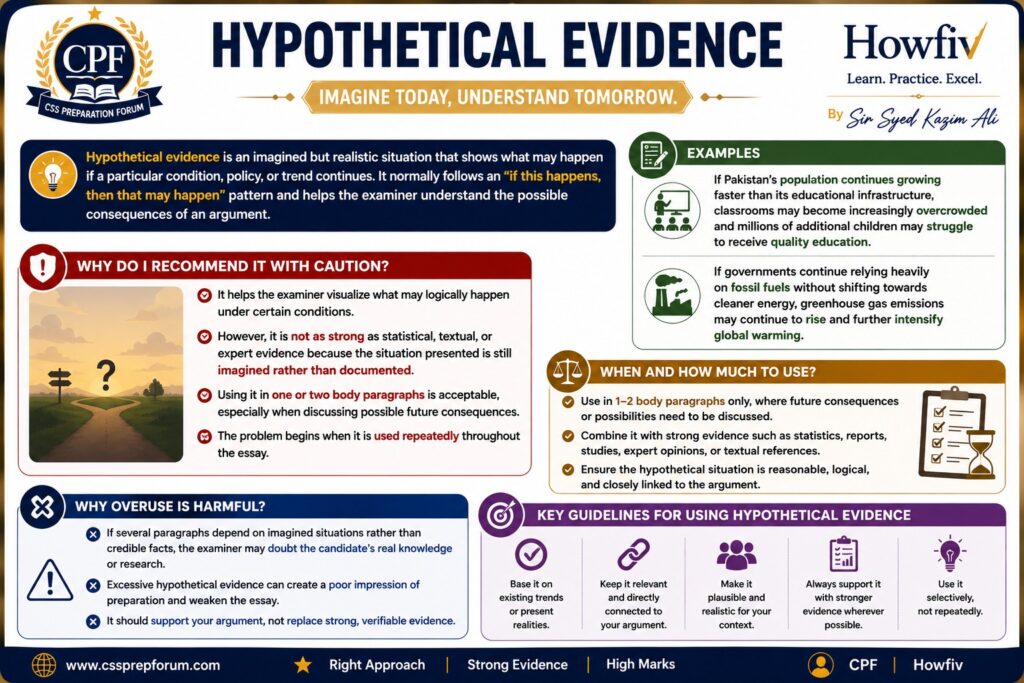
Hypothetical evidence is an imagined but realistic situation that shows what may happen if a particular condition, policy, or trend continues. It normally follows an “if this happens, then that may happen” pattern and helps the examiner understand the possible consequences of an argument. For example:
- If Pakistan’s population continues growing faster than its educational infrastructure, classrooms may become increasingly overcrowded and millions of additional children may struggle to receive quality education.
- If governments continue relying heavily on fossil fuels without shifting towards cleaner energy, greenhouse gas emissions may continue to rise and further intensify global warming.
In both examples, the writer is not presenting something that has already happened as a proven fact. Instead, he is presenting a reasonable possibility based on existing circumstances or observable trends.
Why do I recommend it with caution?
Hypothetical evidence can support an argument effectively because it helps the examiner visualize what may logically happen under certain conditions. However, it is not as strong as statistical, textual, or expert evidence because the situation being presented is still imagined rather than documented.
There is absolutely nothing wrong with using hypothetical evidence in one or two body paragraphs of an essay, particularly when the nature of the argument requires you to discuss a possible future consequence. In fact, a carefully constructed hypothetical situation can make such a paragraph more understandable and persuasive.
The problem begins when a student uses hypothetical evidence repeatedly throughout the essay. If several body paragraphs depend on imagined situations rather than credible facts, reports, studies, statistics, or expert findings, the examiner may reasonably feel that the candidate does not possess sufficient real knowledge or researched material about the topic. Instead of strengthening the essay, excessive hypothetical evidence may therefore create a poor impression of the candidate’s preparation. So, try not using it, if you want to use it, use it selectively.
Example Paragraphs
- Essay Title: Hope in Pakistan’s Youth Bulge
- This paragraph discusses: Pakistan’s youth bulge as a source of hope for developing a competitive workforce through vocational training.
One major hope associated with Pakistan’s youth bulge is its potential to develop into a highly skilled and competitive workforce. A large young population can become an economic asset if the state equips it with vocational, technical, and digital skills aligned with emerging labor-market demands. Undoubtedly, if Pakistan invests consistently in vocational and technical training over the next decade, its millions of young people could develop into one of the region’s most competitive workforces. This realistic possibility demonstrates how appropriate skill development could enable young Pakistanis to secure better employment, increase workforce productivity, and compete for expanding opportunities in domestic and international labour markets. Such progress could gradually transform a potentially burdensome demographic trend into a productive national resource. Hence, Pakistan’s youth bulge offers considerable hope for building a competitive workforce, provided its young population receives the skills required by a rapidly changing economy.
- Essay Title: Success of Digital Financial Inclusion in Pakistan
- This paragraph discusses: The expansion of digital financial inclusion as a potential success in bringing most Pakistanis into the formal financial system.
Meanwhile, the next notable success of Pakistan’s digital transformation has been the expansion of financial services to people previously excluded from conventional banking. Mobile wallets, branchless banking, and digital payment platforms have enabled millions of citizens to conduct financial transactions without depending on traditional bank branches. Had these digital financial services not expanded beyond conventional banking networks, millions of low-income and geographically underserved Pakistanis would still have faced serious difficulties in accessing basic financial services. This hypothetical comparison highlights the achievement already made by showing how digital platforms have reduced geographical and institutional barriers that previously kept large sections of the population outside formal financial channels. As a result, financial transactions have become considerably more accessible to previously underserved communities. Therefore, extending financial services beyond traditional bank branches to millions of previously excluded citizens represents a significant success of digital financial inclusion in Pakistan.

4. Logical or Analytical Evidence
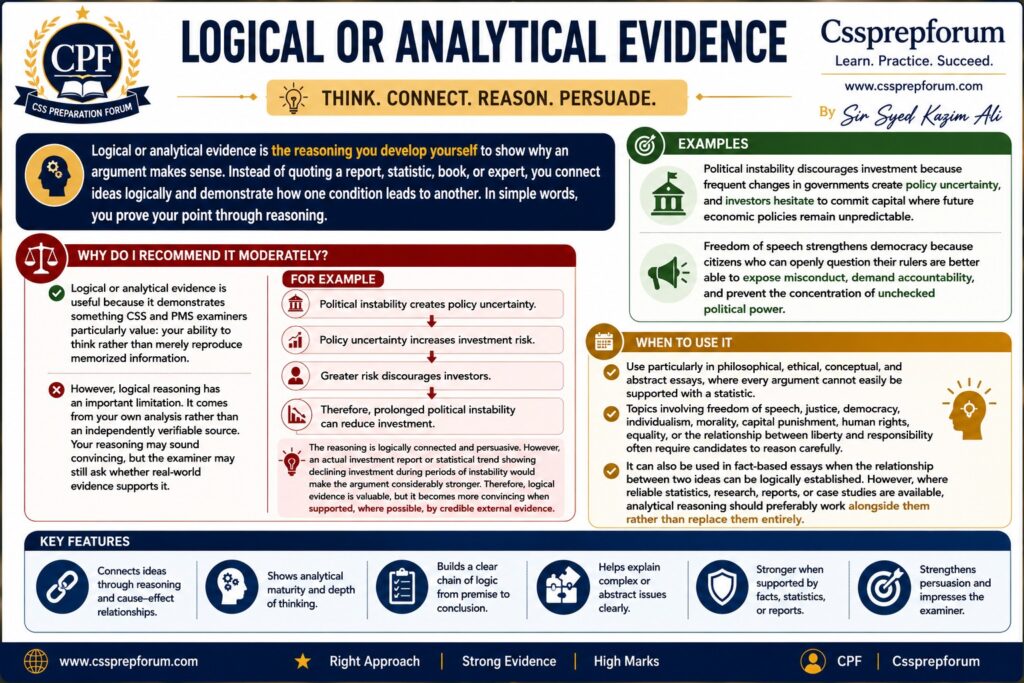
Logical or analytical evidence is the reasoning you develop yourself to show why an argument makes sense. Instead of quoting a report, statistic, book, or expert, you connect ideas logically and demonstrate how one condition leads to another. In simple words, you prove your point through reasoning. For example:
- Political instability discourages investment because frequent changes in governments create policy uncertainty, and investors hesitate to commit capital where future economic policies remain unpredictable.
- Freedom of speech strengthens democracy because citizens who can openly question their rulers are better able to expose misconduct, demand accountability, and prevent the concentration of unchecked political power.
In both examples, no external source has been quoted. Instead, the argument is supported through a clear chain of reasoning. The examiner can follow the logic from the initial condition to its likely consequence.
Why do I recommend it moderately?
Logical or analytical evidence is useful because it demonstrates something CSS and PMS examiners particularly value: your ability to think rather than merely reproduce memorized information. A candidate who can logically explain why something happens demonstrates analytical maturity.
However, logical reasoning has an important limitation. It comes from your own analysis rather than an independently verifiable source. Your reasoning may sound convincing, but the examiner may still ask whether real-world evidence supports it.
For example
Political instability creates policy uncertainty; policy uncertainty increases investment risk; greater risk discourages investors; therefore, prolonged political instability can reduce investment.
The reasoning is logically connected and persuasive. However, an actual investment report or statistical trend showing declining investment during periods of instability would make the argument considerably stronger. Therefore, logical evidence is valuable, but it becomes more convincing when supported, where possible, by credible external evidence.
When to use it
I recommend using logical or analytical evidence particularly in philosophical, ethical, conceptual, and abstract essays, where every argument cannot easily be supported with a statistic. Topics involving freedom of speech, justice, democracy, individualism, morality, capital punishment, human rights, equality, or the relationship between liberty and responsibility often require candidates to reason carefully rather than merely present numbers.
It can also be used in fact-based essays when the relationship between two ideas can be logically established. However, where reliable statistics, research, reports, or case studies are available, analytical reasoning should preferably work alongside them rather than replace them entirely.
Example Paragraphs
- Essay Title: Failure of Governance Reforms in Pakistan
- This paragraph discusses: The absence of effective accountability as a major reason behind the failure of governance reforms in Pakistan.
One major failure of governance reforms in Pakistan has been their inability to produce meaningful institutional change because effective accountability mechanisms have remained weak. When officials face little monitoring or consequence for failing to implement approved reforms, maintaining existing administrative practices becomes easier than undertaking difficult institutional change. Logically, a reform that depends on implementation cannot succeed when those responsible for implementing it face neither effective oversight for inaction nor meaningful consequences for non-compliance. This reasoning explains why many governance initiatives have remained confined to policy announcements and official documents rather than producing the institutional transformation they originally promised. Without accountability, the gap between reform formulation and actual implementation has repeatedly persisted. Hence, the inability of successive governance reforms to translate policy commitments into meaningful institutional change demonstrates their failure in Pakistan.
- Essay Title: Opportunities in Pakistan’s IT Sector
- This paragraph discusses: Pakistan’s competitive advantage in the global remote-work and IT services market as a major economic opportunity.
One significant opportunity for Pakistan’s IT sector lies in capturing a larger share of the global remote-work and digital services market. Pakistan possesses a large young workforce, comparatively low labour costs, growing digital connectivity, and widespread English-language competence among educated professionals, making its IT services attractive to international clients. Logically, when businesses can obtain comparable digital services from skilled professionals at competitive costs, they have a strong economic incentive to outsource such work to countries like Pakistan. This reasoning explains how the combination of affordable labour and a digitally capable workforce gives Pakistan a natural comparative advantage in freelancing, software development, and other technology-based services. Thus, Pakistan’s existing combination of competitive costs and skilled human capital creates a substantial opportunity for the country to expand its presence in the global digital services market.
5. Statistical Evidence
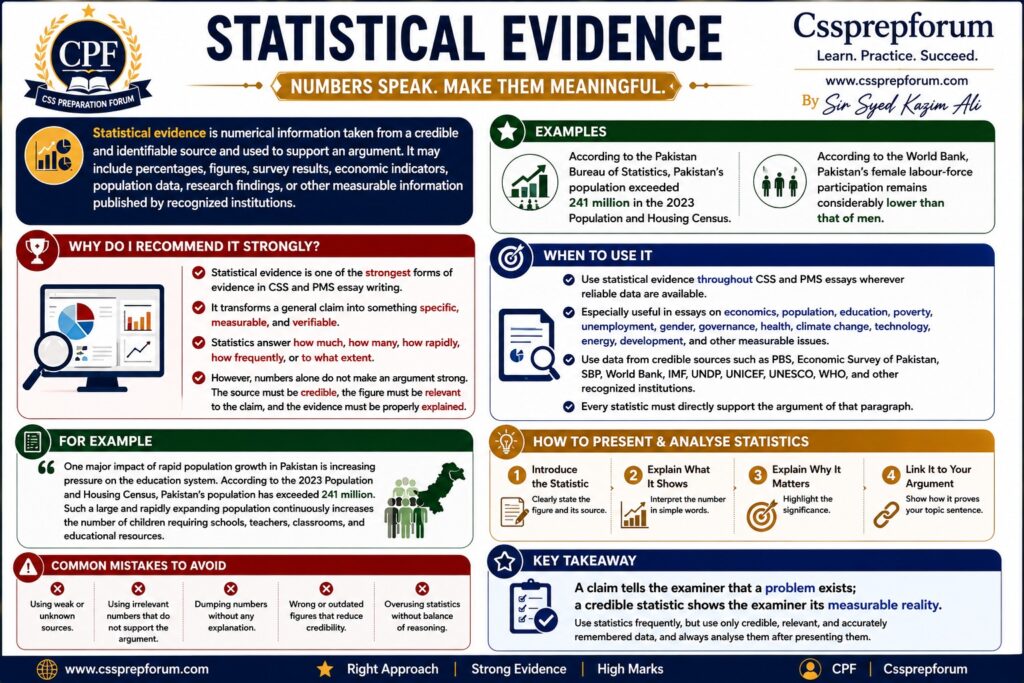
Statistical evidence is numerical information taken from a credible and identifiable source and used to support an argument. It may include percentages, figures, survey results, economic indicators, population data, research findings, or other measurable information published by recognized institutions. For example:
- According to the Pakistan Bureau of Statistics, Pakistan’s population exceeded 241 million in the 2023 Population and Housing Census.
- According to the World Bank, Pakistan’s female labour-force participation remains considerably lower than that of men.
In both examples, the writer is not merely expressing a personal opinion. The argument is being supported by measurable information produced by an external source, making it easier for the examiner to verify and accept.
Why do I recommend it strongly?
Statistical evidence is one of the strongest forms of evidence in CSS and PMS essay writing because it transforms a general claim into something specific, measurable, and verifiable.
Statistics are particularly persuasive because they answer important questions such as how much, how many, how rapidly, how frequently, or to what extent. Instead of simply telling the examiner that a problem is serious, statistical evidence helps you demonstrate its scale.
However, numbers alone do not make an argument strong. The source must be credible, the figure must be relevant to the claim, and the evidence must be properly explained afterwards.
When to use it
I strongly recommend using statistical evidence throughout CSS and PMS essays wherever reliable data are available. It is particularly useful in essays dealing with economics, population, education, poverty, unemployment, gender, governance, health, climate change, technology, energy, development, and other measurable issues.
Reliable sources may include the Pakistan Bureau of Statistics, Pakistan Economic Survey, State Bank of Pakistan, World Bank, IMF, UNDP, UNICEF, UNESCO, WHO, and other recognized national and international research institutions. However, do not insert statistics merely to make your essay appear researched. Every statistic must directly support the argument of that particular paragraph.
For example
One major impact of rapid population growth in Pakistan is increasing pressure on the education system. According to the 2023 Population and Housing Census, Pakistan’s population has exceeded 241 million. Such a large and rapidly expanding population continuously increases the number of children requiring schools, teachers, classrooms, and educational resources.
Here, the statistic is not simply mentioned; it is connected with and explained in relation to the argument. Also remember that a statistic cannot analyse itself. Writing a number and immediately moving to the next point turns evidence into a data dump. After presenting the figure, explain what it shows, why it matters, and how it proves your topic sentence.
My recommendation is simple: statistical evidence should be one of your primary evidence types in fact-based CSS and PMS essays. Use it frequently, but use only credible, relevant, and accurately remembered statistics, and always analyse them after presenting them. Remember: A claim tells the examiner that a problem exists; a credible statistic shows the examiner its measurable reality.
Example Paragraphs
- Essay Title: Hurdles to Educational Reform in Pakistan
- This paragraph discusses: The enormous number of out-of-school children as a major hurdle to educational reform in Pakistan.
One of the most formidable hurdles to educational reform in Pakistan is the enormous number of children who remain outside the formal education system. Meaningful reform becomes difficult when millions of children lack access to schooling in the first place, regardless of improvements in curricula, teaching methods, or assessment systems. According to UNICEF, an estimated 25.1 million children aged 5 to 16 in Pakistan are out of school. This figure demonstrates the extraordinary scale of educational exclusion that reform efforts must confront, as improvements within classrooms cannot benefit children who never enter those classrooms. Consequently, the access gap restricts the reach and effectiveness of broader educational reforms across the country. Thus, the presence of millions of out-of-school children remains one of the most fundamental hurdles preventing Pakistan from achieving comprehensive educational reform.
- Essay Title: Challenges to Political Stability in Pakistan
- This paragraph discusses: Persistent political instability as a major challenge to Pakistan’s economic planning and investment.
One of the most serious challenges created by political instability in Pakistan is the uncertainty it generates for long-term economic planning and investment. Frequent political disruptions and weak institutional continuity make future policies difficult to predict, discouraging businesses from committing capital to long-term projects. According to the Economist Intelligence Unit’s Democracy Index 2024, Pakistan scored 2.84 out of 10 and was classified as an “authoritarian regime,” ranking 124th among 167 countries and territories. This low score reflects serious weaknesses in democratic functioning and political stability, conditions that make the broader policy environment less predictable for investors and economic planners. Such uncertainty can discourage long-term commitments and weaken confidence in policy continuity. Thus, persistent political and institutional uncertainty remains a significant challenge to creating the stable environment required for sustained economic planning and investment in Pakistan.
- Essay Title: OIC’s Obligations towards the Muslim Ummah
- This paragraph discusses: Strengthening unity and solidarity among Muslim states as a fundamental obligation of the OIC.
One of the fundamental obligations of the Organization of Islamic Cooperation (OIC) is to strengthen unity and solidarity among the Muslim Ummah. This responsibility is embedded in the organization’s Charter, which identifies strengthening solidarity and cooperation among member states as one of its fundamental purposes. Statistically, the OIC represents 57 member states spread across four continents, making it the second-largest intergovernmental organization after the United Nations. This numerical strength demonstrates the enormous collective platform available to the OIC for bringing Muslim countries together and coordinating their positions on common political, economic, and humanitarian concerns. Indeed, its Charter explicitly emphasizes strengthening unity and solidarity among Muslim peoples and member states. Thus, representing 57 Muslim states places upon the OIC the institutional obligation it was created to fulfil: consolidating the unity and solidarity of the Muslim Ummah.
- Essay Title: Limitations of the OIC in Serving the Muslim Ummah
- This paragraph discusses: The OIC’s limited institutional authority as a major constraint on its ability to enforce collective decisions.
The next major limitation preventing the Organization of Islamic Cooperation (OIC) from playing its role effectively is its limited institutional authority over member states. Although the organization provides a common platform for Muslim countries, it largely depends on the willingness of sovereign members to translate collective decisions into practical action. According to the Malaysian University Stats (2024), the OIC represents 57 member states, yet it possesses no supranational authority to compel these states to implement its collective decisions. This contrast between enormous numerical representation and limited enforcement power explains why agreements among members do not always produce coordinated action, particularly when their national interests and foreign-policy priorities differ. Consequently, the organisation’s collective strength often remains greater in representation than in implementation. Thus, despite representing 57 Muslim states, the OIC’s limited authority to enforce collective decisions significantly restricts its ability to perform its intended role effectively.
6. Testimonial Evidence
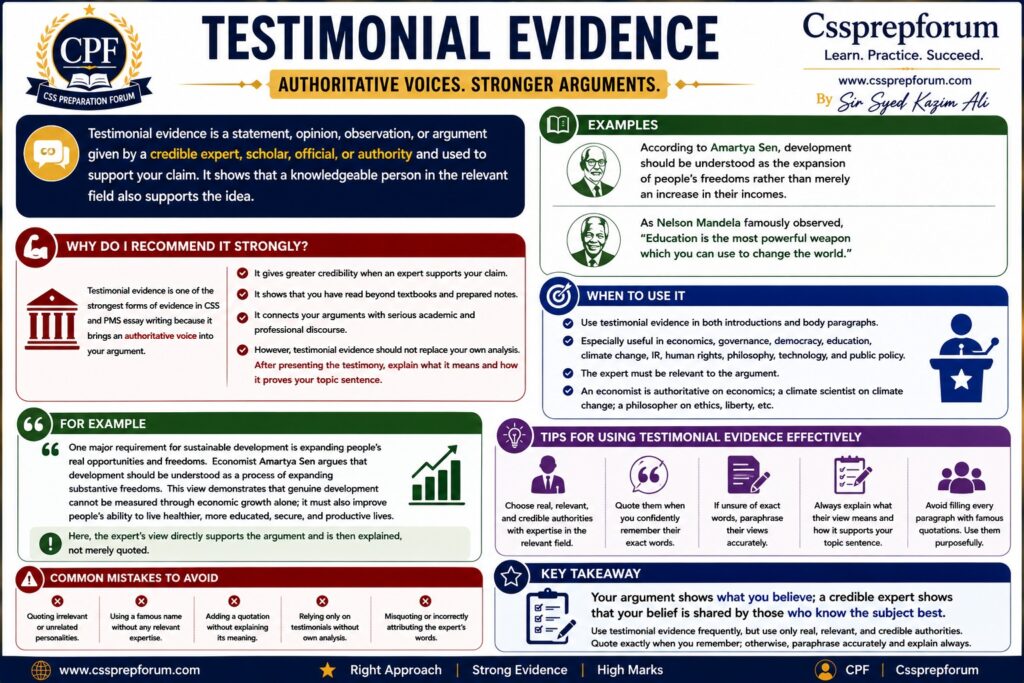
Testimonial evidence is a statement, opinion, observation, or argument given by a credible expert, scholar, official, or authority and used to support your claim. Instead of relying only on your own reasoning, you strengthen the argument by showing that a knowledgeable person in the relevant field also supports the idea. For example:
- According to Amartya Sen, development should be understood as the expansion of people’s freedoms rather than merely an increase in their incomes.
- As Nelson Mandela famously observed, “Education is the most powerful weapon which you can use to change the world.”
In both examples, the argument gains additional credibility because it is supported by someone whose knowledge, experience, or authority is relevant to the issue being discussed.
Why do I recommend it strongly?
Testimonial evidence is one of the strongest forms of evidence in CSS and PMS essay writing because it brings an authoritative voice into your argument. When a recognized economist supports an economic argument, a climate scientist explains climate change, a constitutional expert discusses democracy, or a philosopher comments on liberty, their expertise gives greater credibility to the claim.
It also demonstrates that you have read beyond textbooks and prepared notes. By referring to recognized scholars, experts, policymakers, researchers, and intellectuals, you show the examiner that your arguments are connected with serious academic and professional discourse.
However, testimonial evidence should not replace your own analysis. The expert supports your argument; the expert does not write the argument for you. After presenting the testimony, you must explain what it means and how it proves your topic sentence.
When to use it
I strongly recommend using testimonial evidence in both introductions and body paragraphs. It is particularly useful in essays dealing with economics, governance, democracy, education, climate change, international relations, human rights, philosophy, social issues, technology, and public policy.
The expert you select must, however, be relevant to the argument. An economist’s opinion carries weight in an economic discussion, while a climate scientist is more authoritative on climate change. Simply quoting a famous personality does not automatically make the evidence strong.
For example
One major requirement for sustainable development is expanding people’s real opportunities and freedoms. Economist Amartya Sen argues that development should be understood as a process of expanding substantive freedoms. This view demonstrates that genuine development cannot be measured through economic growth alone; it must also improve people’s ability to live healthier, more educated, secure, and productive lives.
Here, the expert’s view directly supports the argument and is then explained rather than merely quoted. Remember, if you remember the expert’s idea but are uncertain about the exact words, paraphrase the view instead of presenting it as a direct quotation. It is far safer to accurately explain what an expert argues than to reproduce a quotation incorrectly. Besides, you should also avoid filling every paragraph with famous quotations. Testimonial evidence is most effective when the person cited possesses genuine expertise relevant to the particular argument.
My recommendation is simple: use testimonial evidence frequently, but use only real, relevant, and credible authorities. Quote them when you confidently remember their exact words; otherwise, paraphrase their views accurately. Remember: Your argument shows what you believe; credible expert testimony shows that your argument is supported by informed authority.
Example Paragraphs
- Essay Title: Causes of Islamophobia in the West
- This paragraph discusses: Political rhetoric that portrays Muslims as a security threat as a major cause of Islamophobia.
One major cause of Islamophobia in Western societies is political rhetoric that repeatedly associates Muslims and Islam with security threats and extremism. When influential political figures portray an entire religious community through the actions of extremists, public fear can gradually develop into suspicion and prejudice against ordinary Muslims. As former UN Secretary-General Kofi Annan observed, Islamophobia involves hostility towards Islam that is sustained by fear and prejudice and can lead to discrimination against Muslims. His observation explains how fear becomes particularly dangerous when political narratives repeatedly generalize isolated acts of violence to an entire religious community. Such rhetoric can normalize suspicion and strengthen negative stereotypes even among people with little direct interaction with Muslims. Thus, the political cultivation of fear and the repeated association of Islam with extremism remain significant causes of Islamophobic attitudes in Western societies.
- Essay Title: Consequences of Islamophobia in the West
- This paragraph discusses: Social alienation and marginalization of Muslim communities as a serious consequence of Islamophobia.
One serious consequence of Islamophobia is the growing social alienation and marginalization of Muslim communities in Western societies. Persistent prejudice and suspicion can make Muslims feel excluded from societies in which they live, study, and work, weakening their sense of belonging and social acceptance. As former UN Secretary-General Kofi Annan observed, Islamophobia can manifest itself through intolerance, discrimination, unequal treatment, prejudice, and even acts of violence against Muslims. This expert observation demonstrates that Islamophobia does not remain confined to negative perceptions; rather, it can translate into discriminatory behaviour that distances Muslims from the wider society and makes meaningful social integration increasingly difficult. Such exclusion can consequently weaken trust and social cohesion between Muslim and non-Muslim communities. Thus, the increasing alienation and marginalization of Muslims remain among the most damaging social consequences of Islamophobia.
- Essay Title: Suggestions to Counter Islamophobia
- This paragraph discusses: Interfaith dialogue as an effective measure to reduce Islamophobia and promote mutual understanding.
The last suggestion for countering Islamophobia is to promote sustained interfaith dialogue between Muslim and non-Muslim communities. Direct interaction can challenge stereotypes by allowing people of different faiths to understand one another through communication rather than misinformation, fear, or hostile narratives. As former UN Secretary-General Kofi Annan emphasized, the response to Islamophobia requires education, dialogue, and efforts to promote mutual understanding among different communities. His recommendation highlights that prejudice cannot be effectively addressed merely by condemning discriminatory behaviour; the misconceptions and fears producing such behaviour must also be challenged through meaningful engagement. Regular interfaith initiatives can consequently reduce social distance, correct misconceptions about Islam, and develop greater respect for religious diversity. Thus, promoting sustained interfaith dialogue can effectively counter Islamophobia by replacing fear and prejudice with understanding, interaction, and mutual respect.
- Essay Title: Implications of Population Growth in Pakistan
- This paragraph discusses: The perpetuation of intergenerational poverty as a serious implication of unchecked population growth.
One serious implication of unchecked population growth in Pakistan is the perpetuation of poverty across successive generations. Rapidly expanding families place greater pressure on limited household and state resources, making adequate investment in children’s education, healthcare, nutrition, and development increasingly difficult. Renowned Pakistani demographer Dr. Zeba Sathar has repeatedly emphasized the importance of expanding family-planning services to address Pakistan’s rapid population growth and its wider socioeconomic consequences. Her expert assessment highlights how inadequate population planning can intensify resource constraints, leaving poorer families with fewer opportunities to invest sufficiently in each child’s development. Such deprivation can subsequently pass from parents to children, making poverty increasingly difficult to escape over time. Thus, the continuation of intergenerational poverty remains a profound long-term implication of Pakistan’s unchecked population growth.
- Essay Title: Future of Democracy in Pakistan
- This paragraph discusses: The growing political awareness of younger generations as a positive prospect for democracy in Pakistan.
Another promising prospect for democracy in Pakistan is the growing political awareness and participation of its younger generations. Increasing access to education, digital media, and political information has enabled young citizens to question government policies, demand accountability, and participate more actively in democratic discourse. As political scientist Larry Diamond argues, an informed and politically engaged citizenry is essential for the development and consolidation of democracy. His assessment explains why increasing political consciousness among Pakistan’s youth can strengthen democratic culture over time, as citizens who understand their political rights are more likely to demand representative institutions, transparent governance, and accountable leadership. Such sustained civic engagement can gradually deepen democratic norms despite existing institutional weaknesses. Thus, the increasing political awareness and participation of Pakistan’s younger citizens indicate that the country possesses encouraging prospects for a stronger and more mature democratic future.
7. Textual Evidence
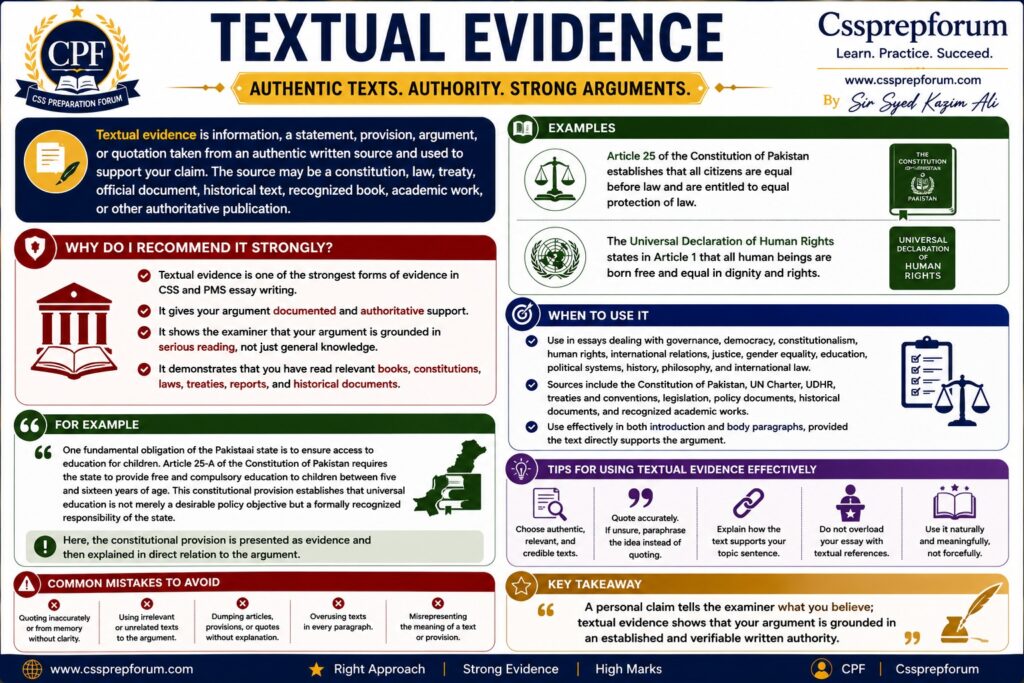
Textual evidence is information, a statement, provision, argument, or quotation taken from an authentic written source and used to support your claim. The source may be a constitution, law, treaty, official document, historical text, recognized book, academic work, or other authoritative publication. For example:
- Article 25 of the Constitution of Pakistan establishes that all citizens are equal before law and are entitled to equal protection of law.
- The Universal Declaration of Human Rights states in Article 1 that all human beings are born free and equal in dignity and rights.
In both examples, the candidate is not supporting the argument through personal opinion. Instead, the evidence comes directly from an established written source that the examiner can recognize and verify.
Why do I recommend it strongly?
Textual evidence is one of the strongest forms of evidence in CSS and PMS essay writing because it gives your argument documented and authoritative support. When you refer to a constitutional article, international treaty, law, official document, recognized book, or established scholarly work, you demonstrate that your argument is grounded in serious reading rather than general knowledge. Textual evidence also shows the examiner that you have read relevant books, constitutions, laws, treaties, reports, and historical documents during your preparation.
When to use it
I strongly recommend using textual evidence in essays dealing with governance, democracy, constitutionalism, human rights, international relations, justice, gender equality, education, political systems, history, philosophy, and international law.
Useful sources may include the Constitution of Pakistan, United Nations Charter, Universal Declaration of Human Rights, international treaties and conventions, legislation, official policy documents, historical documents, and recognized academic books and scholarly works.
It can be used effectively in both the introduction and body paragraphs, provided the selected text directly supports the argument being made.
For example
One fundamental obligation of the Pakistani state is to ensure access to education for children. Article 25-A of the Constitution of Pakistan requires the state to provide free and compulsory education to children between five and sixteen years of age. This constitutional provision establishes that universal education is not merely a desirable policy objective but a formally recognized responsibility of the state.
Here, the constitutional provision is presented as evidence and then explained in direct relation to the argument.
My recommendation is simple: use textual evidence frequently whenever the topic allows it, particularly in constitutional, legal, political, historical, and international-relations essays. However, use only those texts, provisions, books, and quotations that you can reproduce accurately and connect directly with your argument. Remember: A personal claim tells the examiner what you believe; textual evidence shows that your argument is grounded in an established and documented source.
Example Paragraphs
- Essay Title: Globalization: A Curse for Developing Nations
- This paragraph discusses: Globalization’s role in increasing the economic dependence of developing countries on powerful global economies and institutions.
Another damaging impact of globalization on developing nations is their increasing economic dependence on powerful countries and international financial institutions. Greater integration into the global economy can expose weaker states to external financial pressures, debt dependence, and policy conditions that restrict their economic autonomy. As Joseph Stiglitz explains in his book Globalization and Its Discontents, the way globalization has been managed by international economic institutions has often disadvantaged developing countries and limited their ability to pursue policies suited to their own needs. This textual evidence demonstrates that unequal integration can reduce the policy freedom of economically weaker states while increasing their vulnerability to decisions made beyond their borders. Consequently, globalization may deepen rather than reduce existing inequalities between powerful and developing economies. Thus, the erosion of economic autonomy and growing external dependence make globalization a significant curse for many developing nations.
- Essay Title: Climate Change: A Fiction
- This paragraph discusses: Scientific evidence showing that climate change is a measurable reality rather than a fiction.
The claim that climate change is merely a fiction is contradicted by decades of documented scientific evidence showing measurable changes in the Earth’s climate system. Rising global temperatures, melting glaciers, warming oceans, and increasing sea levels have been observed through independent scientific measurements rather than assumed through speculation. The Intergovernmental Panel on Climate Change states in its Sixth Assessment Report that human activities have “unequivocally caused global warming,” with global surface temperature reaching about 1.1°C above the 1850–1900 level during 2011–2020. This documented scientific assessment establishes that contemporary climate change is supported by observable physical evidence and extensive scientific research. Its existence, therefore, does not depend upon political narratives or individual beliefs. Thus, the documented rise in global temperatures and other measurable climatic changes decisively challenge the argument that climate change is merely a fiction.
- Essay Title: Global Warming Is a Fact
- This paragraph discusses: The documented rise in global temperature as proof that global warming is a scientific reality.
One of the strongest arguments establishing global warming as a fact is the scientifically documented rise in the Earth’s average surface temperature. Long-term temperature records demonstrate that the planet has become considerably warmer since the beginning of the industrial era, making the phenomenon measurable rather than speculative. The Intergovernmental Panel on Climate Change states in its Sixth Assessment Report that human activities have “unequivocally caused global warming,” with global surface temperature reaching approximately 1.1°C above the 1850–1900 average during 2011–2020. This authoritative scientific assessment confirms that global warming is based on recorded temperature changes observed over decades rather than assumptions or political narratives. The measurable increase in temperature provides physical evidence of a warming planet. Thus, the documented rise in the Earth’s average surface temperature establishes global warming as a scientifically verified fact rather than a matter of opinion or speculation.
- Essay Title: Gender Equality Is a Reality
- This paragraph discusses: The formal recognition of equal rights in international law as evidence that gender equality is an established legal reality.
One strong argument establishing gender equality as a reality is its formal recognition as a fundamental right in international law. Modern legal frameworks increasingly reject discrimination based on sex and recognize equal rights and opportunities for men and women as essential principles of a just society. Article 2 of the Universal Declaration of Human Rights declares that everyone is entitled to its rights and freedoms without distinction of any kind, including sex, while Article 7 guarantees equal protection before the law. These documented provisions demonstrate that gender equality is no longer merely an abstract aspiration but a formally established principle within the international human-rights framework. Its legal recognition provides an institutional foundation for challenging gender-based discrimination worldwide. Thus, the formal recognition of equal rights irrespective of sex establishes gender equality as a documented legal reality rather than merely an ideal.
- Essay Title: Suggestions to Reduce Gender Inequality in Pakistan
- This paragraph discusses: Ensuring equal educational opportunities for girls as an effective measure to reduce gender inequality.
One effective measure to reduce gender inequality in Pakistan is to ensure equal access to quality education for girls. Education equips women with knowledge, skills, economic independence, and greater capacity to participate in social and public life, thereby weakening the structural inequalities that restrict their opportunities. Article 25-A of the Constitution of Pakistan obligates the state to provide free and compulsory education to all children between the ages of five and sixteen. This constitutional provision provides a documented basis for ensuring that girls receive the same educational opportunities as boys rather than being excluded because of gender or socioeconomic barriers. Greater educational access can consequently improve women’s employment prospects, decision-making power, and social participation. Thus, ensuring girls’ equal access to quality education can significantly reduce gender inequality by strengthening their social, intellectual, and economic empowerment.
- Essay Title: Negative Impacts of Social Media in Pakistan
- This paragraph discusses: The spread of misinformation as a damaging impact of social media on Pakistani society.
One of the most damaging impacts of social media in Pakistan is the rapid spread of misinformation and unverified content among the public. Digital platforms allow misleading claims, manipulated images, and false reports to reach thousands of users before their authenticity can be properly verified, thereby distorting public understanding of important issues. The Prevention of Electronic Crimes Act (PECA) 2016 recognizes the harmful use of electronic communication and provides a legal framework for dealing with various forms of unlawful online content and conduct. This legal recognition demonstrates that misuse of digital platforms can create consequences serious enough to require formal state regulation. When false information spreads unchecked, it can mislead citizens, damage reputations, intensify social tensions, and weaken trust in credible information. Thus, the widespread circulation of misinformation remains one of the most harmful impacts of social media on Pakistani society.
- Essay Title: Negative Impacts of Social Media in Pakistan
- This paragraph discusses: Political polarization as a damaging impact of social media on Pakistani society.
One of the most damaging impacts of social media in Pakistan is the intensification of political polarization among citizens. Social media platforms often expose users to politically aligned content, while emotionally charged posts and partisan narratives can deepen hostility towards opposing political groups. In The People vs. Democracy, political scientist Yascha Mounk explains how digital media can intensify political divisions by allowing like-minded individuals to reinforce one another’s beliefs while becoming increasingly hostile towards opposing viewpoints. This argument helps explain Pakistan’s digital political environment, where partisan online communities can turn legitimate political disagreement into personal hostility and intolerance. Consequently, constructive debate declines while ideological divisions become increasingly difficult to bridge. Thus, the reinforcement of partisan divisions through social media has contributed to deeper political polarization and weakened the culture of democratic dialogue in Pakistan.
- Essay Title: CSS Officers and the Ever-Increasing Failure of CSS and PMS Aspirants
- This paragraph discusses: The growing trend of aspirants choosing recently qualified CSS officers as teachers despite their limited pedagogical experience as a cause of repeated failure.
One significant cause of the increasing failure of CSS and PMS aspirants is the mistaken assumption that qualifying a competitive examination automatically makes a person an effective teacher of that examination. Many aspirants, influenced by designation and recent success, seek guidance from newly qualified officers without sufficiently examining their teaching experience, subject specialization, or pedagogical competence. In The Courage to Teach, educationist Parker J. Palmer emphasizes that effective teaching involves far more than possessing knowledge of a subject; it requires the ability to connect that knowledge meaningfully with learners. This educational principle highlights the distinction between personal examination success and professional teaching competence: an officer may know how he personally qualified, yet may not necessarily possess the experience required to diagnose and develop thousands of differently situated aspirants. Consequently, relying on designation rather than proven teaching competence can leave fundamental weaknesses unaddressed throughout preparation. Thus, confusing examination qualification with teaching expertise can contribute significantly to the repeated failure of CSS and PMS aspirants.
- Essay Title: Artificial Intelligence and the Increasing Failure of CSS and PMS Aspirants
- This paragraph discusses: Excessive dependence on AI-generated content as a cause of weak independent thinking and essay-writing ability among CSS and PMS aspirants.
One emerging cause of failure among CSS and PMS aspirants is their excessive dependence on artificial intelligence for thinking, researching, and writing instead of using it as a tool to support their own intellectual development. When aspirants repeatedly ask AI to generate outlines, arguments, introductions, and complete essays, they may accumulate polished material without developing the independent reasoning and writing skills required inside the examination hall. In The Shallows, Nicholas Carr argues that intellectual tools can reshape the way people think, particularly when dependence on them replaces sustained concentration and deeper mental engagement. This argument becomes particularly relevant to competitive examinations, where candidates must independently analyse unfamiliar topics and construct coherent arguments under strict time constraints. AI-generated preparation cannot compensate for reasoning and writing abilities that the aspirant has never personally developed. Thus, excessive dependence on AI can contribute to CSS and PMS essay failure by creating an illusion of preparation while weakening the independent intellectual skills the examination actually tests.
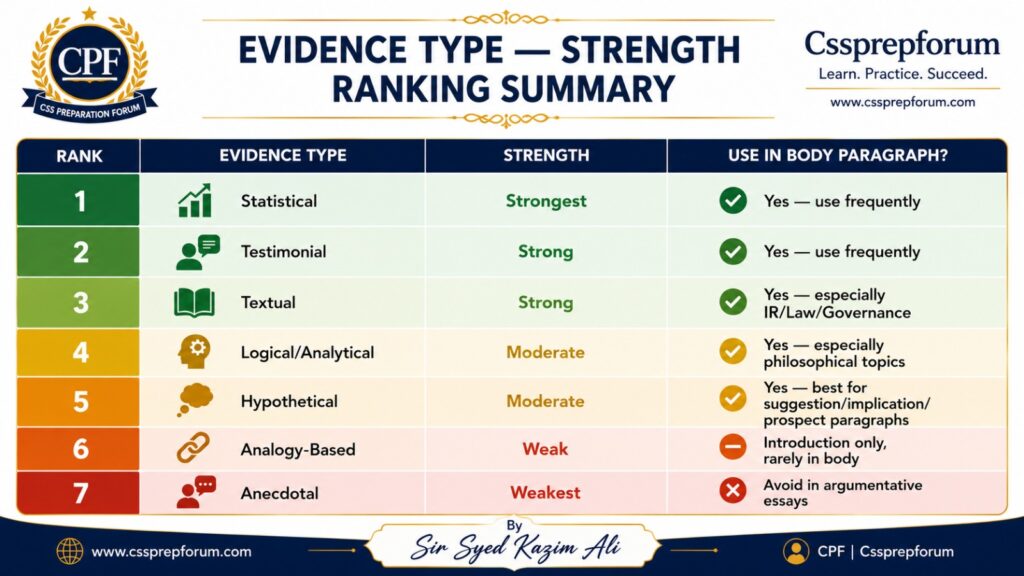
Evidence is what transforms a CSS or PMS essay from a collection of personal opinions into a convincing and intellectually credible argument. An aspirant must not merely tell the examiner what he believes; he must give the examiner a credible reason to believe it. However, evidence should never be inserted simply to make a paragraph appear researched. The most important skill is selecting evidence that directly supports the topic sentence and then explaining how it proves the argument. Analogy and anecdotal evidence are comparatively weak, hypothetical and logical evidence should be used selectively, while statistical, testimonial, and textual evidence generally provide stronger support. Regardless of the type selected, evidence and analysis must always work together: evidence without analysis becomes a data dump, while analysis without evidence remains largely an unsupported opinion.
Therefore, learning evidence does not mean memorizing hundreds of statistics, quotations, reports, and books; rather, it means developing the habit of asking whenever you make a claim: What proves this, and how does that proof strengthen my argument? Once aspirants develop this evidence-oriented approach, they begin to read, research, and write more analytically, collecting information not merely for memorization but for purposeful use in their arguments. Ultimately, a strong body paragraph follows a simple logic: the topic sentence presents the claim, the bridge explains it, the evidence proves it, the analysis establishes its relevance, and the concluding sentence reinforces what has been established. Thus, the golden rule of competitive essay writing remains simple: do not merely tell the examiner that your argument is correct; give him a credible reason to believe it, and then explain why that reason proves your point.

Want to Master Essay Body Paragraphs?
Once you understand what a body paragraph is, the next step is learning how to write its different forms and discourses. I’ve written clear examples of each type: click on any to start exploring and strengthen your essay-writing skills.
- How To Write an Evidence in the CSS and PMS Essay Body Paragraphs
- What Is Evidence in an Essay and How to Use It?
- How to Write Impacts Paragraphs in an Essay’s Body?
- How to Write an Essay Body Paragraph: Structure and Examples
- Why is Writing Evidence Essential in an Essay’s Body Paragraph?
More Essays
Click on any to start reading the essay.