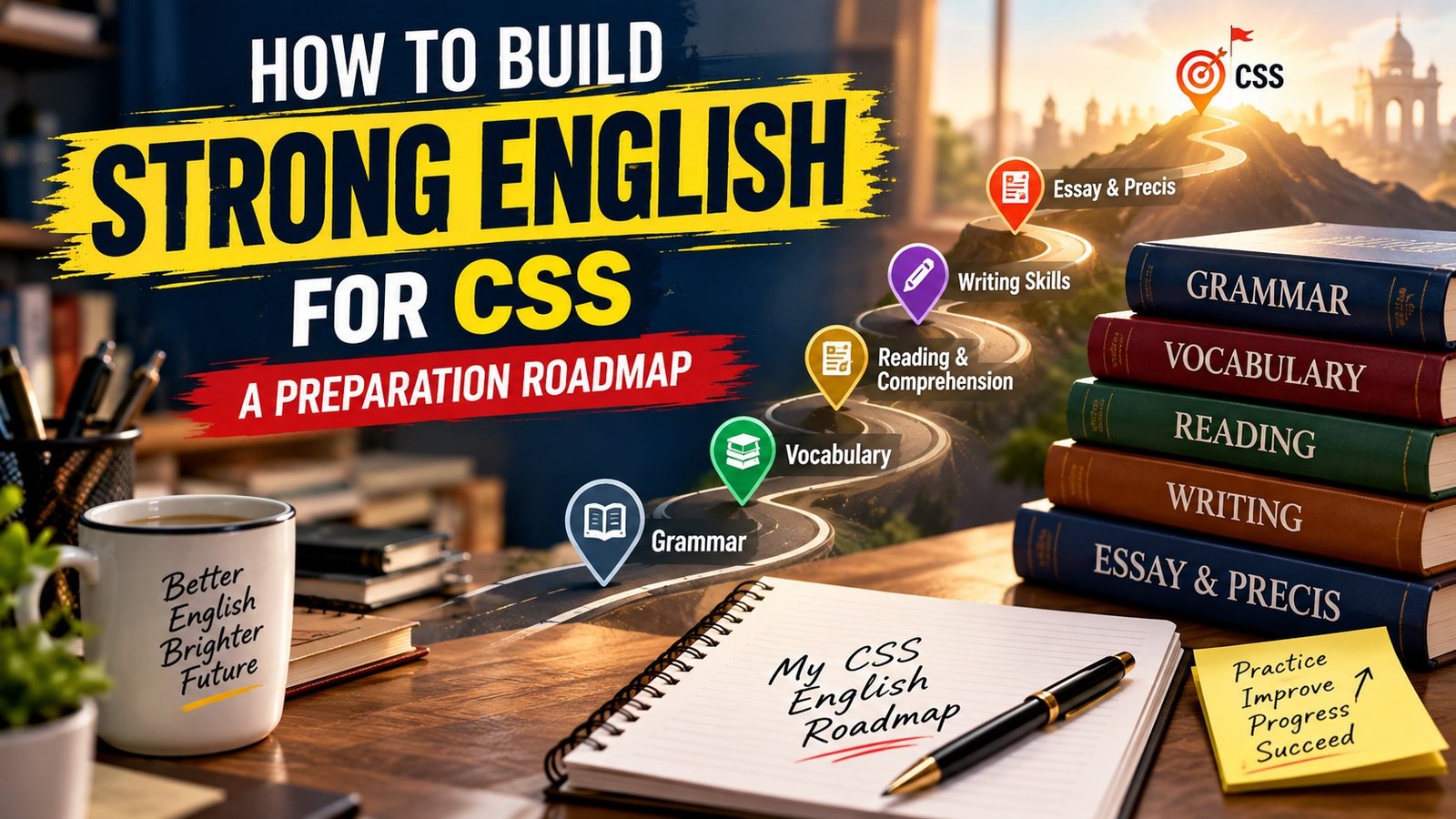
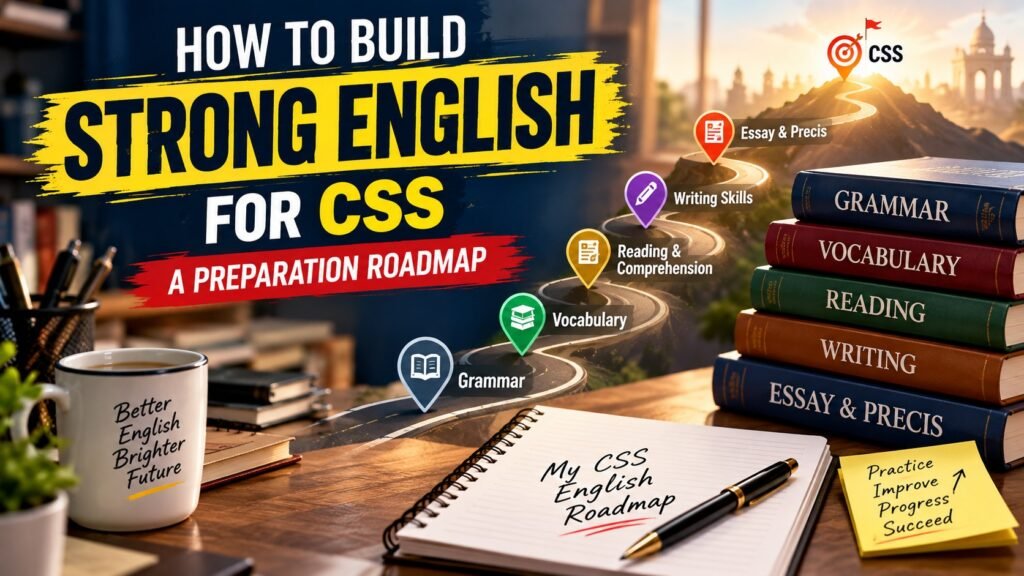
Strong English for CSS is built through a gradual process rather than last-minute memorisation. This practical roadmap, made according to the guidelines Sir Syed Kazim Ali gives his students, takes aspirants from grammar and sentence construction to reading, vocabulary, paragraph development, Essay writing, Precis & Composition, feedback, and timed examination practice.
Building strong English for CSS is not about learning the most difficult vocabulary or memorising dozens of essays. It is about developing control over language so that you can understand a passage, construct accurate sentences, organise ideas, develop arguments, and communicate them clearly under examination conditions.
For many aspirants, English becomes difficult because they approach all of these skills simultaneously. They read editorials, memorise vocabulary, practise essays, study grammar, and attempt precis passages without a clear progression. A roadmap solves this problem by arranging the skills in the order in which they need to develop. If your English is particularly weak right now, it may help to start by learning how to pass CSS English when English is weak before working through the full plan below.

What Does “Strong English” Mean for CSS?
Strong English does not mean using complicated words in every sentence.
For a CSS aspirant, strong English means being able to
- Understand complex written material.
- Write grammatically accurate sentences.
- Develop coherent paragraphs.
- Express arguments precisely.
- Use appropriate vocabulary.
- Summarise information accurately.
- Write a structured Essay.
- Answer comprehension questions clearly.
- Correct common language errors.
- Maintain clarity under time pressure.
The official FPSC syllabus shows that English Precis & Composition itself covers multiple skills, including precis writing, comprehension, grammar, vocabulary, sentence correction, grouping of words, and pairs of words. Therefore, your roadmap should be broader than grammar alone.
Stage 1: Establish Your Grammar Foundation
Begin with the fundamentals. Focus on
Tenses
Understand when and why different verb tenses are used rather than simply memorising their formulas.
Articles and Prepositions
Practise them in complete sentences because usage often depends on context.
Subject-Verb Agreement
Learn to identify the real subject, especially in longer sentences.
Punctuation
Understand how punctuation affects meaning, rhythm, and sentence boundaries.
Sentence Structure
Practise simple, compound, and complex sentence structures.
At this stage, CSS grammar preparation should remain practical. After learning a rule, immediately apply it through writing.
Stage 2: Develop Sentence-Level Accuracy
Once you become familiar with basic grammar rules, focus on constructing grammatically correct and meaningful sentences. A complete sentence should begin with a capital letter, contain a subject or subject phrase to identify who or what the sentence is about, and include a verb or verb phrase to express an action or state of being. Moreover, its words must follow a logical order, convey a complete thought, and end with an appropriate punctuation mark, such as a full stop, question mark, or exclamation mark.
After understanding these essential sentence elements, review your writing and identify common errors, including fragments, run-on sentences, incorrect modifiers, faulty parallelism, unclear pronoun references, incorrect tense shifts, subject-verb agreement errors, and unnecessary words. Do not merely correct a sentence; understand why it was incorrect and how its structure affects meaning.
For example, “Although education improves society.” is a fragment because it does not express a complete thought, whereas “Although education improves society, it requires effective policies and consistent investment.” is a complete sentence. By identifying and correcting such errors, you can gradually develop self-editing skills, which are essential for improving accuracy and clarity in CSS English Essay and Precis writing.
Stage 3: Build a Reading Habit
Strong writing requires strong reading. Read English newspapers, editorials, analytical articles, books, and quality essays. However, reading should be active. After reading an article, try writing the following.
Main argument: one sentence
Supporting arguments: three points
Evidence: important examples
Explanation of Evidence: explain example and connect it to main topic sentence
Conclusion: restate the position
This exercise trains the same analytical habits that later support CSS Essay preparation.

Stage 4: Build a Useful Vocabulary
Vocabulary should support expression rather than decorate it.
In your notebook, create categories relevant to CSS. They may include the following.
- Economy
- Governance
- Democracy
- Education
- Climate change
- Technology
- Gender
- International relations
- Globalisation
- Human development
For each useful word, record its meaning and write an original sentence. For example, learning “sustainable” is more useful when you understand how it works in phrases such as sustainable development, sustainable policy, or sustainable economic growth. Also learn commonly confused words because vocabulary and word usage are explicitly tested in English Precis & Composition.
Stage 5: Learn Paragraph Development
A CSS essay is not merely a collection of impressive sentences. It is a sequence of connected arguments. Therefore, learn to build paragraphs. A practical model includes
Claim
Introduce the main point.
Explanation
Explain what the point means.
Evidence
Provide a fact, example, case, statistic, or relevant reference. You can learn how to write evidence in a CSS and PMS Essay body paragraph in this article.
Analysis
Explain why the evidence matters.
Connection
Link the discussion back to the essay’s central argument.
Practise this structure until you can develop a coherent paragraph without relying on memorised material.
Stage 6: Learn Thesis and Outline Development
Before writing complete Essays, develop the ability to understand the topic.
For every topic, ask
- What exactly is the question asking?
- What is its central issue?
- What position or argument can be developed?
- What dimensions should the Essay cover?
- What evidence can support each major point?
Then write a thesis statement and outline. This stage is essential because a grammatically correct Essay can still become weak if its arguments lack direction.
Stage 7: Start Full Essay Practice
Once you can produce good paragraphs and outlines, begin complete Essays. Do not attempt a full Essay every day if doing so prevents proper review. Instead, write one complete Essay, analyse it carefully, identify weaknesses, and rewrite problematic sections.
Your checklist should include
- Thesis clarity
- Outline relevance
- Introduction
- Topic sentences
- Argument development
- Evidence
- Analysis
- Transitions
- Coherence
- Conclusion
- Grammar
- Vocabulary
The CSS Essay writing practice stage should ultimately include timed attempts and evaluations by an expert mentor like Sir Syed Kazim Ali.
Stage 8: Develop Precis Skills Separately
Precis writing requires its own training. The objective is to condense a passage without damaging its central meaning while covering all the essential ideas. A good practice sequence is,
First Reading
Understand the complete passage.
Second Reading
Identify the central idea and major supporting points.
Drafting
Remove repetition, examples that are unnecessary, decorative language, and secondary details while preserving essential meaning.
Revision
Check grammar, coherence, tense, person, length, and whether the original argument has been preserved.
You can reinforce this skill through CSS solved precis and regular past-paper practice.
Stage 9: Strengthen Comprehension
Comprehension is closely connected to reading. After reading an unseen passage, do not immediately search for answers. First determine
- The central idea
- The author’s purpose
- The tone
- Important arguments
- Implied meanings
- Supporting details
Then answer in clear, concise English. The goal is to demonstrate understanding, not reproduce the passage word for word.
Stage 10: Practise Composition Components
Do not neglect smaller components simply because the essay receives greater attention. Include regular practice of
- Sentence correction
- Punctuation
- Vocabulary
- Pairs of words
- Synonyms and antonyms
- Translation
- Grammar
The official syllabus confirms that these areas form part of the English Precis & Composition assessment.
Stage 11: Use Feedback as Part of Preparation
Self-study can take you far, but feedback from a subject specialist is essential for identifying and correcting mistakes that you may not recognise yourself. In CSS and PMS English preparation, a specialist can evaluate your essays, paragraphs, and precis to identify weaknesses in grammar, sentence construction, coherence, argument development, and expression. More importantly, expert evaluation helps you understand why a particular sentence, paragraph, or argument is ineffective and how it can be improved.
The student reviews of Sir Syed Kazim Ali provide examples of aspirants describing how his detailed evaluation and individual guidance helped them recognise recurring weaknesses and improve their writing. For instance, Dr Farooq Ali Khan, a dermatologist and PMS KPK 2025 written qualifier, describes in his review how Sir Syed Kazim Ali’s guidance and evaluation helped transform his English writing skills and develop a more structured approach to English expression. Such experiences demonstrate the practical value of receiving specific feedback instead of repeatedly writing without understanding or correcting one’s mistakes.
Therefore, whether you prepare independently or study with a teacher, make regular evaluation by a subject specialist an important part of your preparation. After writing an essay, paragraph, or precis, have it evaluated, identify the recurring errors, understand the corrections, rewrite the weak portions, and apply the lessons to your next piece of writing. Simply producing more essays does not guarantee improvement if the same mistakes remain unexamined. Consistent writing combined with expert feedback can gradually improve your grammatical accuracy, clarity, coherence, expression, and analytical writing skills, helping you prepare more effectively for the CSS Essay and Precis papers.
Stage 12: Move Towards Timed Practice
The final stage is performance. Start attempting individual questions under time limits. Later, attempt complete papers.
At this stage, you should practice
- Writing an Essay outline quickly.
- Producing introductions without excessive hesitation.
- Completing a precis within the required time.
- Answering comprehension questions efficiently.
- Correcting sentences accurately.
- Managing vocabulary questions.
- Reviewing your work before submitting it.
The CSS 2026 solved English Precis & Composition paper can also be useful for examining how the latest paper components were approached.
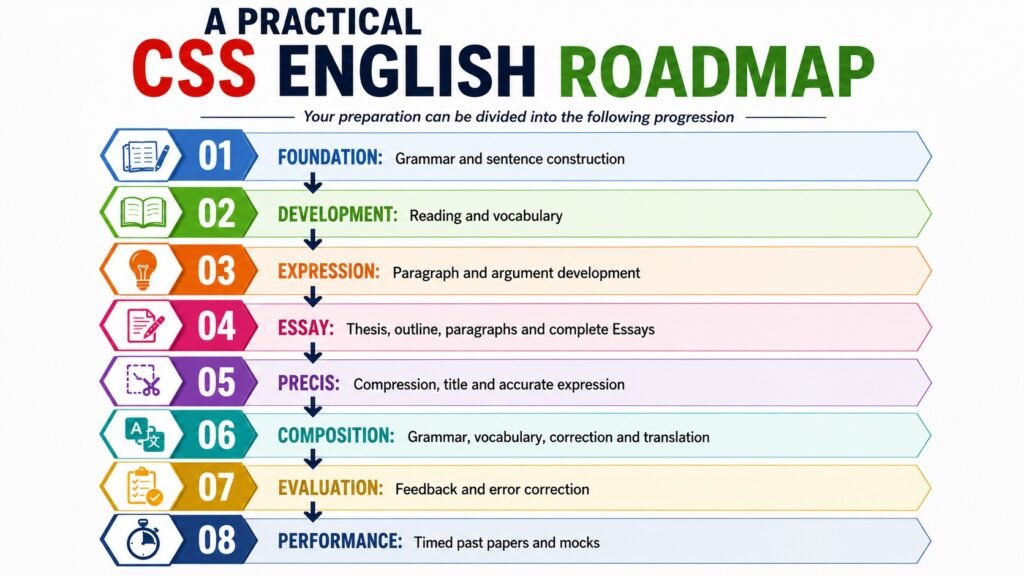
This roadmap prevents you from trying to master everything at once.
How Much Time Should You Give to English?
The exact amount depends on your existing level. For instance, a student with weak grammar may need to devote more time to foundational English, while someone with good language skills but limited CSS writing experience may need greater emphasis on Essay and Precis. The important principle is consistency. Even one focused English session every day can become valuable when it includes actual writing and correction. As your foundation improves, gradually shift more time toward exam-specific practice.
In conclusion, building strong English for CSS is a gradual process. You do not need to begin with perfect grammar, advanced vocabulary, or polished Essays. Begin where you are. Strengthen grammar, improve sentence construction, read actively, develop vocabulary through context, practise paragraphs, learn Essay structure, train for Precis & Composition, and evaluate your writing regularly.
Most importantly, do not confuse studying English with practising English. Reading a grammar rule is study; using that rule correctly in your own writing is practice. Likewise, reading an essay is study whereas constructing your own argument is practice. And reading a solved precis is study while writing one independently is practice. For a complete, step-by-step roadmap to improving your English for CSS and PMS, from the basics to timed exam practice, read “How to Improve English for CSS and PMS: A Step-by-Step Plan”.