CSS/PMS Islamiat | Islamic Knowledge Alone Doesn’t Guarantee Success in the FPSC Islamiat Paper
Many CSS aspirants write Islamiat answers packed with correct Quranic verses and Ahadith, yet still score poorly because FPSC judges how an answer is argued, not just whether the facts are accurate. This article breaks down the main reasons even well-informed students lose marks, answering off-topic, weak structure, and a preachy rather than analytical tone, and shows what a high-scoring answer actually looks like.
Every year, hundreds of CSS candidates walk out of the Islamiat paper convinced they have written a strong attempt. Their Quranic references are accurate, their Ahadith are correctly quoted, their knowledge of Fiqh, Seerah, and Islamic history is solid. Yet the result often disappoints. The reason is simple: FPSC does not grade Islamiat as a test of religious knowledge, it grades it as a competitive examination answer. Correct Islamic content is the raw material, not the finished product. Below is a detailed, example-based breakdown of exactly what most students do wrong, and what the right approach looks like instead.
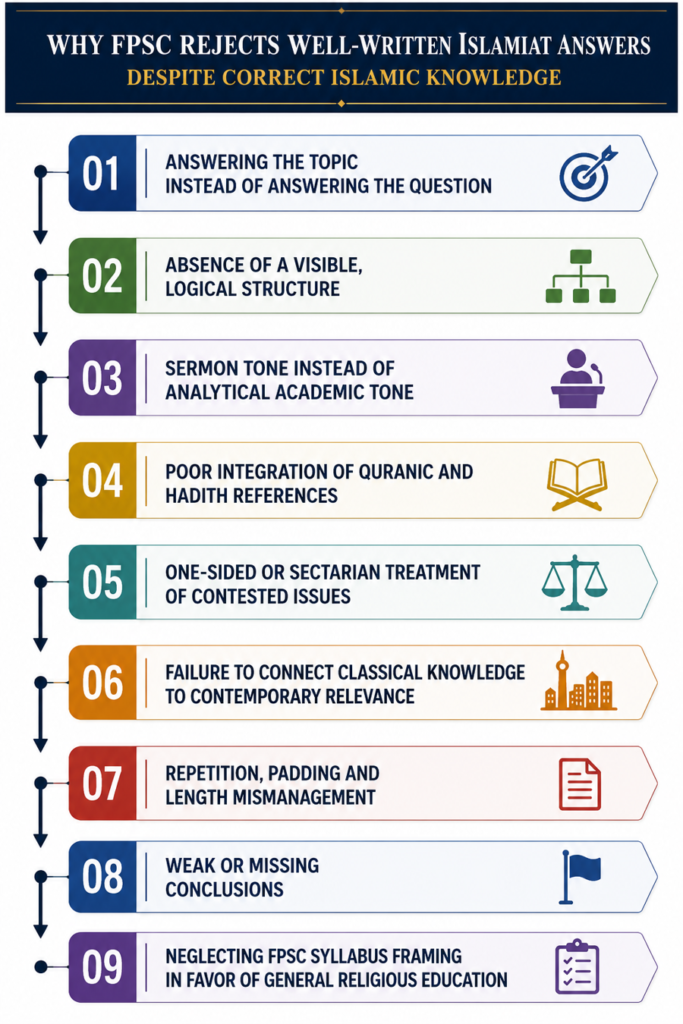
Answering the Topic Instead of Answering the Question
What most students do: The question asks, “Critically analyze the concept of Ijtihad in the modern era.” A typical student writes three pages defining Ijtihad, listing its classical conditions (Ijma, Qiyas, etc.), naming Imam Abu Hanifa and Imam Shafi’i, and narrating the history of the “closing of the gate of Ijtihad”, all correct, but purely descriptive. Nowhere does the answer say whether Ijtihad is workable today, what obstacles it faces, or take a position.
What the right way looks like: After a two-line definition, the answer moves straight into the analytical demand of the question: Why is Ijtihad necessary today (bioethics, finance, technology)? What are the real obstacles (lack of qualified Mujtahids, sectarian resistance, absence of institutional Ijtihad bodies)? What is the candidate’s reasoned conclusion (e.g., collective/institutional Ijtihad through bodies like the Council of Islamic Ideology is the practical way forward)? The classical background is used as a one-paragraph foundation, not the whole answer.
Fix: Before writing, underline the command verb (analyze, evaluate, discuss, compare) and write one sentence stating your thesis. Everything you write should serve that thesis.
Absence of a Visible, Logical Structure
What most students do: A student answering “Discuss the Islamic concept of social justice” writes one continuous seven-paragraph block, Quranic verses, a Hadith, a historical anecdote about Hazrat Umar (RA), a comment on capitalism, all merged together with no headings or breaks. The examiner has to dig to find where one idea ends and another begins. FPSC Annual Examiner Reports highlight that nearly 30% to 95% of candidates write irrelevant or tangential material because they fail to comprehend the exact scope of the question.
What the right way looks like: The same content is broken into clearly labeled parts: Introduction (one paragraph defining social justice in Islam) → Quranic Basis (2–3 verses with brief explanation) → Prophetic Practice (1–2 Ahadith/examples) → Historical Implementation (Khilafat-e-Rashida example) → Contemporary Relevance (Pakistan’s Constitution, Zakat system) → Conclusion. Each part has a mini-heading or at least a clear paragraph break signaling a new point.
Fix: Sketch an outline on the rough page before writing the answer. Give each block of the outline its own paragraph.
3. Sermon Tone Instead of Analytical Academic Tone
What most students do: In answering a question on women’s rights in Islam, a student writes: “We as Muslims must always remember that Islam gave women honor 1400 years ago and it is our duty to follow this and not blindly copy the West which has destroyed family values…” This is preaching, not analysis, and it reads like a mosque lecture rather than a civil-service answer.
What the right way looks like: “Islam grants women a comprehensive legal and social status, evident in rights to inheritance (Surah An-Nisa), consent in marriage, and financial independence. Comparing this framework with pre-Islamic Arab practice and contemporary debates on women’s economic participation in Pakistan shows both the strength of the original framework and the gap between ideal and practiced reality today.” Same religious conviction, but framed as an evidenced, academic argument rather than a moral appeal.
Fix: Read your paragraph back and ask: “Am I proving a point with evidence, or am I preaching?” Replace exhortation (“we must,” “we should always”) with analysis (“this indicates,” “this demonstrates”).
4. Poor Integration of Quranic and Hadith References
What most students do: A student quotes four Quranic verses in Arabic back-to-back, without translation, and without explaining what each verse actually adds to the argument, then moves to the next paragraph. The examiner sees volume, not understanding.
What the right way looks like: One well-chosen verse is quoted briefly, translated in one line, and then explicitly connected: “This verse establishes that inheritance shares are a divinely fixed right, not a discretionary family decision, which directly counters the practice of denying women their inheritance in parts of rural Pakistan today.” One verse used this way earns more marks than four verses dropped in without comment.
Fix: For every reference you cite, add one sentence immediately after it explaining exactly what it proves for your argument.
5. One-Sided or Sectarian Treatment of Contested Issues
What most students do: Answering a question on differences in Fiqh regarding a specific ruling, a student presents only the Hanafi position as the definitive, correct answer, dismissing other schools implicitly by omission.
What the right way looks like: The answer briefly notes that Hanafi, Shafi’i, Maliki, and Hanbali schools differ on this point, states the basis of the difference (usually a difference in source interpretation or a specific Hadith), and then offers a balanced concluding view, without declaring other schools wrong. FPSC, examining candidates from a religiously diverse Muslim population, rewards this inclusive treatment.
Fix: On any fiqhi question, add one sentence acknowledging that valid scholarly differences exist before giving your conclusion.
6. Failure to Connect Classical Knowledge to Contemporary Relevance
What most students do: Asked about the Islamic economic system, a student writes extensively about Riba’s prohibition in the Quran and the history of Bait-ul-Maal under the early Caliphs, but never mentions Pakistan’s Islamic banking sector, State Bank regulations, or the Federal Shariat Court’s rulings on interest.
What the right way looks like: The classical foundation (1 paragraph) is followed by a paragraph explicitly linking it to today: the growth of Islamic banking in Pakistan, the 2022 Federal Shariat Court judgment on eliminating Riba, and the practical challenges of full implementation.
Fix: After writing the classical/historical portion, always add a “Pakistan today” or “contemporary relevance” paragraph before the conclusion.
7. Repetition, Padding, and Length Mismanagement
What most students do: For a 10-mark question, a student writes six pages, repeating the phrase “Islam is a complete code of life” in three different paragraphs with slightly different wording, to visually fill space.
What the right way looks like: A focused two-and-a-half to three-page answer that hits each required point once, with evidence, and stops. Examiners notice selective, well-judged answers more favorably than long ones.
Fix: Match your answer length to the marks allocated, roughly one page per 5 marks, and before submitting, cut any paragraph that repeats a point already made.
8. Weak or Missing Conclusions
What most students do: The answer ends abruptly after the last content point, often mid-argument, with no closing paragraph, leaving the examiner without a sense that the candidate has “landed” the argument.
What the right way looks like: A short final paragraph that ties the discussion together and, where appropriate, offers a balanced way forward: “Thus, while the classical Islamic framework for X provides a comprehensive foundation, its effective implementation in modern Pakistan requires institutional reform in Y and Z.”
Fix: Always budget the last 3–4 minutes of your answer time specifically for a concluding paragraph, never let the answer just stop.
9. Neglecting the FPSC Syllabus Framing in Favor of General Religious Education
What most students do: A student with strong madrassa-style religious education answers a question on “human rights in Islam” using a broad, general theological framework, without addressing the specific angles FPSC’s syllabus and past papers typically test, comparison with the UN Declaration of Human Rights, or Pakistan’s constitutional provisions.
What the right way looks like: The answer is shaped around the specific syllabus themes FPSC repeatedly tests: sources of Islamic law, comparative religion, human rights compared to international frameworks, and the political system of Islam, using past papers as a guide to the expected angle of attack.
Fix: Go through the last 8–10 years of FPSC Islamiat past papers and note the recurring angles for each topic before you rely on general study material alone.
Conclusion
Correct Islamic knowledge is necessary for a good Islamiat answer, but it is not sufficient. FPSC examiners are assessing a candidate’s ability to think, structure, and argue like a future civil servant, using Islamic knowledge as evidence within an argument, not as an end in itself. The students who convert strong religious knowledge into strong marks are the ones who stop writing sermons and start writing analysis: answering the exact question asked, structuring it visibly, integrating references purposefully, acknowledging diverse views, and linking classical material to Pakistan’s present-day reality.
Important Note for CSS and PMS Aspirants
For aspirants preparing for competitive examinations, exploring solved past papers is essential to understand examiner expectations, analytical answer writing, and paper trends. Therefore, candidates are strongly encouraged to read the following comprehensive solved papers available on CSSPREPFORUM.
- CSS Solved Pakistan Affairs Past Papers
- CSS Solved Current Affairs Past Papers
- CSS Solved Islamiat Past Papers
- CSS Solved General Science and Ability Past Papers
Moreover, aspirants searching for the most credible and result-oriented teachers for CSS and PMS preparation can benefit from the following detailed guidance articles
- Who is the Best CSS PMS Islamiat Teacher in Pakistan?
- Who is the Best CSS PMS Pakistan Affairs Teacher in Pakistan?
- Who is the Best CSS Current Affairs Teacher in Pakistan?
- Who is the Best CSS GSA Teacher in Pakistan?
- Who is the Best CSS PMS English Essay and Precis Teacher in Pakistan?
- Who is the Best English Grammar Teacher in Pakistan?