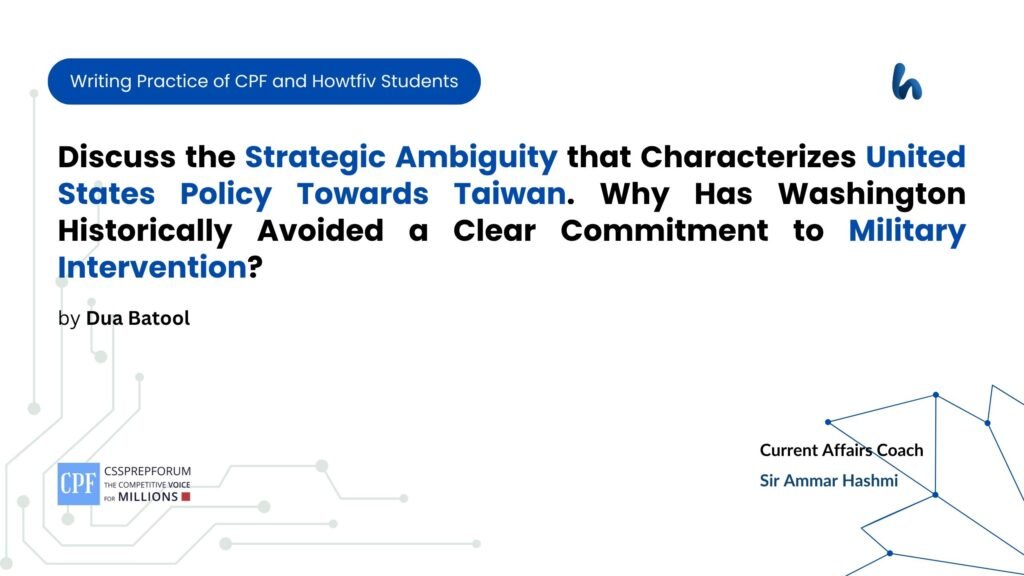
CSS Current Affairs | Strategic Ambiguity Characterizing United States Policy Towards Taiwan and Washington Historically Avoiding a Clear Commitment to Military Intervention
The following assignment question for CSS Current Affairs is solved by Dua Batool under the supervision of Howfiv’s Pakistan Affairs and Current Affairs Coaches: Miss Iqra Ali and Sir Ammar Hashmi. She learnt how to attempt 20 marks question and essay writing from Sir Syed Kazim Ali, Pakistan’s best CSS and PMS English essay and precis teacher with the highest success rate of his students. This solved question is attempted on the pattern taught by Sir to his students, scoring the highest marks in compulsory and optional subjects for years.

Outline
1-Introduction
2-Defining strategic ambiguity
3-Evolution of the Taiwan issue and US Policy
4-Strategic ambiguity as the hallmark of US Policy towards Taiwan
- Balancing the One-China policy with robust support for Taiwan
- Pursuing dual deterrence against Beijing and Taipei
- Maintaining deliberate uncertainty over military intervention
- Preserving the Cross-Strait status Quo
5-Why has Washington historically avoided a clear commitment on military intervention?
- Deterring Chinese military aggression without provoking war
- Discouraging Taiwan from declaring formal independence
- Preserving diplomatic and economic engagement with China
- Retaining strategic and diplomatic flexibility
- Safeguarding US strategic interests and the regional balance of power in the Indo-Pacific
6-Contemporary challenges to strategic ambiguity
7-Conclusion
Answer to the question
Introduction
Strategic ambiguity has remained the defining feature of the United States’ policy towards Taiwan, reflecting Washington’s deliberate refusal to make an explicit commitment on military intervention while maintaining Taiwan’s security. Emerging from the historical evolution of the Taiwan issue and the transformation of US-China relations, this policy has enabled the United States to balance its One-China policy with robust unofficial support for Taiwan. Through strategic ambiguity, Washington has maintained deliberate uncertainty over military intervention, pursued dual deterrence against both Chinese aggression and Taiwanese unilateral independence, and preserved the cross-Strait status quo. Historically, the United States has avoided a clear military commitment to deter conflict, discourage unilateral actions, preserve diplomatic engagement with China, retain strategic flexibility, and safeguard its strategic interests in the Indo-Pacific. Therefore, strategic ambiguity remains the cornerstone of US policy towards Taiwan, serving as a carefully calibrated strategy to maintain peace, stability, and the regional balance of power.
Defining Strategic ambiguity
Against this historical backdrop, the United States adopted strategic ambiguity as the guiding principle of its Taiwan policy to balance competing strategic and diplomatic interests. Strategic ambiguity refers to Washington’s deliberate policy of neither confirming nor denying whether it would militarily intervene if China attacked Taiwan. Rather than being a sign of indecision, it is a calculated strategy designed to deter aggression while preserving flexibility. Its legal foundation lies in the Taiwan Relations Act (1979), which commits the United States to provide Taiwan with defensive arms and maintain the capacity to resist coercion, yet deliberately avoids a binding military guarantee. This ambiguity compels Beijing to consider the possibility of US intervention while discouraging Taipei from assuming unconditional American protection or pursuing formal independence. Consequently, it simultaneously deters both Chinese coercion and Taiwanese unilateralism. Therefore, strategic ambiguity has remained the cornerstone of US policy by balancing deterrence, diplomacy, and regional stability without committing Washington to automatic military intervention.
Evolution of the Taiwan issue and US Policy
To understand the rationale behind America’s policy of strategic ambiguity, it is essential to trace the historical evolution of the China-Taiwan Dispute. The dispute originated in 1949, when the Chinese Civil War ended with the Communist Party establishing the People’s Republic of China (PRC) on the mainland, while the Nationalist government retreated to Taiwan and continued as the Republic of China (ROC). During the Cold War, the United States recognized the ROC and concluded the US-Taiwan Mutual Defense Treaty (1954) to contain communist expansion. However, changing geopolitical realities, particularly the Sino-Soviet split, prompted Washington to normalize relations with Beijing through the Shanghai Communiqué (1972) and formally recognize the PRC in 1979 under the One-China policy. Simultaneously, the Taiwan Relations Act (1979), reinforced by the Three Joint Communiqués and Six Assurances, enabled continued unofficial ties and defensive support for Taiwan. Thus, the evolution of US policy reflects a careful balance between diplomatic engagement with China and safeguarding Taiwan’s security.
Strategic ambiguity as the hallmark of US Policy towards Taiwan
- Balancing the One-China policy with robust support for Taiwan
To begin with, strategic ambiguity is manifested in Washington’s ability to balance its formal adherence to the One-China policy with unwavering support for Taiwan’s security and democratic resilience. While the United States officially recognizes the People’s Republic of China as the sole legal government of China, it simultaneously maintains extensive unofficial political, economic, and security relations with Taiwan. This delicate balance is institutionalized through the Taiwan Relations Act (1979), enacted after Washington shifted diplomatic recognition from Taipei to Beijing. The Act authorizes continued arms sales to Taiwan and obliges the United States to maintain the capacity to resist coercion against the island, despite offering no formal defense treaty. This arrangement demonstrates that diplomatic recognition of Beijing does not translate into abandoning Taiwan’s security. By simultaneously reassuring Beijing through the One-China policy and strengthening Taiwan’s self-defense capabilities, Washington prevents either side from perceiving a decisive shift in US policy. Thus, balancing diplomatic recognition with practical support remains the defining expression of America’s strategic ambiguity.
- Pursuing dual deterrence against Beijing and Taipei
Having established a balanced diplomatic framework, the United States employs strategic ambiguity to pursue dual deterrence, simultaneously discouraging Chinese military aggression and Taiwanese unilateral moves toward formal independence. Rather than favouring either side, Washington deliberately raises the costs of provocative actions by both Beijing and Taipei to preserve regional stability. For example, in the 1995-96 Taiwan Strait Crisis, China conducted missile tests and military exercises to intimidate Taiwan before its first direct presidential election. In response, the United States deployed two aircraft carrier strike groups near the Taiwan Strait, signalling its willingness to resist coercion. Nevertheless, successive US administrations also reaffirmed that they did not support Taiwan’s independence, cautioning Taipei against altering the status quo. This balanced response illustrates that strategic ambiguity is designed to restrain both rather than provide unconditional backing to either. Therefore, dual deterrence remains the central mechanism through which Washington sustains peace and stability across the Taiwan Strait.
- Maintaining deliberate uncertainty over military intervention
Building upon its strategy of dual deterrence, the United States deliberately maintains uncertainty over whether it would militarily intervene in the event of a Chinese attack on Taiwan, making ambiguity itself a tool of deterrence. Instead of offering an explicit security guarantee or ruling out intervention, Washington leaves its response intentionally undefined to influence the calculations of both Beijing and Taipei. For instance, the Taiwan Relations Act (1979) commits the United States to provide Taiwan with defensive arms and maintain the capacity to resist coercion, yet stops short of legally obligating military intervention. This carefully crafted ambiguity forces China to consider the possibility of US involvement before resorting to force, while simultaneously preventing Taiwan from assuming unconditional American protection. Consequently, both sides are discouraged from taking reckless actions that could trigger conflict. Hence, deliberate uncertainty is not a sign of indecision but a calculated strategy that strengthens deterrence while preserving Washington’s freedom of action.
- Preserving the Cross-Strait Status Quo
Further, strategic ambiguity is fundamentally aimed at preserving the cross-Strait status quo by preventing unilateral changes from either Beijing or Taipei. The United States views the existing equilibrium as the most effective means of maintaining peace, safeguarding regional stability, and avoiding a potentially catastrophic confrontation between major powers. This commitment is consistently reflected in official US policy, particularly the long-standing position that any resolution of cross-Strait differences must be achieved peacefully and with the assent of the people on both sides of the Strait. Accordingly, Washington has repeatedly opposed China’s use of force while also discouraging Taiwan from declaring formal independence. By rejecting coercion and unilateral political actions alike, the United States seeks to maintain a stable balance that minimizes the risk of military escalation. Therefore, preserving the status quo remains the ultimate objective of strategic ambiguity, ensuring that disputes are managed through deterrence, restraint, and peaceful engagement rather than armed conflict.
Why has Washington historically avoided a clear commitment on military intervention?
- Deterring Chinese military aggression without provoking war
Washington has historically avoided an explicit military commitment to Taiwan to deter Chinese aggression without unnecessarily provoking a confrontation with Beijing. By refusing to clarify whether it would intervene militarily, the United States compels Chinese leaders to factor the possibility of American involvement into any decision to use force. This uncertainty raises the strategic, military, and political costs of an invasion. For instance, in the 1995-96 Taiwan Strait Crisis, China conducted missile tests near Taiwan. In response, the United States deployed two aircraft carrier strike groups to the region without issuing a formal defense guarantee. The deployment demonstrated America’s capacity to intervene while preserving ambiguity over its future actions. Consequently, Beijing was deterred from escalating the crisis into open conflict. Thus, deliberate uncertainty has enabled Washington to discourage Chinese aggression while avoiding the risks associated with an unconditional military commitment.
- Discouraging Taiwan from declaring formal independence
Equally important, the United States has maintained strategic ambiguity to discourage Taiwan from unilaterally declaring formal independence, which could trigger a devastating regional conflict. An explicit American security guarantee might embolden Taiwanese leaders to pursue independence, assuming automatic US military protection. To prevent such moral hazard, Washington deliberately avoids making unconditional commitments. This policy was clearly reflected in President George W. Bush’s 2003 public criticism of Taiwanese President Chen Shui-bian’s moves toward independence, when Bush reaffirmed that the United States opposed any unilateral attempt to alter the status quo. By signalling restraint to Taipei as well as Beijing, Washington reinforced that US support was conditional upon maintaining peace and stability. This balanced approach reduces the likelihood of provocative political decisions that could spark war across the Taiwan Strait. Thus, strategic ambiguity serves as an effective mechanism for restraining Taiwanese unilateralism while preserving regional stability.
- Preserving diplomatic and economic engagement with China
Furthermore, Washington has refrained from making a clear military commitment because it seeks to preserve constructive diplomatic and economic relations with China despite strategic competition. An explicit pledge to defend Taiwan would likely be viewed by Beijing as abandoning the One-China policy, severely damaging bilateral cooperation. Strategic ambiguity allows the United States to reassure Taiwan’s security while continuing engagement with China on issues of mutual interest. The normalization of US-China relations in 1979, alongside the enactment of the Taiwan Relations Act, best illustrates this balancing strategy. While Washington recognized the People’s Republic of China as the sole legal government of China, it simultaneously maintained unofficial ties with Taiwan without extending a formal defense guarantee. This arrangement enabled cooperation with Beijing on trade, regional security, and global governance while sustaining Taiwan’s security. Hence, avoiding a clear military commitment has allowed the United States to balance strategic competition with pragmatic engagement.
- Retaining Strategic and Diplomatic Flexibility
Moreover, the United States has historically preferred strategic ambiguity because it preserves the flexibility to determine its response according to the specific circumstances of any future crisis. A formal defense commitment could automatically compel Washington to intervene regardless of the nature of the conflict, whereas ambiguity allows policymakers to consider military, diplomatic, legal, and political factors before acting. This flexibility is embedded in the Taiwan Relations Act (1979), which requires the United States to maintain the capacity to resist coercion but deliberately avoids mandating military intervention. Consequently, each administration retains discretion to assess the scale of Chinese aggression, the actions of Taiwan, allied support, and broader regional implications before making a decision. Such adaptability enhances crisis management and reduces the risk of unnecessary escalation. Hence, preserving strategic flexibility has remained one of the principal reasons behind Washington’s long-standing policy of strategic ambiguity.
- Safeguarding US Strategic interests and the regional balance of power in the Indo-Pacific
Further, Washington has maintained strategic ambiguity to safeguard its broader strategic interests and preserve a favourable balance of power in the Indo-Pacific. Taiwan occupies a pivotal position within the First Island Chain, making its security crucial to regional maritime stability, freedom of navigation, and the credibility of America’s alliance network. At the same time, an explicit defense commitment could intensify great-power rivalry and destabilize the region. This strategic importance is reflected in the US Indo-Pacific Strategy (2022), which emphasizes maintaining peace and stability across the Taiwan Strait as indispensable to a free and open Indo-Pacific. By combining military preparedness with diplomatic ambiguity, the United States seeks to deter coercion without provoking conflict or undermining regional equilibrium. Thus, avoiding a binding military commitment enables Washington to protect its long-term geopolitical interests while maintaining stability in one of the world’s most strategically significant regions.
Contemporary challenges to strategic ambiguity
Despite its long-standing success in preserving stability across the Taiwan Strait, strategic ambiguity is increasingly being tested by evolving geopolitical realities that have complicated its effectiveness. The rapid transformation of the Indo-Pacific security environment has intensified debate over whether deliberate uncertainty remains sufficient to deter conflict. For example, China’s unprecedented military buildup and increasing military activities around Taiwan, including frequent incursions into Taiwan’s Air Defense Identification Zone (ADIZ) and large-scale military exercises conducted after high-level US congressional visits. These developments have heightened cross-Strait tensions and fuelled calls within the United States for replacing strategic ambiguity with strategic clarity, while Beijing continues to denounce growing US support for Taiwan as interference in its internal affairs. Consequently, the policy now faces mounting pressure from intensifying US-China strategic competition, rising risks of military miscalculation, and changing regional security dynamics. Thus, contemporary geopolitical developments have significantly challenged the credibility and sustainability of strategic ambiguity as the cornerstone of US policy towards Taiwan.
Conclusion
In conclusion, strategic ambiguity has remained the core principle of United States policy towards Taiwan by balancing adherence to the One-China policy with continued support for Taiwan’s security while deliberately avoiding an explicit commitment to military intervention. Through dual deterrence, deliberate uncertainty, and preservation of the cross-Strait status quo, Washington has sought to maintain regional stability and prevent unilateral actions by either Beijing or Taipei. Historically, the United States has adopted this approach to deter conflict, preserve strategic flexibility, sustain engagement with China, and protect its broader interests in the Indo-Pacific. Thus, strategic ambiguity continues to define US policy towards Taiwan as a pragmatic strategy for safeguarding peace and stability across the Taiwan Strait.

CSS Solved Past Papers’ Essays
Looking for the last ten years of CSS and PMS Solved Essays and want to know how Sir Kazim’s students write and score the highest marks in the essays’ papers? Then, click on the CSS Solved Essays to start reading them.
CSS Solved Essays
CSS Solved Islamiyat Past Papers
Want to read the last ten years’ Islamiyat Solved Past Papers to learn how to attempt them and to score high? Let’s click on the link below to read them all freely. All past papers have been solved by Pakistan’s top CSS Islamiyat coaches having the highest score of their students.
CSS Solved Islamiyat
CSS Solved General Science & Ability Past Papers
Want to read the last ten years’ General Science & Ability Solved Past Papers to learn how to attempt them and to score high? Let’s click on the link below to read them all freely. All past papers have been solved by Pakistan’s top CSS GSA coachez having the highest score of their students.
CSS Solved General Science & Ability
CSS Solved Pakistan Affairs Past Papers
Want to read the last fifteen years’ Pakistan Affairs Solved Past Papers to learn how to attempt them and to score high? Let’s click on the link below to read them all freely. All past papers have been solved by Pakistan’s top CSS Pakistan Affairs coaches having the highest score of their students.
CSS Solved Pakistan Affairs
CSS Solved Current Affairs Past Papers
Want to read the last fifteen years’ Current Affairs Solved Past Papers to learn how to attempt them and to score high? Let’s click on the link below to read them all freely. All past papers have been solved by Pakistan’s top CSS Current Affairs coaches having the highest score of their students.
CSS Solved Current Affairs