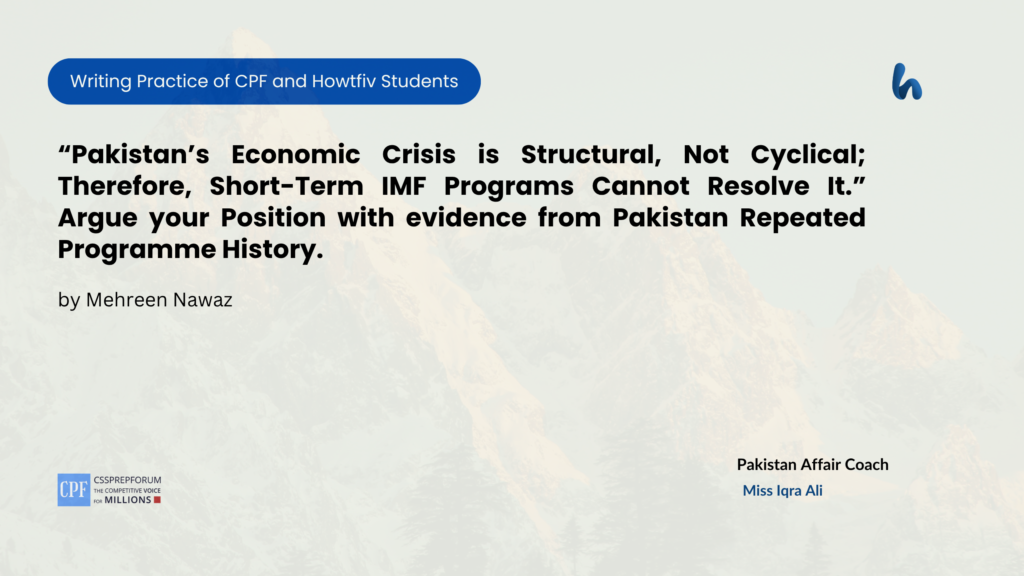
CSS Pakistan Affairs | Pakistan’s Economic Crisis and Repeated IMF Programs History
The following question of CSS Pakistan Affairs is solved by Mehreen Bangash under the supervision of Howfiv’s Pakistan Affairs and Current Affairs Coaches: Miss Iqra Ali and Sir Ammar Hashmir. She learnt how to attempt 20 marks question and essay writing from Sir Syed Kazim Ali, Pakistan’s best CSS and PMS English essay and precis teacher with the highest success rate of his students. This solved question is attempted on the pattern taught by Sir to his students, scoring the highest marks in compulsory and optional subjects for years.

Outline
1-Introduction
2-Historical Background of Pakistan’s Economic Crisis
3-Pakistan’s Economic Crisis is Structural; Not Cyclical
- 3.1 Weak and Narrow Tax Structure
- Case in Point: Pakistan’s tax-to-GDP ratio remained around 10–11% during the early 2000s and improved only slightly to nearly 12–13% in recent years, still considerably lower than many regional economies. Furthermore, only a small proportion of the population files income tax returns despite a population exceeding 240 million.
- 3.2 Chronic Balance of Payments Crisis and Import Dependence
- Case in Point: Pakistan’s exports increased from nearly $10–12 billion in the early 2000s to approximately $30–32 billion today; however, imports simultaneously surged to nearly $55–60 billion, creating a persistent and widening trade deficit. Moreover, exports continue to hover around nearly 10% of GDP, significantly lower than successful export-oriented Asian economies.
- 3.3 Energy Sector Inefficiency and Circular Debt
- Case in Point: Pakistan’s circular debt crossed several trillion rupees despite repeated reform packages, tariff adjustments, and IMF-backed restructuring efforts. Additionally, severe energy shortages after 2007–08 reduced industrial productivity, weakened exports, and contributed to factory closures and unemployment.
- 3.4 Weak Governance, Political Instability, and Policy Discontinuity
- Case in Point: Pakistan repeatedly experienced economic stabilization followed by renewed crises after the IMF programs of 1988, 2008, 2013, and 2019, demonstrating persistent governance and implementation failures.
- 3.5 Currency Depreciation and Inflationary Instability
- Case in Point: The exchange rate moved from nearly Rs50–60 per dollar in 2000 to approximately Rs280–300 per dollar by 2025. Similarly, inflation surged above 30% during the post-2022 crisis before easing in subsequent years.
- 3.6 Dependence on External Borrowing and Rising Public Debt
- Case in Point: Pakistan’s public debt stood around 60% of GDP in the early 2000s but increased to nearly 70–75% of GDP by 2025 despite repeated IMF interventions and fiscal adjustments. Furthermore, foreign exchange reserves repeatedly declined to critically low levels during economic crises.
4- Pakistan’s Repeated IMF Programs Prove That Short-Term Stabilization Cannot Resolve Structural Problems
- 4.1 IMF Programs Focus on Stabilization Rather than Structural Transformation
- Case in Point: Pakistan entered more than twenty IMF programs since 1958, yet the country repeatedly returned to balance-of-payments crises and external financing pressures.
- 4.2 Austerity Measures Intensify Social and Economic Pressures
- Case in Point: During the post-2022 economic crisis, inflation exceeded 30%, while electricity and fuel prices increased sharply under IMF conditionalities, significantly reducing household purchasing power.
- 4.3 Structural Reforms Remain Incomplete after Every IMF Program
- Case in Point: Despite repeated IMF interventions, Pakistan continues to struggle with low tax collection, export underperformance, circular debt, weak industrial productivity, and loss-making state-owned enterprises.
- 4.4 Repeated Borrowing Creates a Cycle of Dependency
- Case in Point: During the 2022–23 economic crisis, Pakistan’s foreign exchange reserves declined to critically low levels, forcing the country to seek emergency IMF assistance and bilateral support from friendly countries to avoid default.
- 4.5 Short-Term Programs Cannot Build Long-Term Competitiveness
- Case in Point: Pakistan’s GDP increased from nearly $100 billion in 2000 to approximately $340–380 billion by 2025; however, average economic growth remained around 3.5–4% over the last fifteen years, insufficient to absorb population growth and unemployment pressures.
- 4.6 Weak Business Competitiveness and Protectionist Economic Model
- Case in Point: Economic analysts repeatedly observed that Pakistani firms focused primarily on protected domestic markets instead of developing globally competitive export industries similar to East Asian economies.
5- Critical Analysis
7- Conclusion
Answer to the Question
Introduction
Pakistan’s recurring economic crises have become a permanent feature of national life, reflected in inflation, currency depreciation, unemployment, rising electricity and fuel prices, and repeated dependence on IMF bailouts. Although the economy occasionally experiences short-term recovery, these improvements rarely translate into sustainable relief for ordinary citizens. This persistent instability demonstrates that Pakistan’s economic crisis is not cyclical or temporary in nature, but structural and deeply rooted in weak governance, narrow taxation, low productivity, export under-performance, institutional fragility, and excessive dependence on external borrowing. Consequently, short-term IMF stabilization programs may temporarily prevent sovereign default and restore macroeconomic confidence, but they cannot permanently resolve the deep-rooted structural weaknesses embedded within Pakistan’s economic system.
Historical Background of Pakistan’s Economic Crisis
At the time of independence in 1947, Pakistan inherited a fragile and underdeveloped economic structure with limited industrial infrastructure, weak financial institutions, and overwhelming dependence on agriculture. During the 1950s and 1960s, Pakistan experienced relatively strong industrial growth under state-led development planning. However, this growth remained uneven and heavily dependent on foreign aid and external support. After 1971, nationalization policies weakened private-sector confidence, while the political instability of the 1980s and 1990s further intensified fiscal and external vulnerabilities. By the late 1990s, following nuclear sanctions after the 1998 nuclear tests, Pakistan became increasingly dependent on IMF support and external borrowing. Although the early 2000s witnessed temporary stability due to foreign inflows, remittances, and favorable global conditions, structural reforms remained incomplete. As a result, every phase of economic recovery was followed by another crisis, proving that Pakistan’s economic weaknesses were structural rather than temporary.
Pakistan’s Economic Crisis is Structural, Not Cyclical
- Weak and Narrow Tax Structure
One of the most serious structural weaknesses of Pakistan’s economy is its narrow and inequitable taxation system. Successive governments failed to broaden the tax base effectively, while politically influential sectors such as agriculture, retail, wholesale trade, and real estate remained either under-taxed or undocumented. As a result, the government increasingly relied on indirect taxes and external borrowing to finance public expenditures, placing disproportionate pressure on salaried and lower-income groups. Pakistan’s tax-to-GDP ratio remained around 10–11% during the early 2000s and improved only slightly to nearly 12–13% in recent years, still considerably lower than many regional economies. Furthermore, only a small proportion of the population files income tax returns despite a population exceeding 240 million. Weak documentation, tax evasion, corruption, and elite capture continue to undermine fiscal sustainability. Consequently, Pakistan repeatedly experiences budget deficits and debt accumulation because domestic revenue generation remains structurally inadequate. This clearly demonstrates that Pakistan’s fiscal crisis is institutional and long term rather than cyclical and temporary.
- Chronic Balance of Payments Crisis and Import Dependence
Pakistan’s economy has continuously suffered from structural external imbalances due to excessive dependence on imports and weak export competitiveness. The country imports petroleum products, machinery, edible oil, chemicals, and industrial raw materials on a large scale, while exports remain concentrated in low-value textile products with limited technological diversification. This imbalance repeatedly creates pressure on foreign exchange reserves and forces the country to seek external financing and IMF support. Pakistan’s exports increased from nearly $10–12 billion in the early 2000s to approximately $30–32 billion today; however, imports simultaneously surged to nearly $55–60 billion, creating a persistent and widening trade deficit. Moreover, exports continue to hover around nearly 10% of GDP, significantly lower than successful export-oriented Asian economies. The economy therefore struggles to generate sufficient foreign exchange for sustainable growth. This recurring balance-of-payments crisis reflects deep structural weaknesses in industrial competitiveness, innovation, and export diversification rather than temporary cyclical pressures.
- Energy Sector Inefficiency and Circular Debt
The energy sector has become one of the most damaging structural constraints on Pakistan’s economic growth and industrial productivity. Although electricity generation capacity improved over the years, inefficiencies in transmission, distribution, pricing mechanisms, and governance continue to generate enormous financial losses. High electricity tariffs, widespread power theft, transmission losses, delayed subsidy payments, and poor recovery systems have collectively intensified the circular debt crisis. Pakistan’s circular debt crossed several trillion rupees despite repeated reform packages, tariff adjustments, and IMF-backed restructuring efforts. Additionally, severe energy shortages after 2007–08 reduced industrial productivity, weakened exports, and contributed to factory closures and unemployment. The rising cost of electricity also reduced the competitiveness of Pakistani industries in global markets. Consequently, the energy crisis reflects institutional inefficiency and governance failure rather than a temporary economic slowdown.
- Weak Governance, Political Instability, and Policy Discontinuity
Frequent political transitions and inconsistent policymaking have prevented Pakistan from implementing long-term economic reforms. Every government introduces new economic priorities, while previously initiated reforms are delayed, weakened, or reversed altogether. This policy inconsistency discourages domestic and foreign investment and undermines institutional credibility. Pakistan repeatedly experienced economic stabilization followed by renewed crises after the IMF programs of 1988, 2008, 2013, and 2019, demonstrating persistent governance and implementation failures. Corruption, bureaucratic inefficiency, weak rule of law, and political polarization further limit the state’s capacity to enforce reforms effectively. Moreover, development planning in Pakistan often remains short term and politically motivated rather than institutionally driven. Therefore, Pakistan’s economic instability reflects structural governance weaknesses instead of ordinary cyclical economic downturns.
- Currency Depreciation and Inflationary Instability
The persistent depreciation of the Pakistani rupee reflects the underlying fragility of the economy. Weak exports, rising imports, debt repayments, and declining foreign exchange reserves continuously place pressure on the national currency. Depreciation increases the cost of imported fuel, machinery, medicines, and food items, thereby fueling inflation and reducing purchasing power for ordinary citizens. The exchange rate moved from nearly Rs50–60 per dollar in 2000 to approximately Rs280–300 per dollar by 2025. Similarly, inflation surged above 30% during the post-2022 crisis before easing in subsequent years. Such severe volatility creates uncertainty for businesses, discourages investment, and weakens household consumption. Temporary monetary tightening and interest-rate adjustments may provide limited relief, but they cannot permanently stabilize prices without addressing structural production and external sector weaknesses. Hence, Pakistan’s inflationary pressures are rooted in structural fragility rather than temporary cyclical fluctuations.
- Dependence on External Borrowing and Rising Public Debt
Pakistan’s economy has become excessively dependent on external borrowing to manage fiscal deficits and balance-of-payments pressures. Instead of financing productive transformation, much of the borrowing has been utilized to repay previous loans or temporarily stabilize foreign reserves. Consequently, debt servicing has become one of the largest expenditures in the federal budget, reducing fiscal space for development projects, education, healthcare, and social welfare. Pakistan’s public debt stood around 60% of GDP in the early 2000s but increased to nearly 70–75% of GDP by 2025 despite repeated IMF interventions and fiscal adjustments. Furthermore, foreign exchange reserves repeatedly declined to critically low levels during economic crises. This borrowing pattern demonstrates that external loans failed to generate long-term economic resilience and instead deepened financial dependency. Therefore, Pakistan’s debt crisis is structural and self-perpetuating rather than temporary.
Pakistan’s Repeated IMF Programs Prove That Short-Term Stabilization Cannot Resolve Structural Problems
- IMF Programs Focus on Stabilization Rather than Structural Transformation
The IMF primarily provides short-term financial assistance aimed at restoring macroeconomic stability, controlling inflation, stabilizing foreign exchange reserves, and preventing sovereign default. While these measures are important during crises, they do not fundamentally transform the productive structure of the economy. IMF conditionalities generally emphasize fiscal tightening, subsidy withdrawal, currency devaluation, and monetary discipline rather than industrial modernization, technological advancement, or export diversification. Pakistan entered more than twenty IMF programs since 1958, yet the country repeatedly returned to balance-of-payments crises and external financing pressures. This repeated dependence clearly demonstrates that stabilization policies alone cannot resolve Pakistan’s deep-rooted structural weaknesses. Without institutional transformation, temporary financial stabilization merely postpones future crises.
- Austerity Measures Intensify Social and Economic Pressures
IMF-supported stabilization programs frequently rely on austerity measures, including higher taxes, subsidy reductions, cuts in development spending, and increases in energy prices. Although these measures may improve fiscal indicators temporarily, they simultaneously increase inflation, unemployment, and the overall cost of living. Rising electricity tariffs and petroleum prices disproportionately affect middle- and lower-income households, worsening poverty and social inequality. During the post-2022 economic crisis, inflation exceeded 30%, while electricity and fuel prices increased sharply under IMF conditionalities, significantly reducing household purchasing power. Businesses also face rising production costs and reduced consumer demand during stabilization periods. Consequently, IMF programs may prevent immediate economic collapse, but they often fail to produce inclusive and sustainable economic recovery for society at large.
- Structural Reforms Remain Incomplete after Every IMF Program
One of the primary reasons behind Pakistan’s repeated economic crises is the failure to implement structural reforms consistently after IMF agreements. Political resistance, elite interests, weak institutions, and bureaucratic inefficiency repeatedly delay reforms related to taxation, privatization, governance, and state-owned enterprises. Governments often implement difficult reforms temporarily to secure IMF funding but abandon them once immediate pressure declines. Despite repeated IMF interventions, Pakistan continues to struggle with low tax collection, export underperformance, circular debt, weak industrial productivity, and loss-making state-owned enterprises. Consequently, structural weaknesses persist across decades despite multiple stabilization efforts. This demonstrates that temporary compliance with IMF conditions cannot substitute long-term institutional reform and political commitment.
- Repeated Borrowing Creates a Cycle of Dependency
Pakistan’s continuous return to the IMF created a dependency cycle in which new loans are frequently used to repay previous obligations instead of financing productive investment and development. This dependence increases external vulnerability and weakens economic sovereignty because policymaking becomes increasingly influenced by external creditors. During the 2022–23 economic crisis, Pakistan’s foreign exchange reserves declined to critically low levels, forcing the country to seek emergency IMF assistance and bilateral support from friendly countries to avoid default. Such repeated crises demonstrate that IMF programs function primarily as temporary financial lifelines rather than permanent solutions to structural economic problems. Consequently, Pakistan remains trapped in a cycle of borrowing, stabilization, and renewed crisis.
- Short-Term Programs Cannot Build Long-Term Competitiveness
Sustainable economic growth requires export diversification, industrial modernization, technological upgrading, skilled human capital, and institutional continuity. However, these reforms require decades of planning and implementation, whereas IMF programs generally operate within short-term stabilization frameworks. Pakistan’s GDP increased from nearly $100 billion in 2000 to approximately $340–380 billion by 2025; however, average economic growth remained around 3.5–4% over the last fifteen years, insufficient to absorb population growth and unemployment pressures. Similarly, youth unemployment and underemployment continued to rise despite periodic economic recovery. Therefore, Pakistan’s economic expansion remained fragile because growth was not accompanied by structural transformation and productivity enhancement.
- Weak Business Competitiveness and Protectionist Economic Model
For decades, significant segments of Pakistan’s business sector operated within a protected economic environment dependent on subsidies, regulatory concessions, import protection, and domestic market monopolies rather than innovation and international competitiveness. This discouraged productivity growth, technological modernization, and export-oriented industrialization. Economic analysts repeatedly observed that Pakistani firms focused primarily on protected domestic markets instead of developing globally competitive export industries similar to East Asian economies. Consequently, investment remained concentrated in speculative and low-productivity sectors rather than manufacturing and technological innovation. Without transforming this economic model, Pakistan cannot achieve sustainable export-led growth and long-term stability.
Critical Analysis
Pakistan’s repeated economic crises clearly demonstrate that macroeconomic stabilization alone cannot substitute structural transformation. IMF programs may temporarily restore investor confidence, stabilize reserves, and prevent sovereign default, but they cannot independently reform governance structures, industrial productivity, taxation systems, or institutional capacity. At the same time, responsibility does not lie solely with the IMF because domestic political elites repeatedly avoided difficult reforms for short-term political considerations. Consequently, Pakistan’s crisis reflects both external dependency and internal structural dysfunction. Sustainable recovery therefore requires export-led industrialization, institutional continuity, governance reforms, energy restructuring, and long-term economic planning beyond temporary bailout arrangements.
Conclusion
Pakistan’s economic history clearly demonstrates that its crisis is structural rather than cyclical. Persistent fiscal deficits, weak exports, energy inefficiencies, institutional fragility, and dependence on external borrowing have created a long-term pattern of instability. Although IMF programs provide temporary stabilization and help prevent immediate default, they cannot resolve the foundational weaknesses embedded within Pakistan’s economic structure. Pakistan’s repeated return to IMF assistance itself serves as evidence of the limitations of short-term stabilization strategies. Therefore, only deep structural reforms aimed at strengthening institutions, broadening taxation, improving competitiveness, promoting export-led growth, and ensuring policy continuity can produce sustainable and inclusive economic stability in the future.

CSS Solved Past Papers’ Essays
Looking for the last ten years of CSS and PMS Solved Essays and want to know how Sir Kazim’s students write and score the highest marks in the essays’ papers? Then, click on the CSS Solved Essays to start reading them.
CSS Solved Essays
CSS Solved Islamiyat Past Papers
Want to read the last ten years’ Islamiyat Solved Past Papers to learn how to attempt them and to score high? Let’s click on the link below to read them all freely. All past papers have been solved by Pakistan’s top CSS Islamiyat coaches having the highest score of their students.
CSS Solved Islamiyat
CSS Solved General Science & Ability Past Papers
Want to read the last ten years’ General Science & Ability Solved Past Papers to learn how to attempt them and to score high? Let’s click on the link below to read them all freely. All past papers have been solved by Pakistan’s top CSS GSA coachez having the highest score of their students.
CSS Solved General Science & Ability
CSS Solved Pakistan Affairs Past Papers
Want to read the last fifteen years’ Pakistan Affairs Solved Past Papers to learn how to attempt them and to score high? Let’s click on the link below to read them all freely. All past papers have been solved by Pakistan’s top CSS Pakistan Affairs coaches having the highest score of their students.
CSS Solved Pakistan Affairs
CSS Solved Current Affairs Past Papers
Want to read the last fifteen years’ Current Affairs Solved Past Papers to learn how to attempt them and to score high? Let’s click on the link below to read them all freely. All past papers have been solved by Pakistan’s top CSS Current Affairs coaches having the highest score of their students.
CSS Solved Current Affairs