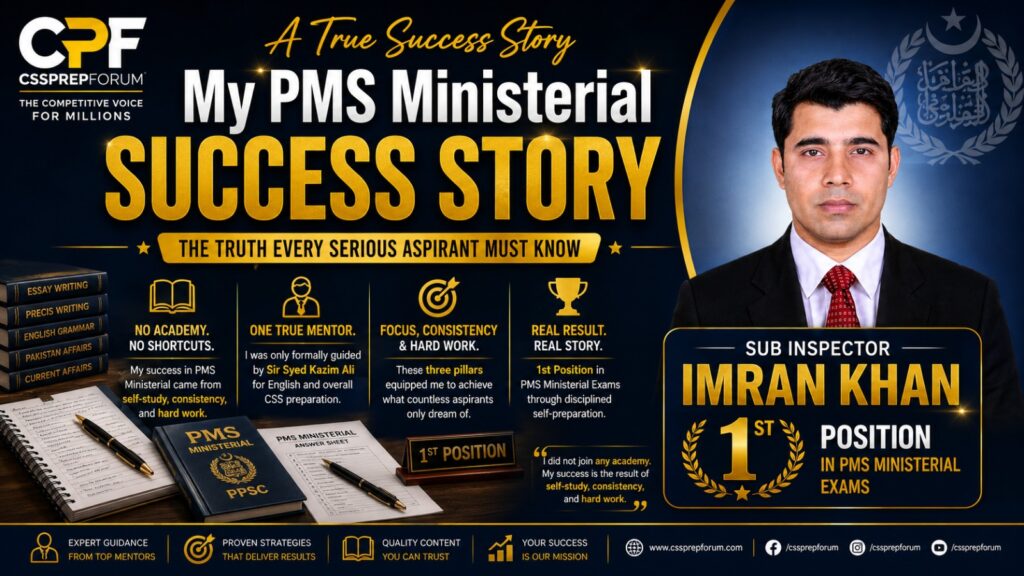
My PMS Ministerial Success Story: The Truth Every Aspirant Must Know reveals the real journey behind securing 1st Position in the PMS Ministerial Examination. Discover how disciplined self-study, the guidance of Sir Syed Kazim Ali, and unwavering consistency became the foundation of my genuine success.
The day my result came out, my phone rang non-stop for many hours. Even though I expected that, what I did not expect was who was calling.
Half the messages came from people who actually mattered to me, such as my colleague, my seniors, friends who had watched me struggle for months. However, the other half came from strangers. Academies I had never visited. WhatsApp groups I had never joined. And even multiple “Academies” put my photo in an advertisement within hours of my result. I never gave them that photo.
It took me a while to understand what was really happening. That is why I decided to write a complete, honest account of my success story. Not just the strange part where strangers began claiming credit for my success, but the whole story: from the day I decided to sit for the PMS Ministerial exam, to the day people I had never met started portraying themselves as the reason behind it.
I am writing this for every serious aspirant who gets pulled in by flashy advertisements and ends up trusting people who have never genuinely helped anyone succeed. My hope is that this story helps you tell the difference between mentors who actually build you through real dedication and proven guidance, and self-promoters who survive on misleading claims and borrowed credit, feeding off the dreams of hardworking students.
My article explaining my story might be long, but it is written for those who are born to succeed — for the ones willing to read every word, sit with every lesson, and put in the months nobody else is willing to give.
Where I Started: An Engineer With a Writing Problem
I don’t come from an English or literature background. I studied engineering. By the time I applied for the PMS Ministerial quota, I was already a Sub-Inspector in Punjab Police. On paper, I ticked every box: right service, right pay scale, right qualification.
But I could not write.
I could write a clean police report. I could explain a procedure without confusion. None of that prepared me for the English essay paper, which demands something completely different, building an argument from nothing, holding it together for two and a half hours, and making a tired examiner, who has already read hundreds of similar essays that week, actually want to finish yours.
I did not know how to build a thesis. I did not know how to make one paragraph grow out of the last one instead of just sitting beside it.
I was not short on confidence anywhere else in my life. It vanished the moment I sat in front of a blank page.
A colleague of mine, someone who had already passed PMS under Sir Syed Kazim Ali guidance, told me to stop trying to fix this alone. I ignored him at first. I thought I could copy a few model essays and get away with it. I was wrong, and it cost me a few weeks before I admitted that.
Before I tell the rest of the story, it’s important to explain why I stay away from academies and officer-led coaching. This context matters, because it shapes almost every decision I made after.
Why I Stayed Away from Officer-Run Academies
I watched colleagues ahead of me join academies run by officers who had already passed. Almost all of them said the same thing: you got exactly as much guidance as you paid for. Want more feedback? Buy the next package. That is not mentorship. That is a business wearing mentorship’s face.
A senior officer standing in front of a room, telling a nice story about how he passed, is not the same as someone sitting with your outline late at night, pointing out exactly where your third paragraph lost its way, because that kind of attention was never part of the package.
There was a second reason too. I was still serving. I needed something that fit around my job, not a full-time academy built for people with nothing else to do.
And a third reason, harder to put into words but just as real: passing an exam does not automatically make someone able to teach it. An officer can tell you what worked for him: that’s it. He can share what worked for him, not teach you what will work for you. That is not nothing: I did listen, and some of it helped. But his success came from his own habits, his own way of thinking. None of that told me why my introduction was weak or why my argument kept drifting. Teaching writing is a different skill from writing well. I was not willing to bet eight months of my life on the idea that the two are the same.
This is not just my personal opinion, either. I know hundreds of PSP and PAS officers who openly dislike the officers who turn CSS and PMS preparation into a business, teaching and quietly exploiting students along the way. Even my own DPO and SP, once they knew I was preparing for the PMS Ministerial exam, told me directly: don’t join a CSP, a qualifier, or an academy — especially the ones running in Lahore and Islamabad. Join someone who is an expert and experienced teacher instead. Their words stuck with me: “We know what they do.”
I have talked about the importance of the right mentorship in detail in my review, which you can read here.
The Trap of Ready-Made Notes
I want to spend real time on this, because I watched it ruin more preparations than anything else, and it’s tempting precisely because it feels like progress.
Many candidates collect ready-made outlines and pre-written essays passed around in WhatsApp groups. It feels like preparation. You end up with a folder full of “good” material, and that folder makes you feel safe. The problem shows up the moment you’re inside the exam hall and the actual topic doesn’t match anything in that folder. Borrowed material can’t bend to a question that’s been twisted or narrowed from what you memorized. You’re stuck.
There’s a slower kind of damage too, one that’s harder to notice until it’s too late. If you always lean on someone else’s outline, you never build the judgment to decide for yourself what belongs in an essay and what doesn’t. That judgment is the actual thing being tested. Examiners read hundreds of essays in one sitting: recycled material is obvious to them almost instantly, because it is recycled.
Here is something worth thinking about. Notice how officers and academies who promote themselves heavily online almost never publish their written material on an actual website. Ever wonder why? Because they know they didn’t write it. It’s copied and pieced together from multiple sources. If they published it properly online, Google and other search engines would penalize their website for it. Google’s policies on plagiarism are strict. But Pakistan has no strong copyright or plagiarism enforcement, so they get away with it. They print material and hand it out quietly. They never publish it where it can be checked.
The second thing, and this is indeed the golden lesson I learned from Sir Kazim, is even more important. Suppose you’re asked how unemployment can be resolved. Every single aspirant should have their own viewpoint, their own argument, built from their own thinking. Once you truly understand this, every ready-made CA and PA essay note becomes useless, because those notes were never built for your argument in the first place. This one realization did more for my success than almost anything else. These officers and academies aren’t teaching students how to think or telling them the truth about the exam: they’re just making them memorize. That is exactly why I stay away from officer-led coaching and academies, and why so many other serious CSS and PMS aspirants do too.
So I made a deliberate choice: no stockpile of memorized essays. I built a stockpile of practice, and my own thinking, instead.
Why Six Weeks Was Never Enough
Here is something that trips up more ministerial-quota candidates than anything else: the exam has no fixed date. PPSC announces the quota only when a vacancy opens, so most people don’t know when to begin. Many wait for the advertisement and then try to cram everything into six or eight weeks.
I understand the temptation. In six weeks, you can learn the shape of an essay — introduction, body, conclusion, a passable thesis. What you cannot learn in that time is the real skill the paper tests: staying on topic when the question is phrased in a way you did not expect, making paragraphs build on each other instead of standing in a row, and holding one argument together across the entire paper without losing the thread. That is not something you memorize. It is closer to a muscle; and muscles are not built in six weeks.
So I gave myself eight to twelve months. Not because I was slow, but because I had watched too many people sprint through this and come out with essays that looked right but had nothing inside them.
Starting English from Zero
I joined Sir Syed Kazim Ali’s English Essay and Precis Course knowing almost nothing about writing. Sir Kazim started from zero. In the very first month, he taught me something I had never been taught before — what a sentence actually is, what it carries inside it, how to write one properly, and how to connect it to the next. That was huge for me. In all my years of using English, I had never looked at it this way, and no one had ever taught it to me this way either.
The first month of the course had nothing to do with arguments or content — it was about English itself, sentence by sentence, before we ever touched a full essay. That order mattered more than I expected. You cannot build a strong argument in a language you are still fighting to control.
Alongside that, every week or two, he would sit with us for four or five hours at a stretch. He listened to every student, made each one of us feel genuinely heard, stayed up late with us, stood by us in our low moments as if we were his own. Watching that, it started to make sense to me why every well-reputed CSS and PMS officer, every respected One Paper officer, and every serious, successful aspirant kept recommending Sir Kazim, again and again.
Once the basics were solid, real learning began: how to read what a topic is actually asking instead of what it seems to ask on the surface, how to build a sharp thesis instead of a vague one, how to write topic sentences that carry an argument forward instead of just opening a new paragraph. Transitions stopped being decoration and became tools I used on purpose, to make one idea earn the next.
What mattered most was that the feedback never stopped when the course technically ended. Sir Kazim kept reviewing my outlines and precis work all the way up to my exam, long after I was officially “done” with the course. I have spoken to people who paid for short courses elsewhere and got feedback for exactly as long as they kept paying. This was not that.
I spent five to six months studying English intensively, and I kept practicing it all the way up to my exam day, getting every bit of it evaluated by Sir Kazim himself. Even after the direct guidance slowed down, I never really lost touch with him: I stayed in contact throughout my self-study phase. Whenever I got stuck on any topic or subject, not just English, I would simply call Sir and get it cleared. I did not just learn something new in that phase: I kept applying everything I had already been taught, again and again, with Sir still a phone call away, until it stopped feeling like a technique and started feeling like how I simply wrote.
After Qualifying for the Written Exam
The day I sat for my written exam, I already knew something. Sir had always told us: the moment a student picks up the pen and starts writing, every sentence he puts down is already telling him whether he will pass or fail. Luck has nothing to do with it. It’s hard work that decides it, and it’s Allah who writes the outcome — not for those who wished for success, but for those who actually put in the effort. Not for the ones who looked at five or seven months of preparation and chose shortcuts instead.
And by the grace of Allah, and through the prayers of my parents and my teacher, my written result came through. Then came interview preparation.
Even during that phase, Sir’s words had a way of maturing a person. His advice, and sometimes his sheer strictness, shaped how I carried myself. He told me plainly, early on: the written exam tests your knowledge. The interview tests something else entirely, whether you deserve the seat, whether you’re fit to hold it. He said there are two kinds of people who walk into that room. One type shows up saying, “We need this seat, the department and the government are the best thing that could happen to us.” The other walks in proving the opposite: “We are the best. The government needs us.” It’s always the second kind who walks out with the job.
What “Mock Interviews” Really Meant for Me
Well! once I was through the writing stage, I ran into the same pattern again: this time around mock interviews. There is a whole informal economy of people offering to run one with you. Some are outright scammers charging money for nothing. Others are academy staff calling themselves “specialists” with no real authority to evaluate anyone.
I stayed away from all of it. What I actually did was far less glamorous: talking out loud, alone in my room, on questions I had not prepared for, until I could form a coherent answer on the spot instead of freezing. I practiced holding eye contact with an imaginary panel, controlling my pace so nerves did not turn into rambling, and sitting comfortably in a short silence instead of filling it with noise.
I also forced myself to answer the kind of questions a real panel throws without warning — about my own service record, questions built to trip me into a contradiction, questions about news that had nothing to do with anything I had revised. None of that can be memorized in advance. It is a live, spoken skill, built only by speaking out loud, under a bit of real pressure, again and again.
The only structured mock-interview practice that actually resembled the real thing happened over phone calls with Sir Kazim directly, him asking, me answering on the spot. No script. No panel. No paid circuit. Just calls.
The Mindset That Actually Changed Things
The most useful thing I learned in interview prep was not a technique: it was a shift in mindset. Sir Kazim was blunt about it: the interview tests your confidence before it tests your knowledge. Nobody is trying to catch you on a fact you don’t know. They are testing whether you can hold your ground and speak like someone who belongs in that room.
The instruction he gave me, which I carried into the real interview almost word for word, was to walk in proving I was the right fit for the institution, not asking to be picked. Those two postures feel completely different from the inside, and a panel can tell which one they are looking at within the first minute.
He told me once that the institution needed me, not the other way around. It sounds like a small shift in framing, but it changes how you sit, how you answer, and how much you hedge. I walked into my interview believing that.
The Day the Result Came Out
Back to where this story began. On the day the PMS Ministerial Quota 2025 result came out, my phone lit up with names that had earned their place in that moment, my colleague, the one who first pointed me toward Sir Kazim; my family, the people who had watched the lights stay on in my room long after everyone else had gone to sleep. Their congratulations meant something. They had witnessed the actual cost of what I was celebrating.
Then came everyone else. Academies I had never set foot in. Academy pages I had never liked or followed. Unfamiliar accounts, unfamiliar names, all suddenly posting my photo and my result as though I had walked through their doors and they had shaped me into who I was. It was disorienting in a way nothing had prepared me for. I had spent eight to twelve months building this almost entirely in silence — late nights bent over an outline, corrections that stung before they helped, one mentor on the other end of a phone call who never once asked what he would get out of it. And then, in the space of a single day, that quiet, private effort suddenly had a dozen loud, public owners.
That is where the real question of this article begins. Why?
Why Academies Chase Passed Candidates for Free Photos and Interviews
Here is the mechanism, laid out as plainly and honestly as I can manage — stitched together from what I lived through myself, and from conversations with other candidates who watched the same thing happen to them.
An academy’s entire marketing engine runs on one fuel: passing faces. That is the business. And when an academy’s own students are not actually clearing the exam in real numbers — and from everything I saw, many simply are not — the academy still needs passing candidates standing next to its name to look credible in a market that is loud, crowded, and unforgiving.
So it waits. It watches the result notice go up, waits until your success is already confirmed, already safe, already something it can attach itself to without risking a single rupee. Then it reaches out with something that costs it almost nothing: a free mock interview, perhaps a small gift, a warm congratulatory message, in exchange for something that is worth everything to its brand: your photo, your testimonial, your name sitting proudly beside theirs.
Say it in the plainest words possible, and the picture becomes impossible to unsee: an academy without its own passed students simply goes out and borrows the credit of outsiders instead.
I am not calling this illegal. I am not even calling it an unusual tactic. But it deserves to be named, loudly and clearly, because it sends a signal into the market that has nothing to do with teaching and everything to do with theatre. The academy shouting loudest about its “results” after every cycle is very often not the one that produced them: it is simply the one most skilled at collecting them once the hard work is already done. Every aspirant who chooses an academy based on its result claims should pause and ask a harder question: am I looking at teaching outcomes here, or am I looking at a marketing budget wearing the costume of one?
The Quiet Part: Personality Over Knowledge
There is a smaller, quieter version of this same pattern, and it may matter even more than the first.
Much of this circuit was never built to produce a well-prepared candidate. It was built to produce a presentable one — someone who photographs well, who speaks with easy confidence on camera, who looks polished and pleasing inside a congratulatory post. Personality. Not knowledge. Not discipline. Not the thousand invisible hours that actually decide an exam.
I understand exactly why this happens, even if I refuse to be part of it. Personality fits neatly into a thirty-second reel. It is instant, visual, shareable. Eight months of outline corrections and precis, done quietly, alone, at midnight, do not make good content: no one records that part, no one claps for it, no one posts it.
But strip away everything else and ask yourself the only question that actually matters: which one carried you through the exam hall? For me, it was never the version that looked good on a screen. It was the unglamorous, unseen part: discipline built sentence by sentence, correction by correction, with no camera watching and no applause waiting, until the one day it finally, quietly, completely mattered.
How I Chose My Mentor
People often ask me how I settled on Sir Kazim over every other option sitting in front of me, so let me lay it out plainly, pulling together everything I actually lived through to get here.
I judged him against four things, and none of them were negotiable.
Could he take something genuinely difficult and make it simple, without ever dumbing it down? He started me from absolute zero. In the very first month, he taught me what a sentence actually is — what it carries inside it, what it is quietly doing, and how to connect it to the next one so that meaning builds instead of just piling up. No one had ever taught me English this way in all my years of speaking and writing it. That is not a small thing. That is the mark of someone who understands a subject deeply enough to break it all the way down to its root, and then rebuild it with you, brick by brick.
Did his past students actually improve, not merely praise him in a testimonial, but visibly write better, think better, argue better after sitting with him? This is exactly where the academies and officer-run circles collapsed for me. Almost every senior I watched walk that road told me the same story: you received precisely as much guidance as you had paid for, not a sentence more. A senior officer can stand at the front of a room and tell you what worked for him, once, in one lecture. That is nothing like someone sitting with your outline at midnight, telling you exactly where your third paragraph quietly lost its way. And I noticed something else too, something that stayed with me, the officers and academies who advertise themselves the loudest online almost never publish their own written material anywhere it could actually be checked. They print it. They hand it out. They never publish it, because they know, better than anyone, that it was never truly theirs to begin with. With Sir Kazim, the evidence was never in his advertising. It was in his students, visibly, measurably growing.
Did his teaching hold up across a long, grinding preparation cycle, or was he only impressive for one lecture, one viral clip, one good afternoon? Every week or two, he sat with us for four, sometimes five, hours at a stretch — listening to every single student, making each of us feel genuinely seen, staying up late alongside us, standing beside us in our lowest, most defeated moments as though we were his own. That was not a one-time performance. That happened for months. And it did not stop the day the formal course ended, either. I studied English with real intensity for five to six months, and I kept practicing it all the way to my exam day, with Sir evaluating my work at every stage. Even after the structured lessons slowed down, I never truly lost touch, whenever I hit a wall on any subject, I simply picked up the phone and called him until it was clear again. That kind of consistency is not something a short paid course can fake, and it is certainly not something one senior’s success story can replicate.
Did he give honest, specific correction — pointing precisely at what was wrong — instead of the soft, vague encouragement that feels pleasant in the moment but teaches nothing? This came through most sharply during interview preparation. He never once handed me a script. He told me plainly: the written paper tests your knowledge, but the interview tests whether you actually deserve the seat. He taught me the difference between walking into that room saying “we need this seat” and walking in proving “we are the best, and the government needs us” — and it was that second mindset, drilled into me through real, unscripted phone calls with no rehearsal and no safety net, that ultimately carried me through.
This is also exactly why I weighed advice from already-qualified officers far more carefully than most people around me ever did. A senior can tell you a genuinely compelling story about his own journey. That is real, and I do not dismiss it for a second. But it is nothing like sitting with your own writing and being told, precisely, why your third paragraph loses the thread. If you are choosing a mentor, do not settle for a good story. Look for evidence of that second thing: proof that they can find what is broken in your work, and rebuild it with you.
What I’d Tell You If You’re Still Preparing
If you are eligible for the ministerial quota and starting to think seriously about preparation, here is what I would actually tell you, in order.
First, confirm your eligibility properly. Do not rely on last year’s cutoff — service years, pay scale, and qualification requirements shift slightly between advertisements. Check the current requirement directly on PPSC’s official website.
Second, expect the free-offer approach once your written result is public, and know what it usually is before you decide whether to accept it. There is nothing wrong with taking a free mock interview if you want one — just know exactly what it is buying the other side.
Third, keep the competition in perspective. In my batch, the real competitive circle was closer to seven or ten serious candidates per network, inside a pool of five to six hundred genuine competitors overall. Most of what looks like a crowd on social media is noise, not people you are actually competing against. Do not let secondhand signals — an academy’s popularity, a casual recommendation, general social proof — replace your own judgment about who is actually teaching you something.
Fourth, treat the General Knowledge paper as a daily habit, not a cram subject. It covers General Knowledge, Pakistan Affairs, Current Affairs, World Affairs, Geography, Islamic Studies, Urdu, English Grammar, Computer Science, EDS, etc., and none of it rewards a two-week sprint. HowTests has downloadable MCQ books and mock tests built exactly for this kind of steady, ongoing practice, and I used them consistently to know where I actually stood.
Fifth, do not neglect the Urdu essay or the psychological assessment. It is easy to pour everything into the English paper because that is where the anxiety concentrates, and lose ground on the parts that get less attention.
Key Takeaways
- One or two months is never enough. Essay writing is a standing discipline, not something you switch on the moment PPSC announces vacancies.
- Ready-made outlines and borrowed notes create the illusion of preparation, not the actual skill the exam tests.
- Free interview offers that appear after your written result is out are usually about the academy’s brand, not your benefit. Know the mechanism before you accept one.
- Confidence and the “prove you belong” mindset were trained deliberately: I did not walk in with that instinct; I was taught it.
- Mock interviews outside a verified mentor relationship are often run by people with no real standing to evaluate you.
- Self-practice and independent argument-building mattered more to my result than any mock circuit did.
- Choose your mentor by evidence of student improvement, not by how loudly they advertise once your name is already on a merit list.
Frequently Asked Questions
How long does it actually take to prepare for the PMS Ministerial English paper?
Based on my own experience, meaningfully useful preparation runs somewhere between eight months and a year, particularly for essay and precis writing. A four-to-eight-week sprint can teach you the basic shape of an essay but won’t build the argumentative control the paper actually tests.
Why do academies offer free interview prep after PMS or CSS results are announced?
Often because their own student base isn’t producing many genuine passes, and attaching a real, already-successful candidate to their name after the fact is a low-cost way to build credibility they didn’t earn through teaching.
How can I tell if a mock interview or evaluator is legitimate?
Ask what their actual credentials are to evaluate a ministerial or civil service interview specifically, and be cautious of anyone offering it for free immediately after a result is public with no prior relationship to your preparation.
Is personality more important than knowledge in the PMS or CSS interview?
From what Sir Syed Kazim Ali taught me, confidence and framing matter a great deal, and they can be trained. But they’re not a substitute for the writing and reasoning discipline the written papers test first. Don’t mistake a well-marketed personality for actual preparation.
Should I rely on readymade outlines or notes from officers who already qualified?
Use them as reference points at most. A senior’s advice is useful for motivation and general direction, but it can’t correct your specific writing weaknesses the way a mentor who reviews your actual work can.
What should I look for when choosing a mentor for essay and precis writing?
Look for someone who simplifies difficult material rather than just sounds impressive, whose past students show measurable improvement, whose teaching holds up over months rather than one good lecture, and who gives specific, honest correction instead of general motivation.
Where can I find MCQ practice and precis resources for PMS Ministerial preparation?
HowTests offers downloadable MCQ books and mock tests for the General Ability paper, and PrecisWritingLet offers free, solved precis passages for writing practice, both currently live for aspirants to use.
Imran Khan is an Assistant Commissioner who qualified the PMS Ministerial Exams 2025 after training under Sir Syed Kazim Ali. This is his complete first-person account of that preparation.