CSS Pakistan Affairs | Muslim Shift to Education: Aligarh, Deoband, and Nadwah
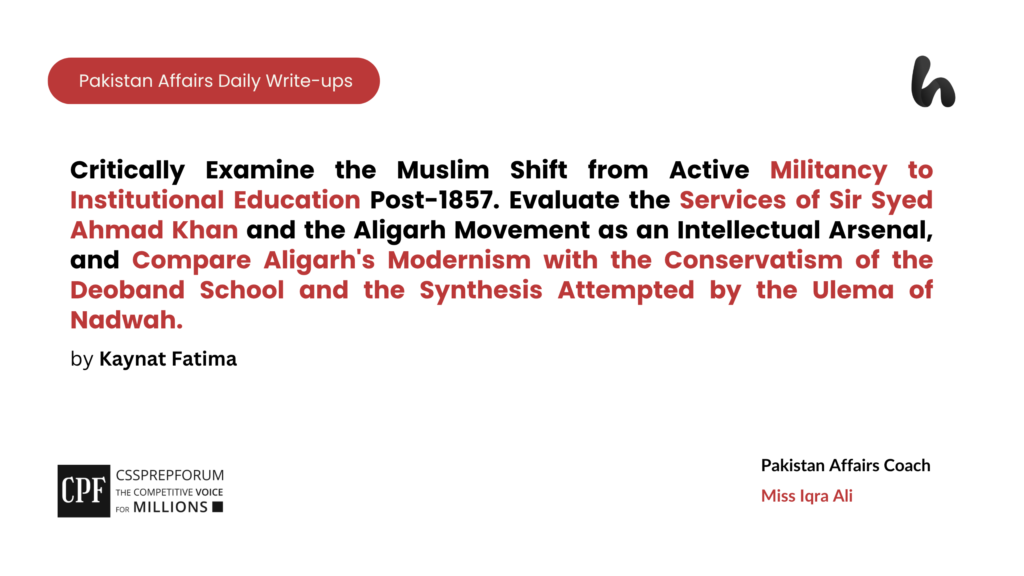
The following article examine the Muslim shift from militancy to education after 1857, Sir Syed’s reforms, the Aligarh Movement, Deoband conservatism, and Nadwah’s synthesis.

Introduction
The Revolt of 1857 marked a decisive turning point in the history of Indian Muslims. The failure of the uprising not only ended the remnants of Muslim political authority but also exposed the futility of armed resistance against an increasingly powerful colonial state. Consequently, Muslim intellectuals and reformers began reassessing traditional revival strategies and gradually shifted their focus from militancy to education, intellectual reform, and institution-building. This transformation gave rise to three major responses to colonial challenges: the modernist Aligarh Movement led by Sir Syed Ahmad Khan, the conservative religious revivalism of the Deoband School, and the reconciliatory approach of Nadwat-ul-Ulama. Thus, the post-1857 shift from militancy to education fundamentally transformed Muslim revival, with Aligarh promoting modernization, Deoband safeguarding orthodoxy, and Nadwah attempting to harmonize tradition with modernity.
Historical Background: Muslim Decline and the Legacy of Militancy
A- Decline of Muslim Political Authority
The decline of Muslim political authority in the Indian subcontinent was a gradual process that culminated in the aftermath of the Revolt of 1857. As the Mughal Empire weakened and British colonial power expanded, Muslims lost their dominant position in administration, politics, and military affairs. Consequently, a community that had once ruled large parts of South Asia found itself politically marginalized and economically vulnerable. The deposition of Emperor Bahadur Shah Zafar after the Revolt of 1857, which symbolized the formal end of Muslim political sovereignty in India. Thereafter, British policies further reduced Muslim influence, creating a sense of insecurity that compelled Muslim leaders to search for alternative strategies of survival and revival.
B- Tradition of Muslim Militancy before 1857
- Shah Waliullah’s Revivalist Thought
Before the shift toward educational reform, Muslim revival largely revolved around political and religious regeneration. In this regard, Shah Waliullah emerged as one of the most influential reformers of the eighteenth century. He believed that the decline of Muslims stemmed from moral decay, political disunity, and departure from Islamic principles. Therefore, he emphasized both spiritual purification and political revival as essential components of reform. His invitation to Ahmad Shah Abdali to counter Maratha expansion and restore Muslim political influence in northern India. Although his efforts did not permanently restore Muslim power, his ideas laid the intellectual foundations for later revivalist movements and inspired subsequent reformers seeking the regeneration of Muslim society.
- Jihad Movement of Syed Ahmad Barelvi
Building upon earlier revivalist ideas, Syed Ahmad Barelvi sought to restore Muslim strength through organized armed struggle. He believed that Islamic revival required not only spiritual reform but also political sovereignty under Islamic principles. Consequently, he mobilized followers and launched a movement aimed at establishing an Islamic order. A main point is the Battle of Balakot in 1831, where Syed Ahmad Barelvi and many of his companions were martyred, leading to the military collapse of the movement. Nevertheless, despite its failure, the movement demonstrated the determination of Muslims to resist perceived threats to their identity and served as an important precursor to later reform efforts in the subcontinent.
- Failure of Armed Resistance in 1857
The Revolt of 1857 proved to be the final major attempt by Muslims and other Indian groups to challenge British rule through armed resistance. Although the uprising initially achieved some successes, it ultimately failed because of poor coordination, limited resources, and the overwhelming military superiority of the British. The swift suppression of rebel centers by British forces, which demonstrated the futility of confronting a technologically advanced colonial power through conventional warfare. As a result, many Muslim intellectuals concluded that military resistance could no longer secure political or social advancement. Therefore, attention gradually shifted from the battlefield to educational institutions, where knowledge and intellectual development became the new instruments of empowerment.
Factors behind the Shift from Militancy to Institutional Education
- Political Realism after 1857
One of the most important factors behind the shift from militancy to education was the emergence of political realism among Muslim leaders. After witnessing the devastating consequences of the Revolt of 1857, many influential Muslims recognized that British rule was likely to remain a permanent feature of the political landscape. Consequently, they abandoned hopes of immediate political restoration through revolutionary means and sought more practical strategies for community survival and advancement. Educational reform emerged as the most effective alternative because it offered opportunities for social mobility, administrative participation, and intellectual empowerment. A relevant point is the changing attitude of Muslim elites, who increasingly abandoned revolutionary politics and encouraged younger generations to acquire a modern education. Thus, political realism transformed Muslim priorities and redirected their energies toward constructive engagement with the colonial system.
- Educational Backwardness of Muslims
Another major factor behind this transformation was the educational backwardness of Muslims in comparison with other communities. Many Muslims remained attached to traditional forms of learning and were reluctant to adopt the English education introduced by the British. As a result, they failed to acquire the qualifications necessary for employment in the colonial administration and modern professions. Furthermore, the replacement of Persian by English as the official language further disadvantaged Muslim communities. Consequently, Muslims became increasingly underrepresented in government services and administrative positions. A significant point is the low participation of Muslims in modern educational institutions, which restricts their access to emerging opportunities. Therefore, educational reform became essential for reversing this trend and restoring the socio-economic position of Muslims.
- Economic Decline
Economic decline also played a crucial role in encouraging Muslims to embrace institutional education. Following the establishment of British rule, many Muslim landowners, administrators, and military personnel lost their traditional sources of income and influence. The colonial economy increasingly rewarded individuals possessing modern education, technical expertise, and professional skills. However, a large segment of the Muslim aristocracy struggled to adapt to these changing economic realities. Consequently, poverty, unemployment, and social stagnation became widespread among Muslims. Therefore, education was increasingly viewed as a means of acquiring new skills, securing employment, and achieving economic advancement in a rapidly changing world.
- Rise of Western Knowledge and Scientific Progress
The growing importance of Western knowledge and scientific advancement further accelerated the shift toward educational reform. During the nineteenth century, scientific discoveries and technological innovations transformed European societies and significantly enhanced British administrative and military capabilities. Muslim reformers observed that the strength of Western nations was closely linked to their educational institutions, scientific research, and intellectual culture. Consequently, they concluded that Muslims could not regain their former status without embracing modern knowledge and scientific learning. A significant point is the effectiveness of British administration, which was largely based on modern education, technical expertise, and scientific methods. Therefore, the acquisition of Western knowledge came to be viewed not as a threat but as a necessity for progress and survival.
- Emergence of Reformist Leadership
Finally, the emergence of visionary reformist leaders played a decisive role in redirecting Muslim energies from confrontation to intellectual empowerment. These leaders recognized that the conditions of the nineteenth century required new strategies and new institutions. Among them, Sir Syed Ahmad Khan emerged as the most influential advocate of educational reform. He argued that Muslims must abandon futile political conflicts and instead focus on acquiring modern education, scientific knowledge, and administrative competence. A significant point is Sir Syed’s persistent campaign for educational advancement through speeches, writings, and institutions. Through his leadership, Muslim society gradually embraced the idea that books, schools, and intellectual development were more effective instruments of revival than military resistance.
Sir Syed Ahmad Khan: Architect of Muslim Intellectual Revival
Among all the Muslim reformers of the nineteenth century, Sir Syed Ahmad Khan occupies a unique position as the principal architect of Muslim intellectual revival in British India. He was not merely an educationist but also a reformer, administrator, writer, and visionary thinker who correctly diagnosed the causes of Muslim decline and proposed practical remedies. Unlike many of his contemporaries, Sir Syed realized that the political realities created by the Revolt of 1857 required a complete reassessment of Muslim priorities. Consequently, he urged Muslims to abandon confrontation and embrace modern education, scientific learning, and intellectual development. A significant point is his conduct during the Revolt of 1857, when he remained loyal to the British administration while simultaneously advocating reforms for Muslims. Therefore, his leadership marked the beginning of a new era in which educational advancement replaced militancy as the primary instrument of Muslim revival.
Services of Sir Syed Ahmad Khan
- Reconciliation between Muslims and the British
One of Sir Syed’s most important services was his effort to improve relations between Muslims and the British government after the Revolt of 1857. Since Muslims were widely blamed for the uprising, they faced suspicion, discrimination, and political marginalization. Recognizing the dangers of continued hostility, Sir Syed sought to dispel British misconceptions about Muslims and encouraged cooperation rather than confrontation. In this regard, his famous work Asbab-e-Baghawat-e-Hind (The Causes of the Indian Revolt) played a significant role. In this book, he objectively analyzed the causes of the rebellion and argued that British administrative mistakes had contributed to the uprising. Thus, instead of promoting resentment, he advocated dialogue and reform. Consequently, his efforts helped reduce tensions and created a more favorable environment for Muslim educational and social advancement.
- Promotion of Modern Education
Perhaps the greatest contribution of Sir Syed Ahmad Khan was his unwavering commitment to modern education. He firmly believed that the backwardness of Muslims stemmed largely from their reluctance to acquire English education and modern scientific knowledge. Therefore, he encouraged Muslims to learn Western sciences, English literature, mathematics, and contemporary disciplines that were essential for success under colonial rule. Moreover, he repeatedly emphasized that education was the only path through which Muslims could regain their lost prestige and compete effectively in the modern world. A notable point is his famous assertion that the future of Muslims depended upon education rather than political agitation. Consequently, his educational philosophy transformed Muslim attitudes toward modern learning and laid the foundation for a broad intellectual awakening.
- Establishment of the Scientific Society (1864)
In order to make modern knowledge accessible to Muslims, Sir Syed established the Scientific Society in 1864. The primary objective of this institution was to translate important Western works on science, history, economics, and technology into Urdu so that educated Muslims could benefit from contemporary intellectual developments. Furthermore, the society served as a bridge between Eastern and Western knowledge systems by introducing modern ideas in a language familiar to the Muslim community. A significant point is the translation of numerous scientific and educational texts that became available to Urdu-speaking readers for the first time. Consequently, the Scientific Society helped cultivate intellectual curiosity, encouraged scientific thinking, and prepared Muslims to engage with modern knowledge without abandoning their cultural identity.
- Foundation of the Aligarh Institution
Another landmark achievement of Sir Syed was the establishment of the Muhammadan Anglo-Oriental (MAO) School in 1875, which later developed into the Muhammadan Anglo-Oriental College. Inspired by the educational models of Oxford and Cambridge, the institution sought to combine modern Western education with Islamic moral values. Unlike traditional seminaries, it offered instruction in science, mathematics, history, political studies, and English alongside religious subjects. A notable point is the transformation of the MAO College into the nucleus of Muslim educational revival in India. Consequently, the institution produced generations of educated Muslims who played important roles in administration, politics, journalism, and social reform. Thus, the Aligarh institution became the most enduring symbol of Sir Syed’s educational mission.
- Literary and Intellectual Reform
Beyond educational institutions, Sir Syed also contributed significantly to literary and intellectual reform. Through his influential journal Tahzib-ul-Akhlaq, he sought to challenge social stagnation, intellectual conservatism, and outdated customs prevalent within Muslim society. Furthermore, he encouraged rational thinking, self-criticism, and constructive debate regarding social and educational issues. A significant point is the role of Tahzib-ul-Akhlaq in promoting discussions on social reform, women’s education, morality, and community development. Consequently, the journal became a platform for intellectual awakening and helped create a new generation of Muslims capable of critically examining their social conditions. Therefore, Sir Syed’s literary efforts complemented his educational reforms and broadened the scope of Muslim intellectual revival.
- Religious Reinterpretation
Another important aspect of Sir Syed’s reform agenda was his attempt to reinterpret Islamic teachings in the light of reason and scientific knowledge. He believed that Islam was a rational religion and that genuine scientific discoveries could never contradict divine revelation. Therefore, he advocated a modernist interpretation of religious texts that emphasized reason, inquiry, and intellectual flexibility. A notable point is his argument that reason and revelation originate from the same source and, therefore, cannot fundamentally contradict one another. Consequently, Sir Syed sought to remove the perceived conflict between Islam and modern science, thereby encouraging Muslims to embrace contemporary knowledge without compromising their faith. Although this approach attracted criticism from conservative scholars, it significantly influenced modern Islamic thought in South Asia.
- Political Awakening
Although Sir Syed initially discouraged active political participation, he nonetheless contributed to the political ideology of Indian Muslims. He argued that Muslims should first acquire education and social strength before entering politics because an uneducated community could not effectively protect its interests. Consequently, he emphasized educational preparation as a prerequisite for political advancement. A significant point is the later influence of his political philosophy on Muslim separatist consciousness and communal organization. While Sir Syed himself did not advocate a separate Muslim state, his emphasis on Muslim distinctiveness and collective interests eventually influenced the political thinking that led to the formation of the All-India Muslim League and, ultimately, the Pakistan Movement.
Aligarh Movement as an Intellectual Arsenal
The Aligarh Movement is often described as an intellectual arsenal because it replaced military resistance with intellectual empowerment as the primary instrument of Muslim revival. Following the failure of armed struggles and the disastrous consequences of the Revolt of 1857, Muslim leaders realized that swords could no longer secure political or social advancement. Consequently, books, educational institutions, scientific knowledge, and intellectual development became the new weapons of progress. A significant point is the emergence of educational institutions such as the MAO College, which became centers of learning, leadership development, and community reform. Therefore, the Aligarh Movement transformed the nature of Muslim resistance by shifting the focus from physical confrontation to intellectual competition and educational excellence.
Major Contributions of the Aligarh Movement
- Educational Renaissance
The Aligarh Movement initiated an educational renaissance among Indian Muslims by introducing modern subjects into the curriculum and encouraging the study of science, mathematics, history, and political science. Consequently, Muslim students acquired the knowledge and skills necessary to participate effectively in modern society. A notable point is the inclusion of modern academic disciplines that were previously neglected by traditional educational institutions.
- Development of Muslim Middle Class
Furthermore, the movement contributed to the emergence of a modern Muslim middle class. Graduates of Aligarh entered government service, law, journalism, education, and administration, thereby creating a new professional class capable of representing Muslim interests. Consequently, Muslims gradually regained socio-economic mobility and influence within colonial society.
- Revival of Muslim Confidence
The movement also restored confidence among Muslims who had been demoralized by political decline and colonial domination. Through educational success and intellectual achievement, Muslims began to believe once again in their ability to compete and progress. Thus, Aligarh revived the morale of a politically defeated community.
- Political Consciousness
In addition, the movement played a crucial role in developing political consciousness among Muslims. Many prominent Muslim political leaders received their education at Aligarh. A significant point is the role played by Aligarh alumni in the establishment of the All-India Muslim League in 1906.
- Promotion of Modern Scientific Temper
The movement promoted rational inquiry and scientific thinking by encouraging critical analysis and intellectual openness. Consequently, scientific temper became an important component of Muslim intellectual discourse and modernization efforts.
- Foundation for Muslim Nationalism
Finally, Aligarh laid the intellectual foundations of Muslim nationalism. Many leaders associated with the Pakistan Movement emerged from the Aligarh tradition. Therefore, the movement not only transformed education but also influenced the political destiny of South Asian Muslims.
Critical Evaluation of the Aligarh Movement
The Aligarh Movement was launched with the primary objective of uplifting the socio-economic, educational, and intellectual condition of Muslims in British India. Sir Syed Ahmad Khan realized that the decline of Muslims was largely due to their reluctance to embrace modern education and their growing distance from the changing political realities of the colonial era. Therefore, the movement sought to reconcile Muslims with the British government, promote Western sciences and English education, encourage rational thinking, and prepare Muslims for participation in modern professions and public life. Furthermore, it aimed to remove the sense of inferiority and despair that had engulfed the Muslim community after the Indian rebellion of 1857. In essence, the movement sought to transform Muslims into a modern, educated, and progressive community capable of competing with other groups while preserving its religious identity and cultural heritage.
The Aligarh Movement achieved remarkable success in transforming the intellectual landscape of Indian Muslims. First and foremost, it modernized Muslim education by introducing contemporary subjects such as science, mathematics, history, and political studies into the curriculum. Consequently, Muslims gradually overcame their educational backwardness and gained access to opportunities in government service and professional fields. Moreover, the movement produced a new generation of political leaders, intellectuals, journalists, and administrators who later guided Muslim political development. Another significant strength of the movement was its attempt to bridge Islam and modernity by demonstrating that Islamic teachings were compatible with reason, scientific inquiry, and progress. Furthermore, it revived socio-economic mobility by enabling educated Muslims to secure employment and improve their social status. As a result, the movement restored confidence to a politically marginalized community and laid the foundations for its intellectual and political resurgence.
Despite its achievements, the Aligarh Movement was not free from limitations and criticism. One of its most controversial aspects was its excessive pro-British orientation, as Sir Syed believed that cooperation with the colonial administration was essential for Muslim progress. Consequently, many critics accused the movement of compromising political independence in favor of accommodation. Furthermore, the movement largely benefited the urban and aristocratic segments of Muslim society and failed to penetrate deeply into rural areas and lower socio-economic classes. As a result, its educational benefits remained limited to a relatively small section of the population. Another major limitation was the strong opposition it faced from traditional religious scholars, who viewed Sir Syed’s rationalist interpretations as a threat to Islamic orthodoxy. Additionally, the movement’s emphasis on elite education sometimes overshadowed the broader educational needs of the Muslim masses. Therefore, while Aligarh was transformative, its impact was neither universal nor uncontested.
Deoband School: Conservative Religious Revivalism
While the Aligarh Movement pursued modernization through Western education, another influential response to the post-1857 crisis emerged in the form of the Deoband School. Established in 1866 through the foundation of Dar-ul-Uloom Deoband, the movement arose from the conviction that Muslim decline was primarily the result of religious and moral degeneration rather than educational backwardness. Consequently, its founders sought to preserve Islamic teachings and protect Muslim identity from the cultural and intellectual influences of colonial rule. Unlike Aligarh, which encouraged engagement with Western knowledge, Deoband emphasized the revival of traditional Islamic scholarship and the preservation of religious values. Therefore, the institution became a center of conservative religious revivalism and played a crucial role in safeguarding Islamic learning during a period of profound political and cultural change.
The Deoband School was established with the primary objective of preserving Islamic identity in an environment increasingly influenced by Western culture and colonial institutions. Its founders believed that the survival of Muslim society depended upon maintaining a strong connection with authentic Islamic teachings and classical scholarship. Therefore, they sought to resist cultural Westernization and prevent the erosion of religious values. Additionally, the institution aimed to revive traditional Islamic scholarship by producing scholars well-versed in Quranic studies, Hadith, Islamic jurisprudence, and classical Arabic literature. Unlike Aligarh, which emphasized adaptation to modernity, Deoband focused on religious preservation and moral reform. Thus, its educational philosophy reflected a commitment to continuity, orthodoxy, and the protection of Islamic civilization from external influences.
Despite its conservative orientation, the Deoband School made significant contributions to Muslim society in South Asia. One of its most important achievements was the establishment of a vast network of madrassas that spread throughout India and later across the Muslim world. Through these institutions, religious education remained accessible even under colonial domination. Furthermore, Deoband played a vital role in preserving Islamic scholarship, ensuring that traditional religious sciences continued to flourish despite rapid social and political change. The movement also helped maintain a strong sense of Islamic identity among Muslims at a time when many feared cultural assimilation and moral decline. Consequently, Deoband became one of the most influential centers of Islamic learning and produced generations of scholars who contributed to religious education, jurisprudence, and spiritual guidance across South Asia and beyond.
Nadwat-ul-Ulama: The Search for Synthesis
The establishment of Nadwat-ul-Ulama in 1894 represented an attempt to bridge the growing divide between the modernist approach of Aligarh and the traditionalist outlook of Deoband. Its founders believed that Muslim revival required a balanced approach that combined the strengths of both movements while avoiding their extremes. Therefore, the institution sought to promote reconciliation between Aligarh and Deoband, introduce educational reforms, and strengthen Muslim unity. Unlike Aligarh, it did not fully embrace Western educational models, and unlike Deoband, it did not reject modern knowledge altogether. Instead, it aimed to create scholars who were firmly rooted in Islamic tradition while remaining aware of contemporary intellectual developments. Thus, Nadwah emerged as a movement dedicated to synthesis, moderation, and intellectual balance.
Nadwat-ul-Ulama made valuable contributions to Muslim intellectual and educational development by promoting a curriculum that combined classical Islamic learning with selected modern subjects. One of its most distinguished achievements was the emergence of Shibli Nomani, who became one of the leading Muslim scholars and historians of his era. Through his writings and scholarship, Shibli demonstrated the possibility of harmonizing traditional Islamic knowledge with modern historical and literary methods. Furthermore, Nadwah played a significant role in reviving the Arabic language and literature, thereby strengthening connections with the broader Muslim world. Its graduates possessed familiarity with both classical and contemporary knowledge, enabling them to engage effectively with modern intellectual challenges while remaining grounded in Islamic tradition. Consequently, Nadwah contributed to the development of a more balanced and intellectually versatile Muslim scholarship.
Despite its noble objectives and valuable contributions, Nadwat-ul-Ulama faced several limitations that restricted its overall influence. Unlike Aligarh, it never achieved a comparable level of political impact or produced a large class of modern political leaders. Similarly, it lacked the extensive institutional network and mass religious influence enjoyed by Deoband. Furthermore, because it attempted to reconcile two opposing intellectual traditions, it often found itself caught between modernists and traditionalists. Modernists considered it insufficiently progressive, whereas conservatives viewed some of its reforms with suspicion. Consequently, Nadwah struggled to establish a distinct identity capable of attracting broad support from either camp. Therefore, although it succeeded in promoting intellectual synthesis and moderation, its influence remained more limited than that of Aligarh and Deoband.
Comparative Analysis: Aligarh, Deoband, and Nadwah
- Difference in Vision
Although the Aligarh Movement, Deoband School, and Nadwat-ul-Ulama emerged in response to the same post-1857 Muslim crisis, they differed significantly in their vision of Muslim revival. The Aligarh Movement, led by Sir Syed Ahmad Khan, advocated modernization and adaptation to the changing realities of colonial India. Its supporters believed that Muslims could regain their lost status only by embracing modern education, scientific knowledge, and contemporary intellectual developments. A notable point was the introduction of Western sciences and English education into Muslim institutions, which reflected Aligarh’s commitment to modernization. In contrast, the Deoband School adopted a vision centered on preservation and protection. Its founders believed that Muslim decline resulted from religious and moral degeneration rather than educational backwardness. Therefore, they focused on safeguarding Islamic teachings through traditional scholarship and religious education. Meanwhile, Nadwat-ul-Ulama pursued a middle path by advocating reconciliation and synthesis between modernity and tradition. Rather than choosing between Aligarh and Deoband, Nadwah attempted to integrate religious and modern studies, thereby creating a balanced framework for Muslim revival. Thus, while Aligarh looked forward to adaptation, Deoband looked inward toward preservation, and Nadwah sought harmony between the two approaches.
- Difference in Attitude toward the West
Another important distinction among these movements was their attitude toward Western civilization and colonial influence. The Aligarh Movement adopted a policy of selective acceptance and cooperation. Sir Syed believed that Western education, scientific progress, and administrative methods had contributed significantly to British success and that Muslims could benefit from these achievements without abandoning their religious identity. Consequently, he encouraged engagement with Western knowledge and institutions. A significant point was the adoption of the Oxford-Cambridge educational model for the Muhammadan Anglo-Oriental College, which reflected Aligarh’s openness to Western educational practices. On the other hand, the Deoband School viewed Western influence with considerable skepticism and cultural resistance. Its scholars feared that excessive engagement with Western ideas could weaken Islamic values and undermine Muslim identity. Therefore, they rejected Western cultural influences and focused on preserving traditional Islamic learning. In contrast, Nadwat-ul-Ulama adopted a balanced approach. While it did not reject modern knowledge outright, it also refused to embrace Westernization uncritically. Instead, it accepted useful aspects of modern education while resisting cultural assimilation. Thus, Aligarh promoted cooperation, Deoband emphasized resistance, and Nadwah advocated cautious engagement.
- Difference in Educational Philosophy
The educational philosophies of Aligarh, Deoband, and Nadwah further illustrate their differing approaches to Muslim revival. Aligarh embraced the modern university model, emphasizing contemporary disciplines such as science, mathematics, history, political science, and English literature alongside religious instruction. The curriculum of the Muhammadan Anglo-Oriental College serves as a significant point because it was specifically designed to prepare Muslims for participation in modern professions and public life. In contrast, Deoband followed the traditional madrassa model, which focused primarily on Islamic sciences, including Quranic studies, Hadith, jurisprudence, Arabic grammar, and theology. The Dars-i-Nizami curriculum, which formed the backbone of Deobandi education, reflected the institution’s commitment to preserving classical Islamic scholarship. Meanwhile, Nadwat-ul-Ulama adopted a hybrid educational model that sought to combine the strengths of both approaches. Its curriculum integrated classical religious subjects with selected modern disciplines, enabling students to acquire familiarity with both Islamic traditions and contemporary intellectual trends. Therefore, while Aligarh emphasized modernization, Deoband prioritized tradition, and Nadwah attempted to blend the two into a coherent educational framework.
- Difference in Historical Legacy
The long-term historical legacy of these movements also highlights their distinct contributions to Muslim society. The Aligarh Movement left a profound political legacy by shaping Muslim leadership and fostering political consciousness among educated Muslims. Its graduates played important roles in public life, and many later emerged as leading figures in the Pakistan Movement. A notable point is the fact that the intellectual foundations of Muslim nationalism and the demand for a separate homeland were significantly influenced by the Aligarh tradition. In contrast, the Deoband School’s greatest legacy lies in the preservation and expansion of Islamic scholarship. Through its extensive network of seminaries, it successfully safeguarded religious education and ensured the continuity of traditional Islamic learning. A significant point is the worldwide expansion of Deobandi seminaries, which continue to influence Islamic education across many countries. Meanwhile, Nadwat-ul-Ulama left a different but equally important legacy by bridging the gap between traditional and modern scholarship. Its graduates and scholars demonstrated that it was possible to engage with contemporary intellectual challenges while remaining firmly rooted in Islamic traditions. The emergence of scholars such as Shibli Nomani serves as because they successfully combined classical scholarship with modern intellectual inquiry. Therefore, Aligarh’s legacy was primarily political and educational, Deoband’s was religious and scholarly, while Nadwah’s was intellectual and reconciliatory.
Comparative Assessment
A critical comparison of Aligarh, Deoband, and Nadwah reveals that these movements were not mutually exclusive but rather represented different responses to the same historical challenge. Aligarh focused on empowering Muslims through modern education and intellectual adaptation; Deoband concentrated on preserving Islamic identity through traditional scholarship; and Nadwah attempted to reconcile the strengths of both approaches. While Aligarh produced modern political leadership and facilitated socio-economic advancement, Deoband ensured the survival of Islamic learning and religious consciousness. Similarly, Nadwah contributed by promoting intellectual balance and reducing the divide between modernists and traditionalists. Consequently, each movement addressed a different dimension of Muslim decline and collectively contributed to the educational, religious, intellectual, and political revival of Muslims in South Asia.
Critical Analysis
The post-1857 Muslim response was not a simple abandonment of militancy but a strategic adaptation to changing realities. The Aligarh Movement correctly recognized that education had become the principal source of power in the modern world and successfully equipped Muslims with the intellectual tools necessary for advancement. However, its elitist character and pro-British orientation limited its reach. Deoband, despite its resistance to Westernization, played an indispensable role in preserving Islamic identity and religious scholarship during a period of cultural upheaval. Meanwhile, Nadwat-ul-Ulama offered a more balanced vision by attempting to harmonize tradition and modernity, though it lacked the institutional influence of its counterparts. Collectively, these movements represented complementary rather than contradictory responses to the challenges of colonialism.
Conclusion
The post-1857 period marked a strategic transformation in Muslim thought from militancy to intellectual and educational activism. The failure of armed resistance convinced Muslim leaders that revival could only be achieved through knowledge, reform, and institution-building. Sir Syed Ahmad Khan and the Aligarh Movement emerged as the principal architects of this transition by creating an intellectual arsenal rooted in modern education and scientific learning. At the same time, Deoband safeguarded Islamic orthodoxy and religious identity, while Nadwat-ul-Ulama attempted to harmonize tradition with modernity. Together, these movements constituted diverse yet complementary responses to colonial challenges and laid the foundations of Muslim educational, religious, intellectual, and political revival in South Asia.

Important Note for CSS and PMS Aspirants
For aspirants preparing for competitive examinations, exploring solved past papers is essential to understand examiner expectations, analytical answer writing, and paper trends. Therefore, candidates are strongly encouraged to read the following comprehensive solved papers available on CSSPREPFORUM.
- CSS Solved Pakistan Affairs Past Papers
- CSS Solved Current Affairs Past Papers
- CSS Solved Islamiat Past Papers
- CSS Solved General Science and Ability Past Papers
Moreover, aspirants searching for the most credible and result-oriented teachers for CSS and PMS preparation can benefit from the following detailed guidance articles
- Who is the Best CSS PMS Islamiat Teacher in Pakistan?
- Who is the Best CSS PMS Pakistan Affairs Teacher in Pakistan?
- Who is the Best CSS Current Affairs Teacher in Pakistan?
- Who is the Best CSS GSA Teacher in Pakistan?
- Who is the Best CSS PMS English Essay and Precis Teacher in Pakistan?
- Who is the Best English Grammar Teacher in Pakistan?