CSS/PMS Islamiat | Morality as the Structural Foundation of Islamic Civilization
The Core Matrix: Morality as the Structural Foundation of Islamic Civilization argues that morality (akhlaq) is the foundation of Islamic civilization, shaping its institutions, society, and individual conduct. It is a key concept in CSS/PMS Islamiat.

Introduction
The concept of morality in Islam represents the structural core of the Islamic civilizational project, functioning as an indispensable pillar of its legal, socio-political, and metaphysical architectures. Far from being a contemporary secondary attachment or a fluid cultural byproduct, morality (Akhlaq) is the very essence of the Islamic message. It provides an unyielding ethical matrix designed to navigate the turbulent waters of a hyper-globalized, normative relativistic world.
The Concept of Morality in Islam: An Objective Paradigm
In the contemporary global landscape, ethical systems are routinely anchored upon the shifting sands of utilitarianism, secular humanism, or shifting societal consensus. Under these fluid frameworks, right and wrong are transactional, frequently redefined to serve tactical geopolitical maneuvers, corporate profitability, or electoral convenience. Islam completely rejects this normative volatility, introducing a highly sophisticated, objective moral paradigm.
The concept of morality in Islam is not an abstract, fluid philosophy; it is a divine, structural mandate explicitly codified through the twin primary sources of Islamic epistemology: the Quran (the verbatim word of God) and the Sunnah (the living, practical model of the Prophet Muhammad, peace be upon him). Taken together, they establish an unyielding ethical architecture that governs the human consciousness and dictates the behavior of functional, just societies.
The Quranic Architecture of Morality
The Quran approaches morality (Akhlaq) not as a peripheral lifestyle choice, but as the primary purpose behind the deployment of divine law (Shariah). It establishes an objective moral framework where right and wrong are absolute, cosmic realities, completely insulated from the volatile swings of public opinion, cultural bias, or geopolitical convenience.
The Divine Blueprint: Adl and Ihsan
The macro-governance of Quranic ethics is anchored upon a dual-track behavioral mandate that balances rigid legal equity with transcendent moral grace:
“Indeed, Allah commands justice (Adl) and excellence (Ihsan) and giving to relatives and forbids immorality, wrongdoing, and oppression.” — (Surah An-Nahl 16:90)
- Justice (Adl): This is the non-negotiable legal baseline. It demands absolute equity in the public sphere, judicial systems, and economic transactions, completely independent of a person’s race, status, or national alignment.
- Excellence (Ihsan): This is the higher, spiritual tier of morality. It challenges the believer to move beyond mere legalism, prompting individuals to voluntarily surrender their own legal rights for the sake of mercy, forgiveness, cross-border humanitarianism, and systemic societal healing.
Radical, Universal Equity
In a contemporary global landscape frequently compromised by selective morality and double standards, the Quran establishes an uncompromising baseline for objective justice, demanding accountability even if it directly conflicts with one’s strategic self-interest:
“O you who believe! Stand firmly for justice, as witnesses for Allah, even if it is against yourselves or your parents and relatives. Whether one is rich or poor, Allah is more worthy of both.”— (Surah An-Nisa 4:135)
The Sunnah as the Living Manifestation of Ethics
If the Quran provides the structural blueprints for human morality, the Sunnah of the Prophet (peace be upon him) serves as its living, empirical validation. The Sunnah translates metaphysical concepts into a tangible, actionable socio-political reality.
The Ultimate Mission Statement
The absolute centrality of character building within the prophetic project was explicitly articulated by the Prophet (peace be upon him) in a definitive manifesto that defines his entire civilizational legacy:
“I was sent only to perfect noble character.” — (Musnad Ahmad)
By encapsulating an expansive prophetic mission, spanning statecraft, military strategy, judicial arbitration, and macroeconomics, under the singular banner of character perfection, Islam demonstrates that all state and religious institutions are downstream from individual moral transformation.
The Operational Definition of Iman (Faith)
The Sunnah systematically rejects the separation of inward belief from outward, civic morality. It continuously employs operational definitions that tie the validity of a person’s faith directly to their social and ethical conduct.
The Prophet (peace be upon him) famously observed:
“The most perfect of believers in faith is the one who is best in character.” — (Jami’ al-Tirmidhi)
In another sharp warning aimed directly at public leadership and regular citizens alike, he declared, “By Allah, he does not believe! He whose neighbor is not safe from his harmful conduct” (Sahih al-Bukhari). Consequently, a theological claim to faith remains structurally invalid if it fails to manifest as ethical integrity within the public domain.

The Unyielding Anchor: Transcendent Accountability
The defining strength of morality according to the Quran and Sunnah is its enforcement mechanism. Unlike secular ethical models that rely on fluid legal codes or the temporary threat of state penalty, which powerful actors can easily evade, Islamic morality is permanently anchored to the certainty of metaphysical accountability in the Hereafter (Akhirah).
The divine text warns and reassures humanity of a microscopic cosmic balance sheet:
“Whoever does an atom’s weight of good shall see it, and whoever does an atom’s weight of evil shall see it.” — (Surah Az-Zalzalah 99:7–8)
This profound awareness of ultimate judgment completely re-engineers human behavior. It ensures that an individual’s or a state’s commitment to truthfulness, human dignity, and financial honesty is independent of immediate material utility, political survival, or legal loopholes. Ultimately, the Quran and Sunnah offer global civilization an enduring, unshakeable compass designed to steer humanity away from materialist nihilism toward structural justice and sustainable peace.
The Dual Dimensions: Khuluq and Khalq
Classical Islamic thinkers, including Imam al-Ghazali, systematically bifurcated the human construct into two dimensions: Khalq (the physical creation or outward form) and Khuluq (the spiritual character or inward form). Just as the physical body possesses distinct, identifiable features, the human soul possesses an internal architecture.
A deeply ingrained state of the soul (Malakah) from which actions flow spontaneously and effortlessly, without requiring prolonged intellectual deliberation or conscious hesitation.
The Immutable Baseline
In the Islamic paradigm, morality is objective because it is anchored in the immutable wisdom of the Divine. Honesty, institutional transparency, structural compassion, and the protection of the vulnerable are not virtues because they happen to align with a particular era’s social contract; they are absolute, universal imperatives. This objective reality ensures that human dignity cannot be negotiated away at the altar of political convenience or national security doctrines.
The Strategic Relationship Between Morality and Faith
Within the architecture of Islamic epistemology, faith (Iman) and morality (Akhlaq) do not exist in separate, insulated compartments. They are locked in a symbiotic, structurally inseparable relationship. Morality is the empirical validation of internal theology; it is faith in action.
The Prophetic Blueprint
This profound convergence was explicitly articulated by the Prophet (peace be upon him) in a statement that serves as the definitive manifesto of his mission:
“I was sent only to perfect noble character.” — (Musnad Ahmad)
By defining the entirety of an expansive civilizational mission through the single lens of character perfection, Islam establishes that legal codes and ritualistic devotions are downstream from moral transformation.
The Empirical Measure of Iman
The text of the Hadith literature routinely employs operational definitions that link the validity of a person’s faith directly to their socioeconomic and ethical conduct. The Prophet (peace be upon him) famously observed:
“The most perfect of believers in faith is the one who is best in character.”
— (Jami’ al-Tirmidhi)
In another stark warning to public leadership and citizens alike, he declared: “By Allah, he does not believe! He whose neighbor is not safe from his harmful conduct” (Sahih al-Bukhari). Consequently, in the Islamic paradigm, a theological claim to faith remains structurally deficient if it does not manifest as ethical integrity within the public sphere. Rituals devoid of moral output mutate into hollow, performative acts.

The Structural Foundations of Islamic Morality
To translate these transcendent concepts into a tangible socio-political reality, Islamic morality operates across several core foundational pillars, creating a balanced equilibrium between individual rights and collective societal obligations.
The Intersect of Justice (Adl) and Excellence (Ihsan)
The macro-governance of Islamic ethics is anchored upon a dual-track mandate codified in the divine text:
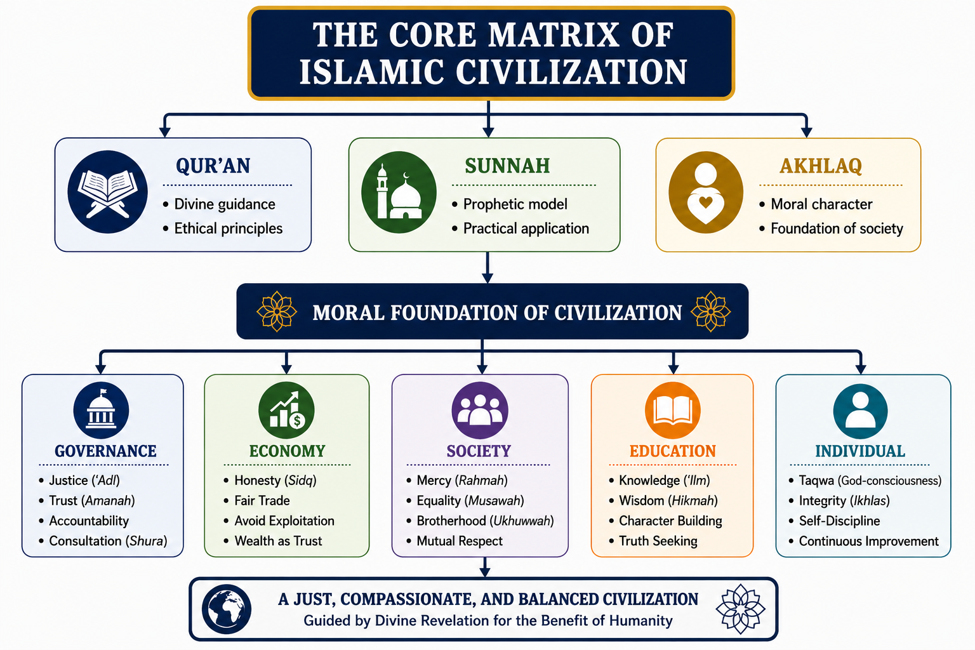
The state must enforce Adl as a baseline, ensuring that no individual’s life, property, or honor is compromised for partisan interests. However, revelation challenges the human consciousness to ascend to Ihsan—where individuals voluntarily surrender their own legal rights to foster societal harmony, cross-border humanitarianism, and systemic reconciliation.
Authority as a Sacred Public Trust (Amanah)
From a political and administrative perspective, public office and institutional authority are never viewed as privileges for self-aggrandizement or political patronage. They are codified as an Amanah, a heavy, metaphysical trust for which leaders will be rigorously cross-examined. This institutional accountability ensures that transparency and honesty are treated as supreme spiritual devotions, forming a powerful shield against public sector corruption and executive overreach.
Metaphysical Accountability: The Ultimate Ethical Stabilizer
A recurring vulnerability of secular ethical models is their reliance on immediate worldly sanctions or fluid legal mechanisms to compel moral behavior. When the threat of legal penalty is removed, or when individual actors possess the systemic power to evade the law, secular ethics frequently collapse into predatory behavior, as seen in global corporate fraud and unilateral geopolitical actions.
Islam bridges this enforcement gap by grounding human behavior in the absolute certainty of metaphysical accountability in the Hereafter (Akhirah). The divine text establishes an unyielding cosmic balance sheet:
“Whoever does an atom’s weight of good shall see it, and whoever does an atom’s weight of evil shall see it.” — (Surah Az-Zalzalah 99:7–8)
This constant awareness of a transcendent, ultimate judgment completely reshapes the calculation of human action. It means that an individual’s commitment to truthfulness, human dignity, and equity is independent of immediate material utility or political survival.
Ultimately, Islamic morality emerges not merely as a collection of personal virtues, but as an indispensable, enduring compass designed to guide contemporary global society away from the abyss of materialist nihilism, steering humanity toward a future anchored in structural justice, systemic compassion, and everlasting salvation.
Critical Analysis: The Structural and Operational Complexities of Islamic Morality
While the foundational text establishes an absolute, objective moral matrix, a critical academic analysis must evaluate the structural challenges, historical execution, and contemporary application of this paradigm within a hyper-globalized landscape. The intersection of divine epistemology and human agency creates dynamic points of friction that shape civilizational progress.
The Paradox of Objectivity vs. Subjective Hermeneutics
The text posits that Islamic morality introduces an unyielding ethical anchor insulated from the fluid variations of moral relativism. However, a critical point of friction arises in the human translation of divine intent. While the foundational values, such as justice (Adl), honesty, and human dignity, are absolute and immutable (Usul), their interpretive execution (Furu) relies on human legal reasoning (Ijtihad).
Throughout Islamic history, different legal schools (Madhahib) and theological movements have contested the boundaries of specific ethical applications. For instance, classical debates between the Ash’arites and the Mu’tazilites centered precisely on whether good and evil are intrinsically knowable by human reason (Aql) or entirely dependent on divine revelation (Nass). Therefore, while the source material is structurally objective, its practical manifestation inevitably introduces a level of interpretative fluidity that requires constant academic rigor to prevent stagnation.
2. The Implementation Gap: Theoretical Perfection vs. Historical Realities
There is a clear distinction between the ideal moral architecture defined by the Quran and Sunnah and the historical realities of Muslim polities. While revelation structures state authority as a sacred public trust (Amanah) and demands radical equality before the law, dynastic successions, political elite overreach, and institutionalized socio-economic stratification have periodically compromised these ideals across various eras.
The structural beauty of the paradigm lies in its built-in self-correcting mechanism. When moral decay occurs within the public or private sphere, the solution is not found in abandoning the core framework, but in holding institutional actors accountable to the original text. This creates a perpetual cycle of internal reform (Tajdid), demonstrating that the moral matrix functions as an active judge of historical behavior rather than a passive justification for state actions.
The Contemporary Challenge of Transcendent Enforcement in a Secular World
The operational core of Islamic morality relies heavily on the concept of metaphysical accountability (Akhirah). While this internal spiritual monitor creates a highly effective self-regulating citizen, modern global governance is built upon materialist, secular, and technocratic frameworks.
In a globalized market economy driven by hyper-consumerism and transaction-based values, maintaining an internal ethical anchor poses significant psychological friction for contemporary citizens. For the Islamic civilizational project to remain viable, its moral principles cannot merely rely on individual piety. They must be translated into modern institutional mechanisms, such as transparent financial systems, robust corporate ethics, and law-based human rights frameworks, that channel the spirit of Adl and Ihsan into functional public structures.
Conclusion
The exploration of “The Core Matrix: Morality as the Structural Foundation of Islamic Civilization” establishes that ethics within the Islamic model is not a separate philosophical luxury, but the vital lifespring of its entire civilizational apparatus. By locking faith (Iman) and action (Akhlaq) into an inseparable, symbiotic relationship, the paradigm effectively ensures that theological belief must validate itself through public integrity and societal welfare. In an international landscape deeply challenged by the fragmentation of objective truth, widespread moral relativism, and systemic institutional decay, the ethical architecture of the Quran and Sunnah offers a highly resilient baseline. It seamlessly bridges the artificial divide between legal formalism and spiritual grace through its dual-track mechanism of Adl and Ihsan.
Ultimately, Islamic morality provides a sophisticated, timeless blueprint for human organization. By anchoring human conduct to a transcendent, cosmic balance sheet, it liberates the individual from the shifting currents of utilitarianism and ideological extremism. It demonstrates that true civilizational advancement is fundamentally downstream from moral transformation, remaining an indispensable, eternal compass for achieving systemic stability in this world and everlasting salvation in the Hereafter.
Important Note for CSS and PMS Aspirants
For aspirants preparing for competitive examinations, exploring solved past papers is essential to understand examiner expectations, analytical answer writing, and paper trends. Therefore, candidates are strongly encouraged to read the following comprehensive solved papers available on CSSPREPFORUM.
- CSS Solved Pakistan Affairs Past Papers
- CSS Solved Current Affairs Past Papers
- CSS Solved Islamiat Past Papers
- CSS Solved General Science and Ability Past Papers
Moreover, aspirants searching for the most credible and result-oriented teachers for CSS and PMS preparation can benefit from the following detailed guidance articles
- Who is the Best CSS PMS Islamiat Teacher in Pakistan?
- Who is the Best CSS PMS Pakistan Affairs Teacher in Pakistan?
- Who is the Best CSS Current Affairs Teacher in Pakistan?
- Who is the Best CSS GSA Teacher in Pakistan?
- Who is the Best CSS PMS English Essay and Precis Teacher in Pakistan?
- Who is the Best English Grammar Teacher in Pakistan?