CSS Pakistan Affairs | Analysis of the Deoband School for Religio-Political Goals
Darul Uloom Deoband combined strict Islamic orthodoxy with anti-colonial resistance following the 1857 uprising. However, its uncompromising theology ultimately restricted its political footprint to seminary networks and rural clerics.

Introduction
Some religious movements in South Asian history illustrate the tension between ideological clarity and political reach as sharply as the Deoband School. Founded in 1867, at Darul Uloom Deoband in the aftermath of the failed War of Independence of 1857, the movement articulated a remarkably coherent set of religious and political objectives: the preservation of Islamic orthodoxy under colonial rule, resistance to British political domination, and, later, an unambiguous stance on the question of Muslim nationhood in India. Yet despite this clarity of purpose, Deoband’s actual sphere of influence remained circumscribed; confined largely to a network of seminary-trained ulema, a rural and semi-urban clerical constituency, and a theological framework that resisted broader coalition-building.
Genesis of Deoband: Trauma of 1857 and Retreat into Institution-Building
The founding of Darul Uloom Deoband by Maulana Muhammad Qasim Nanautavi and Maulana Rashid Ahmad Gangohi cannot be separated from the collective trauma of 1857. The brutal suppression of the uprising, the destruction of Delhi’s Mughal court culture, and the systematic marginalization of the ulema from formal political power convinced the founders that confrontation with British authority was, for the moment, untenable. Their response was strategic redirection rather than resignation; instead of armed resistance, they invested in building an institution that could preserve Islamic learning, produce a trained clerical class, and sustain religious authority independent of state patronage. This was itself a political choice, since it rejected both collaboration with colonial educational reform (as pursued by Sir Syed Ahmad Khan’s Aligarh movement) and quietist withdrawal from public life. Deoband’s founders understood that religious authority, once institutionalized through a self-sustaining seminary system funded by public donation rather than government grant, could become a durable base for future political assertion. This decision to build first and mobilize later gave Deoband a long institutional horizon, but it also meant that its political engagement would always be mediated through a specifically clerical and doctrinal lens rather than a mass electoral or populist one.
Definite Religious Goals: Purification, Standardization, and Institutional Reproduction
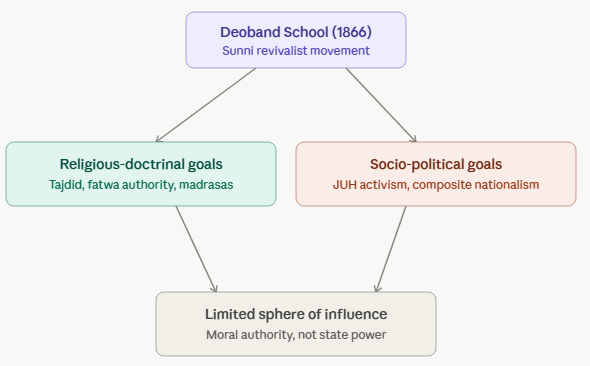
At the doctrinal level, Deoband’s goals were unambiguous. Drawing on the intellectual legacy of Shah Waliullah Dehlawi, the school sought to purify Muslim religious practice of what it regarded as un-Islamic accretions, standardize the teaching of Hanafi jurisprudence, and train a cadre of ulema capable of issuing authoritative rulings independent of colonial or Sufi shrine-based structures of authority. This placed Deoband in direct theological competition with the Barelvi movement, which defended customary devotional practices, shrine veneration, and a more syncretic religious culture rooted in popular Sufism. The Deobandi syllabus, structured around the Dars-i-Nizami with an emphasis on hadith scholarship, aimed to produce scholars who were doctrinally rigorous and socially disciplined; agents of reform who could reproduce the movement’s worldview across successive generations through an expanding network of affiliated madrasas. This religious program was successful on its own terms: by the early twentieth century, Deobandi-trained ulema staffed seminaries across northern India, and the school’s fatwa literature carried significant authority among a defined constituency. However, this same rigor limited Deoband’s appeal precisely because it required doctrinal conformity; it could not easily absorb the religiously plural, devotionally eclectic populations that constituted the majority of South Asian Muslims, many of whom remained loyal to Barelvi or other Sufi-oriented traditions.
Definite Political Goals: Anti-Colonialism, Composite Nationalism, and Pan-Islamism
- The Reshmi Romaal Movement (Also known as Silk Letter Movement)
Deoband’s political ambitions found their earliest concrete expression in the Silk Romaal Movement (Tehrik-i-Reshmi Rumal) of 1913-1920, orchestrated by Maulana Mahmud-ul-Hasan. This was an attempt to organize a transnational anti-British alliance involving the Ottoman Empire and Afghanistan, using correspondence smuggled on silk cloth to coordinate an uprising against colonial rule. Though the plot was ultimately exposed and its leaders imprisoned in Malta, it demonstrates that Deoband’s political goals were neither vague nor merely rhetorical; they extended to concrete, if ultimately unsuccessful, strategies for ending British rule through pan-Islamic solidarity.
- The Jamiat Ulema-e-Hind and Composite Nationalism
The more enduring political vehicle for Deobandi politics was the Jamiat Ulema-e-Hind (JUH), founded in 1919. Under the leadership of figures such as Maulana Husain Ahmad Madani, the JUH articulated a doctrine of “composite nationalism” (muttahida qaumiyat), arguing that Muslims and Hindus could constitute a single Indian nation (qaum) based on shared territory and citizenship, while remaining distinct religious communities (millat). This theological position, grounded in a reading of the Constitution of Medina and early Islamic precedent, allowed the JUH to ally closely with the Indian National Congress and to support the united, undivided nationalist struggle against British colonialism. This was a bold and definite political stance; it was not political ambivalence but a considered doctrinal argument deployed for a specific political end: opposing the fragmentation of the anti-colonial
movement along communal lines.
- Opposition to the Two-Nation Theory
Deoband’s most consequential and controversial political position was its rejection of the Muslim League’s Two-Nation Theory. While the League, under Muhammad Ali Jinnah, argued that Muslims constituted a separate nation requiring a separate state, the dominant Deobandi position, articulated forcefully by Madani, held that nationhood was determined by homeland and shared citizenship rather than religious identity alone. This placed the mainstream Deobandi establishment in direct opposition to the Pakistan Movement, a position that would have lasting consequences for the school’s political standing in the post-1947 landscape, particularly within Pakistan itself, where the founding movement had been actively contested by Deoband’s most prominent political wing.
The Limited Sphere of Influence: Structural and Ideological Constraints
- Confinement to a Particular Theological-Sectarian Identity
Deoband’s political program was inseparable from its sectarian identity. Its opposition to Barelvi devotional practice, its distinct legal methodology, and its specific institutional lineage meant that its authority was recognized primarily within its own doctrinal camp. Muslims who identified with Barelvi, Shia, Ahl-e-Hadith, or various Sufi orders did not accept Deobandi religious authority, and this fragmentation of religious loyalty translated directly into a fragmentation of political mobilization capacity. A movement whose legitimacy rested on doctrinal exclusivity could not easily construct the broad-based coalition that mass nationalist politics required.
- A Rural, Seminary-Based Constituency
Deoband’s institutional base was concentrated in madrasas, largely serving rural and small-town populations across the United Provinces, Punjab, and the North-West Frontier. This stood in contrast to the urban, English-educated professional and landed elite that dominated the Muslim League’s leadership and formed the backbone of the Pakistan Movement’s organizational machinery. The League’s leadership, lawyers, provincial politicians, and urban notables had access to modern political organization, print media, and provincial legislative platforms in a way that the clerical establishment, oriented toward seminary pedagogy rather than electoral mobilization, generally did not replicate at comparable scale. Deobandi influence was real and durable within its own institutional networks, but it rarely translated into the electoral or organizational capacity needed to shape provincial or all-India political outcomes decisively.
- Marginalization Within the Dominant Nationalist Narrative
Because the mainstream JUH position opposed Partition, Deoband’s political legacy became complicated after 1947. In independent India, the JUH’s composite nationalism found continued relevance, but in Pakistan, the new state’s founding narrative privileged the Muslim League and the Two-Nation Theory, sidelining the historical role of anti-Partition ulema. A minority faction, the Jamiat Ulema-e-Islam (JUI), did support the Pakistan Movement and later became politically active within Pakistan, but this represented a break from, rather than continuity with, Deoband’s dominant pre-1947 political line. This bifurcation meant that Deoband’s political legacy was, in the successor state most associated with Muslim political identity, structurally marginal to the founding national narrative; even though its religious and educational institutions continued to exert considerable social influence.
The Central Paradox: Clarity of Purpose Versus Narrowness of Reach
The essential paradox of the Deoband School is that its goals were never ambiguous, yet its political reach never matched the sharpness of its ideological positions. Unlike movements that adjusted their platforms opportunistically to expand their coalition, Deoband consistently prioritized doctrinal and theological consistency, whether in its rejection of shrine-centered devotionalism, its pan-Islamic anti-colonial strategy, or its composite nationalist opposition to Partition, over tactical flexibility. This consistency earned it enduring institutional credibility among its own constituency but simultaneously foreclosed the kind of broad, cross-sectarian, cross-class alliance-building that produced mass political movements elsewhere in colonial India. In this sense, Deoband’s limited sphere of influence was not an accidental failure but a structural consequence of its own definitional clarity: a movement built on doctrinal exclusivity could achieve ideological precision, but precision came at the cost of the pluralistic coalition-building necessary for mass political power.
Legacy and Contemporary Relevance
Deoband’s dual legacy persists in South Asia today. Institutionally, the Deobandi network remains one of the most extensive religious education systems in the subcontinent, producing ulema who continue to exert social and doctrinal influence over large segments of the Muslim population, particularly in madrasa education and religious jurisprudence. Politically, however, the school’s descendants remain fragmented: the JUI in Pakistan operates as a significant but not dominant religio-political party, while Deobandi-affiliated organizations in India continue to negotiate a complex relationship with the Indian state, informed by the JUH’s historical composite nationalism. The tension between doctrinal coherence and political marginality that characterized Deoband in the colonial period thus continues to shape its contemporary political trajectory.
Conclusion
The Deoband School’s history offers an instructive case study in the relationship between ideological clarity and political power. Its founders pursued a well-defined program that combined religious purification with concrete anti-colonial and, later, anti-Partition political positions, articulated through institutions like the Jamiat Ulema-e-Hind and actions such as the Silk Letter Movement. Yet this clarity of purpose operated within a sphere bounded by sectarian identity, rural institutional geography, and eventual marginalization within the dominant nationalist narratives of both India and Pakistan. Deoband demonstrates that definite goals and limited influence are not contradictory but causally linked: the same doctrinal rigor that gave the movement its coherence also constrained the breadth of its political constituency. For students of South Asian religio-political history, Deoband remains a crucial reminder that ideological consistency, however principled, does not automatically translate into proportional political power.

Important Note for CSS and PMS Aspirants
For aspirants preparing for competitive examinations, exploring solved past papers is essential to understand examiner expectations, analytical answer writing, and paper trends. Therefore, candidates are strongly encouraged to read the following comprehensive solved papers available on CSSPREPFORUM.
- CSS Solved Pakistan Affairs Past Papers
- CSS Solved Current Affairs Past Papers
- CSS Solved Islamiat Past Papers
- CSS Solved General Science and Ability Past Papers
Moreover, aspirants searching for the most credible and result-oriented teachers for CSS and PMS preparation can benefit from the following detailed guidance articles
- Who is the Best CSS PMS Islamiat Teacher in Pakistan?
- Who is the Best CSS PMS Pakistan Affairs Teacher in Pakistan?
- Who is the Best CSS Current Affairs Teacher in Pakistan?
- Who is the Best CSS GSA Teacher in Pakistan?
- Who is the Best CSS PMS English Essay and Precis Teacher in Pakistan?
- Who is the Best English Grammar Teacher in Pakistan?