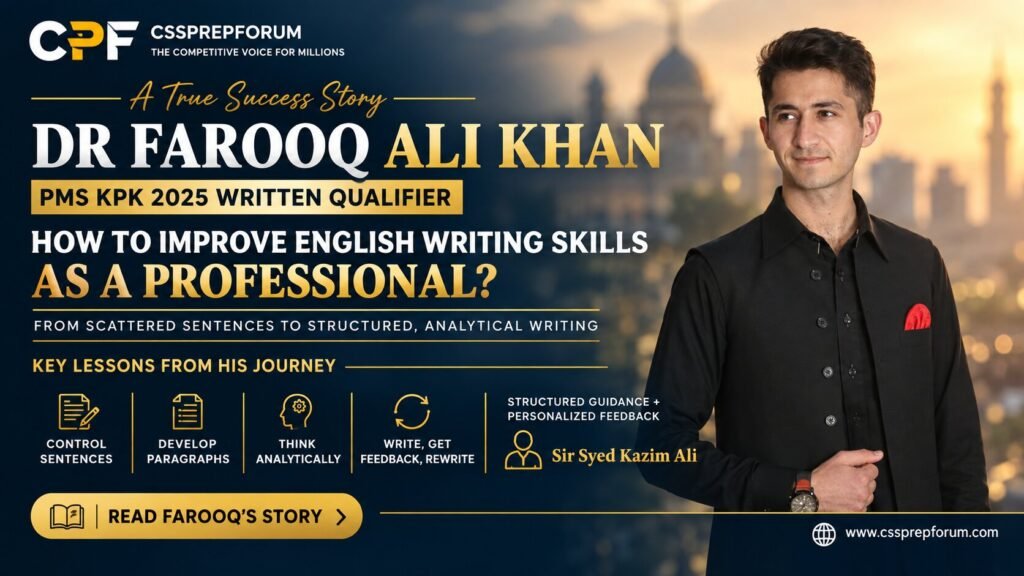
Being an expert in your field doesn’t automatically make you a clear writer. Dr Farooq Ali Khan, a dermatologist and PMS KPK 2025 Written Qualifier, shares how he moved from scattered sentences to structured, analytical writing through sentence control, paragraph development, and detailed feedback, a transformation that reshaped both his exam performance and his medical practice.
Being knowledgeable in your profession does not automatically make you a good writer. A doctor may be excellent at diagnosing a patient yet struggle to write a clear report. An engineer may understand a technical problem perfectly but find it difficult to explain it in precise English. A lawyer may know exactly what an argument means but struggle to present it in a coherent paragraph.
This creates a frustrating gap between what you know and what you can communicate in writing. So, how can you improve your English writing skills as a professional?
The answer is not simply to memorize vocabulary or learn complicated grammatical rules. Strong professional writing develops through control over sentences, clarity of thought, logical organization, precise expression, and repeated correction.

The experience of Dr Farooq Ali Khan, a dermatologist and PMS KPK 2025 Written Qualifier, in his testimonial “Sir Kazim: The Man Who Transformed My English Writing Skills,” provides a particularly useful example. When he began his CSS/PMS journey, he could confidently explain complex medical conditions to patients, but he describes himself as a complete beginner when it came to constructing coherent English sentences. His thoughts were scattered, his sentences were disconnected, and he did not know what good writing actually required.
His eventual transformation demonstrates something important: better writing is not only an examination skill. It can change how a professional thinks, communicates, and works.
Why Can a Professional Be Knowledgeable but Still Write Poorly?
Professional expertise and writing ability develop through different forms of practice. A dermatologist spends years learning how to identify diseases, interpret symptoms, and explain medical conditions, but none of that automatically teaches the person how to structure an argumentative paragraph.
That was the contradiction Dr Farooq experienced: he could explain the mechanics of a skin condition with confidence, yet when he had to construct a coherent English sentence, he felt like a beginner. His thoughts appeared scattered on the page, and he did not understand how one idea should logically lead to the next.
Knowing your subject does not automatically mean you know how to communicate it effectively.
You may have excellent ideas but weak sentence construction. You may have extensive knowledge but poor paragraph writing and organization skills. You may understand a complex issue but struggle to explain it simply. These are writing problems, not necessarily knowledge problems.
How Do You Know Whether Your English Writing Is Actually Weak?
Many people know that their writing “doesn’t sound good,” but they cannot identify the reason. Instead, they blame vocabulary, thinking: “I need better English words.” Sometimes they do. But the underlying problem may actually be
- Disconnected sentences
- Incomplete development of ideas
- Unclear relationships between points
- Weak paragraph structure
- Vague expression
- Unnecessary repetition
- Poor transitions
- Lack of a clear central idea
Dr Farooq’s experience illustrates this difference. His problem was not that he had nothing intelligent to say, for his professional background clearly required substantial knowledge and communication. His difficulty was turning his thoughts into controlled written language, and that is a very different problem, requiring a different solution.
Does Improving Vocabulary Automatically Improve English Writing?
Not necessarily. Vocabulary is useful when it allows you to communicate an idea more precisely, but replacing ordinary words with complicated ones does not automatically make writing better. Compare
The government needs to initiate efficacious measures to ameliorate the multifaceted ramifications of unemployment.
with
The government needs effective measures to reduce the economic and social effects of unemployment.
The second sentence may look less impressive, but it communicates the idea more directly.
Professional writing should prioritize clarity, precision, relevance, and logical structure before ornamental vocabulary.
This becomes especially important for professionals because the purpose of writing is often practical. A medical report needs to communicate accurately; a legal document needs precision; an academic paper needs logical development; a professional email needs clarity; and a CSS or PMS answer needs relevance and argumentation. In each case, complicated vocabulary is secondary to controlled communication.
How Can You Improve English Writing from the Sentence Level?
If your writing feels scattered, do not immediately attempt to write long essays. Start with sentences. A sentence should communicate a complete and understandable thought. Take this example,
Pakistan has many problems, and education is important because without education, development cannot happen, and many countries developed because they improved education.
The writer may understand the issue, but the sentence contains several ideas competing for space. It can be controlled.
Education plays a central role in national development because it improves human capital, expands economic opportunities, and strengthens citizens’ ability to participate in social and political life.
Now the thought has direction. The sentence communicates one central claim and then develops it through related points. This is why sentence construction matters so much: strong paragraphs are built from controlled sentences, and strong professional writing is built from strong paragraphs.
How Do You Learn to Connect Ideas in Writing?
One of the major weaknesses in developing writers is that their sentences may individually be understandable but collectively feel disconnected. Consider the following sentence.
Pakistan needs educational reform. Many schools lack resources. Teachers need training. Students use technology. Unemployment is high.
Each sentence contains a potentially relevant idea, but what is the relationship between them? The reader is forced to create the connection. Effective writing makes that relationship clearer.
Pakistan’s educational crisis cannot be addressed through curriculum reform alone. Many schools continue to suffer from inadequate resources, while teachers often lack opportunities for professional development. At the same time, expanding the productive use of technology could improve access to learning and equip students with skills that respond more effectively to the country’s employment challenges.
Now the ideas work together. The writer is not simply presenting information; instead, the writer is organizing thought. This was one of the major changes Dr Farooq describes in his own writing. Under Sir Syed Kazim Ali‘s guidance, he learned to focus on clarity, structure, and the logical movement from one idea to another rather than writing instinctively.
Why Is Paragraph Structure Important in Professional Writing?
A paragraph should not be treated as a random collection of sentences about the same subject; it should have a central purpose. A useful way to think about paragraph writing is Main Idea → Explanation → Support → Analysis → Connection.
Suppose you are writing about technology in healthcare. Your paragraph might begin with the claim,
Digital health technologies can improve access to medical services in underserved communities.
Then explain the claim by discussing telemedicine, remote consultations, or digital diagnostic support. Then provide an example or evidence. Finally, explain why this matters to the broader argument. The paragraph now has movement; it begins somewhere and ends somewhere. This is the difference between writing about a subject and developing an idea.
How Can You Make Your Writing More Analytical?
Good professional writing is not simply descriptive. It does not only tell the reader what happened. It also explains why it matters, what caused it, what it leads to, what it reveals, and how it relates to the main argument.
Consider
Social media has changed communication.
That is a statement. An analytical version might be
Although social media has made communication faster and more accessible, its algorithm-driven environment can also encourage users to interact primarily with information that reinforces their existing views, potentially narrowing rather than expanding public discussion.
The second sentence does more than state a fact; it establishes a relationship and explores an implication.
Dr Farooq’s review specifically describes analytical thinking as one of the abilities that developed alongside his writing. He says the training changed not only how he wrote but also how he approached problems, encouraging him to consider multiple perspectives before committing his ideas to paper. That is why writing improvement can also become thinking improvement.

Why Should Professionals Learn to Write with Intention?
Many people write instinctively. They put down whatever comes to mind and hope the reader understands the intended meaning. That can work in casual conversation, but professional communication demands more control.
Before writing, ask yourself: What exactly am I trying to say? What is the most important point? What does the reader need to understand before reaching my conclusion? What evidence or explanation supports my point? This process prevents writing from becoming a stream of disconnected thoughts.
Dr Farooq describes this as one of the biggest changes in his approach. He says that he no longer writes instinctively or simply hopes for the best; he writes with intention, focusing on clarity, structure, and logical flow. That is a transferable writing skill: it works in an essay, a report, an email, an academic assignment, and professional communication generally.
Can Better English Writing Help You Professionally?
Absolutely. This is one of the most interesting aspects of Dr Farooq’s experience, because his improvement did not stop after the PMS examination. He explains that clearer expression became useful in his medical career as well; the ability to articulate ideas precisely and persuasively helped him explain diagnoses, write reports, and communicate with colleagues and patients.
This demonstrates why English writing should not be viewed solely as a competitive-examination requirement. A professional who can communicate complex information clearly has an advantage in almost every knowledge-based field. The skill is especially valuable when the professional has to
- Prepare reports
- Write research
- Explain technical information
- Communicate with clients or patients
- Prepare presentations
- Write proposals
- Respond to formal correspondence
- Document professional decisions
- Explain complex ideas to non-specialists
In all these situations, clarity becomes part of professional competence.
How Does Critical Thinking Improve Writing?
Writing and thinking influence each other. If your thoughts are unclear, your writing often becomes unclear. But the reverse is also true: when you force yourself to organize an idea in writing, you may discover weaknesses in your own reasoning.
Suppose you believe: “Social media is harmful to young people.” Writing the argument forces you to ask: harmful in what way? Psychologically, socially, academically, politically? For everyone, or only certain groups? Compared with what? What evidence supports the claim? Are there benefits that complicate the argument? Suddenly, writing has exposed the assumptions behind your thought. That is analytical writing.
Dr Farooq says his training encouraged him to approach problems from multiple perspectives before writing, and he connects this habit with producing writing that became more impactful and persuasive. Therefore, improving writing is not simply about making sentences prettier; it can teach you to think more carefully before making a claim.
What Role Does Feedback Play in Improving English Writing?
Self-practice is important, but self-diagnosis has limitations. A writer may repeatedly make a mistake without noticing it because the mistake has become normal to them. That is why detailed feedback matters.
Useful feedback should answer three questions: what is wrong, why is it wrong, and how should I improve it?
Simply writing “Improve expression” does not teach much. A useful correction might explain that the sentence is ambiguous, the relationship between two clauses is unclear, or the chosen word does not accurately express the intended meaning. Once you understand the reason, you can apply the lesson elsewhere.
Dr Farooq specifically describes personalized feedback and the identification of small, repeated weaknesses as important parts of his transformation. He says those recurring loopholes were addressed individually until they stopped being weaknesses. That is what makes feedback educational rather than merely evaluative.
Why Is Rewriting Important?
Feedback only becomes useful when you apply it. Suppose someone identifies a problem in your paragraph, you understand the explanation, and then you immediately start writing something completely new. You have understood the correction intellectually, but you have not necessarily developed the skill.
Instead: write → receive feedback → understand the problem → correct → rewrite → apply the principle again.
This process turns feedback into practice. Over time, the corrections that initially require conscious attention become part of your normal writing process.
Can Professionals Improve English Writing Without Becoming English Specialists?
Yes. You do not need to become a grammarian or linguist before you can become a clearer writer. Your objective should be functional control. You should be able to
- Construct clear sentences
- Develop one idea logically
- Organize paragraphs
- Connect ideas
- Choose precise words
- Support important claims
- Remove unnecessary material
- Adapt your writing to your audience
A doctor does not need to become an English literature specialist to write a clear medical report. Similarly, an engineer does not need to study literature to explain a technical proposal. And likewise, a civil servant does not need ornate prose to write an effective policy brief. The goal is not literary decoration; the goal is controlled communication.
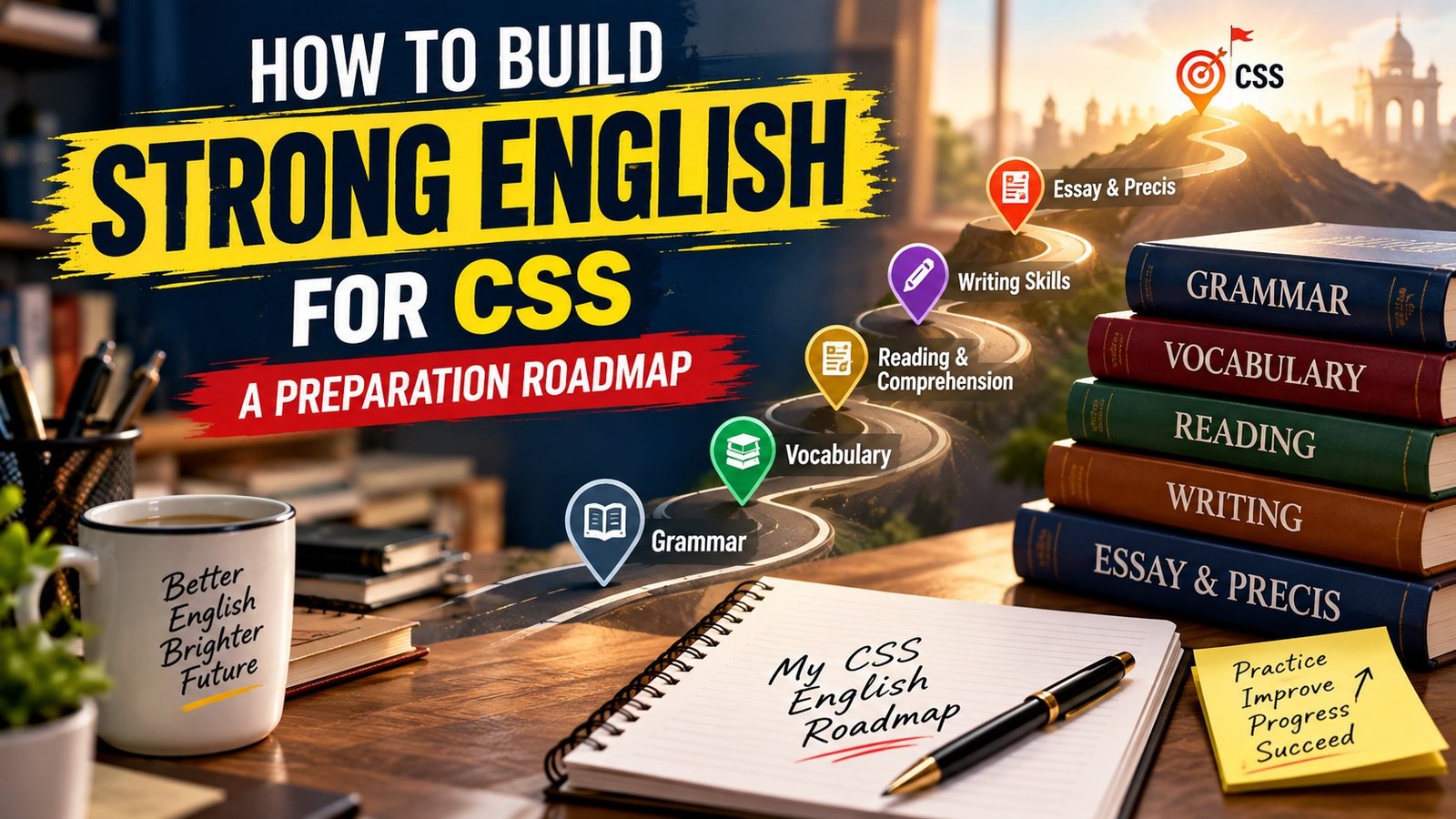
A Practical Roadmap to Improve English Writing Skills
If your writing currently feels weak, begin systematically.
Step 1: Diagnose Your Actual Weakness
Write a 250–300-word passage on a subject you know well, then examine it. Are your sentences grammatically controlled? Do your ideas connect? Do your paragraphs have central points? Do you repeat yourself? Are your claims supported? Do you use unnecessary words? Do you know what each paragraph is trying to accomplish?
Step 2: Fix Sentence Construction
Practise writing clear sentences before attempting very long pieces. Focus on subject-verb agreement, sentence structure, clause relationships, punctuation, pronoun clarity, and precise word choice.
Step 3: Practise Paragraph Development
Choose one idea and develop it fully. Do not try to discuss five issues in one paragraph.
Step 4: Practise Analytical Questions
Instead of merely describing a topic, ask: why, how, with what consequences, according to what evidence, what is the counterargument, and what does this imply?
Step 5: Read Good Writing for Structure
Do not read only for information. Notice how professional writers introduce an idea, develop it, provide evidence, and move to the next point.
Step 6: Write Regularly
Writing ability cannot be developed entirely through passive reading. Produce your own sentences and paragraphs.
Step 7: Get Specific Feedback
Find out which weaknesses recur.
Step 8: Rewrite
Do not allow corrections to remain comments on a page. Apply them.
Step 9: Compare Your Writing Over Time
Keep older samples. After several weeks or months, compare them with recent work. Look for measurable changes in clarity, structure, precision, coherence, and analytical depth.

What Can CSS and PMS Aspirants Learn from a Professional Like Dr Farooq?
Although Dr Farooq’s story comes through his PMS KPK preparation, his experience is relevant beyond competitive examinations.
An aspirant can learn how to construct a thesis, develop arguments, connect paragraphs, and apply the same discipline to precis writing. A professional can apply the same principles when writing reports, emails, proposals, or academic material. The common skill is structured expression.
This is why his story is particularly different from a conventional “I qualified PMS.” His transformation began with something much more fundamental: he learned what good writing actually required. He moved from scattered thoughts to structured ideas, from disconnected sentences to logical flow, from instinctive writing to intentional writing, from general claims to supported arguments, and from technical knowledge to clear communication, and eventually, from writing improvement to professional communication improvement.
His PMS KPK Written qualification became an important result of that development, but the skill itself proved useful beyond the examination.
Final Takeaway
Improving English writing is not about sounding sophisticated. It is about making your thinking understandable.
You may have years of professional knowledge and still struggle to communicate it effectively on paper. That does not necessarily mean you lack intelligence, knowledge, or ideas. It may simply mean that your writing skills have not developed at the same pace as your professional expertise.
Dr Farooq Ali Khan’s journey, and the mentorship of Sir Syed Kazim Ali behind it, offers a particularly clear example. As a dermatologist, he was already capable of explaining complex medical conditions. Yet he began his writing journey struggling with basic sentence construction, disconnected thoughts, and paragraph coherence. Through structured guidance, personalized feedback, and a deliberate focus on clarity, structure, and analytical thinking, he developed writing abilities that eventually supported his PMS KPK Written qualification and proved useful in his medical career as well.
The lesson is simple: good writing is not merely knowing more words. It is knowing how to turn your thoughts into clear, connected, and purposeful language.
So if you currently think, “I know what I want to say, but I cannot express it properly,” do not immediately start memorising difficult vocabulary. Start with the sentence. Then the paragraph. Then the argument. Then the complete piece of writing. Learn to think before you write, write with intention, accept correction, and rewrite what is weak.
Because whether you are preparing for CSS or PMS, writing a research paper, preparing a professional report, or communicating with a patient, the ability to express a good idea clearly is itself a professional skill. And undoubtedly, a mentor like Sir Syed Kazim Ali can guide you through a network of resources that can make that journey considerably more structured.
Frequently Asked Questions
How can I improve my English writing skills?
Start by identifying your actual weaknesses rather than trying to improve everything simultaneously. Work on sentence construction, paragraph development, clarity, logical organization, and precise expression. Write regularly, obtain specific feedback, and rewrite your weak work.
How can professionals improve their English writing?
Professionals should focus on clear, purposeful communication rather than complicated vocabulary. Practise writing reports, explanations, and short analytical passages, paying attention to structure, precision, coherence, and audience.
Why do I have good ideas but struggle to express them in English?
You may have a gap between conceptual understanding and linguistic control. Knowing what you want to say does not automatically mean knowing how to structure the sentence or paragraph that communicates it. Sentence and paragraph practice can help bridge that gap.
Does reading improve English writing?
Reading can expose you to vocabulary, sentence patterns, organization, and different ways of developing ideas. However, reading alone does not guarantee writing improvement. You also need to produce your own writing and receive feedback on it.
Is vocabulary the most important part of good English writing?
No. Vocabulary is useful, but clarity, sentence structure, logical organization, precision, and relevance are more fundamental. A simple, accurate sentence is generally more effective than a complicated sentence that obscures its meaning.
How can I make my writing more analytical?
Move beyond describing facts. Ask why something happens, how it happens, what consequences it produces, what evidence supports it, and whether another interpretation is possible. These questions force you to develop rather than merely state ideas.
Is feedback necessary to improve writing?
Feedback can be extremely valuable because writers often fail to notice their own recurring mistakes. The most useful feedback explains the problem, its cause, and the method for correcting it, something structured practice on platforms like Howtests can help reinforce, once the diagnosis is clear.
Can better English writing improve professional communication?
Yes. Clear writing can help professionals prepare reports, explain complex information, communicate with colleagues, write academic or technical material, and present ideas more persuasively. Dr Farooq’s experience illustrates how writing improvement extended into his medical professional life.