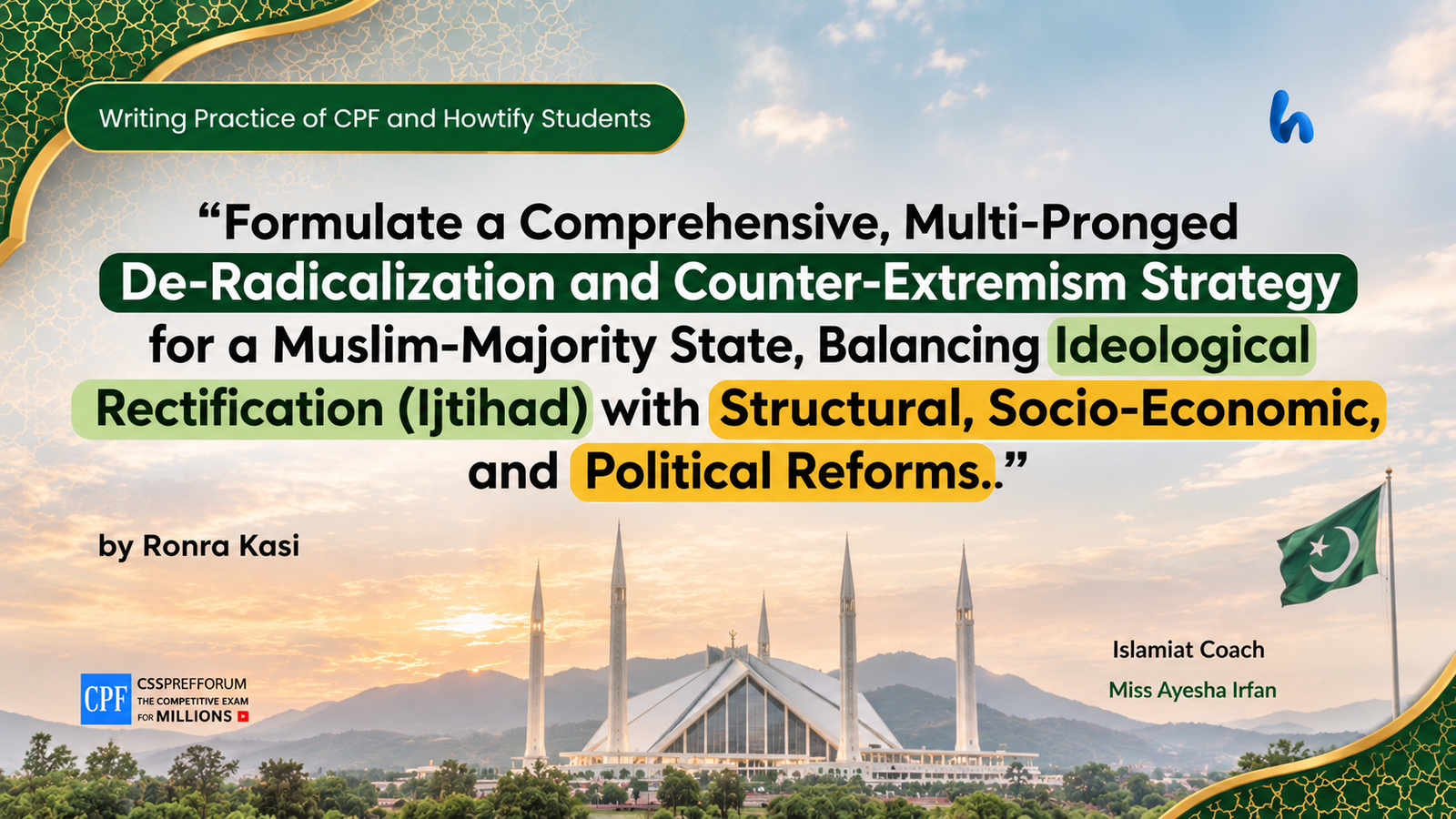
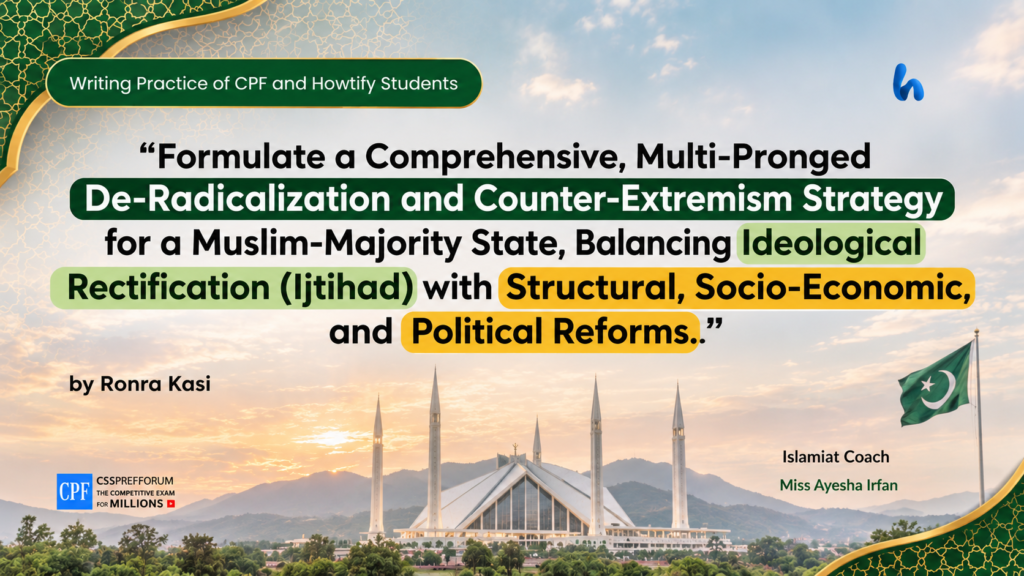
CSS Islamiat | Multi-Pronged De-Radicalization and Counter-Extremism Strategy for a Muslim-Majority State
The following question of CSS Islamiat is solved by Ronra Kasi under the supervision of Howfiv’s Islamiat coach, Miss Ayesha Irfan. She learnt how to attempt 20 marks question and essay writing from Sir Syed Kazim Ali, Pakistan’s best CSS and PMS English essay and precis teacher with the highest success rate of his students. This solved question is attempted on the pattern taught by Sir to his students, scoring the highest marks in compulsory and optional subjects for years.

Outline
1-Introduction
2-Analysing De-Radicalization and Counter-Extremism
3-Formulating a Multi-Pronged De-Radicalization Strategy for a Muslim-Majority State
- 3.1-Removing Ethnic Divisions: Replacing Racial and Tribal Superiority with Piety as the Only Measure of Worth, Making Equal Dialogue Possible Among All Peoples
- 3.2-Rehabilitating Militants Through Religious Counseling Centers
- 3.3-Reintegrating Former Extremists Into Mainstream Society
4-Formulating a Multi-Pronged Counter-Extremism Strategy for a Muslim-Majority State
- 4.1-Reforming Education To Prevent Radicalization
- 4.2-Policy Reviving Madrassas For Moderate Religious Teaching
- 4.3-Countering Online Extremism And Propaganda
5-Balancing Ideological Rectification (Ijtihad) with Structural Reforms
- 5.1-Reforming Justice System To Reduce Grievances
- 5.2-Strengthening State Institutions Alongside Religious Reform
6-Balancing Ideological Rectification (Ijtihad) with Socio-Economic Reforms
- 6.1-Reducing Poverty To Curb Extremism
- 6.2-Creating Jobs While Reforming Religious Narratives
7-Balancing Ideological Rectification (Ijtihad) with Political Reforms
- 7.1-Ensuring Political Inclusion Reduces Alienation
- 7.2-Promoting Shura-Based Governance With Ijtihad
8-Conclusion
Answer to the Question
Introduction
Terrorism and extremism have cost Pakistan and the wider Muslim world dearly, in blood, in trust, and in reputation. For years, the word ‘Muslim’ has often been wrongly linked to violence in the eyes of the world, while the real teachings of Islam, patience, justice, and moderation, get pushed aside by a loud, violent minority. At the same time, Pakistan alone has lost tens of thousands of lives to terrorism since the early 2000s, and the scars of attacks like the one on the Army Public School in Peshawar are still fresh in the nation’s memory. Yet, the roots of this violence are rarely just religious; they grow out of poverty, injustice, and political exclusion just as much as they grow out of twisted religious ideas. Accordingly, this means no single fix, whether a fatwa or a bank loan, can solve the problem on its own. Therefore, a Muslim-majority state needs a strategy that repairs both the mind and the circumstances of the people at risk of radicalization.
Analysing De-Radicalization and Counter-Extremism
Before building a strategy, it helps to understand what these two terms actually mean. De-radicalization is the process of helping someone who has already picked up extremist beliefs let go of them and return to a normal, peaceful life. And, counter-extremism, on the other hand, is about stopping radicalization before it starts, by removing the conditions and narratives that make extremism attractive in the first place. Similarly, ijtihad is independent reasoning by qualified Islamic scholars, used to correct religious arguments that extremists have twisted or misused. To sum up, a serious strategy needs all three working together: helping the already-radicalized, protecting those still at risk, and using sound religious reasoning to fix the ideas at the root of the problem.
Formulating a Multi-Pronged De-Radicalization Strategy for a Muslim-Majority State
A country dealing with existing militants must first look inward, guiding them back to a peaceful life before anything else. The following steps outline a workable de-radicalization strategy for a Muslim-majority state.
- Removing Ethnic Divisions: Replacing Racial and Tribal Superiority with Piety as the Only Measure of Worth, Making Equal Dialogue Possible Among All Peoples
In the first instance, Islam removes ethnic divisions by replacing racial and tribal superiority with piety as the only measure of worth. This is clearly established in the Quran. For instance, Allah declares that “the most noble of you … is the most righteous of you” (Surah Al-Hujurat 49:13), and the Charter of Madinah (622 CE) applied this principle practically, uniting the Muhajirun, the Ansar (Aws and Khazraj) and allied Jewish tribes into one ummah despite the city’s tribal rivalry. This fact signifies that Islam judges people by character, not lineage, and can unite even bitterly divided groups. Hence, equal dialogue among all peoples becomes possible.
- Rehabilitating Militants Through Religious Counseling Centers
Hand in hand with this, one way to fix a militant’s broken mind is not through punishment alone but through patient religious counseling. Allah tells us in the Quran, “Invite to the way of your Lord with wisdom and good instruction, and argue with them in a way that is best” (16:125), which means correction works best through calm words, not force. Similarly, as a illustration, Pakistan followed this exact idea at the Sabaoon Rehabilitation Centre in Swat, set up in 2009 by the Pakistan Army along with the Hum Pakistani Foundation and UNICEF. Additionally, at Sabaoon, former child soldiers of the TTP were slowly taught the real, peaceful meaning of Islam through religious counseling, normal schooling, and skill training, instead of being locked away and forgotten. Thus, this shows that religious counseling centers, built on the Quranic method of gentle persuasion, can turn even a trained militant back into a productive citizen.
- Reintegrating Former Extremists Into Mainstream Society
Furthermore, correcting a militant’s beliefs is only half the job; he also has to be welcomed back into normal life. The Quran gives huge value to a single human life, saying “whoever saves one soul; it is as if he had saved mankind entirely” (5:32), which tells us that saving even one radicalized young man from a life of violence is worth the effort. Besides, the results from Sabaoon prove this point in real numbers. In particular, as reported by the United States Institute of Peace, of nearly 200 boys who went through the centre, 192 were successfully reintegrated into their communities, and many went on to live ordinary lives with their families. Therefore, this proves that reintegration, guided by this Quranic value of saving a life, is not just a moral duty but a practical, working solution.
Formulating a Multi-Pronged Counter-Extremism Strategy for a Muslim-Majority State
Once existing militants are attended to, a state must also stop new radicalization from ever starting. The following steps outline a workable counter-extremism strategy for a Muslim-majority state.
- Reforming Education To Prevent Radicalization
Moving ahead, before a young mind is radicalized, education is the first wall that can stop it. The Quran itself values religious learning highly, saying that a group of believers should stay behind “to obtain understanding in the religion” so they can guide their people correctly (9:122). With this same spirit, Pakistan launched the Single National Curriculum, starting in 2021. consequently, this reform brought public schools, private schools, and madrassas onto one shared syllabus, so children from all backgrounds grow up learning the same balanced version of religion and knowledge, instead of three separate and disconnected worldviews. To sum up, a shared, moderate curriculum like this is one of the strongest long-term tools against radicalization, because it reaches children before extremist recruiters ever get the chance to.
- Regulating Madrassas For Moderate Religious Teaching
Moreover, madrassas are not the enemy, but unregulated madrassas can become an easy entry point for extremist teaching. For instance, the Quran describes the Muslim Ummah as “a just community” (2:143), a balanced nation, and this balance is exactly what madrassa teaching should reflect. To bring this balance into practice, the government signed a 2019 agreement with Ittehad-e-Tanzeemat-e-Madaris Pakistan. This agreement created the Directorate General of Religious Education, which registered more than 30,000 madrassas and placed them under the oversight of the Ministry of Education. Bringing madrassas into this kind of formal, moderate framework is a direct, practical step toward the balanced Ummah the Quran describes.
- Countering Online Extremism And Propaganda
Adding to the above, today’s extremist recruiter does not need a mosque or a training camp; a phone screen is enough. In particular, the Quran warns believers, “if there comes to you a disobedient one with information, investigate, lest you harm a people out of ignorance” (49:6), a clear instruction to verify information before acting on it. NACTA, Pakistan’s counter-terrorism authority, built this exact idea into technology through its “Chaukas” app and “Tat’heer” portal. Accordingly, these platforms let ordinary citizens report extremist content they find online, so hate speech and propaganda can be verified and removed by law enforcement before it spreads further. In other words, this shows how a simple Quranic principle of verification, once turned into public policy and technology, can help a state fight extremism on the very battlefield where it now lives most: the internet.
Balancing Ideological Rectification (Ijtihad) with Structural Reforms
Ideological correction alone cannot survive without solid structures holding it up. The following section shows how Ijtihad-based reform must walk hand in hand with structural reform.
- Reforming Justice System To Reduce Grievance
Likewise, a slow, unfair justice system quietly pushes people toward extremist groups who promise “quick justice” instead. The Quran commands plainly, “when you judge between people, judge with justice” (4:58). Recognizing this, Pakistan’s 2014 National Action Plan, drafted after the Army Public School attack, included speedy-trial mechanisms for terrorism cases as one of its twenty points. In addition, these special courts were meant to end years of delay and impunity that had let terrorists walk free and left victims’ families without closure, one of the biggest grievances that extremist groups exploit to recruit angry young men. To summarize, a justice system that actually delivers justice, as the Quran demands, removes one of the strongest excuses extremist groups use to justify their violence.
- Strengthening State Institutions Alongside Religious Reform
Moving on, religious reform on its own cannot succeed if the state institutions meant to carry it out are weak or scattered. The Quran’s guidance to “consult them in the matter, and when you have decided, then rely upon Allah” (3:159) points to organized, collective decision-making rather than one-man efforts. As an illustration, NACTA, the National Counter Terrorism Authority, was built to be this collective mechanism. Accordingly, since 2014, NACTA has coordinated the civilian government, the military, and all four provinces under one roof to implement the National Action Plan, instead of leaving counter-extremism work scattered across different departments. Consequently, a strong, coordinated institution like NACTA is what turns scattered religious reform efforts into one unified national strategy.
Balancing Ideological Rectification (Ijtihad) with Socio-Economic Reforms
A young man cannot think clearly about correct belief on an empty stomach. The following section shows how Ijtihad-based reform must be matched with real economic relief.
- Reducing Poverty To Curb Extremism
Compounding this further, a hungry, jobless young man is far easier to recruit than one who has food, shelter, and hope. To illustrate, the Quran warns against wealth becoming “a perpetual distribution among the rich from among you” (59:7), a clear call for economic fairness. Provided this, Pakistan’s Benazir Income Support Programme, launched in 2008, was designed to answer this exact call. Moreover, as the country’s largest cash-transfer safety net, it now reaches over 5 million of the poorest families, giving them a basic income cushion that extremist financiers cannot easily buy away with promises of money. Therefore, reducing poverty through programmes like this directly closes one of the biggest doors through which extremist groups pull in desperate recruits.
- Creating Jobs While Reforming Religious Narratives
In the same vein, correcting an extremist narrative works far better when the young man being corrected also has a job to go to the next morning. In particular, the Quran’s instruction for believers to gain religious understanding and then return to “warn their people” (9:122) works best when that return is to a life with real purpose and income, not idle unemployment. For this very reason, Pakistan tried to give young people that purpose through the Kamyab Jawan Program, launched in 2019. With Rs. 100 billion allocated for business loans and skills training, the programme specifically targeted the youth demographic that extremist recruiters most often target, giving them an economic alternative to militancy. Resultantly, pairing religious correction with real economic opportunity, as this programme attempted, gives young Pakistanis a genuine reason to choose a peaceful life.
Balancing Ideological Rectification (Ijtihad) with Political Reforms
Belief and bread are not the only things extremism feeds on; a sense of political voicelessness feeds it too. The following section shows how Ijtihad-based reform must be matched with real political inclusion.
- Ensuring Political Inclusion Reduces Alienation
Additionaly, a community that has no political voice will eventually look for one outside the system, sometimes through the barrel of a gun. For instance, the Quran describes true believers as those “whose affair is (determined by) consultation among themselves” (42:38), showing that inclusion in decision-making is a core Islamic value. Similar to this, Pakistan gave this principle real, constitutional weight through the FATA merger with Khyber Pakhtunkhwa in 2018. To illustrate, the 25th Constitutional Amendment ended over a century of colonial-era exclusion under the Frontier Crimes Regulation, finally extending equal constitutional and political rights to the tribal areas that extremist groups had long exploited as a lawless recruiting ground. In other words, political inclusion, exactly as the Quran encourages through consultation, removes the sense of alienation that extremist groups depend on to recruit marginalized communities.
- Promoting Shura-Based Governance With Ijtihad
The final piece of the puzzle is making sure Ijtihad itself, the reasoning that corrects extremist ideas, has a proper institutional home within the state. As an illustration, the Quran points to this kind of reasoned governance when it says matters should go to “those of authority among them, [so] the ones who [can] draw correct conclusions from it would have known about it” (4:83), a verse scholars point to as the basis of Ijtihad by qualified people. Similarly, Pakistan created exactly this kind of body in the Council of Islamic Ideology. Since 1962, under Articles 228 to 230 of the Constitution, this Council has advised Parliament on Islamic legislation and even publishes its own journal titled “Ijtihad”, keeping religious reasoning connected to actual state policy. To conclude, a permanent body like this shows how shura-based governance and Ijtihad can work together inside a formal state institution, rather than being left to individual clerics acting alone.
Conclusion
All in all, de-radicalization and counter-extremism cannot rest on force alone, nor can they rest on religious correction alone. A Muslim-majority state needs both: scholars and religious institutions working through Ijtihad to fix distorted beliefs, and the state working through education, justice, jobs, and political inclusion to remove the grievances extremists feed on. Moreover, Pakistan’s own experience, from Sabaoon to the FATA merger, shows that this balanced, multi-pronged approach is not just an idea but something that has already been tried, with real, if incomplete, results. Going forward, the task is not to invent new solutions but to strengthen, fund, and sustain the ones already in motion, so the peaceful, balanced message of Islam finally overtakes the loud, violent voices that have hijacked it for far too long.
Searching for CSS or PMS Solved Islamiat Past Papers?
Are you preparing for the CSS or PMS and searching for solved Islamiat past papers, notes, books, PDFs, and MCQs? Explore them for free on Howtests and Cssprepforum. All content is fully solved and written by Miss Ayesha Irfan. For your convenience, the links are provided below. Simply click on any to start reading and preparing.