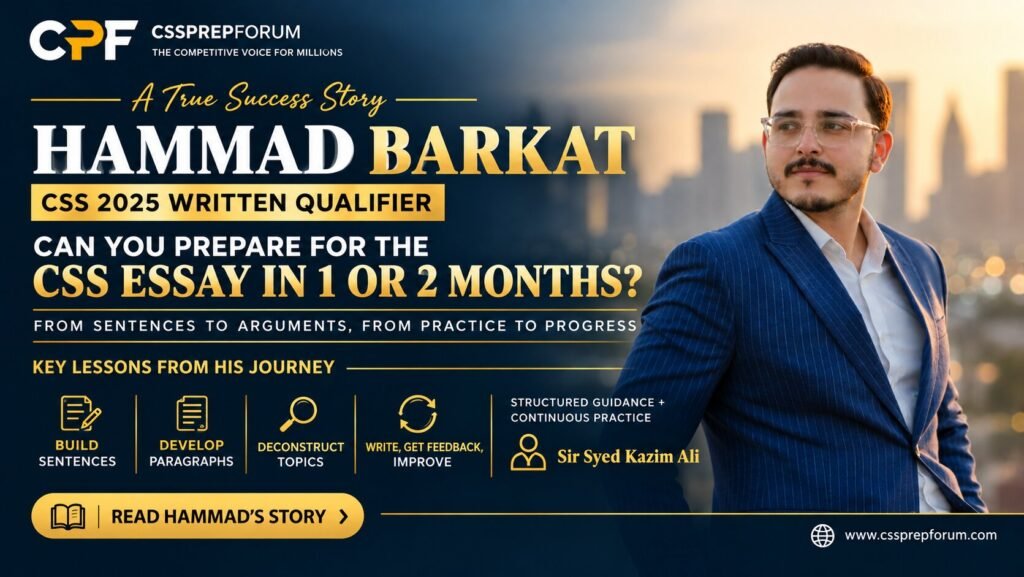
Is 1-2 months enough for CSS Essay prep? Learn Hammad Barkat’s structured method to build sentences, arguments, and exam-ready essays fast.
If you have only one or two months left before the CSS examination, one question can become difficult to ignore: can you really prepare for the CSS Essay in such a short time? The honest answer is that it depends on where you are starting from, how you prepare, and whether your preparation is structured.

One or two months may not be enough to develop complete mastery of English writing from scratch. But a focused aspirant with the right foundation, a clear method, continuous writing practice, and detailed feedback can make substantial progress in a short period.
The experience of Hammad Barkat, a CSS 2025 Written Qualifier and government officer at the Ministry of Information, offers a particularly useful case study. His review describes how structured training helped him significantly improve his essay writing within two months, beginning with sentence construction and paragraph development before progressing towards complete essays. He also credits continuous practice and detailed feedback from Sir Syed Kazim Ali for making his preparation more manageable.
His experience raises a more useful question than simply asking whether two months are “enough”: what can an aspirant realistically accomplish in those two months?
Can You Really Prepare for the CSS Essay in 1 or 2 Months?
Yes, but “prepare” and “master” are not the same thing.
If an aspirant already has reasonable English comprehension, some general knowledge, and the ability to understand basic written English, a highly focused two-month period can be used to build exam-oriented essay-writing skills. However, someone starting with severe difficulties in sentence construction, grammar, comprehension, expression, argumentation, and analytical thinking should not assume that a few weeks will automatically produce mature writing.
This distinction matters because many CSS aspirants ask, “Can I prepare for the CSS Essay in two months?” when they should first ask, “What exactly do I need to improve in these two months?” If the answer is “everything,” the preparation needs a different strategy from that of a student who already writes reasonably well but lacks essay structure and examination technique.
Hammad Barkat’s experience is valuable precisely because his short-term improvement was not based on memorising a few essays or learning a last-minute formula. His account describes a structured progression from sentence construction to paragraph development and then to full essay writing. That sequence is the key.
What Can You Actually Improve in Two Months?
Two months can be productive if the time is spent developing specific skills rather than trying to consume unlimited material. For the CSS Essay, these skills include
- Understanding the exact demand of a topic
- Developing a clear thesis
- Organizing arguments logically
- Writing effective topic sentences
- Developing coherent paragraphs
- Maintaining relevance
- Connecting ideas smoothly
- Expressing thoughts precisely
- Practising under examination conditions
- Identifying recurring weaknesses through evaluation
Notice what is missing from this list: memorising fifty complete essays.
Short preparation becomes useful when it is skill-focused. If an aspirant spends two months simply reading essays, downloading outlines, and collecting quotations, the amount of material may increase considerably without producing an equivalent improvement in writing. But if those same two months are spent writing, receiving feedback, correcting mistakes, and rewriting, the outcome can be very different.
Why Starting with Sentences Matters
A common mistake in CSS Essay preparation is to jump directly into full-length essays. An aspirant reads a few model essays, learns the basic introduction-body-conclusion format, and immediately attempts a 2,500-word essay. When the result is weak, the student assumes the problem is a lack of information. Sometimes the problem is much more basic: can the student construct a clear sentence? Can one sentence communicate one complete thought? Can the next sentence logically extend that thought? Can several sentences form a coherent paragraph?
Only after these foundations are reasonably controlled does the full essay become easier to manage. Hammad’s account describes exactly this progression in his training: sentence construction, then paragraph development, then full essay writing.
This offers an important lesson for anyone attempting short-term CSS Essay preparation: do not measure progress by how many full essays you have attempted. Measure whether the smaller units of your writing are becoming stronger.

How Should You Prepare for the CSS Essay in Two Months?
A short preparation period needs structure. Instead of approaching every day as another opportunity to “study English,” divide the preparation into connected stages.
Stage 1: Strengthen Sentence Construction
Begin with the smallest unit of your essay: the sentence. Work on sentence structure, grammatical accuracy, clarity, punctuation, precise expression, and the logical relationships between ideas. Do not make unnecessarily difficult vocabulary your primary goal; a simple sentence that communicates a sophisticated idea clearly is more useful than an impressive-looking sentence whose meaning is unclear.
Stage 2: Learn to Develop Paragraphs
Once sentence control improves, practise paragraphs. Take one argument and develop it completely. A useful basic structure is Topic Sentence → Explanation → Evidence/Example → Analysis → Link to the Main Argument.
The purpose is not to force every paragraph into a rigid formula. The purpose is to ensure that the paragraph actually does something. A paragraph should not merely introduce another fact; it should advance the essay’s argument.
Stage 3: Learn Essay Deconstruction
Before writing an essay, learn to understand what the topic is actually asking. Consider “Technology has made humanity less human.” This is not simply an essay about technology; the statement contains a proposition that must be examined. What does “less human” mean? Does technology reduce empathy? Does excessive digital interaction weaken social relationships? Does automation affect human purpose? Are there ways in which technology has actually strengthened human connection?
Once the demand becomes clear, the writer can determine the direction of the essay. Without this step, an aspirant may write a perfectly informed essay about technology that never properly answers the topic. Hammad specifically identifies essay deconstruction as an important part of his improvement.
Why Is Essay Deconstruction Important in CSS?
Because knowing the subject is not enough. Suppose you have prepared everything about climate change: its causes, effects, international agreements, economic consequences, and environmental impact. Then the paper gives you: “Climate change is less an environmental crisis than a governance crisis.”
You cannot simply reproduce everything you know about climate change. The statement requires you to engage with a specific argument. You must determine what the examiner is asking you to establish, what position you will take, and which arguments can defend that position.
That is essay deconstruction, precisely why CSS aspirants fail the essay: it transforms a broad subject into a specific intellectual task.
Stage 4: Build a Thesis Before Writing the Essay
Once you understand the topic, establish your position. A thesis should give the essay direction. For example, if the topic is “Education is the strongest weapon against inequality,” a weak thesis might simply repeat the topic: “Education is very important for reducing inequality.”
A more purposeful thesis establishes a direction: by expanding access to quality education, improving employability, and reducing inherited disadvantages, education can become one of the most effective long-term mechanisms for narrowing social and economic inequality.
The exact wording will vary according to the topic and argument. The important point is that the thesis should tell the reader what the essay intends to establish.
Stage 5: Practise Argument Development
Once you have a thesis, ask yourself why you believe this position. Those answers become your arguments. For example, if your position is that quality education can reduce socioeconomic inequality, your possible arguments might be
- It improves access to employment.
- It increases social mobility.
- It reduces inherited educational disadvantages.
- It develops civic and economic participation.
- It can empower marginalized communities.
Now the essay has an argumentative skeleton. The next task is to develop each argument rather than merely naming it. This is where many short-term aspirants go wrong: they prepare outlines containing ten impressive-looking headings but have never practised turning one heading into a coherent analytical paragraph. Two months are better spent developing fewer arguments properly than collecting dozens of undeveloped ones.
Stage 6: Write, Get Evaluated, and Rewrite
This may be the most important stage of short-term preparation. Writing alone is not enough. Imagine that you write an essay today and make the same five mistakes repeatedly: a vague thesis, descriptive topic sentences, weak paragraph connections, irrelevant evidence, and imprecise expression. If nobody identifies these problems, you may write another essay tomorrow and reproduce all five. You have practised, but you have not necessarily improved.
A more useful cycle is: write → evaluate → identify weaknesses → understand the problem → correct → rewrite → apply again.
Hammad’s experience places significant emphasis on continuous practice and detailed feedback. That is particularly important when preparation time is limited, because feedback reduces wasted practice. Instead of spending two months repeating an ineffective method, you can use each evaluation to determine what the next writing task should improve.
Is Two Months Enough Without a Teacher?
This question requires a nuanced answer. An aspirant can certainly study independently, but independent study becomes difficult when the student cannot accurately diagnose weaknesses in his own writing. You may believe your thesis is strong, think your paragraph is coherent, feel that your vocabulary is sophisticated, and even receive encouraging comments from friends. But the important question is: can you identify precisely why your writing is weak and how to repair it?
If yes, self-study can be productive. If not, reliable feedback becomes particularly valuable.
Hammad’s review makes another useful distinction here: an officer or CSS qualifier can share experience and direction, but passing an examination and teaching another person how to develop writing are different skills. A successful candidate can tell you what worked for them; a true teacher should be able to diagnose your writing, explain the problem, guide your practice, and help you improve systematically. The distinction matters especially when only one or two months remain.
Can an Officer or CSS Qualifier Teach You Essay Writing?
An officer or qualifier can certainly provide useful advice. Their experience may help an aspirant understand examination pressure, preparation mistakes, time management, and the realities of the competitive process. But experience does not automatically equal teaching ability, and Hammad’s own reflection emphasizes this distinction. Someone may successfully write a CSS essay without necessarily being able to explain why another student’s essay is weak.
Teaching requires another layer of competence: diagnosis + explanation + practice + correction + progression.
Therefore, when selecting guidance, do not ask only, “Did this person qualify CSS?” Also ask, “Can this person actually teach me how to write?”
Why Readymade Essays and Outlines Are Risky in Short-Term Preparation
When time is running out, memorisation becomes tempting. An aspirant thinks: “I have only six weeks. I cannot develop everything from scratch. I should prepare twenty important essays.” This can create a temporary feeling of security.
But the CSS Essay does not guarantee that the examination topic will resemble the essays you memorised. Even a familiar subject can appear from an unfamiliar direction. Suppose you prepare “Climate Change: Causes, Effects and Solutions,” and the examination asks, “Climate insecurity is fundamentally a crisis of political responsibility.” You may know everything about climate change, but the question is asking you to examine a particular claim. A memorised essay gives you content; it does not automatically give you interpretation.
That is why short-term preparation should prioritize transferable skills: deconstructing topics, developing arguments, writing theses, structuring paragraphs, and expressing ideas clearly. These skills remain useful even when the topic changes.
What About CSS Precis Preparation in a Short Time?
Hammad’s experience is relevant here as well, because his review specifically discusses live precis practice and his experience of preparing for what he regarded as an exceptionally difficult precis paper. The central principle remains the same: understand first, compress second.
A student cannot reliably reduce a passage without first understanding its central idea, supporting points, logical relationships, essential information, unnecessary detail, and overall tone and meaning. Short-term precis writing preparation should therefore not consist of memorising a list of tricks. Instead, practise passages repeatedly and ask what the author is actually saying, and then what must remain if you have to reproduce that meaning in substantially fewer words. The skill lies in comprehension and controlled expression, not mechanical shortening.
How Much Writing Practice Should You Do in Two Months?
There is no universal number of essays that guarantees readiness. Writing ten essays without meaningful feedback may be less useful than writing fewer essays and carefully studying your recurring weaknesses. The important question is not “How many essays have I written?” but “What did each essay teach me?”
After every serious attempt, identify one sentence-level weakness, one paragraph-level weakness, one argumentation weakness, one structural weakness, and one recurring language problem. Then deliberately correct those weaknesses in the next task. This turns writing into a learning process rather than a counting exercise.
A Two-Month CSS Essay Preparation Framework
If you have approximately eight weeks, your preparation can be organized around progressive skill development.
Weeks 1–2: Build the Foundation
Focus on sentence construction, grammar in actual writing, clarity, paragraph structure, and basic expression. Do not obsess over complete essays yet.
Weeks 3–4: Learn to Think Through Topics
Practise essay deconstruction, identifying scope, identifying the central demand, generating questions, developing positions, writing thesis statements, and preparing structured outlines.
Weeks 5–6: Develop Complete Essays
Now move towards full essays. Focus on logical progression, argument development, paragraph coherence, evidence, analysis, and introductions and conclusions. Have your writing evaluated.
Weeks 7–8: Exam-Oriented Practice
Shift towards timed writing, unfamiliar CSS essay topics, complete essays, precis practice, rewriting recurring weaknesses, refining expression, and reviewing feedback. The purpose of the final weeks is not to discover hundreds of new topics but to make your existing skills more reliable under pressure.
What If Your English Is Very Weak and You Have Only Two Months?
Then the answer becomes more cautious. Two months can still be used productively, but you should not expect the same outcome as an aspirant who already possesses reasonable language control.
If your major difficulties include basic sentence construction, grammar, comprehension, and expression, your first priority should be foundational control. Do not spend most of your remaining time collecting quotations because you believe sophisticated content will compensate for weak expression. Build the language first, then develop paragraphs, then arguments, then complete essays.
A shorter preparation period makes prioritization more important, not less.
What Does Hammad Barkat’s CSS 2025 Success Teach?
Hammad’s experience does not prove that every aspirant can become an expert essay writer in 2 months. That would be an unrealistic conclusion. What his experience demonstrates is more specific: a structured, guided, and practice-oriented approach can produce significant improvement within a relatively short period.
His preparation moved progressively from sentence construction to paragraph development and then to full essays. He describes essay deconstruction as an important technique, emphasizes continuous practice and feedback, and credits live precis practice with helping him tackle a difficult CSS Precis paper.
Most importantly, his story challenges two opposite misconceptions. The first is that “one or two months can never make a meaningful difference.” They can. The second is that “I have two months, so I only need shortcuts.” That is much more dangerous. Short-term preparation should become more systematic, not more dependent on shortcuts.

So, Can You Prepare for the CSS Essay in 1 or 2 Months?
The most accurate answer is: you can make substantial, exam-relevant progress in one or two months, but the result depends heavily on your starting level, the quality of your method, the amount of actual writing you do, and the quality of feedback you receive.
If you already possess basic language control, a focused two-month programme can help you develop essay structure, argumentation, topic interpretation, thesis writing, and examination confidence. If your foundation is extremely weak, the same period should be used to address the most fundamental problems first rather than attempting to cover everything.
And in either case, the preparation should not revolve around memorising ready-made essays. The objective is to become capable of responding to the topic you actually receive in the examination.
Final Takeaway
Two months can feel impossibly short when you look at everything involved in CSS English. But the solution is not to panic and start collecting more material. It is to determine what actually needs to improve.
If your sentences are weak, work on sentences. If your paragraphs are disconnected, work on paragraph development. If you cannot understand essay topics, practise deconstruction. If your ideas are scattered, learn to build arguments. If you know what to write but cannot organize it, work on thesis and outlines. If you keep repeating the same mistakes, get your writing evaluated and rewrite it.
That is the more realistic lesson from Hammad Barkat’s experience. His CSS 2025 qualification did not come from discovering a two-month shortcut. His account describes a structured process in which writing was broken into manageable skills, practised repeatedly, and refined through feedback under the mentorship of Sir Syed Kazim Ali.
So, if you have only one or two months left, do not ask only, “Is two months enough?” Ask the more useful question: “How effectively can I use the two months I actually have?” Because a short preparation period filled with deliberate practice can be far more valuable than a long preparation period spent merely collecting material.

Frequently Asked Questions
Can I prepare for the CSS Essay in 2 months?
Yes, significant improvement is possible within two months if preparation is structured, intensive, and practice-oriented. However, two months should not be treated as a guaranteed period for complete mastery. Your starting level and the quality of your practice matter greatly.
Can I prepare for the CSS Essay in 1 month?
One month can be useful for improving an existing foundation, but it is a much tighter window for someone with serious weaknesses in grammar, sentence construction, comprehension, and argumentation. The less developed your foundation, the more carefully you need to prioritize.
What should I study first for the CSS Essay?
Start with sentence construction and expression, then move towards paragraph development, topic interpretation, thesis writing, argument development, and complete essays. Building the smaller skills first makes full essay writing more manageable.
Is it possible to prepare for the CSS Essay without memorizing essays?
Yes. In fact, developing independent thinking is more transferable than memorizing complete essays. Read model essays at CSSPrepForum to understand structure and argumentation, but practise producing your own thesis, arguments, and paragraphs.
How important is essay evaluation in CSS preparation?
Very important, particularly if you struggle to identify your own weaknesses. Effective evaluation should explain what is wrong, why it is wrong, and how you can improve it in future writing.
Can a CSS qualifier teach me essay writing?
A CSS qualifier can provide valuable experience and direction, but qualification and teaching are different skills. When choosing guidance, look for someone who can diagnose writing problems, explain them clearly, provide structured practice, and give detailed feedback.
How can I improve my CSS Essay quickly?
Prioritize the skills that directly affect your writing: sentence control, topic interpretation, thesis development, argumentation, paragraph coherence, and regularly evaluated practice, ideally reinforced with mock tests at Howtests as your deadline gets closer. Avoid spending most of your limited preparation time collecting material that you cannot yet use.
Is CSS Precis also possible to prepare in a short time?
You can improve precis skills through concentrated practice, but the focus should be on comprehension before compression. Learn to identify the central idea, distinguish essential from supporting information, and reproduce the meaning concisely.