CSS Pakistan Affairs | IMF’s Stabilization Conditions and Pakistan’s Financial Sustainability
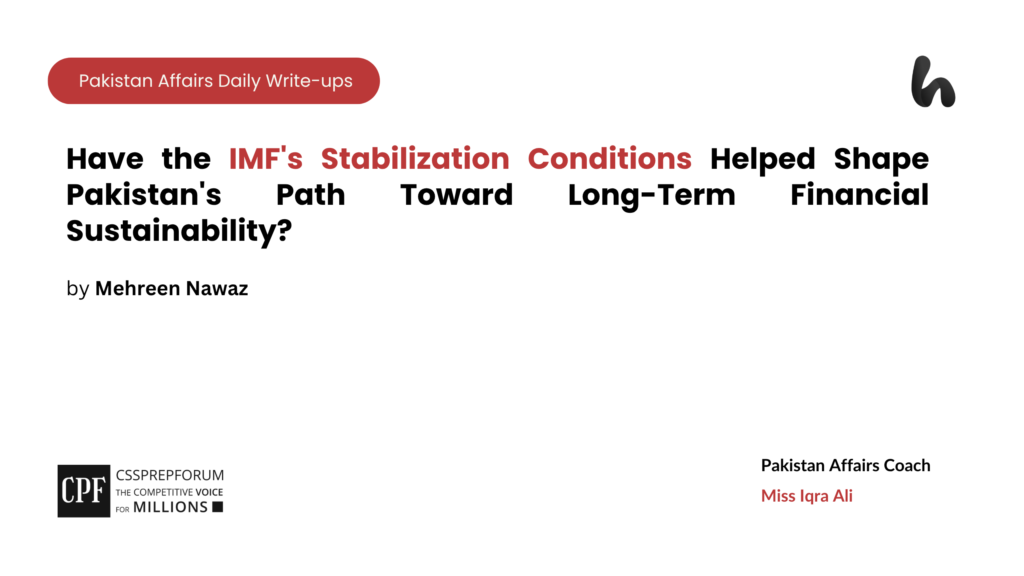
The following assignment question for CSS Pakistan Affairs is solved by Mehreen Nawaz under the supervision of Howfiv’s Pakistan Affairs and Current Affairs Coaches: Miss Iqra Ali and Sir Ammar Hashmi. She learnt how to attempt 20 marks question and essay writing from Sir Syed Kazim Ali, Pakistan’s best CSS and PMS English essay and precis teacher with the highest success rate of his students. This solved question is attempted on the pattern taught by Sir to his students, scoring the highest marks in compulsory and optional subjects for years.

Outline
1-Introduction
2-IMF Stabilization Conditions in Pakistan
3-IMF stabilization conditions and their Impact on Pakistan’s Path Toward Long-Term Financial Sustainability
- 3.1 Promoting Fiscal Discipline and Reducing Persistent Budget Deficits
- IMF stabilization programs traditionally include ceilings on fiscal deficits and domestic credit.
- 3.2 Strengthening Domestic Revenue Mobilization through Tax Reforms
- IMF conditionality includes fiscal revenue measures and strengthening tax administration.
- 3.3 Restoring Macroeconomic Stability through Inflation and Monetary Control
- Fiscal and monetary tightening can reduce inflation and excessive import demand while improving the balance of payments.
- 3.4 Improving External-Sector Stability and Rebuilding Foreign-Exchange Reserves
- Countries generally approach the IMF after foreign-exchange reserves have been depleted and external borrowing has increased because of worsening balance-of-payments positions.
- 3.5 Reforming the Energy Sector and Addressing Circular Debt
- State-owned enterprises generating large deficits require their underlying financial problems to be addressed rather than simply having their losses financed.
4-Why Stabilization Has Not Yet Fully Translated into Long-Term Financial Sustainability
- 4.1 Short-Term Economic Costs of Fiscal and Monetary Adjustment
- Fiscal and monetary tightening can reduce inflation and import demand but can also produce a slowdown in economic activity.
- 4.2 Higher Energy Prices and Inflationary Pressure on Households and Businesses
- Larger increases in electricity tariffs and other government-service prices impose greater hardship on users.
- 4.3 High Interest Rates and Their Constraints on Investment and Economic Growth
- Tighter monetary and fiscal policies can reduce inflation and import demand but can also cause a slowdown in economic activity.
- 4.4 Recurring IMF Programs and Reflecting the Persistence of Structural Economic Weaknesses
- The “stop-go” cycle shows that initial fiscal and monetary tightening can improve inflation and the external position, followed by renewed expenditure and monetary easing that recreate inflation and external deficits.
5-Way Forward
6-Conclusion
Answer to the question
Introduction
The International Monetary Fund (IMF) provides financial assistance to countries facing balance-of-payments and macroeconomic crises in return for agreed policy adjustments. IMF stabilization conditions aim to restore macroeconomic stability, correct external imbalances, and create the basis for sustained economic growth. These conditions commonly involve fiscal discipline, monetary control, exchange-rate adjustment, revenue measures, and structural reforms. However, stabilization does not automatically guarantee long-term financial sustainability because temporary correction of economic imbalances may not eliminate the structural weaknesses that repeatedly generate crises. In Pakistan’s case, IMF stabilization conditions have contributed to financial stability, but their success in achieving long-term sustainability remains limited by recurring fiscal pressures, structural weaknesses, and repeated dependence on IMF assistance.
IMF Stabilization Conditions in Pakistan
IMF stabilization conditions require the borrowing government to undertake specific policy actions before and during an IMF program. These include prior actions, quantitative performance criteria, indicative targets and structural benchmarks. Prior actions may include fiscal revenue measures, while quantitative criteria can place limits on fiscal balances, external borrowing and public-sector arrears. Strengthening tax administration, fiscal revenue measures, ceilings on fiscal deficits and domestic credit, and limits on external borrowing are among the measures used under stabilization programs. Structural benchmarks may also address governance, fiscal transparency, and state-owned enterprises. Without policy changes, financial assistance could merely provide “temporary breathing space” and postpone another crisis while increasing debt. Thus, stabilization conditions seek to combine immediate financial assistance with policy adjustment.
IMF Stabilization Conditions and Their Impact on Pakistan’s Path Toward Long-Term Financial Sustainability
- 3.1 Promoting Fiscal Discipline and Reducing Persistent Budget Deficits
IMF stabilization conditions promote fiscal discipline by requiring governments to control excessive expenditure and reduce fiscal deficits, which can contribute to inflation and external imbalances. For Pakistan, controlling persistent deficits can reduce government borrowing and prevent further accumulation of public debt. The IMF stabilization framework traditionally includes ceilings on fiscal deficits and domestic credit, making fiscal consolidation a central component of stabilization. Fiscal discipline can therefore improve the government’s ability to manage expenditure within available resources. However, its long-term success depends on maintaining these reforms after the IMF program ends.
- 3.2 Strengthening Domestic Revenue Mobilization through Tax Reforms
IMF conditionality can strengthen Pakistan’s domestic revenue base by encouraging improvements in tax collection and administration. A sustainable fiscal system requires sufficient domestic revenue to finance public expenditure and reduce dependence on borrowing. Strengthening tax administration and fiscal revenue measures can form part of an IMF program. Such reforms can reduce the fiscal gap and provide greater resources for public services. However, tax measures adopted only to meet short-term program targets may not produce lasting results, making permanent institutional reform essential for long-term sustainability.
- 3.3 Restoring Macroeconomic Stability through Inflation and Monetary Control
IMF stabilization conditions seek to reduce inflationary pressures by restricting excessive monetary and fiscal expansion. Persistent inflation undermines purchasing power, increases uncertainty, and makes economic planning difficult. Fiscal and monetary tightening can reduce inflation and excessive import demand while improving the balance of payments. For Pakistan, monetary discipline can therefore create a more predictable economic environment. However, excessive tightening can suppress economic activity, so stabilization must eventually be accompanied by policies that support investment, productivity and sustainable growth.
- 3.4 Improving External-Sector Stability and Rebuilding Foreign-Exchange Reserves
IMF stabilization conditions can improve Pakistan’s external position by reducing excessive import demand, supporting exchange-rate adjustment and providing foreign-exchange financing. Countries generally approach the IMF when foreign-exchange reserves have fallen sharply, and balance-of-payments pressures have intensified. Governments typically seek IMF assistance after reserves have been depleted and external borrowing has increased because of worsening balance-of-payments positions. Stabilization can reduce import demand and encourage exports, while IMF financing provides immediate external support. Tighter fiscal and monetary policies can reduce import demand and improve the balance of payments.
- 3.5 Reforming the Energy Sector and Addressing Circular Debt
IMF stabilization programs can contribute to structural sustainability by addressing loss-making state-owned enterprises and inefficient pricing systems that create fiscal pressures. Persistent losses may require government financing, increasing borrowing and monetary pressures. State-owned enterprises generating large deficits require their underlying financial problems to be addressed rather than simply having their losses financed. This principle is relevant to Pakistan’s energy sector and circular debt. Reforming the sector can reduce recurring government liabilities, although higher energy prices may impose short-term costs on households and businesses.
Why Stabilization Has Not Yet Fully Translated into Long-Term Financial Sustainability
- 4.1 Short-Term Economic Costs of Fiscal and Monetary Adjustment
Although stabilization conditions can improve macroeconomic indicators, they can create high short-term economic costs. Fiscal consolidation may require expenditure cuts or higher revenues, while monetary tightening can restrict economic activity and investment. Fiscal and monetary tightening can reduce inflation and import demand but can also produce a slowdown in economic activity. Stronger stabilization programs can impose greater adjustment costs on affected groups. Larger fiscal reductions and increases in electricity tariffs or government-service prices create greater hardship. Therefore, stabilization must balance financial correction with economic and social costs.
- 4.2 Higher Energy Prices and Inflationary Pressure on Households and Businesses
Stabilization may require reductions in subsidies or increases in government-controlled prices, raising costs for households and businesses. Such measures can be necessary when subsidies create fiscal losses that the government cannot sustainably finance. Larger increases in electricity tariffs and other government-service prices impose greater hardship on users. In Pakistan, higher energy prices can therefore increase household expenses and business production costs. Although these reforms can improve the financial position of the state, their long-term sustainability requires greater energy-sector efficiency and appropriate protection for vulnerable groups.
- 4.3 High Interest Rates and Their Constraints on Investment and Economic Growth
Monetary tightening can help control inflation and stabilize the external sector, but persistently high interest rates can constrain private investment and economic activity. Expensive credit raises borrowing costs for businesses, making expansion and productive investment more difficult. Although tighter monetary conditions can suppress excessive demand and reduce external pressures in the short term, prolonged high borrowing costs can weaken investment, productivity, employment, and productive capacity. Consequently, macroeconomic stabilization may not translate into long-term financial sustainability unless monetary stability eventually creates conditions for investment-led and export-oriented growth.
- 4.4 Recurring IMF Programs and Reflecting the Persistence of Structural Economic Weaknesses
The recurrence of IMF programs indicates that short-term macroeconomic stabilization has not eliminated the structural weaknesses that repeatedly push Pakistan toward fiscal and balance-of-payments crises. IMF-supported adjustment can temporarily reduce fiscal deficits, contain inflation, suppress excessive import demand, and rebuild foreign-exchange reserves. However, these gains remain fragile when underlying problems such as weak revenue mobilization, energy-sector losses, low export competitiveness, inefficient state-owned enterprises, and limited productive capacity remain unresolved. Consequently, Pakistan may emerge from an immediate stabilization crisis without developing the domestic revenue and foreign-exchange earning capacity required to sustain stability independently. The repeated return to external financial assistance therefore demonstrates the gap between temporary macroeconomic stabilization and long-term financial sustainability.
Way Forward
- Pakistan should maintain fiscal discipline after IMF programs end instead of reversing reforms once immediate financial pressure declines.
- Tax reforms should strengthen domestic revenue collection and tax administration to reduce dependence on external borrowing.
- Monetary stability should be maintained while gradually creating conditions for private investment, productive activity, and sustainable economic growth.
Conclusion
IMF stabilization conditions have played an important role in shaping Pakistan’s path toward financial sustainability by imposing fiscal discipline, supporting monetary stability, improving the external position, and encouraging structural reforms. However, their contribution remains incomplete because stabilization primarily addresses immediate macroeconomic imbalances, while long-term sustainability requires permanent improvements in taxation, public finances, productive capacity, energy-sector efficiency, and external competitiveness. Pakistan’s recurring need for IMF assistance demonstrates that temporary stabilization has not yet been transformed into a self-sustaining economic framework. Therefore, IMF conditions should be viewed as a stabilizing mechanism and reform catalyst, while genuine long-term financial sustainability ultimately depends on Pakistan’s sustained commitment to structural and institutional reforms.

CSS Solved Past Papers’ Essays
Looking for the last ten years of CSS and PMS Solved Essays and want to know how Sir Kazim’s students write and score the highest marks in the essays’ papers? Then, click on the CSS Solved Essays to start reading them.
CSS Solved Essays
CSS Solved Islamiyat Past Papers
Want to read the last ten years’ Islamiyat Solved Past Papers to learn how to attempt them and to score high? Let’s click on the link below to read them all freely. All past papers have been solved by Pakistan’s top CSS Islamiyat coaches having the highest score of their students.
CSS Solved Islamiyat
CSS Solved General Science & Ability Past Papers
Want to read the last ten years’ General Science & Ability Solved Past Papers to learn how to attempt them and to score high? Let’s click on the link below to read them all freely. All past papers have been solved by Pakistan’s top CSS GSA coachez having the highest score of their students.
CSS Solved General Science & Ability
CSS Solved Pakistan Affairs Past Papers
Want to read the last fifteen years’ Pakistan Affairs Solved Past Papers to learn how to attempt them and to score high? Let’s click on the link below to read them all freely. All past papers have been solved by Pakistan’s top CSS Pakistan Affairs coaches having the highest score of their students.
CSS Solved Pakistan Affairs
CSS Solved Current Affairs Past Papers
Want to read the last fifteen years’ Current Affairs Solved Past Papers to learn how to attempt them and to score high? Let’s click on the link below to read them all freely. All past papers have been solved by Pakistan’s top CSS Current Affairs coaches having the highest score of their students.
CSS Solved Current Affairs