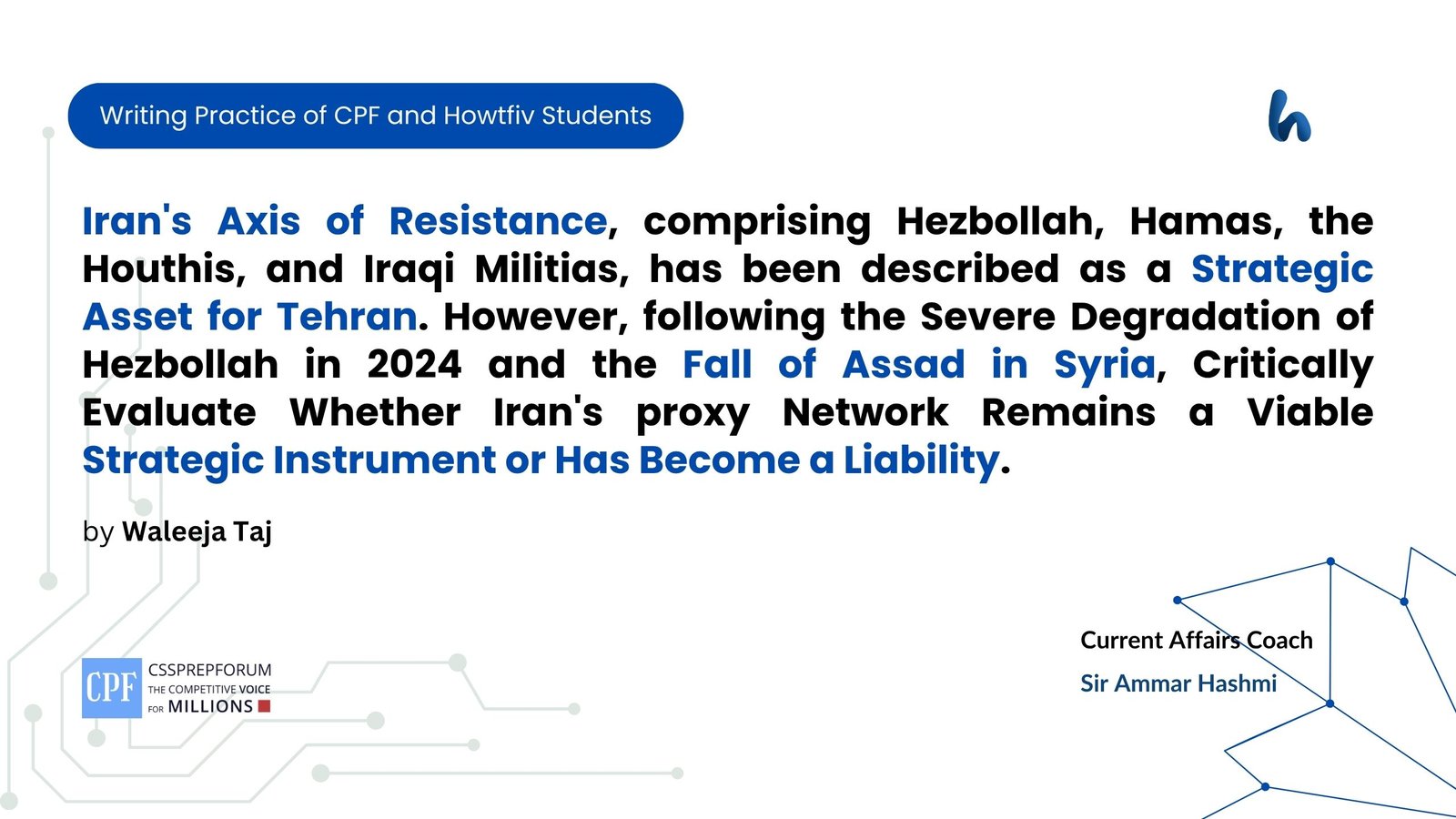
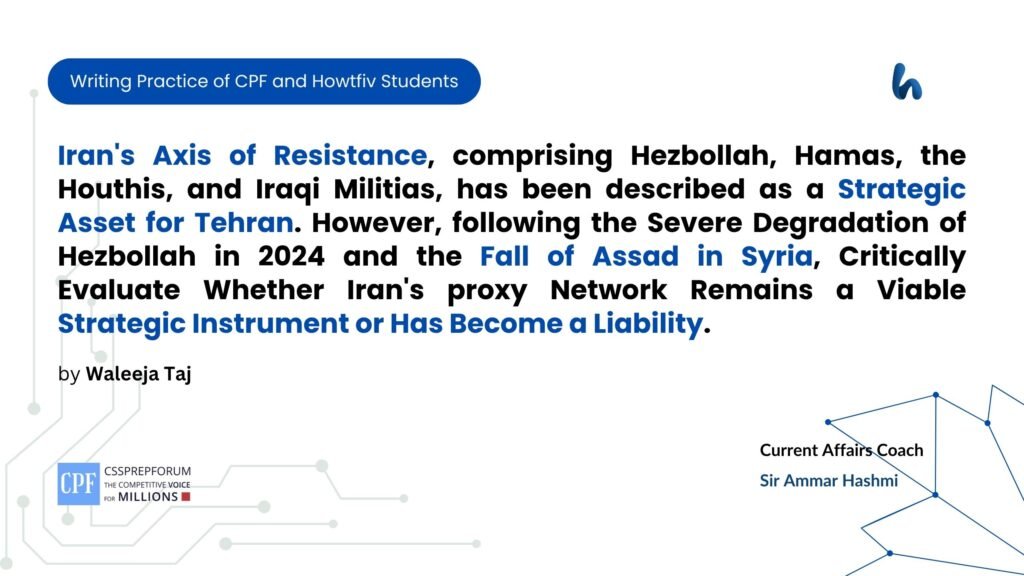
CSS Current Affairs | Iran’s Axis of Resistance as a Strategic Asset for Tehran
The following assignment question for CSS Current Affairs is solved by Waleeja Taj under the supervision of Howfiv’s Pakistan Affairs and Current Affairs Coaches: Miss Iqra Ali and Sir Ammar Hashmi. She learnt how to attempt 20 marks question and essay writing from Sir Syed Kazim Ali, Pakistan’s best CSS and PMS English essay and precis teacher with the highest success rate of his students. This solved question is attempted on the pattern taught by Sir to his students, scoring the highest marks in compulsory and optional subjects for years.
Outline
1-Introduction
2-Unveiling Iran’s “Axis of Resistance”: Historical Background and Objectives
3-Evaluating the Iranian “Axis of Resistance” as a Liability in the Current Epoch after the Fall of Assad in Syria and the Degradation of Hezbollah in Lebanon in 2024
- Disintegration of the supply chain and regional isolation
- Erosion of political leverage and governance of proxies
- Failure of Iran to maintain power due to overextension of proxy network
- Internal power struggles of proxies and their downplaying of Iranian Interests
- Collapse of the Asymmetric Warfare Doctrine Under Direct State Confrontation
4-Critical Analysis
5-Conclusion
Answer to the question
Introduction
Since the Iranian Revolution, Iran has adopted the policy of “exporting the revolution”, with like-minded people across the Middle East through the sponsorship of armed non-state actors. Framed as unified resistance against Israel and the United States, this network enabled Tehran to project influence across Lebanon, Syria, Iraq, Yemen, and Gaza while limiting the risk of direct Iranian confrontation. However, with the expansion of the network, Iran’s strategic control gradually loosens, as the armed groups pursue their own interests, sanctions from the global community on proxies, and economic constraints on Iran have downplayed their role as a strategic asset. Recently, the vulnerability of Iranian proxies has increased even more with Assad fall in Syria and Hezbollah’s degradation in Lebanon. Arguably, the strategic asset of Tehran has now turned into a strategic liability.
Unveiling Iran’s “Axis of Resistance”: Historical Background and Objectives
Iranian Revolution in 1979 served as a landmark event that changed not only the political landscape of Iran, but also brought major shifts in its foreign policy. In this line, they adopted a new ideological framework, “Wilayat al Faqhi,” meaning Guardianship of Islamic jurists, which led them to support groups and movements that aligned with the revolutionary ethos across the Middle East. The political chaos of the Iraq-Iran war set the stage for Iran to ally. In this way, they supported Hezbollah in Lebanon, Palestinian Jihad in Palestine, Iraqi militias in Iraq, and Houthis in Yemen. In practice, the objectives behind supporting armed groups include deterrence and retaliation against perceived threats from both regional rivals and global powers, using proxies to project power, and creating a semblance of strategic depth, allowing Iran to respond on multiple fronts.
Evaluating the Iranian “Axis of Resistance” as a Liability in the Current Epoch after the Fall of Assad in Syria and Hezbollah Degradation in Lebanon
- Disintegration of supply chain and regional isolation of Iran
First and foremost, geographically, Syria occupies a central position in the resistance ring, bridging Lebanon with Iraq and, ultimately, with Iran. Hezbollah in Lebanon, being an active proxy of Iran, was supported by Iran both militarily and financially, with Syria providing the safest transitional land route. Since the 2011 Arab Spring, Iran invested huge amounts in sustaining the Syrian regime and its security, creating militias through the Quds Force, sending Afghan Hazaras, Fatemi Youn brigades, supporting certain units of the regular army, and, additionally, Hezbollah of Lebanon was involved in supporting the regime. However, the fall of Assad was coupled with the disruption of the supply chain and also fractured the “Axis of Resistance,” as the East-West bridge broke, which constituted the Axis. For instance, Hassan Nasrallah, the former leader of Hezbollah, convinced Khamenei to sustain the Assad regime, arguing that the fall of the Assad regime would also mean the fall of the Axis of Resistance. This asserts Syria as a central link in the Axis of Resistance, whose collapse led to the regional isolation of Iran. Thus, Assad’s fall was of great disadvantage for Iran and broadly for Iranian proxies.
- Erosion of political leverage and governance of proxies
Similarly, Hezbollah in Lebanon was not only leveraged by Iran, but also remained an active player in the Lebanese government. In addition to its military wing, Hezbollah enjoyed popularity among Shia Muslims through its social welfare, along with its political position. However, after the October 2023 Hamas attack on Israel, Hezbollah’s intervention in the Gaza war with the intent of supporting Hamas, which culminated in Israel’s indiscriminate attacks on Lebanon, led to the mass displacement of Lebanese. This caused a wave of accusations against Hezbollah, as it was responsible for dragging the country into the war zone. Besides, Hezbollah was also blamed for fighting for Iran. As a result of this, the November 2024 ceasefire terms and UN resolutions 1559 and 1701, which stipulated the disarmament of Hezbollah and the deployment of the Lebanese army on the borders instead of Hezbollah. This pinpoints the erosion of Hezbollah’s legitimacy in Lebanon. Thus, once serving as a backbone of Iranian proxies, Hezbollah now faces domestic backlash, turning the strategic asset into a liability.
- Failure of Iran to maintain and project power due to overextension of network
Furthermore, the over extension of proxy network with the passage of time proved to be a burden for already sanctioned Iran with various financial constraints. To project power across the Middle East and deter rivals, Iran has to constantly supply weapons and finances to non-state actors to serve Iranian Interests. However, with the expansion of its proxy network, Iran faced hardships in sustaining the emerging network. For instance, the 2024 Israeli pager attack on Hezbollah caused the death of 176 commanders, creating a leadership vacuum that forced the IRGC to assume power, placing additional strain on Iran’s military resources. Thus, the extension of the proxy network not only stretches Iran’s army but also puts strain on Iran’s financial position, ultimately turning potential proxies into a liability.
- Collapse of the Asymmetric Warfare Doctrine under direct state confrontation
Moving forward, as per the objective of the Resistance axis, given the power imbalance, Iran used a proxy strategy to project influence and avoid direct state-to-state confrontation. This strategy serves not only as a tool of deterrence but also a destabilizing force in the Middle East. However, in the recent past, this strategic restraint has not translated in Iran’s favor. The proxies have largely failed in shielding Iran from full-scale war. For instance, the recent US- Israel war with Iran, started on 28 February 2026, can be aptly described as a failure of proxies to protect Iran from the cost of conventional war. Ultimately, shattered the asymmetric war doctrine of Iran, which they served as an asset.
- Internal power struggles of proxies and their downplaying of Iranian Interests
Moreover, the internal fragmentation due to power struggles among various militant groups and their retreat from serving Iranian Interests also created a dilemma for Iran. Iran has spent a lot on building, training, and sustaining these proxies that have now turned into a liability. For instance, Houthis’ shift to downplaying Iran’s and Hezbollah’s military role in Yemen shows that the group moved to prioritizing self-preservation over a regional projection of influence. In practice, in the 2025 Iran-Israel war, none of the proxies acted in a significant capacity in aid of Iran. This reflects the fractured structure and domestic power struggles instead of propelling Iranian agendas. Thus, although the proxy network served as a strategic asset for Tehran, it has now turned into a strategic liability.
Critical Analysis
Critically analyzing the so-called Axis of Resistance, reflecting the unity-of-fronts narrative has significantly lost its viability, if not completely degraded. The 2024 defeat of Hezbollah by Israel came as a major blow, after Israeli forces killed their leader and degraded most of their military arsenal. The subsequent toppling of the Assad regime in Syria contributed to the fragility of the Axis of Resistance. Syria, being a logistical and central corridor that served as a backbone of the axis, has now closed to Iran. However, following the concept of “Down but Not Out”, it is more likely that the effort of Iran and its partners will continue, although with less intensity, as noted by Al Jazeera. Despite the fact, the Strategic Restraint narrative of Iran has reached its lows with US-Israel joint aggression towards Iran and its proxies.
Conclusion
To sum it up, Iranian ideology of forward power projection through the Axis of Resistance has reflected strategic cohesion for almost two decades. Yet, under the facade of strategic cohesion, the strategic unification witnessed fragmentation due to its overextension and the devastation of a major proxy, Hezbollah, at the hands of Israel. The issue was compounded by Assad’s toppling, leading to the regional isolation, operational overstretching of the IRGC, and economic vulnerability of Iran. Moreover, the Iranian agenda of avoiding confrontation has also failed, mirrored in the 2026 Joint Israel-US attack on Iran, showing the ineffectiveness of proxy shielding. Therefore, the strategic depth and influence of the Iranian Axis of Resistance have largely failed, converting Iran’s strategic asset into a strategic liability.

CSS Solved Past Papers’ Essays
Looking for the last ten years of CSS and PMS Solved Essays and want to know how Sir Kazim’s students write and score the highest marks in the essays’ papers? Then, click on the CSS Solved Essays to start reading them.
CSS Solved Essays
CSS Solved Islamiyat Past Papers
Want to read the last ten years’ Islamiyat Solved Past Papers to learn how to attempt them and to score high? Let’s click on the link below to read them all freely. All past papers have been solved by Pakistan’s top CSS Islamiyat coaches having the highest score of their students.
CSS Solved Islamiyat
CSS Solved General Science & Ability Past Papers
Want to read the last ten years’ General Science & Ability Solved Past Papers to learn how to attempt them and to score high? Let’s click on the link below to read them all freely. All past papers have been solved by Pakistan’s top CSS GSA coachez having the highest score of their students.
CSS Solved General Science & Ability
CSS Solved Pakistan Affairs Past Papers
Want to read the last fifteen years’ Pakistan Affairs Solved Past Papers to learn how to attempt them and to score high? Let’s click on the link below to read them all freely. All past papers have been solved by Pakistan’s top CSS Pakistan Affairs coaches having the highest score of their students.
CSS Solved Pakistan Affairs
CSS Solved Current Affairs Past Papers
Want to read the last fifteen years’ Current Affairs Solved Past Papers to learn how to attempt them and to score high? Let’s click on the link below to read them all freely. All past papers have been solved by Pakistan’s top CSS Current Affairs coaches having the highest score of their students.
CSS Solved Current Affairs