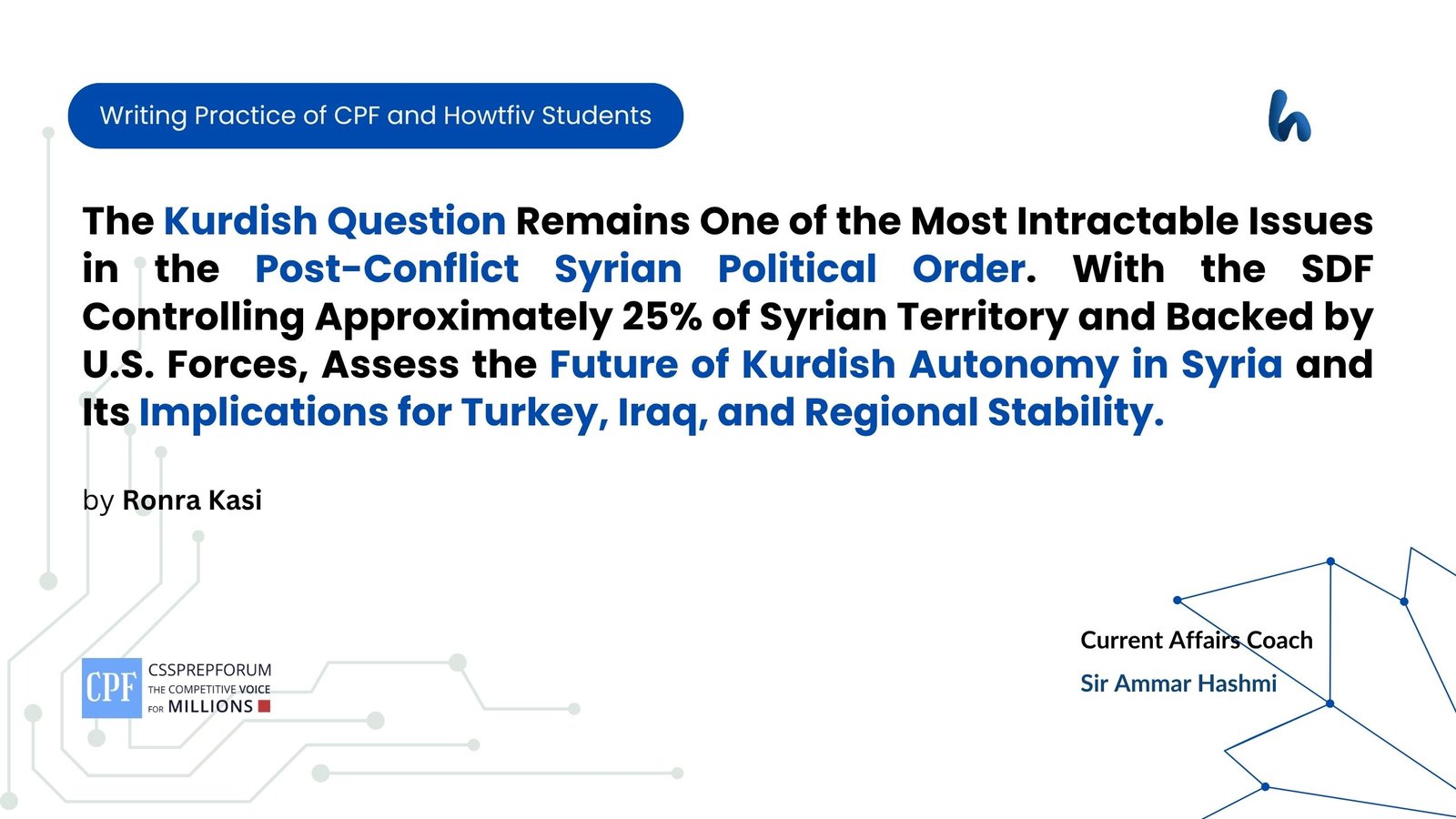
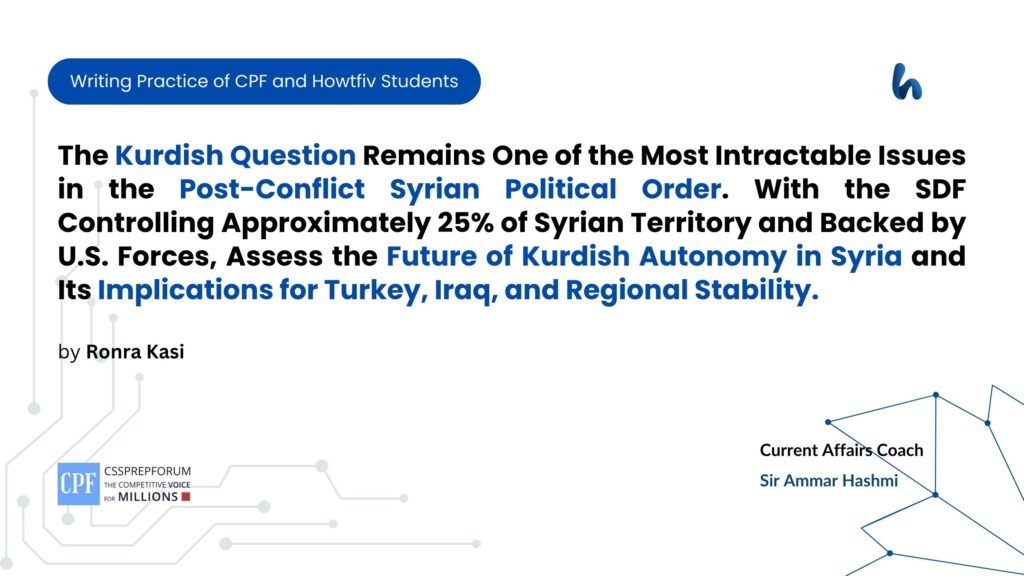
CSS Current Affairs | The Kurdish Question in the Post-Conflict Syrian Political Order
The following assignment question for CSS Current Affairs is solved by Ronra Kasi under the supervision of Howfiv’s Pakistan Affairs and Current Affairs Coaches: Miss Iqra Ali and Sir Ammar Hashmi. She learnt how to attempt 20 marks question and essay writing from Sir Syed Kazim Ali, Pakistan’s best CSS and PMS English essay and precis teacher with the highest success rate of his students. This solved question is attempted on the pattern taught by Sir to his students, scoring the highest marks in compulsory and optional subjects for years.

Outline
1-Introduction
2-Appraising the Current Overview on the Kurdish Question: Most Intractable Issues in the Post-Conflict Syrian Political Order
3-Assessing the Future of Kurdish Autonomy in Syria
- Kurdish Autonomy is Effectively Over, Replaced by Managed Centralization
- Case in Point: According to Chatham House, Feb 2026, hopes to establish a federal constitution or system of decentralization that would enshrine Kurdish autonomy in the northeast “lie in tatters,” with the push for a unified centralized state promoted by Damascus and embraced by its foreign backers having prevailed
- Asymmetrical Federalism Remains the Most Academically Credible Long-Term Solution, but Lacks Elite Political Backing
- Case in Point: According to the Middle East Policy journal (2026), President al-Sharaa’s drive to unify the country under centralized governance “appears unworkable,” and asymmetrical federalism offers a more durable pathway to stability.
- Structural Barriers Make Full Integration Fragile, Even if Politically Agreed
- Case in Point: According to the Washington Institute, the SDF has accepted nominal integration into the national military but prefers to maintain local command and control over Kurdish units. At the same time, Syria’s interim defence minister rejected the SDF’s proposal to remain a separate military bloc.
- Without Binding Constitutional Guarantees, Current Concessions are Reversible and Insufficient
- Case in Point: According to theStimson Centre, Jan 2026, current gains lack legal permanence: a decree alone cannot constitute a lasting guarantee or a comprehensive solution to the Kurdish issue, particularly since any presidential decree can be amended or revoked by executive decision; the absence of binding guarantees remains a central Kurdish concern.
4-Implications of the Kurdish Autonomy in Syria for Turkey, Iraq, and the Regional Stability
- Implication for Turkey: A Strategic Win that May Finally Unlock the Domestic PKK Peace Process
- Implication for Iraq: Weakened Bargaining Leverage and Economic Exposure, Despite Political Solidarity
- Implication for Regional Stability: A Security Vacuum Risk Tied to ISIS Detention and US Withdrawal
5-Conclusion
Answer to the Question
Introduction
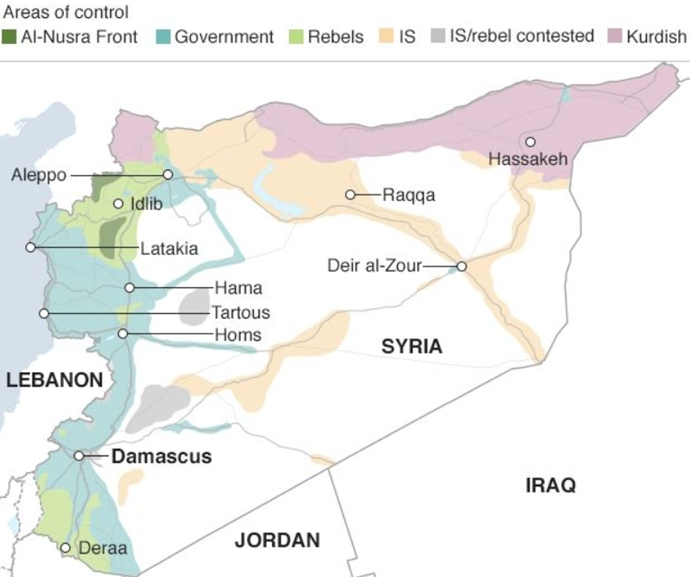
For over a decade, the Syrian Democratic Forces (SDF) governed nearly a third of Syria, controlled most of its oil wealth, and operated under U.S. military protection, making Kurdish autonomy the most consequential exception to Syria’s post-2011 fragmentation. Notwithstanding that, the foundation has since collapsed. As an illustration, in January 2026, a Syrian government offensive stripped the SDF of roughly 80-90% of its territory within two weeks, confining it to a narrow strip. By April 2026, U.S. forces had fully withdrawn, ending the external backing that sustained Kurdish self-rule. In a word, the Kurdish question has shifted from defending territorial autonomy to negotiating recognition within a centralized state.
Appraising the Current Overview on the Kurdish Question: Most Intractable Issues in the Post-Conflict Syrian Political Order
Military integration has eroded Kurdish autonomy more rapidly than expected. Following the clashes in January 2026, Damascus regained roughly 80% of the territory previously held by the Democratic Autonomous Administration of North-East Syria (DAANES). Furthermore, Kurdish political representation is now split between participation and boycott. In the May 2026 parliamentary process, voters and local electoral colleges in al-Hassakeh, Qamishli, and Ayn al-Arab selected representatives for the parliament in Damascus on May 24, 2026, but the YPG refused to participate and called for the elections’ cancellation, while the Kurdish National Council (KNC) chose institutional engagement and secured seats. Thus, this is the structural issue underlying all the others above: integration, representation, and rights protections are currently running ahead of any binding legal framework.
Assessing the Future of the Kurdish Autonomy in Syria
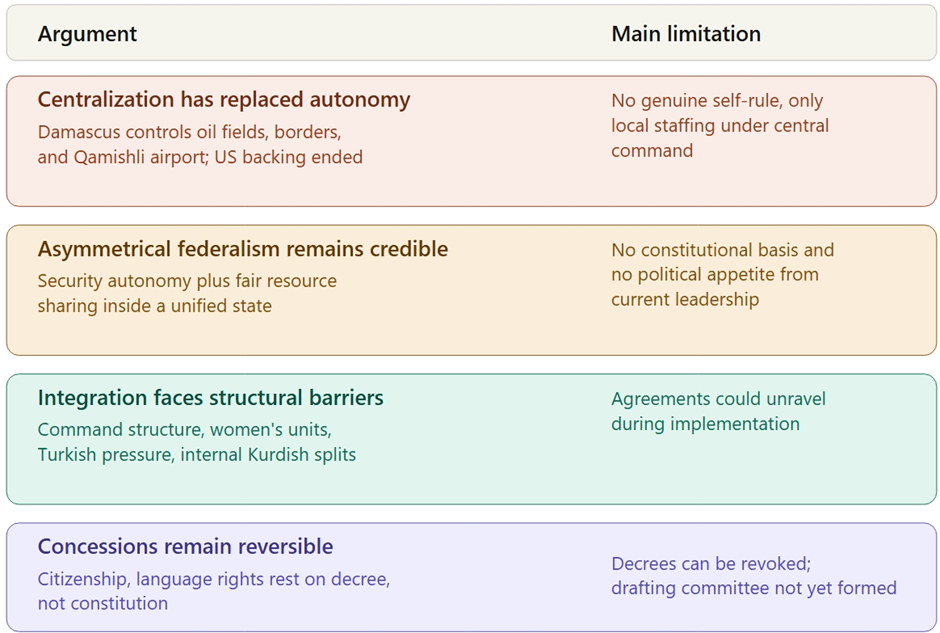
- Kurdish Autonomy is Effectively Over, Replaced by Managed Centralization
To begin with, the military and political record of early 2026 points firmly toward centralization rather than continued Kurdish self-rule. Certainly, after losing the vast majority of its territory within weeks, the SDF’s remaining strongholds now exist only at the discretion of Damascus, which has already absorbed key oil fields, border crossings, and the Qamishli airport into central control. As an illustration, according to Chatham House, February 2026, hopes to establish a federal constitution or system of decentralization that would enshrine Kurdish autonomy in the northeast “lie in tatters,” with the push for a unified centralized state promoted by Damascus and embraced by its foreign backers having prevailed. Accordingly, the United States, once the SDF’s principal backer, declined to intervene during the offensive and has since aligned itself fully with the Syrian government. On the other hand, while some local institutions may remain staffed by Kurds, they now answer to Damascus rather than operating independently. Consequently, this suggests recognition without genuine autonomy, marking a decisive shift away from federal or decentralized arrangements.
- Asymmetrical Federalism Remains the Most Academically Credible Long-Term Solution, but Lacks Elite Political Backing
Building upon the same lines, a more durable long-term solution may lie in a carefully limited federal arrangement, granting Kurdish regions security autonomy and a fair share of resource revenue while remaining inside a unified Syrian state. Nevertheless, comparable arrangements elsewhere show that negotiated security structures and shared resource management can stabilize divided societies over time. Yet, Syria differs from these precedents in one critical respect: Kurdish self-administration there has no constitutional foundation, unlike federal systems built on formal legal recognition. In particular, according to the Middle East Policy journal (2026), President al-Sharaa’s drive to unify the country under centralized governance “appears unworkable,” and asymmetrical federalism offers a more durable pathway to stability. Namely, the current Syrian leadership has shown no interest in adopting such a model, and shifting international priorities provides little pressure to reconsider it. Therefore, federalism remains a credible idea on paper, but one without realistic political traction at present.
- Structural Barriers Make Full Integration Fragile, Even if Politically Agreed
Compounding this further, even where Kurdish forces and Damascus have reached formal understandings, several practical obstacles threaten to undermine lasting integration. Disputes persist over whether Kurdish units will retain any local command structure or dissolve entirely into the national army, and the presence of all-female Kurdish combat units sits uneasily with the worldview of Syria’s current leadership. For instance, according to the Washington Institute, the SDF has accepted nominal integration into the national military but prefers to maintain local command and control over Kurdish units. At the same time, Syria’s interim defence minister rejected the SDF’s proposal to remain a separate military bloc. Turkey’s continued unease about armed Kurdish groups near its border adds an external constraint that is only partly within Damascus’s control. Kurdish political factions themselves remain divided over what kind of self-governance they ultimately want, with no single agreed model. These unresolved tensions mean that today’s agreements, however genuine, could still unravel during implementation.
- Without Binding Constitutional Guarantees, Current Concessions are Reversible and Insufficiently Reversible
On the whole, the rights Kurds have gained so far, including citizenship restoration and recognition of the Kurdish language, currently rest on presidential decree rather than constitutional law. This distinction matters greatly, since a decree can be altered or withdrawn by executive decision alone, leaving no durable legal protection in place. To illustrate, according to the Stimson Centre, Jan 2026, current gains lack legal permanence: a decree alone cannot constitute a lasting guarantee or a comprehensive solution to the Kurdish issue, particularly since any presidential decree can be amended or revoked by executive decision; the absence of binding guarantees remains a central Kurdish concern. Of critical importance here is that Syria’s permanent constitution has yet to be drafted, and the body responsible for writing it has not even been formed, meaning the rules that would make these rights permanent simply do not exist, yet. Kurdish representatives have consistently pushed for these protections to be written into the constitution itself, recognizing that anything short of this remains conditional. Until that happens, today’s gains remain provisional rather than secure.
Implications of the Kurdish Autonomy in Syria for Turkey, Iraq, and Regional Stability
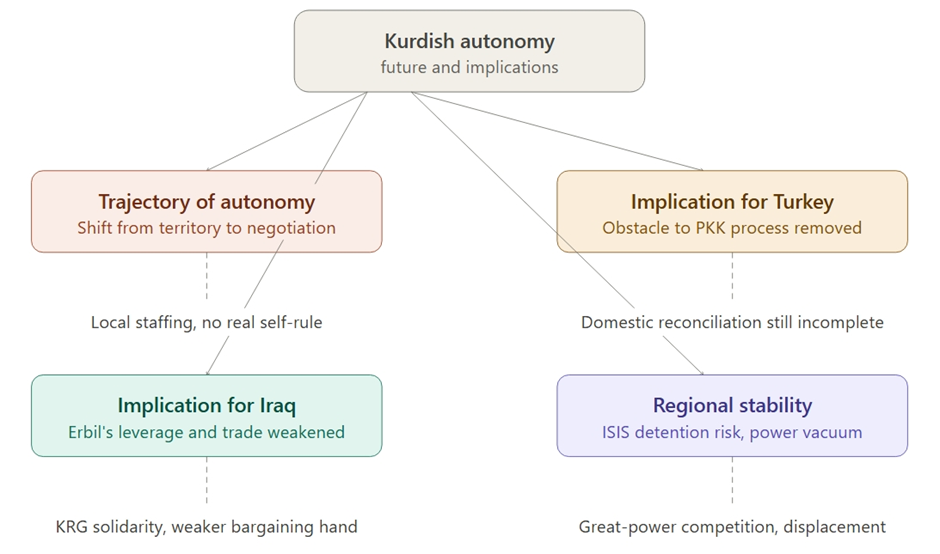
- Implication for Turkey: A Strategic Win that May Finally Unlock the Domestic PKK Peace Process
The collapse of SDF autonomy in northern Syria has removed one of Turkey’s deepest security anxieties: the fear of a PKK-linked self-governing zone taking root along its border. Moreover, the SDF is now folding into the Syrian state rather than standing apart from it; ultimately, Ankara has begun publicly distinguishing between the SDF’s pragmatic leadership and the PKK’s commanders in northern Iraq, framing the former as cooperative and the latter as obstructive. In no uncertain terms, this shift has practical consequences; Turkish officials have linked Syria’s outcome directly to their own domestic reconciliation effort, suggesting that a major roadblock to advancing legislation on the PKK’s disarmament and reintegration has now been cleared. Even so, the underlying peace process remains incomplete, since the PKK’s leadership has not yet agreed to formal terms for demobilisation, and Kurdish political voices in Turkey have warned against mistaking the SDF’s weakening for a genuine resolution of Kurdish demands more broadly. In other words, Turkey’s gain is strategic and immediate, but the harder political work of integrating Kurdish rights into Turkey’s own constitutional order still lies ahead.
- Implication for Iraq: Weakened Bargaining Leverage and Economic Exposure, Despite Political Solidarity
For Iraq, and particularly for the Kurdistan Regional Government in Erbil, the weakening of the SDF carries mixed and largely unfavourable consequences. With Damascus now in control of former Kurdish-held territory in the northeast, new trade and transit routes between Syria, Iraq, and Turkey are likely to bypass the Kurdistan Region altogether, threatening the revenue and strategic relevance that Erbil’s border crossings have long provided. Iraqi Kurdish officials have acknowledged that without the SDF as a fellow Kurdish actor at the negotiating table, their own bargaining position in regional diplomacy has been diminished. Consequently, this comes at a moment when the Kurdistan Region is already strained by drone attacks linked to wider regional conflict and by its exposed position as host to both foreign forces and opposition groups from neighbouring states. In the same way, Iraqi Kurdish leaders have responded with solidarity rather than alarm, offering humanitarian support to Syrian Kurds and pointing to their own constitutionally protected status in Iraq as a source of greater long-term security than the SDF ever possessed. To put it succinctly, whether that constitutional protection proves sufficient to offset the economic and political costs of a weakened Syrian Kurdish partner remains to be seen.
- Implication for Regional Stability: A Security Vacuum Risk Tied to ISIS Detention and US Withdrawal
Beyond Turkey and Iraq, the unravelling of Kurdish autonomy in Syria carries broader risks for regional security. The withdrawal of American forces has eliminated the principal guarantor that once secured detention facilities holding thousands of ISIS fighters and their families, raising fears of escapes and a slow re-infiltration of militants into local communities. For instance, reports during the January 2026 fighting of prisoners escaping from at least one detention facility, even if the exact numbers remain disputed, illustrate how quickly security can deteriorate when oversight changes hands. Certainly, the vacuum left by the American departure has also begun attracting renewed attention from other outside powers seeking influence in north-eastern Syria, adding a layer of great-power competition to an already fragile situation. Accordingly, large-scale displacement of Kurdish civilians during the fighting has further strained neighbouring areas, including parts of Iraqi Kurdistan already under economic and security pressure. Taken together, these developments suggest that the consequences of Syria’s Kurdish settlement will not remain confined to Kurdish communities alone, but will shape the wider stability of a region still recovering from years of overlapping conflicts.
Conclusion
The inescapable conclusion is that the era of de facto Kurdish autonomy in Syria, sustained by territorial control and U.S. patronage, has closed. What remains is conditional accommodation, citizenship, language rights, and limited local administration, offered by a government that rejects federalism and has yet to enshrine any of it constitutionally. For Turkey, this removes a major obstacle to its PKK peace process; for Iraq’s Kurdistan Region, it weakens regional leverage; for the wider region, it risks a security vacuum and a precedent that informally granted autonomy can be informally withdrawn. The real test now lies in constitutional bargaining, not battlefield outcomes.

CSS Solved Past Papers’ Essays
Looking for the last ten years of CSS and PMS Solved Essays and want to know how Sir Kazim’s students write and score the highest marks in the essays’ papers? Then, click on the CSS Solved Essays to start reading them.
CSS Solved Essays
CSS Solved Islamiyat Past Papers
Want to read the last ten years’ Islamiyat Solved Past Papers to learn how to attempt them and to score high? Let’s click on the link below to read them all freely. All past papers have been solved by Pakistan’s top CSS Islamiyat coaches having the highest score of their students.
CSS Solved Islamiyat
CSS Solved General Science & Ability Past Papers
Want to read the last ten years’ General Science & Ability Solved Past Papers to learn how to attempt them and to score high? Let’s click on the link below to read them all freely. All past papers have been solved by Pakistan’s top CSS GSA coachez having the highest score of their students.
CSS Solved General Science & Ability
CSS Solved Pakistan Affairs Past Papers
Want to read the last fifteen years’ Pakistan Affairs Solved Past Papers to learn how to attempt them and to score high? Let’s click on the link below to read them all freely. All past papers have been solved by Pakistan’s top CSS Pakistan Affairs coaches having the highest score of their students.
CSS Solved Pakistan Affairs
CSS Solved Current Affairs Past Papers
Want to read the last fifteen years’ Current Affairs Solved Past Papers to learn how to attempt them and to score high? Let’s click on the link below to read them all freely. All past papers have been solved by Pakistan’s top CSS Current Affairs coaches having the highest score of their students.
CSS Solved Current Affairs