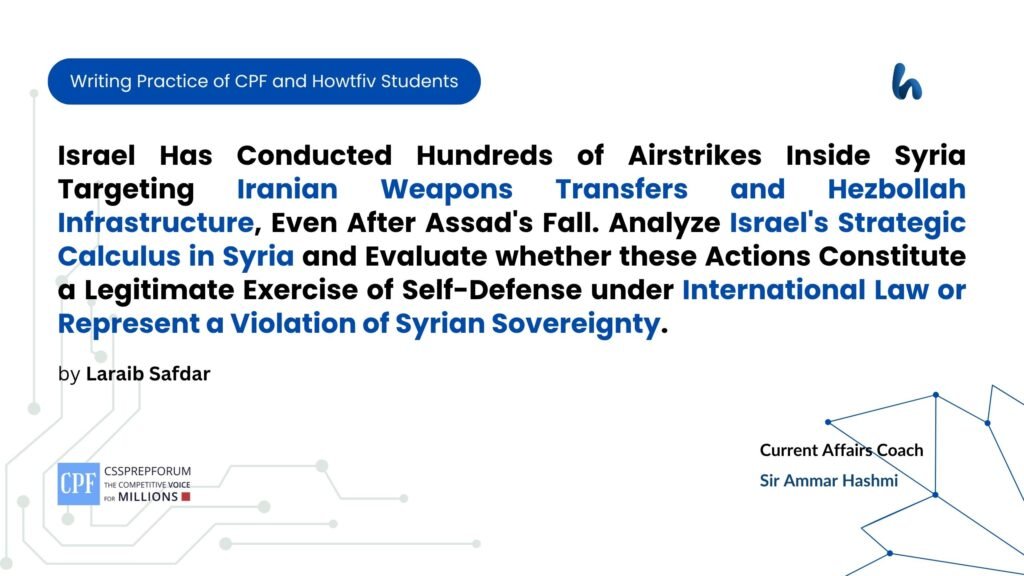
CSS Current Affairs | Israel’s Strategic Calculus in Syria after Assad’s fall
The following assignment question for CSS Current Affairs is solved by Laraib Safdar under the supervision of Howfiv’s Pakistan Affairs and Current Affairs Coaches: Miss Iqra Ali and Sir Ammar Hashmi. She learnt how to attempt 20 marks question and essay writing from Sir Syed Kazim Ali, Pakistan’s best CSS and PMS English essay and precis teacher with the highest success rate of his students. This solved question is attempted on the pattern taught by Sir to his students, scoring the highest marks in compulsory and optional subjects for years.

Outline
1-Introduction
2-Israel’s Strategic Calculus in Syria
- Preventing Iranian Entrenchment
- Countering Hezbollah’s Military Capabilities
- Maintaining Regional Deterrence
3-Legal Evaluation Under International Law
- Israel’s Self-Defense Argument under Article 51
- Arguments Supporting Violation of Syrian Sovereignty
- The Debate over Anticipatory Self-Defense
4-Critical Analysis
5-Conclusion
Answer to the question
Introduction
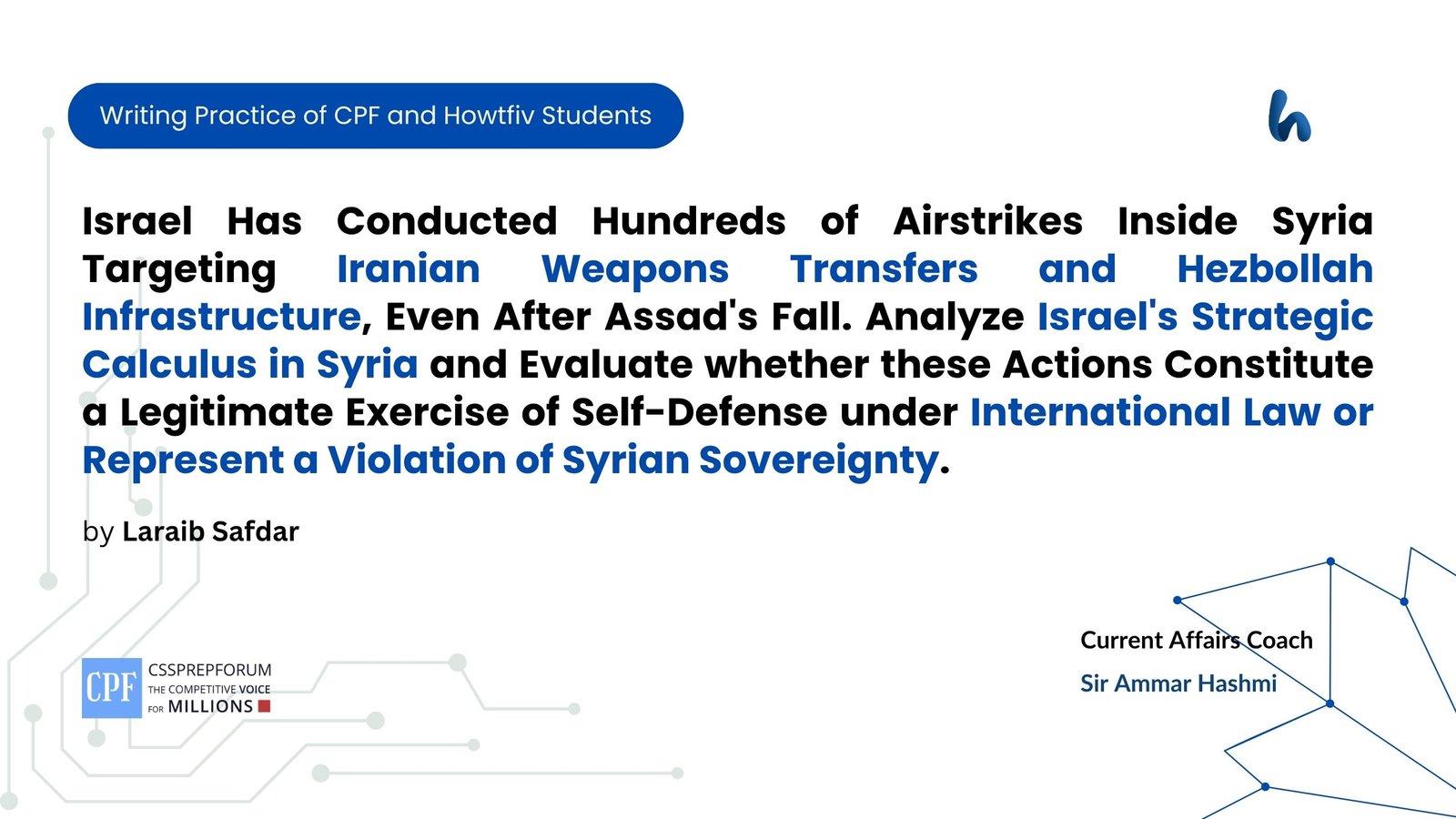
The conflict in Syria has evolved into a complex regional security challenge involving multiple state and non-state actors. Among the most significant external actors is Israel, which has conducted hundreds of airstrikes targeting alleged Iranian weapons transfers, military installations, and the infrastructure of Hezbollah. These operations have continued even after the fall of Assad government, reflecting Israel’s determination to prevent hostile forces from consolidating their presence along its northern frontier. Consequently, Israel justifies these strikes as preventive measures necessary for its national security, whereas Syria and many international observers regard them as violations of state sovereignty. Therefore, evaluating Israel’s actions requires balancing its strategic security objectives against the principles of sovereignty and the legal limits imposed by international law regarding the use of force.
Israel’s Strategic Calculus in Syria
To begin with, Israel views Syria as a critical arena in its broader security strategy because of Iran’s expanding regional influence and Hezbollah’s growing military capabilities. Consequently, Israeli policymakers seek to prevent Syria from becoming a logistical corridor for the transfer of advanced missiles, drones, and military equipment from Iran to Hezbollah in Lebanon. Moreover, Israel perceives the establishment of Iranian military infrastructure near the Golan Heights as a direct threat to its national security. Therefore, Israeli military operations are intended to deny adversaries the ability to establish a permanent strategic presence close to Israeli territory.
- Preventing Iranian Entrenchment
Furthermore, Israel’s air campaign is guided by the objective of preventing long-term Iranian military entrenchment in Syria. Iran has historically supported allied militias and provided military assistance to the Syrian government and Hezbollah. Consequently, Israel fears that unchecked Iranian influence would enable the creation of an integrated military front extending from Iran through Iraq and Syria to Lebanon. Thus, repeated airstrikes are intended to disrupt weapons transfers, destroy military infrastructure, and weaken Iran’s regional deterrence capabilities.
- Countering Hezbollah’s Military Capabilities
Moreover, Hezbollah possesses a substantial arsenal of rockets and precision-guided missiles capable of striking Israeli territory. Consequently, Israel considers the transfer of sophisticated weapon systems through Syria to Hezbollah as an unacceptable security risk. By targeting warehouses, transportation routes, and military facilities, Israel seeks to degrade Hezbollah’s operational capabilities before these weapons become operational. Therefore, these strikes form part of Israel’s broader doctrine of pre-emptive security and deterrence.
- Maintaining Regional Deterrence
To begin with, Israel’s actions are designed to reinforce regional deterrence by demonstrating its willingness to act against perceived security threats beyond its borders. Consequently, repeated military operations signal that Israel will not tolerate the military expansion of hostile actors in neighbouring states. Furthermore, this strategy aims to discourage Iran and its allies from increasing their military footprint in Syria. Thus, deterrence remains a central element of Israel’s regional security calculus.
Legal Evaluation Under International Law
- Israel’s Self-Defense Argument under Article 51
Furthermore, Israel argues that its operations are justified under Article 51 of the United Nations Charter, which recognizes the inherent right of self-defense following an armed attack. Israeli officials contend that imminent threats posed by Iranian weapons transfers and Hezbollah’s military activities necessitate preventive action before attacks can be launched against Israeli territory. Consequently, supporters of Israel’s position argue that when a neighbouring state is unable or unwilling to prevent its territory from being used by hostile armed groups, limited defensive measures may be justified to protect national security.
- Arguments Supporting Violation of Syrian Sovereignty
However, critics argue that Israel’s repeated airstrikes violate one of the fundamental principles of international law: the sovereignty and territorial integrity of states. Article 2(4) of the UN Charter prohibits the use of force against another state’s territorial integrity or political independence except in limited circumstances recognized under international law. Consequently, many legal scholars maintain that preventive strikes based on anticipated future threats do not satisfy the strict legal requirements of necessity and imminence associated with self-defense. Furthermore, the absence of authorization from the United Nations Security Council strengthens arguments that these operations constitute unlawful uses of force within Syrian territory.
- The Debate over Anticipatory Self-Defense
Moreover, international law remains divided regarding the doctrine of anticipatory or preventive self-defense. Some states interpret Article 51 broadly, allowing action against imminent threats before an attack occurs. In contrast, others argue that self-defense is lawful only after an armed attack has taken place or when the threat is immediate and unavoidable. Consequently, Israel’s reliance on anticipatory self-defense remains legally controversial because assessments of imminence, necessity, and proportionality are subject to differing interpretations. Therefore, the legality of Israel’s operations continues to be widely debated among international legal experts.
Critical Analysis
However, determining the legality of Israel’s airstrikes requires balancing two competing principles of international law: the inherent right of self-defense and the sovereign equality of states. Israel argues that repeated strikes are necessary to prevent imminent threats posed by Iranian military infrastructure and Hezbollah. Nevertheless, many international legal scholars contend that the frequency and preventive nature of these operations exceed the strict requirements of necessity, imminence, and proportionality under Article 51 of the UN Charter. Furthermore, the absence of Syrian consent or explicit authorization from the United Nations Security Council reinforces claims that these strikes undermine Syrian sovereignty. Therefore, while Israel’s security concerns remain genuine, the legal justification for its continued military operations remains highly contested, illustrating the tension between strategic necessity and the international legal prohibition on the unilateral use of force.
Conclusion
In conclusion, Israel’s airstrikes in Syria are driven by a strategic objective of preventing Iranian military entrenchment, disrupting Hezbollah’s weapons supply networks, and maintaining regional deterrence. From Israel’s perspective, these operations constitute necessary measures of self-defense against evolving security threats. However, under international law, their legality remains disputed because repeated military operations conducted without Syrian consent or explicit UN authorization raise serious concerns regarding state sovereignty, concerns that persist even as Syria transitions into a post-Assad era, and the permissible scope of anticipatory self-defense. Ultimately, the diplomatic and legal deadlock reflects the continuing tension between a state’s right to protect its national security and the international legal order founded upon sovereignty, territorial integrity, and the prohibition of the unilateral use of force.

CSS Solved Past Papers’ Essays
Looking for the last ten years of CSS and PMS Solved Essays and want to know how Sir Kazim’s students write and score the highest marks in the essays’ papers? Then, click on the CSS Solved Essays to start reading them.
CSS Solved Essays
CSS Solved Islamiyat Past Papers
Want to read the last ten years’ Islamiyat Solved Past Papers to learn how to attempt them and to score high? Let’s click on the link below to read them all freely. All past papers have been solved by Pakistan’s top CSS Islamiyat coaches having the highest score of their students.
CSS Solved Islamiyat
CSS Solved General Science & Ability Past Papers
Want to read the last ten years’ General Science & Ability Solved Past Papers to learn how to attempt them and to score high? Let’s click on the link below to read them all freely. All past papers have been solved by Pakistan’s top CSS GSA coachez having the highest score of their students.
CSS Solved General Science & Ability
CSS Solved Pakistan Affairs Past Papers
Want to read the last fifteen years’ Pakistan Affairs Solved Past Papers to learn how to attempt them and to score high? Let’s click on the link below to read them all freely. All past papers have been solved by Pakistan’s top CSS Pakistan Affairs coaches having the highest score of their students.
CSS Solved Pakistan Affairs
CSS Solved Current Affairs Past Papers
Want to read the last fifteen years’ Current Affairs Solved Past Papers to learn how to attempt them and to score high? Let’s click on the link below to read them all freely. All past papers have been solved by Pakistan’s top CSS Current Affairs coaches having the highest score of their students.
CSS Solved Current Affairs