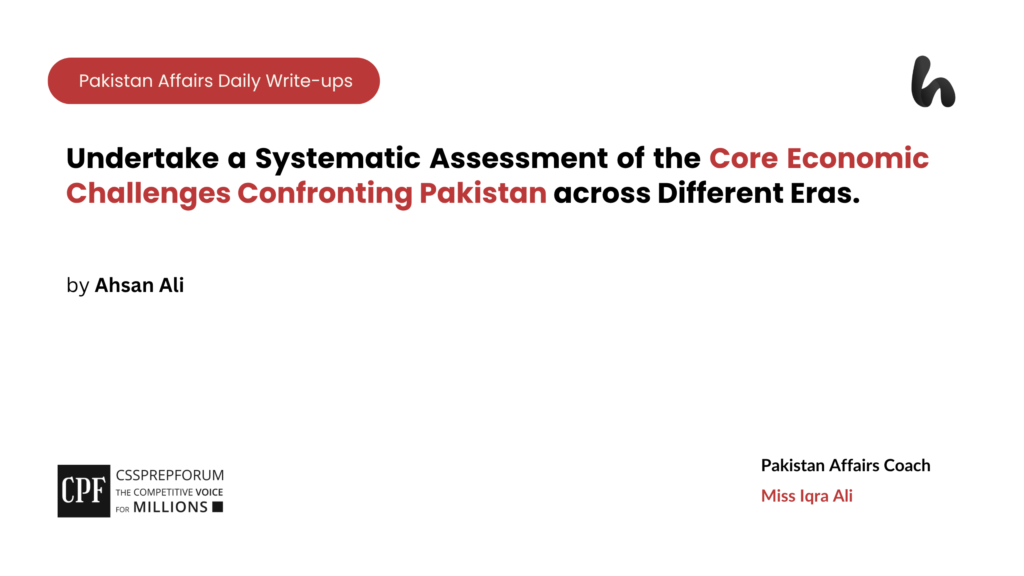
CSS Pakistan Affairs | Economic Challenges of Pakistan in Different Eras.
The following assignment question for CSS Current Affairs is solved by Ahsan Ali under the supervision of Howfiv’s Pakistan Affairs and Current Affairs Coaches: Miss Iqra Ali and Sir Ammar Hashmi. She learnt how to attempt 20 marks question and essay writing from Sir Syed Kazim Ali, Pakistan’s best CSS and PMS English essay and precis teacher with the highest success rate of his students. This solved question is attempted on the pattern taught by Sir to his students, scoring the highest marks in compulsory and optional subjects for years.

Outline
1-Introduction
2-Overview of Pakistan’s Economic Evolution
3-Economic Challenges of Pakistan Across Different Eras
- 1947–1971: Foundations and Early Structural Imbalances
- 1971–1988: State-led Economy and External Dependence
- 1988–2008: Recurring Fiscal and External Crises
- 2008–2018: Energy Crisis and Macroeconomic Instability
- 2018–2026: Debt, Inflation and Intensified Structural Vulnerabilities
4-Critical Analysis
5-Conclusion
Answer to the question
Introduction
Pakistan’s economic history has been characterized by repeated cycles of growth followed by fiscal, external, and inflationary crises. Although each era has had its own circumstances, persistent debt, inflation, weak exports, low productivity, and external dependence have remained major constraints on sustainable development. According to the IMF, Pakistan’s real GDP contracted by 0.2% in FY2022-23, while average consumer-price inflation reached 29.2% and general government debt stood at 77.3% of GDP. These figures reflect the severity of the recent economic crisis and the interaction of multiple economic pressures. The recurrence of such crises across different periods indicates that short-term stabilization has often been achieved without resolving deeper structural weaknesses. Therefore, Pakistan’s economic challenges are fundamentally structural and have evolved across successive eras.
Overview of Pakistan’s Economic Evolution
Pakistan’s economic trajectory has been marked by high growth without sustained structural transformation, followed by recurring periods of macroeconomic instability. The 1960s witnessed rapid expansion, while later decades saw the economy increasingly constrained by fiscal deficits, external imbalances, debt, and weak productivity. According to the World Bank, Pakistan’s GDP growth averaged 6.8% during the 1960s, compared with 4.8% during the 1970s, indicating a significant decline in growth momentum after the first major phase of economic expansion. This transition established a recurring pattern in which periods of strong growth were not accompanied by sufficient structural reforms to sustain that growth. Thus, Pakistan’s economic evolution can be viewed as a transition from early growth and industrialization to persistent macroeconomic and structural vulnerabilities.
Economic Challenges Across Different Eras
- 1947-1971: Foundations and Early Structural Imbalances
The first decades after independence were characterized by institution-building, rapid industrialization, and the creation of a productive economic base. Pakistan initially faced limited industrial capacity and dependence on agriculture, but the 1960s brought substantial expansion in manufacturing and investment. According to the World Bank, GDP growth averaged 6.8% during the 1960s, with agriculture growing by 5% and manufacturing by 10% annually. This rapid expansion, however, was supported partly by substantial foreign-resource inflows and was accompanied by growing concerns regarding the distribution of economic gains. Hence, the first era established growth but left important structural and distributional weaknesses unresolved.
- 1971-1988: State-led Economy and External Dependence
The post-1971 period witnessed a significant shift towards state intervention and nationalization, alongside external shocks that weakened economic performance. Nationalization reduced the role of private enterprise, while oil-price increases and other external pressures added to economic difficulties. According to the World Bank, average GDP growth fell from 6.8% in the 1960s to 4.8% in the 1970s, while the large-scale nationalization Programme between 1972 and 1976 weakened private-sector confidence and impaired resource allocation. The decade therefore represented a departure from the earlier growth model and increased the economy’s dependence on state-led activity and external resources. Consequently, the foundations of later fiscal and structural problems became more pronounced.
- 1988-2008: Recurring Fiscal and External Crises
The period from 1988 to 2008 was characterized by repeated balance-of-payments pressures, fiscal weaknesses, and dependence on stabilization programs. Economic growth continued, but successive governments struggled to maintain macroeconomic stability and implement reforms consistently. According to the IMF, Pakistan entered seven IMF-supported arrangements between 1988 and 2001, reflecting the recurrence of external financing and stabilization requirements during this period. The repeated programs also indicated that short-term financial stabilization was not translating into durable resolution of fiscal and external-sector weaknesses. Thus, the era entrenched Pakistan’s recurring boom-and-bust pattern.
- 2008-2018: Energy Crisis and Macroeconomic Instability
The period from 2008 to 2018 witnessed growing energy shortages, fiscal pressures, inflation, and balance-of-payments difficulties, which constrained economic growth. The energy crisis was particularly significant because persistent losses and payment arrears in the power sector created a fiscal burden and discouraged productive activity. According to the IMF, energy-sector circular-debt accumulation reached Rs 450 billion in FY2018, reflecting the scale of the power sector’s structural weakness. The energy crisis therefore became closely connected with fiscal stress, reduced industrial productivity, and wider macroeconomic instability. Thus, energy-sector weaknesses became a major structural constraint during this era.
- 2018-2026: Debt, Inflation and Intensified Structural Vulnerabilities
The period since 2018 has been marked by severe external financing pressures, rising debt, currency depreciation and exceptionally high inflation, particularly during 2022-23. The COVID-19 shock, global commodity-price pressures and domestic imbalances further intensified these vulnerabilities. According to the IMF, Pakistan’s consumer-price inflation reached 29.2% in FY2022-23, while general government debt, including IMF obligations, reached 83.5% of GDP. The simultaneous rise in inflation and debt demonstrated the limited room available for macroeconomic policy and contributed to repeated demands for external financing and stabilization. Hence, the recent era represents the most intense manifestation of Pakistan’s long-standing economic vulnerabilities.
Critical Analysis
Pakistan’s recurring economic crises reveal a fundamental gap between short-term stabilization and long-term structural reform. Successive governments have often responded to fiscal and external pressures through borrowing, austerity, and stabilization programs, while the underlying weaknesses in taxation, exports, energy, and productivity have remained largely unresolved. According to the IMF, Pakistan has entered 23 IMF-supported programs since 1958, highlighting the repeated need for external assistance to manage economic instability. This repeated reliance on stabilization programs suggests that the country has frequently addressed immediate financing gaps without achieving sufficient structural transformation. Therefore, Pakistan’s recurring economic crises stem from unresolved structural weaknesses rather than temporary shocks alone.
Conclusion
In conclusion, Pakistan’s economic challenges have evolved across eras, but their underlying structural weaknesses have persisted. The nature of the crisis has shifted from early developmental constraints to fiscal deficits, external dependence, energy shortages, debt accumulation, and inflation. The repeated need for stabilization programs indicates that short-term measures have not produced lasting economic transformation. Sustainable growth requires stronger fiscal capacity, export competitiveness, energy-sector reform, and consistent economic policies. Pakistan must therefore move from recurring crisis management towards sustained structural reform.
CSS Solved Past Papers’ Essays
Looking for the last ten years of CSS and PMS Solved Essays and want to know how Sir Kazim’s students write and score the highest marks in the essays’ papers? Then, click on the CSS Solved Essays to start reading them.
CSS Solved Essays
CSS Solved Islamiyat Past Papers
Want to read the last ten years’ Islamiyat Solved Past Papers to learn how to attempt them and to score high? Let’s click on the link below to read them all freely. All past papers have been solved by Pakistan’s top CSS Islamiyat coaches having the highest score of their students.
CSS Solved Islamiyat
CSS Solved General Science & Ability Past Papers
Want to read the last ten years’ General Science & Ability Solved Past Papers to learn how to attempt them and to score high? Let’s click on the link below to read them all freely. All past papers have been solved by Pakistan’s top CSS GSA coachez having the highest score of their students.
CSS Solved General Science & Ability
CSS Solved Pakistan Affairs Past Papers
Want to read the last fifteen years’ Pakistan Affairs Solved Past Papers to learn how to attempt them and to score high? Let’s click on the link below to read them all freely. All past papers have been solved by Pakistan’s top CSS Pakistan Affairs coaches having the highest score of their students.
CSS Solved Pakistan Affairs
CSS Solved Current Affairs Past Papers
Want to read the last fifteen years’ Current Affairs Solved Past Papers to learn how to attempt them and to score high? Let’s click on the link below to read them all freely. All past papers have been solved by Pakistan’s top CSS Current Affairs coaches having the highest score of their students.
CSS Solved Current Affairs