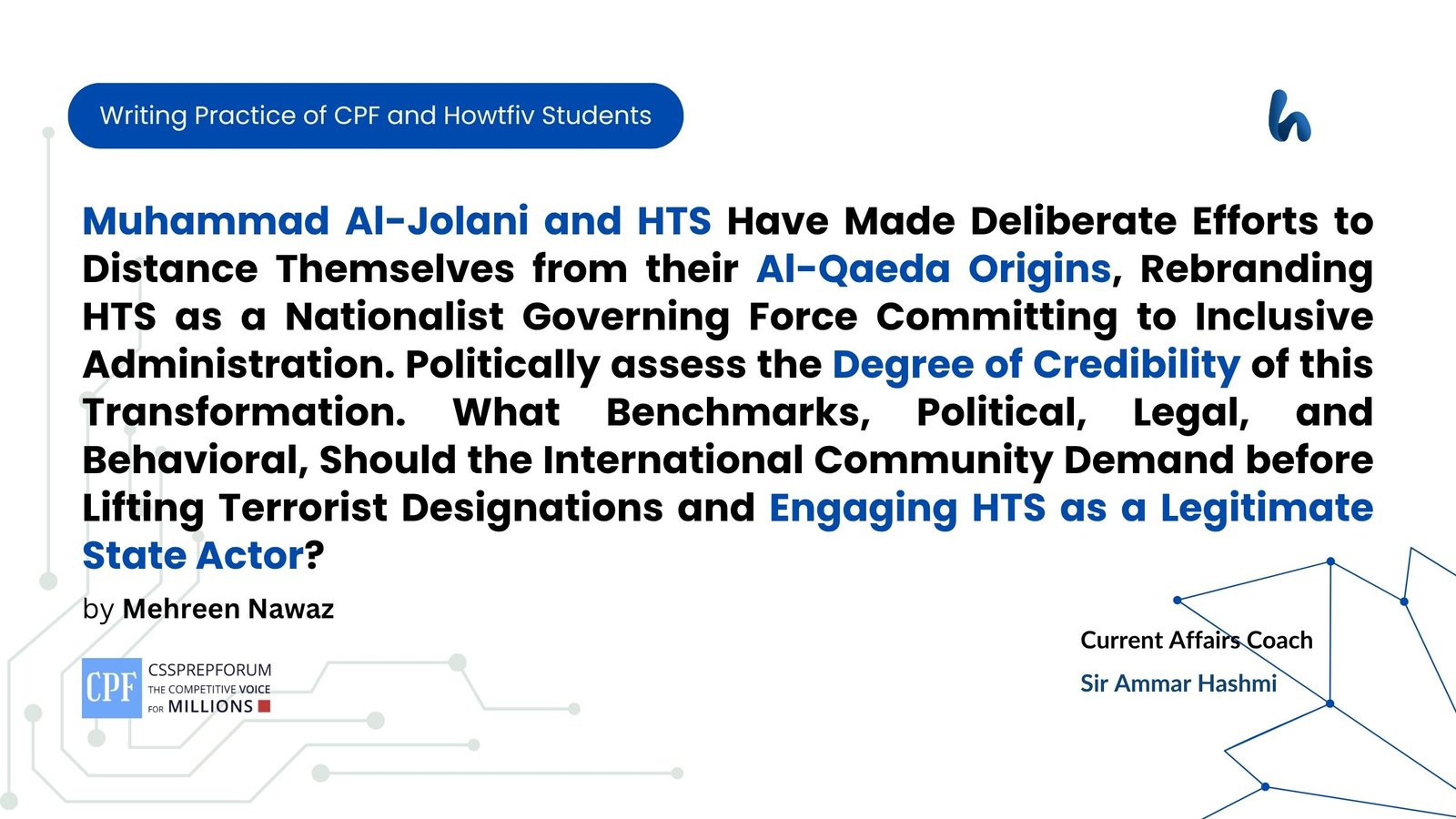
CSS Current Affairs | Al-Jolani and HTS as a Nationalist Governing Force
The following assignment question for CSS Current Affairs is solved by Mehreen Nawaz under the supervision of Howfiv’s Pakistan Affairs and Current Affairs Coaches: Miss Iqra Ali and Sir Ammar Hashmi. She learnt how to attempt 20 marks question and essay writing from Sir Syed Kazim Ali, Pakistan’s best CSS and PMS English essay and precis teacher with the highest success rate of his students. This solved question is attempted on the pattern taught by Sir to his students, scoring the highest marks in compulsory and optional subjects for years.
Outline
11-Introduction
2-Historical Background
3-Assessing the Credibility of HTS’s Transformation
- Formal Severance of Ties with Al-Qaeda
- Evidence: Al-Jolani publicly severed ties with Al-Qaeda in 2016; Ayman al-Zawahiri condemned the split, and Hurras al-Din emerged as Al-Qaeda’s new affiliate in Syria.
- Shift from Global Jihadist Agenda to Syrian Nationalism
- Evidence: HTS publications increasingly emphasize Syrian governance and local administration, while references to global jihad have significantly declined.
- Crackdown on Al-Qaeda-Linked Factions
- Evidence: Since 2020, HTS has dismantled the “So Be Steadfast” operations room, detained Hurras al-Din commanders, and closed Al-Qaeda-linked military facilities.
- Development of Administrative and Governance Structures
- Evidence: HTS established the Salvation Government and transferred administrative functions to civilian institutions to govern territories under its control.
- Pursuit of Political Legitimacy and International Engagement
- Evidence: The United States announced its intention to revoke HTS’s Foreign Terrorist Organization designation following the group’s dissolution and anti-terrorism commitments.
4-Benchmarks Required Before Lifting Terrorist Designations and Recognizing HTS as a Legitimate State Actor
- Demonstrable Commitment to Inclusive Governance
- Evidence: Major political and security decisions in Idlib remain subject to HTS approval, while power-sharing initiatives have faced resistance from HTS leadership.
- Verifiable and Permanent Separation from Al-Qaeda and Other Extremist Networks
- Evidence: The 2016 split, Zawahiri’s condemnation, defections to Hurras al-Din, and HTS’s detention of Al-Qaeda-linked figures support its separation from Al-Qaeda.
- Respect for Human Rights and Civil Liberties
- Evidence: Bilal Abdul Kareem’s detention and allegations of prison abuses have become prominent examples challenging HTS’s moderation claims.
- Independent Rule of Law and Judicial Accountability
- Evidence: Studies indicate that security institutions remain heavily influenced by HTS, while the Salvation Government often serves as an administrative cover.
- Transparency and Accountability in Economic and Administrative Affairs
- Evidence: HTS maintains significant control over the Bab al-Hawa crossing, banking, telecommunications, and energy sectors in Idlib.
- Constructive Engagement with Regional and International Norms
- Evidence: HTS has cooperated with Turkish observation posts and patrol arrangements while presenting itself as a locally focused Syrian actor.
5-Critical Evaluation
6-Conclusion
Answer to the question
Introduction
Hay’at Tahrir al-Sham (HTS), led by Abu Muhammad al-Jolani, has attempted to transform its image from that of an Al-Qaeda-affiliated jihadist organization into a nationalist governing force in Syria. Since formally severing ties with Al-Qaeda in 2016, HTS has sought political legitimacy through governance initiatives, local administration, and efforts to portray itself as a pragmatic actor. However, the credibility of this transformation remains contested due to continuing concerns regarding authoritarian governance, human rights violations, and the group’s ideological legacy. Therefore, the legitimacy of HTS must be assessed through verifiable actions rather than political rhetoric.
Historical Background of HTS
Hay’at Tahrir al-Sham (HTS) originated as Jabhat al-Nusra, the Syrian branch of Al-Qaeda established during the Syrian civil war in 2011. Under the leadership of Abu Muhammad al-Jolani, the group became one of the most influential armed factions fighting against the Assad regime. As the conflict evolved, HTS sought to distance itself from its association with global jihadist movements and improve its local legitimacy. In July 2016, Jabhat al-Nusra formally announced its separation from Al-Qaeda and adopted the name Jabhat Fatah al-Sham. The organization later merged with several other opposition factions in January 2017 to form Hay’at Tahrir al-Sham. Since then, HTS has attempted to portray itself as a Syrian nationalist movement focused on governance and regional stability. However, questions regarding the sincerity and completeness of this transformation continue to generate debate within the international community.
Assessing the Credibility of HTS’s Transformation
- Formal Severance of Ties with Al-Qaeda
The strongest evidence supporting HTS’s transformation is its formal organizational break with Al-Qaeda. In 2016, al-Jolani publicly declared that the group would no longer maintain external affiliations with Al-Qaeda. The credibility of this separation was reinforced when Al-Qaeda leader Ayman al-Zawahiri openly condemned the decision, while Al-Qaeda supporters accused HTS of betraying the jihadist project and violating its oath of loyalty. The emergence of Hurras al-Din as Al-Qaeda’s new Syrian branch further indicates that Al-Qaeda no longer viewed HTS as its representative in Syria.
- Shift from Global Jihadist Agenda to Syrian Nationalism
HTS has gradually moved away from Al-Qaeda’s transnational jihadist ideology and adopted a more localized Syrian agenda. Rather than prioritizing the establishment of a global caliphate, the organization increasingly focuses on governance, territorial control, and the future political order of Syria. Research on HTS’s publications indicates that references to global jihad have significantly declined, while official statements increasingly emphasize protecting Syrian territory, administering local affairs, and confronting the Assad regime. This ideological shift suggests a departure from Al-Qaeda’s traditional strategic objectives.
- Crackdown on Al-Qaeda-Linked Factions
HTS’s confrontational relationship with Al-Qaeda-affiliated organizations provides additional evidence of transformation. Instead of cooperating with Al-Qaeda loyalists, HTS has actively suppressed them in areas under its control. Since 2020, HTS has dismantled Al-Qaeda’s operations room known as “So Be Steadfast,” detained more than twenty Hurras al-Din commanders, and shut down military facilities associated with Al-Qaeda-aligned factions. Such actions are difficult to reconcile with the claim that HTS remains an operational arm of Al-Qaeda.
- Development of Administrative and Governance Structures
Another indication of transformation is HTS’s effort to build administrative institutions and provide governance in territories under its authority. Through the Salvation Government, HTS has attempted to regulate economic activity, deliver public services, and manage local administration. The establishment of the Salvation Government and HTS’s transfer of administrative functions to civilian institutions were presented as evidence that the organization seeks to operate as a governing authority rather than solely as an insurgent force. This governance-oriented approach distinguishes HTS from many traditional jihadist organizations.
- Pursuit of Political Legitimacy and International Engagement
HTS has increasingly sought acceptance from regional and international actors through political moderation and diplomatic engagement. Al-Jolani has granted interviews to Western media and attempted to distance the organization from extremist narratives. The most significant indication of growing international recognition came when the United States announced its intention to revoke HTS’s Foreign Terrorist Organization designation following the group’s dissolution and commitments by the new Syrian government to combat terrorism. Such developments suggest that some international actors acknowledge elements of HTS’s transformation.
- Continuing Concerns Regarding Authoritarianism and Human Rights
Despite evidence supporting organizational change, serious concerns continue to undermine the credibility of HTS’s transformation. Critics argue that the group remains authoritarian and intolerant of dissent. Reports from journalists, human rights observers, and local activists have documented allegations of arbitrary detention, torture in HTS-controlled prisons, suppression of political opponents, and monopolization of economic sectors such as border crossings, telecommunications, and banking. These practices raise doubts about whether HTS has genuinely embraced inclusive governance and democratic norms.
Benchmarks Required Before Lifting Terrorist Designations and Recognizing HTS as a Legitimate State Actor
- Demonstrable Commitment to Inclusive Governance
Before HTS can be recognized as a legitimate political actor, it must demonstrate that political authority is not monopolized by a single group or leader. Genuine inclusion requires meaningful participation of rival political factions, local councils, minorities, and civil society actors in governance. Despite the existence of the Salvation Government, studies of governance in Idlib indicate that major political, economic, and security decisions remain subject to HTS approval, while Turkey-backed efforts to establish a broader military council and power-sharing arrangement were resisted by HTS leadership. Therefore, the international community should require institutionalized power-sharing mechanisms rather than governance dominated by one movement.
- Verifiable and Permanent Separation from Al-Qaeda and Other Extremist Networks
The most important benchmark is clear evidence that HTS has permanently abandoned ties with transnational jihadist organizations. Mere declarations are insufficient; the separation must be demonstrated through long-term behavior. Strong evidence supporting HTS’s break includes the 2016 public severance from Al-Qaeda, Ayman al-Zawahiri’s condemnation of the split as a violation of allegiance, the defection of numerous Al-Qaeda loyalists from HTS, the formation of Hurras al-Din as Al-Qaeda’s new Syrian branch, and HTS’s detention of prominent Al-Qaeda-linked figures. However, UN monitoring reports have continued to raise concerns that some channels of communication may still exist between HTS elements and Al-Qaeda networks. Consequently, continued independent verification would be required before terrorist designations are removed.
- Respect for Human Rights and Civil Liberties
Any organization seeking international legitimacy must demonstrate respect for internationally recognized human rights standards. Freedom of expression, freedom of association, and protection from arbitrary detention should be guaranteed in practice rather than merely promised. Serious allegations have emerged from journalists, activists, and former detainees regarding arbitrary arrests, solitary confinement, torture, and the suppression of critics in HTS-controlled areas. The detention of journalist Bilal Abdul Kareem and his subsequent allegations concerning prison abuses became one of the most widely cited examples challenging HTS’s claims of political moderation. Independent investigations and transparent accountability mechanisms would therefore be essential benchmarks.
- Independent Rule of Law and Judicial Accountability
A transformed political actor must govern through legal institutions rather than the discretionary authority of armed leaders. Courts must function independently and provide equal legal protections to all citizens. Research on governance in Idlib has repeatedly shown that security institutions remain heavily influenced by HTS leadership and that the Salvation Government often functions as an administrative cover for decisions ultimately shaped by the organization. The international community should therefore require evidence of judicial independence, due process protections, and civilian oversight of security institutions before extending political recognition.
- Transparency and Accountability in Economic and Administrative Affairs
International legitimacy requires transparent governance and responsible management of public resources. HTS must demonstrate that economic institutions serve the population rather than the interests of a dominant faction. Analyses of HTS rule in Idlib have highlighted its extensive control over strategic sectors such as the Bab al-Hawa border crossing, banking activities, telecommunications, and energy resources. Researchers have argued that this concentration of economic power enables HTS to maintain political dominance while limiting accountability. Transparent budgeting, independent audits, and civilian oversight would therefore constitute important benchmarks for recognition.
- Constructive Engagement with Regional and International Norms
A final benchmark should be HTS’s willingness to act as a responsible political actor within the international system. This includes cooperation on counterterrorism, humanitarian access, regional stability, and peaceful political processes. HTS’s acceptance of Turkish observation posts in Idlib, its cooperation with Turkish patrol arrangements, and its efforts to present itself as a locally focused Syrian actor rather than a participant in global jihad have been cited by supporters as evidence of growing pragmatism. At the same time, continued international skepticism demonstrates that pragmatic behavior must be sustained over time before trust can be established. Long-term compliance with international norms would therefore be necessary before HTS could be fully accepted as a legitimate state actor.
Critical Evaluation
HTS has demonstrated a genuine organizational break from Al-Qaeda through its formal separation, confrontation with Al-Qaeda-affiliated factions, and emphasis on local governance in Syria. However, the credibility of this transformation remains constrained by allegations of authoritarian rule, human rights abuses, and the concentration of power within HTS leadership. While the group has moved away from transnational jihadism, it has yet to fully demonstrate the political inclusivity, accountability, and transparency expected of a legitimate governing actor. Therefore, HTS’s transformation appears significant but not yet fully convincing, making continued scrutiny and verification necessary.
Conclusion
In conclusion, HTS has made notable efforts to distance itself from its Al-Qaeda origins and redefine itself as a locally focused governing force in Syria. Its formal break with Al-Qaeda, conflict with Al-Qaeda-affiliated factions, and involvement in governance through the Salvation Government indicate that significant organizational changes have occurred. However, persistent concerns regarding authoritarian practices, political exclusion, and human rights violations continue to undermine the full credibility of its transformation. Therefore, while HTS can no longer be viewed simply as Al-Qaeda’s Syrian branch, its legitimacy as a responsible political actor remains conditional upon sustained political, legal, and behavioral reforms. Consequently, the international community should base any decision to lift terrorist designations or engage HTS diplomatically on verifiable actions and long-term conduct rather than declarations alone.
CSS Solved Past Papers’ Essays
Looking for the last ten years of CSS and PMS Solved Essays and want to know how Sir Kazim’s students write and score the highest marks in the essays’ papers? Then, click on the CSS Solved Essays to start reading them.
CSS Solved Essays
CSS Solved Islamiyat Past Papers
Want to read the last ten years’ Islamiyat Solved Past Papers to learn how to attempt them and to score high? Let’s click on the link below to read them all freely. All past papers have been solved by Pakistan’s top CSS Islamiyat coaches having the highest score of their students.
CSS Solved Islamiyat
CSS Solved General Science & Ability Past Papers
Want to read the last ten years’ General Science & Ability Solved Past Papers to learn how to attempt them and to score high? Let’s click on the link below to read them all freely. All past papers have been solved by Pakistan’s top CSS GSA coachez having the highest score of their students.
CSS Solved General Science & Ability
CSS Solved Pakistan Affairs Past Papers
Want to read the last fifteen years’ Pakistan Affairs Solved Past Papers to learn how to attempt them and to score high? Let’s click on the link below to read them all freely. All past papers have been solved by Pakistan’s top CSS Pakistan Affairs coaches having the highest score of their students.
CSS Solved Pakistan Affairs
CSS Solved Current Affairs Past Papers
Want to read the last fifteen years’ Current Affairs Solved Past Papers to learn how to attempt them and to score high? Let’s click on the link below to read them all freely. All past papers have been solved by Pakistan’s top CSS Current Affairs coaches having the highest score of their students.
CSS Solved Current Affairs