CSS Pakistan Affairs | Assessment of the Core Economic Challenges of Pakistan
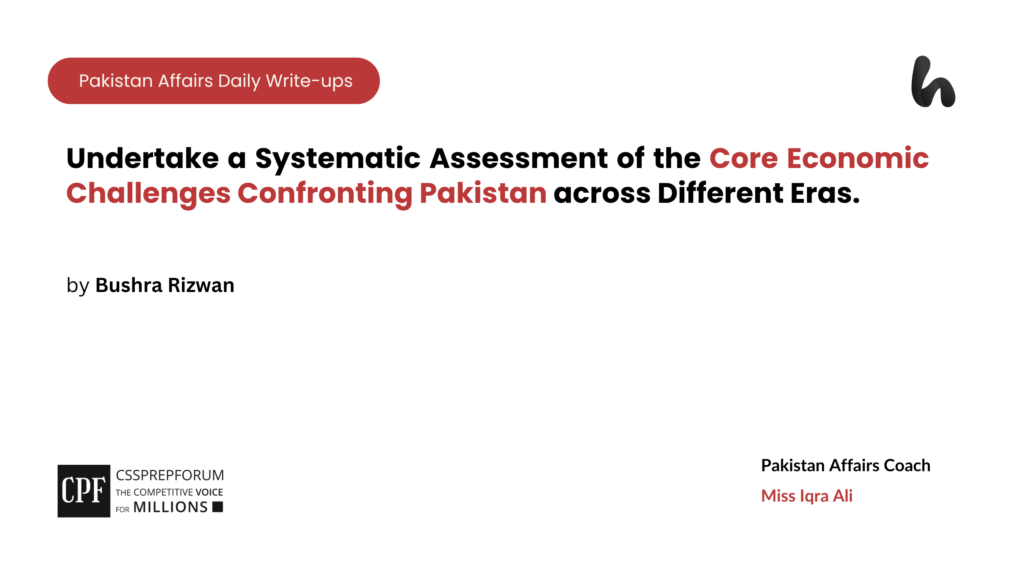
The following assignment question for CSS Pakistan Affairs is solved by Bushra Rizwan under the supervision of Howfiv’s Pakistan Affairs and Current Affairs Coaches: Miss Iqra Ali and Sir Ammar Hashmi. She learnt how to attempt 20 marks question and essay writing from Sir Syed Kazim Ali, Pakistan’s best CSS and PMS English essay and precis teacher with the highest success rate of his students. This solved question is attempted on the pattern taught by Sir to his students, scoring the highest marks in compulsory and optional subjects for years.

Outline
1-Introduction
2-Historical Background of Pakistan’s Economic Problems
3-What is a Systematic Assessment of the Core Economic Challenges Confronting Pakistan across Different Eras
- 1947-1958
- Inherited structural challenges and the start of foreign debt
- Agricultural share of exports, low industrialization, and low inflation
- Politically motivated economic decisions and Exchange rate mismanagement
- 1960s-1970s
- Green Revolution and flawed land reform in Ayub Khan’s era: impact on GDP
- No debt crisis owing to Heavy US and World Bank aid
- Low inflation supported by aid-financed stability
- 1970s-1980s
- Balance of payments shock and Fiscal deficit: consequence of the 1971 crisis: Yahya Khan’s government
- Partial implementation of IMF standby agreement, nationalisation and increase in foreign debt: Zulfiqar Ali Bhutto’s era
- Junejo’s experiment and moderate inflation
- 1990s-2000s
- Intransparent privatisation, stagnant tax-to-GDP and inflation
- Rising external debt; near sovereign default: violating IMF agreements and sanctions due to nuclear crisis
- Flawed IPP agreements and circular debt: Benazir Bhutto’s government
- Musharraf’s boom-bust cycle and its impact on inflation and external debt
- 2010s to 2020s
- Stagflation prevailed, and public debt increased: Zardari’s era
- Controlled inflation and rise in external debt: Nawaz Sharif’s third term
- Inflation and rise in public debt in Imran Khan’s era
4-Critical Analysis
5-Conclusion
Answer to the question
Introduction
Pakistan has faced mounting external debt and rising inflation over the years. In 1947-1958, though inflation was low, the external debt was still present. In the decade of the 1960s to 1970s, foreign aid led to low inflation and less external debt. Subsequently, in the 1970s to 1980s, Dhaka fall; partial implementation of IMF standby agreements and nationalisation led to inflation and an external debt crisis. Likewise, intransparent privatisation and nuclear sanctions led to near-sovereign default and doubled inflation. Moreover, Musharraf’s boom-bust cycles further worsened conditions. In the 2010s to 2020s, stagflation prevailed, and public debt increased. This was later followed by rising inflation and worsening external debt. Consequently, Pakistan has grappled with debt structural vulnerabilities, debt crises, and inflation from its independence till the present.
Historical Background of Pakistan’s Economic Problems
Since its inception, Pakistan has grappled with economic challenges. These challenges include debt accumulation, corruption, sub-optimal use of natural resources, fiscal deficit, and increased vulnerability to external shocks. The underlying causes of these economic crises are the politically motivated and short-sighted economic policies that lead to recurrent balance of payments shocks. The mounting public and external debt, capital flight, and economic sovereignty at risk have created a fragile national economy. Thus, Pakistan’s economic challenges are numerous and continue to worsen due to a lack of insightful policies.
What is a Systematic Assessment of the Core Economic Challenges Confronting Pakistan (including Debt, Inflation, and Structural Vulnerabilities) across Different Eras
1- 1947-1958
- Agricultural share of exports, low industrialization, and low inflation
To begin with, Pakistan was an agrarian economy, with few industrial assets and very low inflation. At that time, raw cotton and jute were exported for processing abroad. Manufacturing of jute and cotton contributed to 7.8 percent of GDP in 1950, and at that time, the agricultural share of GDP was 53 percent. Moving to inflation, it was at its lowest point. According to Pakistan Development Economics (PIDE), Pakistan’s inflation went from 3 percent in 1950 to 1.18 percent in 1958. This shows that the purchasing power of locals was high during that time period. Thus, low inflation, low industrialization, and agricultural growth were visible in Pakistan’s initial years.
- Inherited structural challenges and start of foreign debt
During this time, Pakistan was newly independent with inherited structural challenges and at the start of foreign debt cycles. Due to a mass displacement of refugees, no industrial base, partition of economic assets, it struggled to attain economic growth. In 1947, Pakistan’s initial foreign debt at the time of independence was 1 billion rupees. Moreover, its investment rate and national savings rate were quite low. As a result, Pakistan, at the time of partition, was ridden in foreign debt and in severe need of foreign aid due to its internal challenges.
- Politically-motivated economic decisions and Exchange rate mismanagement
Pakistan’s history of politically motivated economic decisions have impacted its economy. Its resistance to devaluing its rupee when Britain devalued the pound sterling led to exchange rate mismanagement. This impacted Pakistan’s currency severely. In 1949, when Britain devalued the pound streling, but Pakistan chose not to devalue the Pakistani rupee, a decision that was driven by politcial considerations rather than economic rationality. Thus, such decisions have mostly led to Pakistan to trade loss.
2- 1960s-1970s
- Green revolution and flawed land reform in Ayub Khan’s era: impact on GDP
Green Revolution and agricultural transformation in Ayub Khan’s era led to GDP growth. This period is called the Green Revolution. The Green Revolution refers to the introduction of High-yielding Variety seeds and other technologies that dramatically increase crop yields. This produced an average agricultural growth of 6.6 percent per annum. Moreover, the land reforms that were adopted were flawed. According to Akbar Ali Zaidi, land reforms by Ayub Khan failed to achieve a meaningful contribution because the political class is itself the landowning class. And the failure of these reforms is also confirmed in the 1960 Agricultural Census. Hence, green revolution that improved agriculture, and failed land reforms impacted GDP in a mixed way.
- No debt crisis owing to Heavy US and World Bank aid
Ayub Khan’s era showed no debt crisis as there were transfers of heavy US aid to Pakistan. At the peak of the Cold War, Pakistan had joined the Western bloc by signing SEATO and CENTO, which led to aid from the World Bank. Fiscal deficit financing was kept below 4 percent of GDP, supported by large inflows from the World Bank, IMF, and Consortium of Aid to Pakistan(CAP, 1960). Moreover, US became the foremost aid donor for Pakistan. Pakistan became the largest per capita recipient of US aid; US aid totalled 2.5 billion dollars between 1958 and 1965. Thus, Pakistan extracted the economic benefits of becoming part of the Western bloc through low fiscal deficit.
- Low inflation supported by aid-financed stability
In addition, this era witnessed a low inflation trajectory due inflow of foreign aid. Moreover, the budget was also development-led and financed primarily by external aid. According to “Issues in Pakistan’s economy” by Akbar Ali Zaidi, during Ayub Khan’s era, the budget was mostly development-led and financed by external aid. Moreover, inflation was in decline for the same reason. Due to IMF standby agreements in 1958 and 1963, there was aid-financed stability that led to low inflation. Thus, foreign aid in the form of IMF SAP helped stabilize inflation.
3- 1970s-1980s
- Balance of payments shock and Fiscal deficit: consequence of the 1971 crisis: Yahya Khan’s government
Furthermore, the economic cost of the 1971 crisis led to Pakistan’s balance of payments shock during Yahya Khan’s era. After Bangladesh’s independence, Pakistan lost its primary foreign exchange source , jute. The 1971 crisis led to a more than 5.5 percent fiscal deficit, the highest in the post-independence era. Moreover, since the budget was war-focused, development was entirely ignored. This created a foreign debt of 3 billion dollars and loss of 40 percent of Pakistan’s exports, causing a balance of payment crisis. Thus, Pakistan’s international credibility was hampered due to the 1971 crisis.
- Partial implementation of IMF standby agreement, nationalisation and increase in foreign debt: Zulfiqar Ali Bhutto’s era
Zulfiqar Ali bhutto’s government carried out partial implementation of the IMF standby agreement and a nationalisation programme that was divided into three phases: the first phase nationalised industries; the second phase nationalised cotton ginning factorized and flour mills; third phase brought land reforms. The partial implementation of IMF standby Agreement(1973) was worth 75 million dollars and conditioned on currency devaluation and subsidy cuts, was only partially implemented. During this time period, the foreign debt rose to 6.4 billion dollars from 6.4 billion dollars. In the same way, inflation rose to unprecedented levels due to investment losses and the nationalisation burden on the budget. Inflation rose to a double-digit average of 13-15 percent. Thus, the nationalisation burdened state along with non-compliance of IMF conditionalities, leading to doubling of inflation and out of control external debt.
- Junejo’s experiment and moderate inflation
Junejo’s civilian experiment under Zia led to an improvement. With Junejo’s selection as Prime Minister, Pakistan formally entered into the IMF structural Adjustment programme ,with the beginning of first wave of privatisation. Junejo announced privatisation of small industrial units, which the IMF SAP programme ,granting tied aid worth 800 billion dollars demanded. As a result, inflation remained moderate: 6.2% to 7.9% from 1986 to 1988. The period also witnessed slight trade liberalization. The external debt, being managed by foreign inflows, reached at 10.5 billion dollars by 1988. This era kickstarted privatisation with the formation of a cabinet committee in 1987. Thus, Jenejo’s administration resulted in reduced inflation and external debt, managed by foreign inflows.
4- 1990s-2000s
- Intransparent privatisation , stagnant tax-to-GDP and inflation
As both Benazir Bhutto and Nawaz Sharif performed extensive privatisation, which mostly lacked transparency, inflation rose. Moreover, the tax-to-GDP remained stagnant due to it. Benazir(1988-90) privatised 11 industrial units and Nawaz(1990-93) privatised 70 plus units, but it did not lead to any tax to GDP gain that remained stagnant at 11-12 percent, as this privatisation mostly favoured political elites. In addition to that, inflation averaged 12 – 14 percent annually. While a privatisation commission was also formed, no real economic growth occurred. As a result, intransparent privatisation led to stagnant Tax-to-GDP and worsened inflation.
- Rising external debt; near sovereign default: violating IMF agreements and sanctions due to nuclear crisis
Moreover, non-compliance with IMF agreements and nuclear sanctions contributed to the economic crisis of Pakistan. To begin with, repeated failures to meet performance targets led to suspension of IMF programmes. During 1988-93, IMF provided three facilities: SBA(273 million dollars,1988), SBA-I(1.2 billion dollars,1989), and SAP-II (1.5 billion dollars, 1991), but it ultimately stopped lending owing to non-compliance. During the same period, the external debt rose from 11.4 billion dollars to 20 billion dollars (1993). Moreover, the nuclear sanctions further deteriorated the economic situation. Due to the nuclear tests leading to US sanctions and IMF suspension, the external debt jumped to 32 billion dollars by 1999 that is considered near sovereign default. Thus, the compounding impact of IMF violations and sanctions due to nuclear tests derailed the already fragile economy.
- Flawed IPP agreements and circular debt: Benazir Bhutto’s government
During the Benazir Bhutto era, flawed power purchase agreements were made with Independent Power Producers(IPPs), leading to expensive capacity payments. For years, even though the government did not purchase electricity from IPPs due to their unaffordable rates, the latter were still paid from the government exchequer. The fiscal deficit rose to 7.5 percent of GDP due to these flawed IPP payments. According to Akbar Ali Zaidi, the IPP power investments led to worsening of circular debt, the servicing of which already consumed 50-60 percent of revenue. This led to GDP loss. As a result, Pakistan further slipped into circular debt.
- Musharraf’s boom-bust cycle and its impact on inflation and external debt
Furthermore, Pervaiz Musharraf, during his government, there was sudden decline in inflation and rise of foreign exchange that was followed by severe inflation and external debt crisis. As there was incoming US aid money, WTO liberalization, and ongoing privatisation of banks, there was artificially sustained economic growth that went down in 2008. According to “Pakistan’s economy under Musharraf”, published by Dr. Ishrat Hussain in March, 2023, the external debt by the end of 2008 rose to 46 billion dollars. Moreover, inflation spiked as soon as the energy crisis began. Inflation was out of control at 25.3 percent by 2008. Thus, temporary improvement in inflation went down and the external debt rose.
5- 2010s to 2020s
- Stagflation prevailed, and public debt increased: Zardari’s era
Though Zardari’s government inherited a crisis-ridden economy with low foreign reserves and worsening power crisis, the public debt rose, stagflation prevailed, and tax-to-GDP fell. Moreover, large-scale manufacturing contracted sharply due to long power outages, disrupting economy. Stagflation prevailed: inflation peaked at 25.3 percent (2008), declining to 7.4 percent by 2013. In addition, the country was hit by damage that led to financial loss and foreign aid. Total public debt rose from 5.8 trillion dollars (2008) to Rs. 14.3 trillion (2013). The public debt continued its uprising trajectory. Thus, foreign debt continued to rise, but inflation decline to some extent during this governemnt era.
- Controlled inflation and rise in external debt: Nawaz Sharif’s third term
During Nawaz Sharif’s third term in office(2013-2018), inflation remained under control as there was a global oil price slump yet the external debt rose. The rupee was kept officially strong until the end of his term; as a result, the country transitioned into a balance of payments crisis. Inflation was under control at 2.9 percent (2016) due to cheap global oil prices, then it rose to 5.1 percent(2018). Moving on to external debt, its situation remained concerning as the country had slipped into a trade crisis owing to rising imports. By 2018, the total external debt was 95 billion dollars by 2018; total public debt was Rs. 24.2 trillion dollars. And Pakistan’s foreign debt was expected to rise due to the ongoing CPEC project. Thus, although they controlled inflation, the external debt situation did not improve during priod of government.
- Inflation and rise in public debt in Imran Khan’s era
The inflation and external debt situation in PTI’s government was even more grim as it inherited twin fiscal and current account deficits, IMF scepticism, and depleting reserves. During its government, the public debt rose from 24.2 trillion (2018) to 44.4 trillion(2022) and external debt exceeded 100 billion dollars. In the meantime, COVID-19 struck Pakistan, for which the government launched response programmes. The rupee depreciated sharply from 121 rupees per dollar(2018) to 202 rupees per dollar (2022), and inflation reached 13.4 percent by 2022. Thus, the combined rupee depreciation and debt crisis compounded economic hurdles.
Critical Analysis
Pakistan has witnessed an upward trajectory of circular debt across different eras from 1947 to the present. Though Ayub Khan’s era and Musharraf’s era showed periodic economic growth and less inflation, but it was driven by foreign aid and boom-bust cycles, leaving the economy in worse condition than before. Zia’s nationalisation burdened the national economy and destroyed investor confidence, leading to high inflation and an external deficit. In comparison to other governments, Zardari’s economic governance lowered inflation. Though external debt rose at this time, the change was far less than under other governments. Nonetheless, Pakistan’s economy requires far-sighted economic policies and their continuity for long-term economic growth, lower inflation, and lower external debt.
Conclusion
In conclusion, Pakistan’s economic challenges are multiplying with passing years. In 1947-1958, though inflation was low, the external debt was still present. In the decade of the 1960s to 1970s, foreign aid led to low inflation and less external debt. Subsequently, in the 1970s to 1980s, Dhaka fall; partial implementation of IMF standby agreements and nationalisation led to inflation and an external debt crisis. Likewise, intransparent privatisation and nuclear sanctions led to near-sovereign default and doubled inflation. Moreover, Musharraf’s boom-bust cycles further worsened conditions. In the 2010s to 2020s, stagflation prevailed, and public debt increased. This was later followed by only rising inflation and worsening external debt. Consequently, Pakistan has grappled with debt structural vulnerabilities, debt crisis, inflation from its independence till present.

CSS Solved Past Papers’ Essays
Looking for the last ten years of CSS and PMS Solved Essays and want to know how Sir Kazim’s students write and score the highest marks in the essays’ papers? Then, click on the CSS Solved Essays to start reading them.
CSS Solved Essays
CSS Solved Islamiyat Past Papers
Want to read the last ten years’ Islamiyat Solved Past Papers to learn how to attempt them and to score high? Let’s click on the link below to read them all freely. All past papers have been solved by Pakistan’s top CSS Islamiyat coaches having the highest score of their students.
CSS Solved Islamiyat
CSS Solved General Science & Ability Past Papers
Want to read the last ten years’ General Science & Ability Solved Past Papers to learn how to attempt them and to score high? Let’s click on the link below to read them all freely. All past papers have been solved by Pakistan’s top CSS GSA coachez having the highest score of their students.
CSS Solved General Science & Ability
CSS Solved Pakistan Affairs Past Papers
Want to read the last fifteen years’ Pakistan Affairs Solved Past Papers to learn how to attempt them and to score high? Let’s click on the link below to read them all freely. All past papers have been solved by Pakistan’s top CSS Pakistan Affairs coaches having the highest score of their students.
CSS Solved Pakistan Affairs
CSS Solved Current Affairs Past Papers
Want to read the last fifteen years’ Current Affairs Solved Past Papers to learn how to attempt them and to score high? Let’s click on the link below to read them all freely. All past papers have been solved by Pakistan’s top CSS Current Affairs coaches having the highest score of their students.
CSS Solved Current Affairs