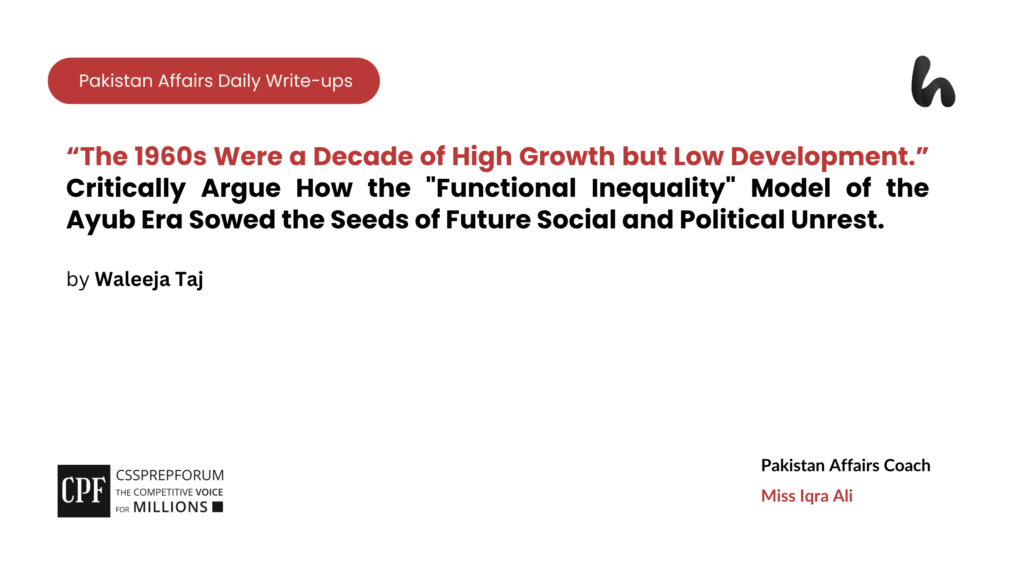
CSS Pakistan Affairs | Functional Inequality Model of the Ayub Era
The following assignment question for CSS Pakistan Affairs is solved by Waleeja Taj under the supervision of Howfiv’s Pakistan Affairs and Current Affairs Coaches: Miss Iqra Ali and Sir Ammar Hashmi. She learnt how to attempt 20 marks question and essay writing from Sir Syed Kazim Ali, Pakistan’s best CSS and PMS English essay and precis teacher with the highest success rate of his students. This solved question is attempted on the pattern taught by Sir to his students, scoring the highest marks in compulsory and optional subjects for years.

Outline
1-Introduction
2-Evaluating the 1960s as a Decade of High Growth but Low Development
3-How does Ayub’s Economic Model of ‘Functional Inequality’ Sow the Seeds of Future Social and Political Unrest?
- Widened the economic chasm between West and East wings
- Amplified the intraregional disparities among farmers, leading to rural-urban displacement due to uneven land reforms
- Growth of inter-regional inequality through unequal distribution of tube wells in certain districts of Punjab
- Growth of Interregional disparities through the concentration of Tube wells in certain districts of Punjab
- Catalyzed the Partition of East Pakistan from the west wing
4-Critical Analysis
5-Conclusion
Answer to the question
Introduction
Pakistan first military quo was established under General Muhammed Ayub Khan in October 1958, who became the president of Pakistan. With his ambition to modernize the country, he laid down a plane to invest in agriculture and industrial sector namely the green revolution. The aim was to revolutionize agriculture sector alongside industrial development from small to medium enterprises. Consequently, the plane was materialized through the subsequent mechanization through providing tractors, deployment of tube wells, and fertilizers; land reforms in the Punjab and Sindh provinces. However, the project rested on purely capitalist principles, with development centered in a small group of elites, which culminated in multiple social and political ramifications. For instance, the centralization of wealth driven by uneven distribution of inputs stirred the later regional and economic disparities among the elite farmers and the middle class farmers. Not only this, but the capitalization of wealth in west Pakistan resulted in alienation of East Pakistan, who were unable to creep the fruits of green revolution. Besides, political repercussions of this economic model includes the subsequent emergence of Bhutto’s people’s party and its overwhelming victory in 1970 election, setting the stage for Bhutto’s nationalist regime. Most importantly, the social and economic implications of the ‘decade of development’ integrated deep feelings of injustice in Eastern wing which catalyzed the separatist movement in East wing, resulting in its secession.
Evaluating the 1960s as a decade of high growth but low development
Evaluating the decade of development, Ayub Khan’s economic policies were characterized by a deliberate strategy to foster development through investing in the private sector and export promotion. This strategy, although brought about impressive aggregate growth figures, contained inherent structural biases that would prove dangerous for social cohesion. With its purely capitalistic structure, the model selected a group of entrepreneurs who were capable of driving industrial growth. Moreover, the agricultural sector developments were largely associated with elite farmers who shared large sum to country’s GDP. This disproportionate share in investment led to the concentration of wealth in a few hands. For example, the annual GDP growth raised to 6.0% according to then planning commission of Pakistan. However, the benefits of growth were not equitable, this contributed in growth of discontent among masses particularly in East Pakistan. Moreover, the development was limited to certain districts of Punjab and Sindh which shared 80% of crops share while holding 75% of population; thus, the growth was restricted to these regions. In conclusion, the economic model was featured by immediate growth, but was an embodiment of structural biases in favor of elites, hampering inclusive development and promoted feudalism.
How does the Ayub economic model of functional inequality sowed the seeds of future social and political unrest?
- Widened the economic chasm between West and East wings
First and foremost, the economic framework of Ayub khan is cited a paramount as it expands GDP growth. However, a close examination reveals its foundational flaw: the development was concentrated in a few selected industrialists in West Pakistan, especially Punjab province. This structural inequality fostered an illusion of growth which ultimately led to the fracture of national unity and social cohesion between two wings. For instance, the jute provided by East wing accounted for 50%-70% of Pakistan’s total export earning, it recieved only marginal allocation of government developmental projects. Ayub’s decade of development also missed out East Pakistan development. This, ultimately ripened the seeds of injustice and marginalization in East wing that led to wide spread protests against Ayub regime.
- Amplified the intraregional disparities among farmers leading to rural-urban displacement due to uneven land reforms
Second, the so called decade of development characterized by unequal distribution of land reforms gave birth into intra-regional disparities among farmers. Akbar Ali Zaidi pointed in ‘Issues in Pakistan economy’, that only the handful of farmers having land more than 100 acres were enjoying the technology of green revolution. On the other hand, the farmers who owned small lands either sold it to the landlords or rented it to the neighbors, along with displacement of sharecropperes. This increased rural-urban migration and consumerism, that fueled the regional disparity among farmers, leading to unemployment and promotion of poverty. Thus, the green revolution had adopted the size-efficiency strategy for farmers by giving more advantage to landlords. while left the small farmers out of advantage of development.
- Set the stage for socialist leadership of Zulfiqar Ali Bhutto
Moving ahead, the capitalist economic policies at the decade of development had repercussions in the political domain too. The disproportionate advantages to some left others in an entrenched feeling of alienation and discontent. The ’22 families’, who got 90% of the advantages, faced backlash that further tarnished Ayub’s reputation among the masses. Akbar Ali Zaidi aptly mentioned in his book that the overwhelming electoral victory of PPP was the direct result of Ayub’s policies. This was a demonstration of the earlier agricultural development that exacerbated the existing economic disparities and dissatisfaction. PPP won even in the heartland of agricultural development just because of intensified regional economic imbalances that lifted a selected few. Thus, the widespread economic divide paved the way for radical politics, making the conditions favorable for the pro-social regime of Zulfiqar Ali Bhutto.
- Growth of inter-regional inequality through unequal distribution of tube wells in certain districts of Punjab
Unequal distribution of technology package at the backdrop, certain implications were associated with the location, size and cost of tube wells too. As of 1968, almost 91% of initial 76000 tube wells were installed in the canal colony of central Punjab while only a fraction were installed outside. While NWFP and Balochistan were largely missed because of their mountainous stony terrain, difficult to drill. This limit water availablity, the pivot of agriculture, majorly to one province. Besides, most of tube wells were allocated to those farmers holding more than 25 acres of land while only 4% to those owning fewer than 13 acres, mainly due to the high cost of the installation and maintenance. Consequently, this was a reflection of the apparently neutral effect of increasing irrigation to hold significant repercussions in terms of inter-regional concerns, economic alienation, and a sense of marginalization of middle to small range of peasants.
- Catalyzed the Partition of East Pakistan from the West Wing
Last but not least, the economic model inadvertently accelerated East Pakistan’s sense of economic exploitation. Thus, it contributed significantly to the political and social unrest that culminated in the 1971 secession. The government development share for East Pakistan was 30%, while the West Pakistan received 70% of total government expenditure in the decade of development, mentioned by PIDE. Moreover, in the 1970 elections Awami league under Shiekh Mujeebur rahaman were denied to form the government despite winning 160 out of 162 seats, an absolute majority in overall national assembly. This led to widespread protest and non cooperation movement in East Pakistan following military intervention that culminated in the secession of East wing, giving birth to Bangladesh. Thus, the separation of the East Wing was not a separate event, but was a reaction to the systematic negligence of Ayub’s developmental projects and the later electoral gridlock.
Critical Analysis
Critically evaluating, the economic efforts of Ayub khan regime was apperantly successful in attaining aggregate growth of GDP; however, its systemic and structural faults based on capitalisim caused social and political disharmony. As Dr Ishrat Hussain observed, “the Ayub era’s economic policies, while achieving impressive growth rates, created a highly unequal society. This concentration of wealth and the neglect of regional disparities sowed the seeds of future political instability and ultimately contributed to the country’s division. The lesson is that growth without equity is unsustainable. Ultimately, the model entrenched the existing rich-poor gap, accelerated the social unrest and stained social fabric.
Conclusion
To sum it up, the Ayub khan after seizing power, laid the framework for agricultural and industrial development. However, the investment under this technological package was resided in large landlords and industrial houses in located in Punjab and Sindh, respectively. Clearly, the advantages were restricted to the said elites groups. This biased economic strategy and concentration of wealth to a selected few resulted in widening of social, economic and political grievances both in West and East wing. From regional and economic disparities to the political and geographical division of East wing, the economic policies caused disproportionate loss. Thus, despite the superficial success of Ayub’s developmental agenda, his efforts were largely met with failure due to its foundational flaws of inequality.

CSS Solved Past Papers’ Essays
Looking for the last ten years of CSS and PMS Solved Essays and want to know how Sir Kazim’s students write and score the highest marks in the essays’ papers? Then, click on the CSS Solved Essays to start reading them.
CSS Solved Essays
CSS Solved Islamiyat Past Papers
Want to read the last ten years’ Islamiyat Solved Past Papers to learn how to attempt them and to score high? Let’s click on the link below to read them all freely. All past papers have been solved by Pakistan’s top CSS Islamiyat coaches having the highest score of their students.
CSS Solved Islamiyat
CSS Solved General Science & Ability Past Papers
Want to read the last ten years’ General Science & Ability Solved Past Papers to learn how to attempt them and to score high? Let’s click on the link below to read them all freely. All past papers have been solved by Pakistan’s top CSS GSA coachez having the highest score of their students.
CSS Solved General Science & Ability
CSS Solved Pakistan Affairs Past Papers
Want to read the last fifteen years’ Pakistan Affairs Solved Past Papers to learn how to attempt them and to score high? Let’s click on the link below to read them all freely. All past papers have been solved by Pakistan’s top CSS Pakistan Affairs coaches having the highest score of their students.
CSS Solved Pakistan Affairs
CSS Solved Current Affairs Past Papers
Want to read the last fifteen years’ Current Affairs Solved Past Papers to learn how to attempt them and to score high? Let’s click on the link below to read them all freely. All past papers have been solved by Pakistan’s top CSS Current Affairs coaches having the highest score of their students.
CSS Solved Current Affairs