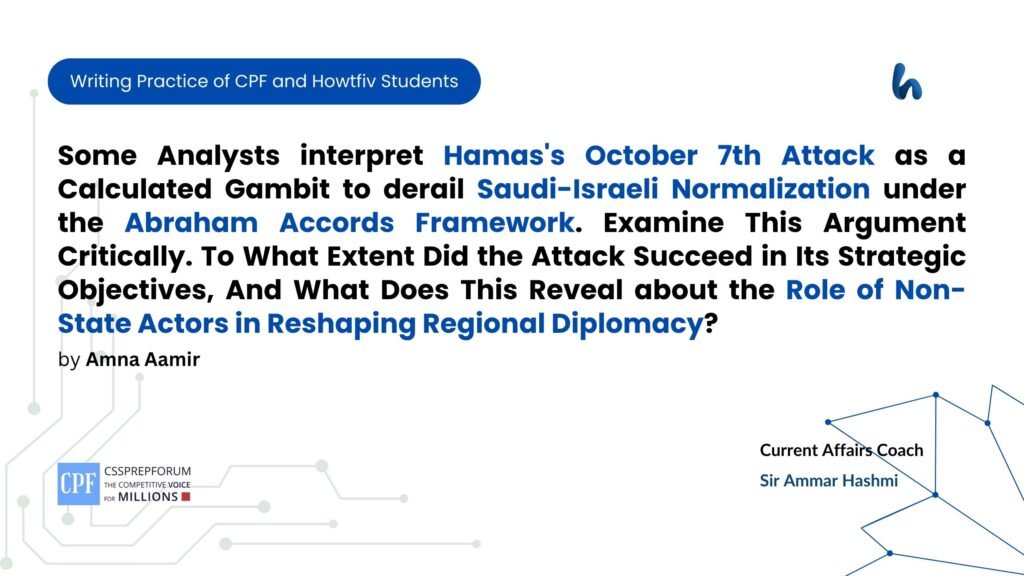
CSS Current Affairs | Hamas’s October 7th Attack as a Calculated Gambit to derail Saudi-Israeli Normalization under the Abraham Accords Framework
The following assignment question for CSS Current Affairs is solved by Amna Aamir under the supervision of Howfiv’s Pakistan Affairs and Current Affairs Coaches: Miss Iqra Ali and Sir Ammar Hashmi. She learnt how to attempt 20 marks question and essay writing from Sir Syed Kazim Ali, Pakistan’s best CSS and PMS English essay and precis teacher with the highest success rate of his students. This solved question is attempted on the pattern taught by Sir to his students, scoring the highest marks in compulsory and optional subjects for years.

Outline
1-Introduction
2-Brief Overview of the Abraham Accords and the Pre-October 7th Diplomatic Landscape
3-Critical Examination of the “Calculated Gambit” to Derail Saudi-Israeli Normalization
- Sabotage of the U.S.-Brokered Saudi-Israel Normalization Initiative
- Disruption of the Emerging Anti-Iran Regional Security Architecture
- Challenging the Assumption that Economic Integration Could Replace Political Resolution
4-Evaluating the Strategic Objectives and the Extent of the Attack’s Success
- Suspension of Saudi-Israeli Normalization
- Re-Internationalization of the Palestinian Issue
- Erosion of Israeli Deterrence through Multi-Domain Asymmetric Tactics
- Strategic Costs: The Destruction of Gaza and the Attrition of Hamas’s Organizational Capacity
5-The Changing Dynamics of Regional Diplomacy and the Shifting Role of Non-State Actors
- Violent Vetoes over State-Level Pacts and the Challenge to Westphalian Sovereignty
- Hybrid Fronts and Asymmetric Proxy Warfare as Tools to Paralyze Superpowers
- The Arab Street Dividend and the Weaponization of Public Sympathy against Absolute Monarchies
6-Reformative Diplomatic Pathways for Achieving Sustainable Regional Stability
- To Strengthen the Board of Peace Framework for Post-War Gaza Governance
- To Institutionalize Inclusive Regional Security Frameworks in Place of Exclusive Defense Blocks
7-Conclusion
Answer to the Question
Introduction
The geopolitical structure of the contemporary Middle East underwent a profound, systemic shock after the October 7, 2023 attack. For years, regional diplomacy had steadily moved toward a post-Palestinian order, driven by the U.S.-brokered Abraham Accords and an imminent trilateral security alignment among Washington, Riyadh, and Tel Aviv. Within this highly charged context, the offensive is widely interpreted by strategic analysts not merely as a localized border breach, but as a calculated gambit specifically engineered to derail Saudi-Israeli normalization. This interpretation, however, cannot be accepted, since Hamas’s domestic governance crisis, its rivalry with the Palestinian Authority, and the hostage-driven tactical objectives behind the assault complicate any single-cause explanation. Nevertheless, the attack did force a suspension of the normalization talks and re-internationalized the Palestinian cause, thereby shattering Israel’s long-standing myth of absolute deterrence in the process. Yet this success remains heavily compromised, as the catastrophic asymmetric destruction of Gaza and the steep attrition of Hamas’s own organizational capacity represent costs no less significant than the gains. Consequently, this crisis reveals a tectonic shift in Middle Eastern diplomacy: heavily armed subnational actors can use an effective violent veto over state-level treaties, paralyze superpower-brokered diplomacy through asymmetric and hybrid means, and, hence, exploit the gap between autocratic state policy and popular Arab sentiment to force sovereign capitals to re-center the Palestinian issue on the global stage.
Brief Overview of the Abraham Accords and the Pre-October 7th Diplomatic Landscape
To properly contextualize this paradigm shift, the pre-October 7th diplomatic landscape was increasingly defined by the marginalization of the Palestinian issue, a trend whose genesis lies in the 2020 Abraham Accords, which normalized ties between Israel and the United Arab Emirates, Bahrain, and Morocco. This diplomatic framework operated on a revolutionary yet controversial premise of “outside-in” diplomacy, which assumed that regional economic integration and shared anti-Iran containment strategies could entirely bypass the unresolved question of Palestinian statehood. By mid-2023, this framework was on the verge of its ultimate consolidation, as intensive American mediation brought Saudi Arabia and Israel close to a historic, trilateral security and normalization pact. For Riyadh, the accord promised a civilian nuclear program and ironclad American defense guarantees; for Tel Aviv, it offered total regional integration without territorial concessions. This emerging framework effectively treated the Palestinian struggle as an internal security matter rather than a foundational regional conflict. Consequently, it was this impending diplomatic sealing of a post-Palestinian Middle East that created the very strategic stakes against which Hamas’s October 7th attack must now be examined.
Critical Examination of the “Calculated Gambit” to Derail Saudi-Israeli Normalization
- Sabotage of the U.S.-Brokered Saudi-Israel Normalization Initiative
To begin with the core argument, the October 7th attack served as an immediate structural disruption aimed at freezing the advanced trilateral negotiations occurring between Washington, Riyadh, and Tel Aviv. Moreover, this bold military strike was launched because the rapid momentum of Gulf-Israel diplomacy threatened to permanently sideline the Palestinian statehood movement. For instance, this diplomatic momentum was officially confirmed during Crown Prince Mohammed bin Salman’s landmark September 2023 interview with Fox News, where he publicly stated that both nations were moving “closer every day” toward a historic normalization breakthrough. This specific piece of public evidence underscores how imminent the trilateral deal was, proving that Hamas timed its cross-border raid to provoke an intense Israeli military response that would make it politically impossible for Riyadh to continue talks. Consequently, the offensive successfully weaponized regional escalation to block an impending state-level alignment that would have structurally sealed the isolation of the Palestinian cause.
- Disruption of the Emerging Anti-Iran Regional Security Architecture
Additionally, the conflict sought to dismantle a broader, Western-backed regional defense alignment designed to contain Iran and its network of non-state allies. Furthermore, the strategic objective here was to fracture an emerging containment wall before it could institutionalize a new, permanent security paradigm in the Middle East. To illustrate this defense integration, the November 2022 Negev Forum brought together top military officials from Israel, the United Arab Emirates, Bahrain, and Morocco to actively coordinate joint integrated air and missile defense networks. Not only does this military summit serve as clear proof of an operational anti-Iran axis, but it also explains why a revisionist non-state actor felt compelled to launch an aggressive counter-strike to shatter the alliance before its air defense shields became fully operational. Therefore, the tactical execution of the raid successfully fractured this emerging security block by exposing the profound vulnerabilities of Israel’s internal defenses and forcing the Gulf states to distance themselves from a joint axis with Tel Aviv.
- Challenging the Assumption that Economic Integration Could Replace Political Resolution
Furthermore, this violent intervention directly targeted the flawed geopolitical hypothesis that regional economic corridors and infrastructure investments could permanently substitute for a sovereign Palestinian state. In addition, this policy of economic bypass operated on the assumption that material prosperity and cross-border trade networks could soothe the region while leaving millions of Palestinians under permanent blockade. For instance, global leaders at the G20 New Delhi Summit in September 2023 officially signed the India-Middle East-Europe Economic Corridor (IMEC), an ambitious infrastructure project designed to link Indian ports to Europe via railways crossing straight through mainland Israel. This high-profile economic agreement proves how close world powers were to solidifying a post-Palestinian order, making it the primary target for a violent disruption that aimed to prove no trade route could safely operate while core territorial grievances remained ignored. Ultimately, by physically tearing through the border fences of Gaza, Hamas violently demonstrated that regional economic integration remains an unsustainable illusion if it attempts to completely bypass foundational self-determination rights.
Evaluating the Strategic Objectives and the Extent of the Attack’s Success
- Suspension of Saudi-Israeli Normalization
Ultimately, the primary strategic achievement of the October 7th attack was the immediate collapse of the U.S.-led diplomatic efforts to normalize relations between Riyadh and Tel Aviv. In addition, the immediate fallout of the operation forced a dramatic, defensive retreat in Gulf foreign policy to prevent domestic political instability. This immediate reversal became evident when the Saudi Ministry of Foreign Affairs issued a formal diplomatic statement within days of the escalation, announcing the total suspension of all normalization talks with Israel. This official policy declaration serves as undeniable evidence of diplomatic sabotage, showing that the intensity of the ensuing war made it impossible for a Gulf monarchy to sign a peace treaty while public anger was peaking across the Muslim world. Consequently, this diplomatic freeze proved that the offensive successfully achieved its immediate geopolitical goal of halting an impending trilateral agreement that would have marginalized Palestinian statehood.
- Re-Internationalization of the Palestinian Issue
Moreover, the asymmetric offensive succeeded in dragging the long-neglected question of Palestinian self-determination back to the absolute center of global geopolitics. Furthermore, the violent disruption effectively broke through years of international apathy, forcing global bodies to abandon their passive stance on the conflict. For example, the United Nations Security Council (UNSC) was jolted out of its multi-year gridlock, leading to the historic passage of Resolution 2728 in March 2024, which explicitly demanded an immediate ceasefire and highlighted the urgent need for a two-state solution. This binding international resolution serves as clear evidence of a revived global focus, proving that world powers were forced to acknowledge that regional stability cannot be achieved without addressing the legal rights of the Palestinian people. Ultimately, this intense diplomatic revival showed that the operation successfully shattered the international status quo and forced global capitals to re-prioritize the Palestinian cause on the highest multilateral stages.
- Erosion of Israeli Deterrence through Multi-Domain Asymmetric Tactics
Similarly, the execution of the raid significantly degraded the long-standing geopolitical doctrine of absolute military invincibility that Israel had projected across the region for decades. The operational success of the assault exposed critical, systemic vulnerabilities within the state’s highly sophisticated intelligence and border defense networks. This structural failure was clearly demonstrated when Hamas fighters rapidly bypassed the multi-billion-dollar “Iron Wall” subterranean barrier and completely overcame the Gaza Division’s automated command centers within the first few hours of the assault. Not only does this battlefield breakdown provide empirical evidence of compromised defense networks, but it also proved to regional adversaries that high-tech surveillance systems could be completely neutralized using low-tech, synchronized asymmetric maneuvers. Therefore, this severe breach permanently compromised Tel Aviv’s conventional deterrence posture by revealing that its advanced security structure could be completely paralyzed by a well-prepared non-state actor.
- Strategic Costs: The Destruction of Gaza and the Attrition of Hamas’s Organizational Capacity
Furthermore, the tactical breakthroughs achieved by the faction were heavily counterbalanced by the catastrophic humanitarian and military destruction imposed upon their primary base of operations. The subsequent retaliatory campaign launched by Tel Aviv systematically targeted the group’s structural survival and administrative infrastructure, extracting an immense price for their tactical gamble. To quantify this immense cost, international monitoring agencies and satellite data confirmed that over 60% of Gaza’s entire civilian infrastructure was destroyed, while Israel Defense Forces (IDF) operations severely degraded the vast subterranean tunnel networks and eliminated key military commanders. This extensive physical destruction serves as material evidence of strategic failure, proving that while Hamas achieved a political victory abroad, its actual administrative grip and combat readiness inside the enclave were reduced to a state of severe attrition. Subsequently, this immense material and human toll shows that the strategic successes of the gamble remain deeply compromised by the near-total devastation of its domestic governance capacity.
The Changing Dynamics of Regional Diplomacy and the Shifting Role of Non-State Actors
- Violent Vetoes over State-Level Pacts and the Challenge to Westphalian Sovereignty
Moving forward, the contemporary Middle Eastern crisis highlights how armed subnational entities can effectively hold a violent veto over formal treaties signed by sovereign, Westphalian states. This development highlights a profound shift where traditional state authorities are no longer the exclusive arbitrators of war, peace, and regional diplomacy. As a prime example of this, despite the sovereign signatures and legal consensus binding the United Arab Emirates, Bahrain, and Morocco to the 2020 Abraham Accords, the unilateral military actions of a subnational group completely halted the expansion of this state-level framework. This disruption of international accords provides clear historical evidence of a non-state veto, highlighting that armed factions now possess the operational capability to forcibly alter the foreign policy trajectories of established sovereign governments. Thus, this reveals that modern regional diplomacy can be completely hijacked and rewritten by heavily armed factions, thereby undermining the traditional Westphalian monopoly over international relations.
- Hybrid Fronts and Asymmetric Proxy Warfare as Tools to Paralyze Superpowers
Moreover, the operational aftermath of the October 7th attack shows how non-state actors utilizing hybrid and asymmetric warfare can effectively paralyze the strategic planning of global superpowers. The expansion of the conflict into multiple geographic zones has stretched American diplomatic and military resources to their absolute limits, leaving Washington unable to contain the wider regional fallout. This state of strategic paralysis became evident when the United States was forced to deploy multi-carrier strike groups to the Eastern Mediterranean and initiate Operation Prosperity Guardian in December 2023 to counter asymmetric Houthi missile strikes in the Red Sea. This massive deployment of naval power serves as a superpower overextension, proving that low-cost, decentralized drone and missile technology possessed by non-state factions can disrupt global maritime trade and drain superpower resources. Therefore, the rise of these hybrid fronts has disrupted traditional superpower-led power projection, making conventional military dominance increasingly difficult to enforce.
- The Arab Street Dividend and the Weaponization of Public Sympathy against Absolute Monarchies
In addition, the escalation of the conflict successfully weaponized the historical gap between the normalization policies of autocratic Arab regimes and the deeply rooted pro-Palestinian sentiments of the Arab public. This surge in popular mobilization severely restricted the diplomatic flexibility of pro-Western monarchies, forcing them to align their official rhetoric with the raw emotions of their populations. For instance, comprehensive public opinion data gathered by the Arab Center for Research and Policy Studies in late 2023 revealed that over 90% of surveyed Arab citizens viewed the Palestinian cause as a collective Arab issue, heavily criticizing any form of diplomatic alignment with Tel Aviv. It also explains why it became a domestic political responsibility for absolute rulers in the Gulf to continue public engagements with Israeli officials. Ultimately, this effective exploitation of the “Arab street” demonstrated that non-state actors can mobilize public sympathy to constrain the geopolitical choices of absolute monarchies, forcing state leaders to re-center the Palestinian issue on the global stage.
Reformative Diplomatic Pathways for Achieving Sustainable Regional Stability
- To Strengthen the Board of Peace Framework for Post-War Gaza Governance
In light of these systemic realities, achieving sustainable regional stability requires the urgent implementation of a credible, internationally backed administrative framework to oversee the reconstruction and stabilization of post-war Gaza. The establishment of a transitional authority is vital to fill the volatile governance gap that would otherwise feed perpetual subnational militancy. This reformative pathway can be shown in the proposed “Board of Peace” framework, an international body comprised of key regional stakeholders including Egypt, Jordan, Saudi Arabia, and the United Arab Emirates, working in coordination with the United Nations to manage internal security and distribute humanitarian aid. This proves that replacing militia rule with a transparent, multi-state developmental administration is the only way to systematically isolate extremist elements. Consequently, strengthening this international administrative framework represents a foundational step toward transforming Gaza from a hotbed of asymmetric warfare into a stable, reconstructed territory.
- To Institutionalize Inclusive Regional Security Frameworks in Place of Exclusive Defense Blocks
Last but not least, long-term Middle Eastern peace cannot be achieved through exclusive, anti-Iran military alliances, but rather through the institutionalization of inclusive security architecture that incorporates all regional states. Furthermore, the complete collapse of the pre-October 7th security blocs proved that attempting to build regional stability by isolating major actors only invites violent blowback from proxy networks. For example, a viable alternative involves creating a formal regional platform modeled after the Organization for Security and Co-operation in Europe (OSCE), which would facilitate direct de-escalation dialogues between Riyadh, Tehran, Tel Aviv, and Ankara. This shows that long-term stability is achieved by establishing shared maritime protocols, joint counter-terrorism measures, and verified ballistic missile limitations rather than building exclusive defense blocs. Therefore, transitioning from exclusive defense alliances to inclusive security dialogues offers the only sustainable path to prevent catastrophic miscalculations by state and non-state actors alike.
Conclusion
In conclusion, Hamas’s October 7th attack stands as a classic, high-stakes example of an asymmetric non-state actor successfully derailing a major, state-level diplomatic alignment. By choosing to launch an unconventional offensive on the eve of a historic Saudi-Israeli normalization deal, the faction successfully revived the two-state solution requirement, making it politically impossible for Arab capitals to bypass the Palestinian cause. However, this tactical success came at a catastrophic cost, leading to the absolute physical destruction of Gaza and triggering post-war international frameworks like the Board of Peace that are designed to eliminate the group’s governance. Ultimately, this ongoing crisis serves as a stark warning for the future of global diplomacy, where ignoring deep-rooted political conflicts in favor of exclusive economic and security deals is an inherently unstable strategy. Permanent peace in the Middle East cannot be built by bypassing local populations through top-down state treaties; it requires a direct, courageous effort to resolve the core issue of sovereign self-determination on the ground. to overcome the shortfall and avoid its adverse effects on production and employment. These solutions will enable SMEs to become even more effective contributors to the country’s economic development.

CSS Solved Past Papers’ Essays
Looking for the last ten years of CSS and PMS Solved Essays and want to know how Sir Kazim’s students write and score the highest marks in the essays’ papers? Then, click on the CSS Solved Essays to start reading them.
CSS Solved Essays
CSS Solved Islamiyat Past Papers
Want to read the last ten years’ Islamiyat Solved Past Papers to learn how to attempt them and to score high? Let’s click on the link below to read them all freely. All past papers have been solved by Pakistan’s top CSS Islamiyat coaches having the highest score of their students.
CSS Solved Islamiyat
CSS Solved General Science & Ability Past Papers
Want to read the last ten years’ General Science & Ability Solved Past Papers to learn how to attempt them and to score high? Let’s click on the link below to read them all freely. All past papers have been solved by Pakistan’s top CSS GSA coachez having the highest score of their students.
CSS Solved General Science & Ability
CSS Solved Pakistan Affairs Past Papers
Want to read the last fifteen years’ Pakistan Affairs Solved Past Papers to learn how to attempt them and to score high? Let’s click on the link below to read them all freely. All past papers have been solved by Pakistan’s top CSS Pakistan Affairs coaches having the highest score of their students.
CSS Solved Pakistan Affairs
CSS Solved Current Affairs Past Papers
Want to read the last fifteen years’ Current Affairs Solved Past Papers to learn how to attempt them and to score high? Let’s click on the link below to read them all freely. All past papers have been solved by Pakistan’s top CSS Current Affairs coaches having the highest score of their students.
CSS Solved Current Affairs