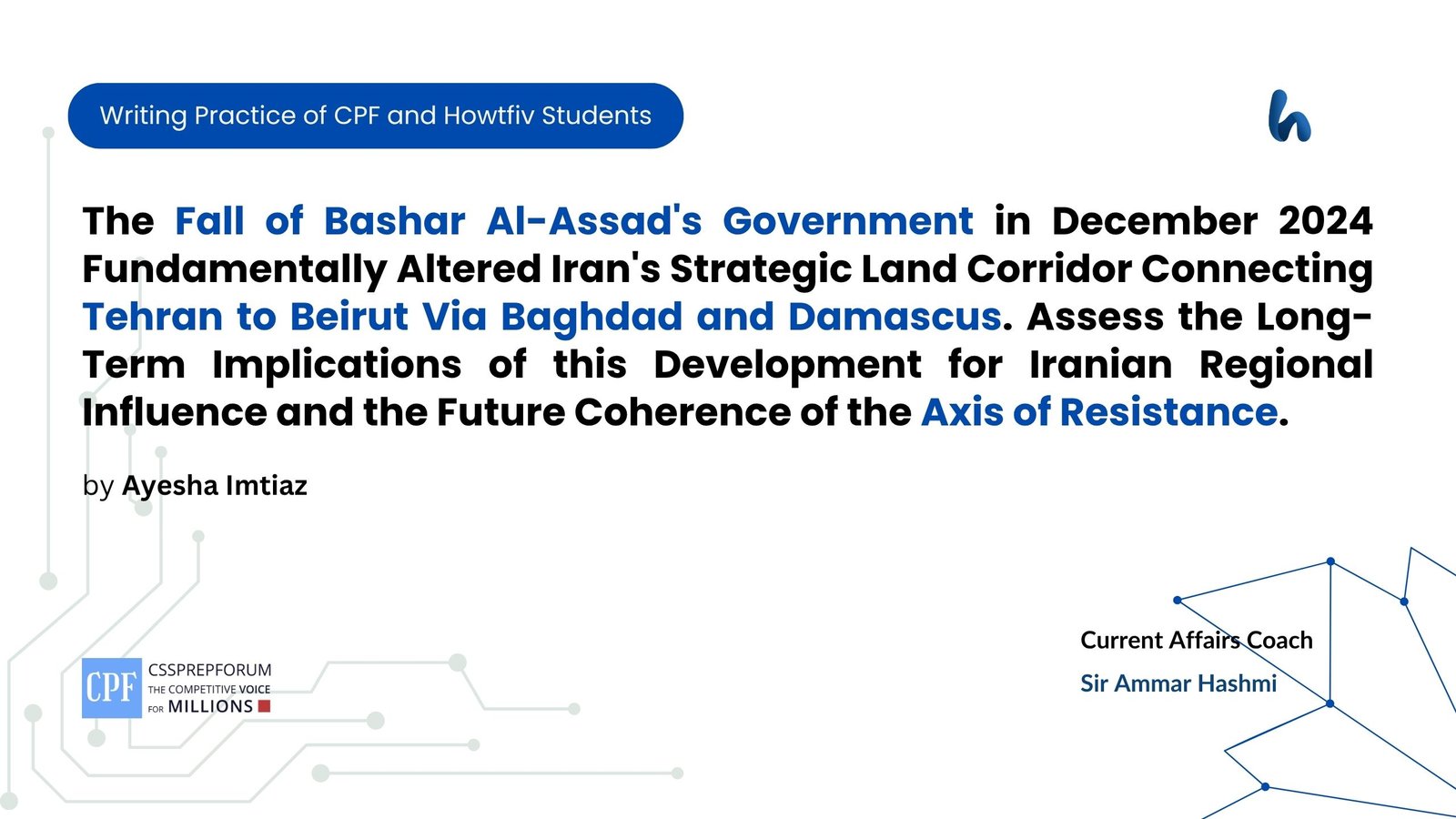
CSS Current Affairs | Long-Term Implications of the Fall of Bashar Al-Assad’s Government for Iranian Regional Influence and the Future Coherence of the Axis of Resistance
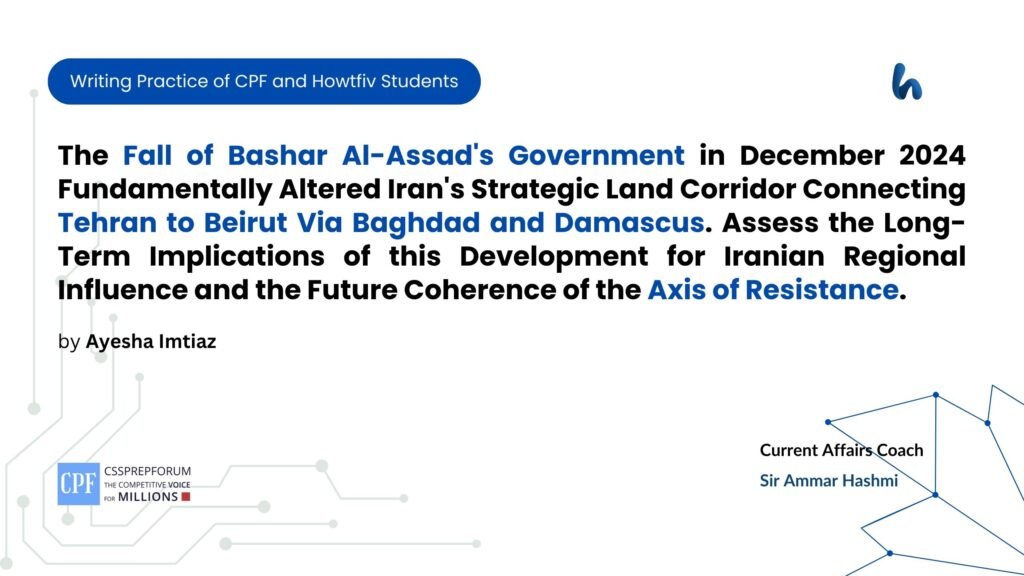
The following assignment question for CSS Current Affairs is solved by Ayesha Imtiaz under the supervision of Howfiv’s Pakistan Affairs and Current Affairs Coaches: Miss Iqra Ali and Sir Ammar Hashmi. She learnt how to attempt 20 marks question and essay writing from Sir Syed Kazim Ali, Pakistan’s best CSS and PMS English essay and precis teacher with the highest success rate of his students. This solved question is attempted on the pattern taught by Sir to his students, scoring the highest marks in compulsory and optional subjects for years.

Outline
1-Introduction
2-The Fall of Bashar al-Assad’s Government in December 2024
3-Implications of the Fall of Bashar al-Assad’s Government for Iranian Regional Influence
- Severing the logistical lifelines to Hezbollah
- Shrinking the geographic depth of the “Forward Defense” doctrine
- Realigning the regional balance of power toward competing axes
- Forcing a costly shift from state-level partnerships to asymmetric subversion
4-The Future Coherence of the Axis of Resistance
- Navigating a highly fragmented future network without a unified land route to move troops or heavy weapons.
- Rebuilding underground smuggling networks through a deeply hostile Syrian territory over the long term.
- Shifting heavily toward risky maritime and aerial supply routes to sustain a weakened Hezbollah.
- Moving toward localized tech sharing
5-Conclusion
Answer to the question
Introduction
The fall of Bashar al-Assad’s government in December 2024 completely broke Iran’s power in the Middle East. For a sustained period, Syria was the most important link in Iran’s defense plan. It connected Iran to Iraq, Syria, and Lebanon, forming a direct highway to the Mediterranean Sea. Now, this regime change has adopted a hostile foreign policy towards Iran. This massive change has ruined Iran’s network of armed groups, known as the Axis of Resistance, thereby severing the logistical lifelines to Hezbollah and undermining the “Forward Defense” doctrine. The future coherence of the Axis of Resistance would rely on a highly fragmented future network and underground smuggling networks through a deeply hostile Syrian territory. Therefore, the new government in Syria has significantly shattered the structural unity of the Axis of Resistance.
The Fall of Bashar al-Assad’s Government in December 2024
In December 2024, Bashar al-Assad’s government in Syria suddenly collapsed. Rebel forces launched a fast military attack and captured the capital city, Damascus. Assad’s army was tired, weak, and chose not to fight back. His main allies, Russia and Iran, were too busy with their own wars. Assad quickly fled the country and went to Russia for safety. This historic event ended over 50 years of brutal rule by the Assad family. It completely changed the Middle East and ruined Iran’s network of power in the region.

Implications of the Fall of the Bashar al-Assad Government for Iranian Regional Influence
- Severing the logistical lifelines to Hezbollah
The fall of Bashar al-Assad’s government has significantly cut off Iran’s land route, which was used to support its axis of resistance. For decades, Iran used these highways through Baghdad and Damascus to safely drive trucks filled with heavy missiles and weapons directly to Hezbollah. However, they are now forced to use ships or airplanes, which are much easier for their enemies to spot and intercept. This new administration in Damascus has shut down the border crossings once used by Iranian forces and banned Iranian military planes from landing. Simultaneously, Israel and its Western allies have increased their monitoring of the surrounding airspace and waters. This major regime change has made it incredibly difficult for Iran to support its regional proxies. Consequently, this supply bottleneck leaves Hezbollah, the core of the resistance network, isolated and running out of advanced weapons, ultimately destroying Iran’s long-term plan to threaten Israel from its northern border.
- Shrinking the geographic depth of the “Forward Defense” doctrine
Additionally, the collapse of the Syrian corridor has severely damaged the geographic depth of Iran’s “Forward Defense” doctrine. Under this doctrine, Iran’s military strategy relied on fighting its adversaries in the Levant rather than on its own soil, using Syria as a protective buffer zone to pressure its enemies from a distance. However, with the sudden fall of the Assad government, Iran lost its vast network of military bases, drone hubs, and command centers that were scattered across Syrian territory. This major regime change has effectively pushed Tehran’s strategic frontline hundreds of miles backward to Iraq, stripping Iran of its vital foothold next to Israel’s border. Ultimately, losing this buffer zone means Iran can no longer block threats from far away, leaving its own home borders much more open to attack and fundamentally causing its “Forward Defense” doctrine to fail.
- Realigning the regional balance of power toward competing axes
Moreover, the fall of the Assad regime has completely changed the balance of power in the region. This shift has moved Syria away from Iran and toward competing alliances. For decades, Damascus was Tehran’s most reliable partner in the Middle East. However, after the transition of power, rival powers like Turkey and the Gulf states quickly stepped in. They significantly reshaped Syria’s foreign policy by shifting it toward a pro-West and pro-Sunni alliance. Additionally, Damascus has signed major economic and energy deals with Turkish and Gulf partners. The new government is relying on Saudi Arabia, Qatar, and Turkey for financial reconstruction. This cooperation is building a powerful Arab-Turkish bloc. This new bloc naturally blocks Iranian expansion in the region. Therefore, this emerging geopolitical shift fosters policies that are deeply hostile to Tehran. Ultimately, these changes severely hinder Iran from continuing its influence in the area.
- Forcing a costly shift from state-level partnerships to asymmetric subversion
Furthermore, the collapse of the Syrian alliance forces Iran to shift its regional strategy from low-cost state partnerships to highly expensive asymmetric subversion. Before the collapse, under the regime of Bashar al-Assad, Tehran operated openly through a legal, friendly government in Damascus. Now, it must rely on underground proxy networks and guerrilla operations to keep its regional influence alive. The Islamic Revolutionary Guard Corps (IRGC) must spend immense financial and intelligence resources to secure risky, underground smuggling routes through the Iraqi-Syrian desert. Ultimately, this forced strategic pivot severely drains Iran’s limited budget, making its remaining regional footprint far more expensive and dangerous to sustain.
The Future Coherence of the Axis of Resistance
- Navigating a highly fragmented future network without a unified land route to move troops or heavy weapons
The fall of the Syrian government has broken Iran’s land route to the Mediterranean, forcing the Axis of Resistance to operate as a split and disconnected network in the future. Without friends in Damascus to keep the roads open, the alliance can no longer easily drive trucks full of heavy weapons, bullets, or fighters across the borders from Iraq into Syria and Lebanon. This new government in Syria has started closing down Iranian military bases, locking down its borders, and cutting diplomatic ties with Tehran. This shows that Syria has changed from a safe highway for Iran into a giant roadblock, obstructing the movement of weapons or troops across the land. Therefore, this physical cut-off has turned a once-powerful land alliance into separated, weaker pieces.
- Rebuilding underground smuggling networks through a deeply hostile Syrian territory over the long term
Likewise, to fix this broken connection, Iran will focus on rebuilding underground smuggling networks across unfriendly Syrian territory over the long term. Since state-to-state cooperation is no longer an option, Iranian intelligence agencies will try to exploit corrupt officials, remote border crossings, and local tribal connections to secretly move smaller weapons, electronics, and cash toward Lebanon. The massive Syrian desert is very hard for the new government to guard, and local tribes have been using these empty spaces to smuggle goods across the borders for a very long time. These secret paths will be very dangerous, expensive, and cannot handle the heavy missiles and large supplies that Iran used to send. Ultimately, relying on these hidden, weak paths means the future Axis supply chain will be far less reliable, keeping the alliance weak and prone to constant disruptions.
- Shifting heavily toward risky maritime and aerial supply routes to sustain a weakened Hezbollah
Similarly, deprived of its continental land bridge, Iran’s future strategy involves shifting heavily toward vulnerable maritime and aerial supply routes to sustain a weakened Hezbollah. Because trucks can no longer drive through Syria, Tehran must rely on cargo ships crossing the Mediterranean Sea or airplanes landing in Beirut to send weapons and financial aid. Military records show that whenever land routes are closed, Iran immediately starts using more secret cargo planes and ships to send missile parts directly into Lebanon. This shows that while boats and planes are fast, they are very easy for enemies like Israel to spot. Israel can easily watch the ports, block the sea, or bomb airport runways to stop the supplies from arriving. Therefore, being forced to use these open and unprotected paths means Iran’s plans to supply Hezbollah will be easily trapped and stopped by its enemies.
- Moving toward localized tech sharing
Last but not least, the Axis of Resistance is shifting to localized tech sharing to survive, so each group can build its own basic drones and missiles without needing to import finished weapons. Instead of smuggling heavy weapons, the alliance now shares digital blueprints and technical expertise. For instance, groups in Yemen and Gaza have already built effective drones inside hidden, local workshops using these shared designs. This strategy bypasses border blocks entirely, making it impossible for enemies to cut off the supply chain. By making each group self-sufficient, the network ensures its survival without relying on vulnerable supply routes.
Conclusion
In conclusion, the loss of the land route through Syria is a permanent defeat for Iran’s regional empire. The Axis of Resistance is no longer a united, powerful team. Instead, it is broken into small, separated groups. While friendly militias still exist in Iraq and Yemen, their main connection point in Syria is gone forever. Iran can no longer easily send heavy weapons to Hezbollah by land; it may rely on underground strategies or cargo ships that are quite vulnerable to detection. Because of this, Iran’s aggressive plans to control the region have failed. Tehran must now accept that its power is shrinking, and it must focus only on protecting its own borders from being surrounded.

CSS Solved Past Papers’ Essays
Looking for the last ten years of CSS and PMS Solved Essays and want to know how Sir Kazim’s students write and score the highest marks in the essays’ papers? Then, click on the CSS Solved Essays to start reading them.
CSS Solved Essays
CSS Solved Islamiyat Past Papers
Want to read the last ten years’ Islamiyat Solved Past Papers to learn how to attempt them and to score high? Let’s click on the link below to read them all freely. All past papers have been solved by Pakistan’s top CSS Islamiyat coaches having the highest score of their students.
CSS Solved Islamiyat
CSS Solved General Science & Ability Past Papers
Want to read the last ten years’ General Science & Ability Solved Past Papers to learn how to attempt them and to score high? Let’s click on the link below to read them all freely. All past papers have been solved by Pakistan’s top CSS GSA coachez having the highest score of their students.
CSS Solved General Science & Ability
CSS Solved Pakistan Affairs Past Papers
Want to read the last fifteen years’ Pakistan Affairs Solved Past Papers to learn how to attempt them and to score high? Let’s click on the link below to read them all freely. All past papers have been solved by Pakistan’s top CSS Pakistan Affairs coaches having the highest score of their students.
CSS Solved Pakistan Affairs
CSS Solved Current Affairs Past Papers
Want to read the last fifteen years’ Current Affairs Solved Past Papers to learn how to attempt them and to score high? Let’s click on the link below to read them all freely. All past papers have been solved by Pakistan’s top CSS Current Affairs coaches having the highest score of their students.
CSS Solved Current Affairs