CSS Pakistan Affairs | An Analysis of the Productivity Gap in the Agricultural Sector of Pakistan
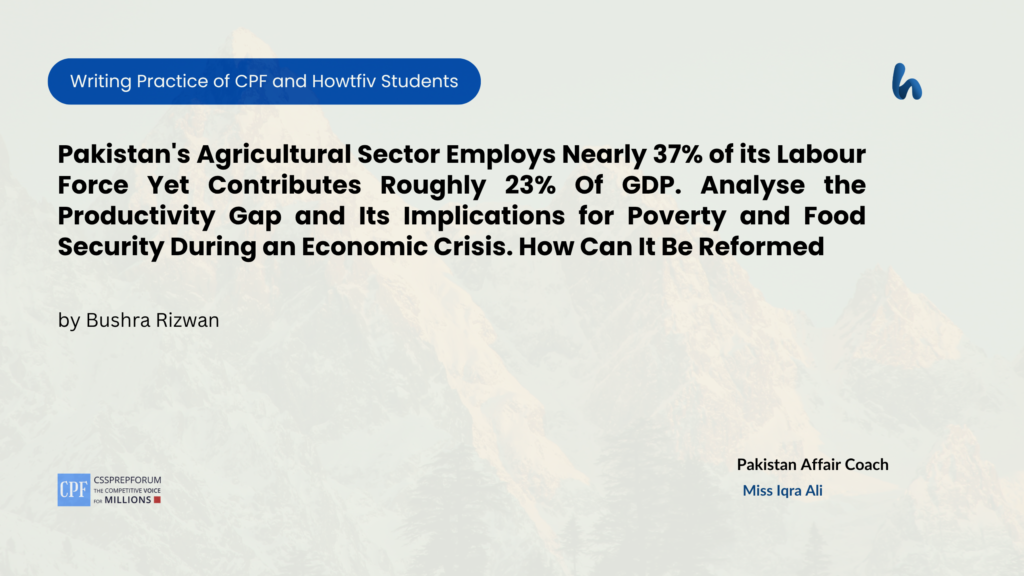
The following question of CSS Pakistan Affairs is solved by Bushra Rizwan under the supervision of Howfiv’s Pakistan Affairs and Current Affairs Coaches: Miss Iqra Ali and Sir Ammar Hashmir. She learnt how to attempt 20 marks question and essay writing from Sir Syed Kazim Ali, Pakistan’s best CSS and PMS English essay and precis teacher with the highest success rate of his students. This solved question is attempted on the pattern taught by Sir to his students, scoring the highest marks in compulsory and optional subjects for years.

Outline
1- Introduction
2- An overview of Pakistan’s agrarian economy
3- Why does a productivity gap exist in Pakistan’s agriculture sector?
- Feudal hegemony leading to agricultural tax exemption
- Seed crisis undermining agricultural productivity and export competitiveness
4- What are its implications for poverty and food security during an economic crisis?
- Rising Unemployment due to the climate vulnerability nexus
- Exacerbating the threat to food sovereignty due to import dependence
5- How can the agriculture sector be reformed?
- Improving Agricultural income taxation through the proper implementation of agricultural tax laws
- Agricultural modernisation through mechanised farming, cold chain logistics, and breed improvement programmes
- Agricultural climate adoption through flood-resilient crops and crop insurance mechanisms
- Improving medium-term export revenue through livestock productivity programmes
6- Conclusion

Answer to the Question
Introduction
Since its creation, Pakistan has emerged as an overwhelmingly agrarian economy. Despite a broad labour base, an agricultural paradox persists, where it employs 37% of the labour force, yet contributes only 23.5% of GDP and less than 0.1% of total taxes. This fiscal gap is caused by a productivity deficit, which is itself created by tax exemptions due to feudal hegemony. Moreover, the import dependency of Pakistan in the seed sector further weakens export competitiveness. As a result of this productivity gap, unemployment rises, and food sovereignty gets threatened, further pushing people down the poverty line. In order to mitigate the declining agricultural productivity, a few reforms must be introduced and thoroughly implemented: Proper implementation of agriculture tax laws, agricultural modernisation, and climate adoption. Therefore, the true potential of Pakistan’s agriculture sector can only be harnessed through the proper implementation of these tailored reforms that are best suited to the sector’s requirements.
Historical overview of Pakistan’s agrarian economy
In the era of 1947-58, agriculture’s share of GDP was 53%, and the labour force employed in agriculture was 65%. As the administrative infrastructure was devastated and there was no industry at the time of independence, the economy depended heavily on primary agricultural commodities. During 1958-70, due to the Green Revolution, Pakistan recorded an 6.6% average agricultural growth, and average GDP growth was 5.82-6.25% per annum. During 1969-71, Pakistan went into fiscal deficit due to the Bengal separation. Subsequently, in the era (1977-85), agricultural growth averaged at 4.2%. During Bhutto and Nawaz Sharif’s eras, agricultural output remained steady. Later, during Musharraf’s era, the agricultural prices soared, and rural inequality was entrenched. Moving further, the CPEC signed during the Nawaz Sharif era(2013-2018), the agricultural SEZs were introduced. During this era, agricultural growth averaged at 2.1%. During the 2018-2023 era, agriculture was devastated by floods, and cotton fell below 5 million bales. As a result, this uneven agricultural trajectory shows that this sector has been underutilized throughout the country’s history.
Why does a productivity gap exist in Pakistan’s agriculture sector
- Feudal hegemony leading to agricultural tax exemption
To begin with, under the constitution of Pakistan, only provincial governments can tax agricultural income; Yet, they collect only negligible amounts. The result is a glaring structural inequity: wealthy landowners pay virtually no tax income, while salaried employees pay a huge sum in taxes. Out of 260 directly elected seats in the Pakistan National Assembly, approximately 55% represent constituencies where agriculture is the primary economic activity, which results in legislators having little appetite to tax their own farmers, resulting in less than 0.1 % contribution of total tax revenue by the agricultural sector. Due to the creation of this structural political incentive, such legislators oppose agricultural tax reforms, as they do not want to tax farmers in their own constituencies. Therefore, a tax disparity is formed that represents one of the largest untapped fiscal opportunities in Pakistan.
- Seed crisis undermining agricultural productivity and export competitiveness
Additionally, the seed crisis is a multidimensional obstacle to Pakistan’s agricultural productivity and agri-based export competitiveness, as hybrid and genetically manufactured seeds remain underutilized. In the private sector, maize seed copies are sold without patent protection, and the Federal Seed Certification and Registration Department(FSCRD) takes as many as 3-4 years in seed certification, far too slow for the farmers to adopt improved varieties. Since the transfer of agriculture to the provincial list under the 18th Amendment, a jurisdictional overlap has been created in seed regulation, compounded by a shortage of trained technical staff. Consequently, the technical gap and lack of government oversight on seed manufacturers have hampered agricultural efficiency, resulting in export backwardness.
What are its implications for poverty and food security during an economic crisis?
- Rising Unemployment due to the climate vulnerability nexus
First and foremost, the climate disasters often draw down any improvement in the poverty index produced by agricultural reforms. As Pakistan is prone to floods, droughts, and heatwaves, the agricultural produce is often affected by these events. According to the Pakistan Inflation and Labour Market Snapshot(2020-2025)”, due to the 2022 floods, the unemployment ratio rose from 6.5% in 2022 to 8.5% in 2023. Simultaneously, food inflation spiked up 40%. This increase in unemployment and inflation ratio contributes to poverty. Consequently, natural disasters in the country, due to its climate-prone agriculture, hamper livelihoods and increase the rich-poor gap.
- Exacerbating the threat to food sovereignty due to import dependence
Moreover, the import dependence of Pakistan even for crops that it has the potential to produce sufficiently. Moreover, food insecurity is further heightened by the prioritization of cash crops by landlords. According to PIDE(Pakistan Institute of Development Economics), approximately 80% of seeds used in Pakistan are imported, primarily from China, representing severe import dependence and a threat to food sovereignty. This over-reliance on imported seeds for fulfilling basic food necessities places Pakistan at risk of a food crisis. Consequently, food shortages and price hikes occur that severely impact the already malnourished population.
How can the agriculture sector be reformed?
- Improving Agricultural income taxation through the proper implementation of agricultural tax laws
First, agricultural reforms should be aimed at tapping this under-taxed sector, so that provincial control on this undersued sector can be utilized, and provincial revenue can be improved. Through properly designed and thoroughly implemented agriculture laws, a sector long shielded from taxation due to feudal hegemony, will transform into a broad source of revenue that would align provincial income tax rates with federal ones. A Key feature of the National Fiscal Pact is the commitment of all provinces to reform the Agriculture Income Tax Laws by October 2024. And it was decided that by January 2025, farmers would be taxed like normal citizens. Such beneficial reforms and others, like alignment of agricultural policies, through coordination of federal and provincial governments, should be implemented in the true spirit to ensure harmonized tax frameworks. Consequently, the agricultural sector of Pakistan, through these coordinated reforms, would transform into the highest contributors of tax, improving the economic trajectory of the country.
- Agricultural modernisation through mechanised farming, cold chain logistics, and breed improvement programmes
Second, agricultural modernisation, through the incorporation of tech-based machinery, is an imperative for economic and food security. Through mechanised farming, cold-chain logistics, precision irrigation, breed improvement programmes, and certified seed technology, agricultural modernisation can be achieved. As during the Green Revolution, the introduction of High-Yielding Variety seeds, chemical fertilizers, and pesticides produced agricultural growth around 11.7% per annum (1966-68) and overall GDP growth around 5.82-6.25 % in the entire Ayub Khan era, similar agricultural technology advances can transform agriculture in the present times. In addition, these technologies can dramatically increase crop yields in developing countries like Pakistan, producing sustainable GDP growth. As a result, incorporating biotech advances in agriculture is a prerequisite for GDP increase through agri-based exports.
- Agricultural climate adoption through flood-resilient crops and crop insurance mechanisms
Third, for Pakistan, a shift to a green economy is not only an environmental aspiration but also an economic necessity: climate change disproportionately impacts water availability and agricultural output, creating economic risks that dwarf the investment required for adoption. Systematic investment in flood-resilient crop varieties, water management infrastructure, and crop insurance mechanisms is required to reduce the fiscal cost of climate-driven food import dependency. According to Express Tribune, climate change will decrease agricultural productivity by 8-10 % by 2040, which shows that structural adaption with climate change is a necessity to ensure long-term food security. This further emphasizes that Pakistan must adapt to narrow climate-driven disruptions due to monsoon pattern intensification. Therefore, agricultural climate adoption can increase crop yields and protect them from severe climate-induced destruction.
- Improving medium-term export revenue through livestock productivity programmes
Livestock productivity programmes: animal breed improvement, animal nutrition, and veterinary service programmes should target bovine and ovine (sheep) as a medium-term export-revenue opportunity.To improve the meat output of Pakistani farmers, who generate only a fraction of meet output that is achievable through technologically advanced agricultural systems. As Agricultural GDP is highly livestock dominant, it accounts for 63.60 % of agricultural GDP and 14.97 % of actual GDP, which highlights that livestock improvement programs are necessary not only for agricultural productivity but also for overall GDP growth of Pakistan. Hence, the country’s livestock sector must be reformed to improve export competitiveness, especially in global meat markets.
Conclusion
In conclusion, the agricultural sector of Pakistan is grappled with challenges, including but not limited to feudal hegemony and a seed crisis that have made the country import dependent, even in utilities it has sufficient ability to produce. Due to this, the productivity gap persists, worsening the poverty baseline, raising food prices, and resulting in food shortages at times of economic crisis. Only through agricultural modernisation, climate adoption, and livestock productivity programmes can Pakistan increase the efficiency and competitiveness of its agricultural sector. Therefore, real-time application of these appropriate reforms can help Pakistan revitalize its agricultural output and, in turn, course-correct its economic trajectory.

CSS Solved Past Papers’ Essays
Looking for the last ten years of CSS and PMS Solved Essays and want to know how Sir Kazim’s students write and score the highest marks in the essays’ papers? Then, click on the CSS Solved Essays to start reading them.
CSS Solved Essays
CSS Solved Islamiyat Past Papers
Want to read the last ten years’ Islamiyat Solved Past Papers to learn how to attempt them and to score high? Let’s click on the link below to read them all freely. All past papers have been solved by Pakistan’s top CSS Islamiyat coaches having the highest score of their students.
CSS Solved Islamiyat
CSS Solved General Science & Ability Past Papers
Want to read the last ten years’ General Science & Ability Solved Past Papers to learn how to attempt them and to score high? Let’s click on the link below to read them all freely. All past papers have been solved by Pakistan’s top CSS GSA coachez having the highest score of their students.
CSS Solved General Science & Ability
CSS Solved Pakistan Affairs Past Papers
Want to read the last fifteen years’ Pakistan Affairs Solved Past Papers to learn how to attempt them and to score high? Let’s click on the link below to read them all freely. All past papers have been solved by Pakistan’s top CSS Pakistan Affairs coaches having the highest score of their students.
CSS Solved Pakistan Affairs
CSS Solved Current Affairs Past Papers
Want to read the last fifteen years’ Current Affairs Solved Past Papers to learn how to attempt them and to score high? Let’s click on the link below to read them all freely. All past papers have been solved by Pakistan’s top CSS Current Affairs coaches having the highest score of their students.
CSS Solved Current Affairs