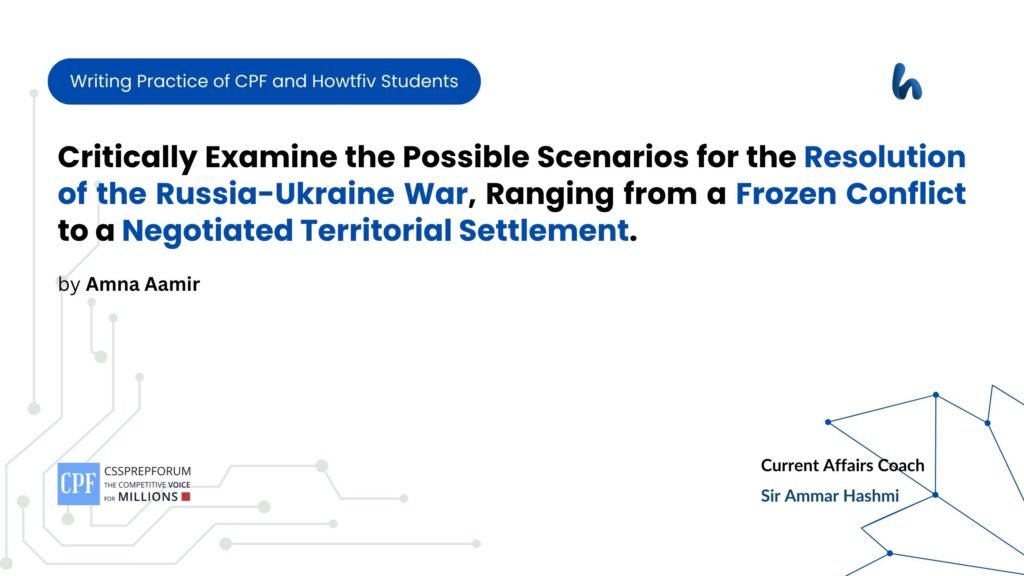
CSS Current Affairs | Possible outcome Scenarios for the Russia-Ukraine War
The following assignment question for CSS Current Affairs is solved by Amna Aamir under the supervision of Howfiv’s Pakistan Affairs and Current Affairs Coaches: Miss Iqra Ali and Sir Ammar Hashmi. She learnt how to attempt 20 marks question and essay writing from Sir Syed Kazim Ali, Pakistan’s best CSS and PMS English essay and precis teacher with the highest success rate of his students. This solved question is attempted on the pattern taught by Sir to his students, scoring the highest marks in compulsory and optional subjects for years.
Outline
1 Introduction
2-Evaluating the Strategic Preconditions for War Termination
3-Critically Examining the Possible Scenarios for the Resolution of the Russia-Ukraine War along the Conflict Spectrum
- ✓A Prolonged “Frozen Conflict” via an Un-Negotiated Armistice
- ✓A Negotiated Territorial Settlement through Sovereign Trade-Offs
- ✓A Managed War of Attrition and Continuous Frontline Attrition
- ✓A Unilateral Military Imposition through Strategic Breakthrough
4-Broader Implications for European and Global Security Architecture
- ✓The Transition from Post-Cold War Diplomatic Norms to Militarized Border Deterrence
- ✓The Fracturing of Global Energy Networks and Supply Chain Realignment
- ✓The Strain on Transatlantic Defense Inventories and Industrial Attrition Endurance
- ✓The Restructuring of Strategic Hedging and Trade Vulnerabilities in the Global South
5-Pragmatic Pathways for Conflict Mitigation
- ✓To Establish Incremental, Low-Level Ceasefire Arrangements and Localized Security Corridors
- ✓To Construct Multi-Tiered European Defense Pacts Short of Immediate NATO Accession
- ✓To Implement Phased Sanctions Relief Tied Directly to Verifiable Compliance Metrics
6-Conclusion
Answer to the Question
Introduction
The contemporary Russia-Ukraine conflict represents the most severe geopolitical disruption in European security since the end of the Cold War, marking the decisive collapse of the post-Cold War security structure. What initially manifested as an asymmetrical hybrid operation in 2014 has transformed into a high-intensity, industrial-scale war of attrition that redefines global systemic stability. At its core, the conflict involves an irreconcilable structural divergence: Russia’s revisionist strategic doctrine seeks the total subordination of Ukrainian sovereignty and the reversal of NATO’s eastern expansion, while Ukraine, backed by Western allies, treats its territorial integrity and Euro-Atlantic integration as non-negotiable prerequisites for survival. As the military frontlines stabilize near a bloody dead end, evaluating the prospective resolution pathways along a dynamic conflict spectrum, covering an un-negotiated “frozen conflict,” a formally negotiated territorial settlement, a sustained war of attrition, and a unilateral strategic imposition, becomes vital. Furthermore, a prolonged and un-negotiated frozen conflict along the current line of contact remains the most probable near-term trajectory, given the domestic political constraints that make either outright capitulation or formal territorial concession untenable for Moscow and Kyiv alike. A negotiated territorial settlement, though offering the only legally durable model for long-term regional stability, remains the least immediately feasible outcome precisely because it demands the sovereign compromises both capitals currently reject. Consequently, the eventual trajectory of this war will not merely dictate the future of Eastern Europe, but will fundamentally reshape global energy flows, strain Western defense-industrial capacities, and establish new precedents for border deterrence and international legal norms in an increasingly multipolar world order.
Evaluating the Strategic Preconditions for War Termination
War termination is rarely a linear event; rather, it represents the strategic equilibrium where the perceived costs of continued warfare exceed the political risks of compromise. While military engagements dictate daily frontline geometry, the transition toward any conflict endstate, whether an unnegotiated frozen conflict or a formally negotiated territorial settlement, is governed by structural preconditions rather than isolated battlefield shifts. Three decisive variables dictate the strategic calculus of both belligerents: operational attrition capacities, external material sustainability, and domestic regime resilience. Evaluating these underlying preconditions provides the necessary analytical baseline against which the four scenarios below can be judged.

Critically Examining the Possible Scenarios for the Resolution of the Russia-Ukraine War along the Conflict Spectrum
- A Prolonged “Frozen Conflict” via an Un-Negotiated Armistice
To begin with, a prolonged frozen conflict represents an operational cessation of hostilities along current frontline positions without a formal peace treaty or legal border recognition. This scenario becomes primary when both militaries reach a state of mutual attrition where neither can launch decisive offensive operations to alter the status quo. According to a research paper by the RAND Corporation, armistice arrangements similar to the 1953 Korean Ceasefire Agreement successfully suspend daily kinetic strikes, but they leave systemic security threats unresolved, preserving a high risk of future re-escalation. This historical comparison proves that while an un-negotiated truce halts immediate casualties and reduces Black Sea maritime disruptions, it leaves Ukraine in legal ambiguity and forces both nations into permanent military readiness along a fortified borderland. Therefore, an un-negotiated armistice serves as a pragmatic tactical pause rather than a permanent diplomatic settlement.
- A Negotiated Territorial Settlement through Sovereign Trade-Offs
Simultaneously, a formal territorial settlement involves a binding diplomatic treaty under which Ukraine cedes de facto administrative control over occupied regions in exchange for hard Western security guarantees and European integration. Realizing this pathway requires intense diplomatic pressure combined with economic exhaustion that forces both capitals to lower their minimalist political terms. According to a policy study by the Stockholm International Peace Research Institute (SIPRI), land-for-peace frameworks yield durable stability only when backed by enforceable, multi-power security pacts that effectively deter future border revisionism. This assessment confirms that while accepting formal land concessions violates Article 2(4) of the UN Charter and risks triggering severe political instability within Ukrainian domestic politics, formal legal clarity remains impossible without binding external enforcement. Thus, while a negotiated settlement offers long-term legal predictability, the domestic political costs of surrender make it exceedingly difficult to finalize.
- A Managed War of Attrition and Continuous Frontline Attrition
Additionally, a managed war of attrition reflects the continuation of localized artillery duels, long-range drone strikes on infrastructure, and trench warfare without formal ceasefires or diplomatic engagement. This default state continues when political leaders on both sides determine that the domestic fallout of signing a compromise deal compensates the costs of ongoing combat. According to the International Institute for Strategic Studies (IISS) Military Balance Report, neither belligerent currently possesses the offensive industrial capacity required to achieve a decisive battlefield breakthrough, locking both armies in a slow war of endurance. This technical analysis highlights that continuous frontline fighting drains European defense inventories, deepens global economic polarization, and prolongs humanitarian strain without delivering a definitive political result. Hence, an attritional struggle remains the baseline reality until external material or political factors force a shift.
- A Unilateral Military Imposition through Strategic Breakthrough
On the other hand, a unilateral military imposition occurs when one side suffers a complete structural collapse of its defense lines, resulting in a forced capitulation or dictated peace terms. Naturally, this scenario depends on a severe breakdown in operational logistics, critical troop shortages, or an abrupt termination of key foreign supply pipelines. According to risk assessments published by Chatham House, forcing a nuclear-armed power or a major state into absolute military defeat exponentially increases the risk of unpredictable escalation strategies, including nuclear signaling. This strategic assessment underscores that a peace imposed purely by force creates deep revanchism, ensuring future conflict as soon as the defeated party rebuilds its military strength. Therefore, a unilateral military outcome carries severe risks of non-conventional escalation and fails to build lasting regional stability.
Broader Implications for European and Global Security Architecture
- The Transition from Post-Cold War Diplomatic Norms to Militarized Border Deterrence
Moreover, the crystallization of an unresolved conflict fundamentally dismantles the post-Cold War European security structure that relied on multilateral arms control and diplomatic engagement. Instead, European security is returning to heavy forward deterrence, militarized borders, and sustained defense spending across Eastern Europe. According to an official report by the European Council on Foreign Relations (ECFR), NATO member states have systematically shifted from expeditionary force structures toward heavy armored mobilization and permanent brigade deployments along the eastern flank. This operational shift shows that the continent is institutionalizing a permanent security divide across Eastern Europe, ending decades of economic and diplomatic integration. Consequently, future European stability will depend on military deterrence rather than cooperative diplomatic treaties.
- The Fracturing of Global Energy Networks and Supply Chain Realignment
In addition, the conflict has caused a permanent realignment of global energy transit routes and industrial supply networks. Most notably, European economies have largely decoupled from Russian pipeline gas, prompting a structural pivot toward liquefied natural gas (LNG) and alternative Eurasian trade routes. According to energy tracking data from Bruegel, the European Union reduced its reliance on Russian fossil fuel imports from over 40% of total consumption in 2021 to below 10% by late 2023, rerouting trade flows globally. This substantial reallocation of trade proves that geo-economic decoupling has permanently altered global commodity markets, raising base operational costs for European industries. Therefore, economic fracturing remains an enduring global consequence of the conflict regardless of frontline changes.
- The Strain on Transatlantic Defense Inventories and Industrial Attrition Endurance
Furthermore, the high rate of weapon consumption along the Ukrainian frontline has highlighted severe bottlenecks within Western defense manufacturing capacities. This reality has forced NATO leadership to re-evaluate industrial readiness, stockpile depths, and procurement timelines for long-term high-intensity warfare. According to a defense assessment by the Kiel Institute for the World Economy, total Western military commitments to Ukraine exceeded $100 billion by 2024, exposing structural limitations in Western shell production compared to wartime industrial output. This quantitative shortfall reveals how industrial strain limits Western strategic flexibility in other global theaters, such as the Indo-Pacific. Thus, the war has forced a fundamental restructuring of Western defense-industrial policies.
- The Restructuring of Strategic Hedging and Trade Vulnerabilities in the Global South
Finally, developing economies continue to bear significant collateral damage from the conflict through market volatility in grain, fertilizer, and energy supply chains. In view of growing polarization between Western coalitions and non-Western blocks, key nations across Asia, Africa, and Latin America are pursuing active diplomatic hedging. According to trade data from the World Trade Organization (WTO), developing nations experienced average food and fertilizer price increases exceeding 25% during peak conflict periods, forcing them to balance economic ties between Western financial networks and non-Western energy suppliers. This economic pressure proves that strategic hedging accelerates the rise of a multipolar international order where non-aligned nations refuse to enforce unilateral Western sanctions. Therefore, the conflict has deepened political and economic multipolarity across the Global South.
Pragmatic Pathways for Conflict Mitigation
- To Establish Incremental, Low-Level Ceasefire Arrangements and Localized Security Corridors
Besides, international diplomatic efforts must prioritize functional, operational ceasefires such as Black Sea maritime transit guarantees, nuclear power plant safety zones, and humanitarian exchanges before trying to resolve broad sovereignty disputes. To make progress, securing small-scale, practical agreements builds essential baseline trust and creates technical mechanisms needed for broader political negotiations down the road. According to a policy paper by the United States Institute of Peace (USIP), historical conflict resolution data demonstrates that localized operational agreements increase the statistical likelihood of reaching a stable, durable armistice by over 40%. This empirical evidence indicates that by decoupling immediate humanitarian and maritime protections from permanent border definitions, mediators can reduce daily collateral damage while keeping diplomatic channels open. Therefore, establishing step-by-step operational ceasefires provides the most pragmatic entry point for conflict de-escalation.
- To Construct Multi-Tiered European Defense Pacts Short of Immediate NATO Accession
Additionally, to address Ukraine’s long-term security needs without triggering an immediate consensus deadlock in NATO, key European powers should establish legally binding bilateral defense pacts. These structured commitments provide Ukraine with credible military deterrence, intelligence sharing, and defense-industrial integration without requiring immediate Article 5 coverage. According to strategic analysis by the International Institute for Strategic Studies (IISS), multi-tiered bilateral security pacts provide effective military deterrence by creating clear, enforceable costs for future aggression while managing broader escalation risks. This structural finding validates that non-NATO defense pacts give Kyiv the security guarantees necessary to engage in long-term reconstruction and diplomatic talks. Thus, constructing multi-layered European defense pacts offers a realistic bridge between immediate defense needs and long-term security integration.
- To Implement Phased Sanctions Relief Tied Directly to Verifiable Compliance Metrics
Last but not least, international economic sanctions should be organized into a clear, multi-stage framework where adjustments are explicitly linked to verified steps in border stabilization and troop pullbacks. In this way, establishing verifiable compliance metrics prevents premature economic concessions while retaining leverage to enforce agreement terms over time. According to an economic brief published by the Carnegie Endowment for International Peace, structured, conditional sanctions frameworks offer higher compliance rates compared to static economic penalties, as they incentivize step-by-step de-escalation. This economic analysis confirms that by linking specific sanctions relief to measurable actions such as heavy artillery pullbacks and monitoring access, the international community maintains leverage to ensure treaty adherence. Consequently, implementing conditional sanctions relief ensures that diplomatic commitments are matched by verifiable actions on the ground.
Conclusion
In conclusion, the strategic landscape of Western Eurasia has undergone a fundamental transformation, shifting from post-Cold War cooperative security into a highly militarized war of endurance. While a formal negotiated territorial settlement offers the clearest legal framework for European peace, the fundamental gap between Moscow’s geopolitical objectives and Kyiv’s sovereign requirements makes an un-negotiated frozen conflict or armistice the most probable medium-term outcome. To mitigate these risks and to achieve regional stability, states must first establish incremental, low-level ceasefire arrangements and localized security corridors to protect human lives and stabilize critical Black Sea shipping routes. Second, regional actors must construct multi-tiered European defense pacts short of immediate NATO accession to provide Ukraine with credible long-term military deterrence while preventing future border revisionism. Ultimately, lasting European stability will depend not on rapid diplomatic compromises, but on establishing realistic military and economic frameworks that prevent a frozen frontline from turning into future aggression.

CSS Solved Past Papers’ Essays
Looking for the last ten years of CSS and PMS Solved Essays and want to know how Sir Kazim’s students write and score the highest marks in the essays’ papers? Then, click on the CSS Solved Essays to start reading them.
CSS Solved Essays
CSS Solved Islamiyat Past Papers
Want to read the last ten years’ Islamiyat Solved Past Papers to learn how to attempt them and to score high? Let’s click on the link below to read them all freely. All past papers have been solved by Pakistan’s top CSS Islamiyat coaches having the highest score of their students.
CSS Solved Islamiyat
CSS Solved General Science & Ability Past Papers
Want to read the last ten years’ General Science & Ability Solved Past Papers to learn how to attempt them and to score high? Let’s click on the link below to read them all freely. All past papers have been solved by Pakistan’s top CSS GSA coachez having the highest score of their students.
CSS Solved General Science & Ability
CSS Solved Pakistan Affairs Past Papers
Want to read the last fifteen years’ Pakistan Affairs Solved Past Papers to learn how to attempt them and to score high? Let’s click on the link below to read them all freely. All past papers have been solved by Pakistan’s top CSS Pakistan Affairs coaches having the highest score of their students.
CSS Solved Pakistan Affairs
CSS Solved Current Affairs Past Papers
Want to read the last fifteen years’ Current Affairs Solved Past Papers to learn how to attempt them and to score high? Let’s click on the link below to read them all freely. All past papers have been solved by Pakistan’s top CSS Current Affairs coaches having the highest score of their students.
CSS Solved Current Affairs