CSS/PMS Islamiat | Critical Assess of the Incident of the Cloak to Corruption Control in Pakistan

Introduction
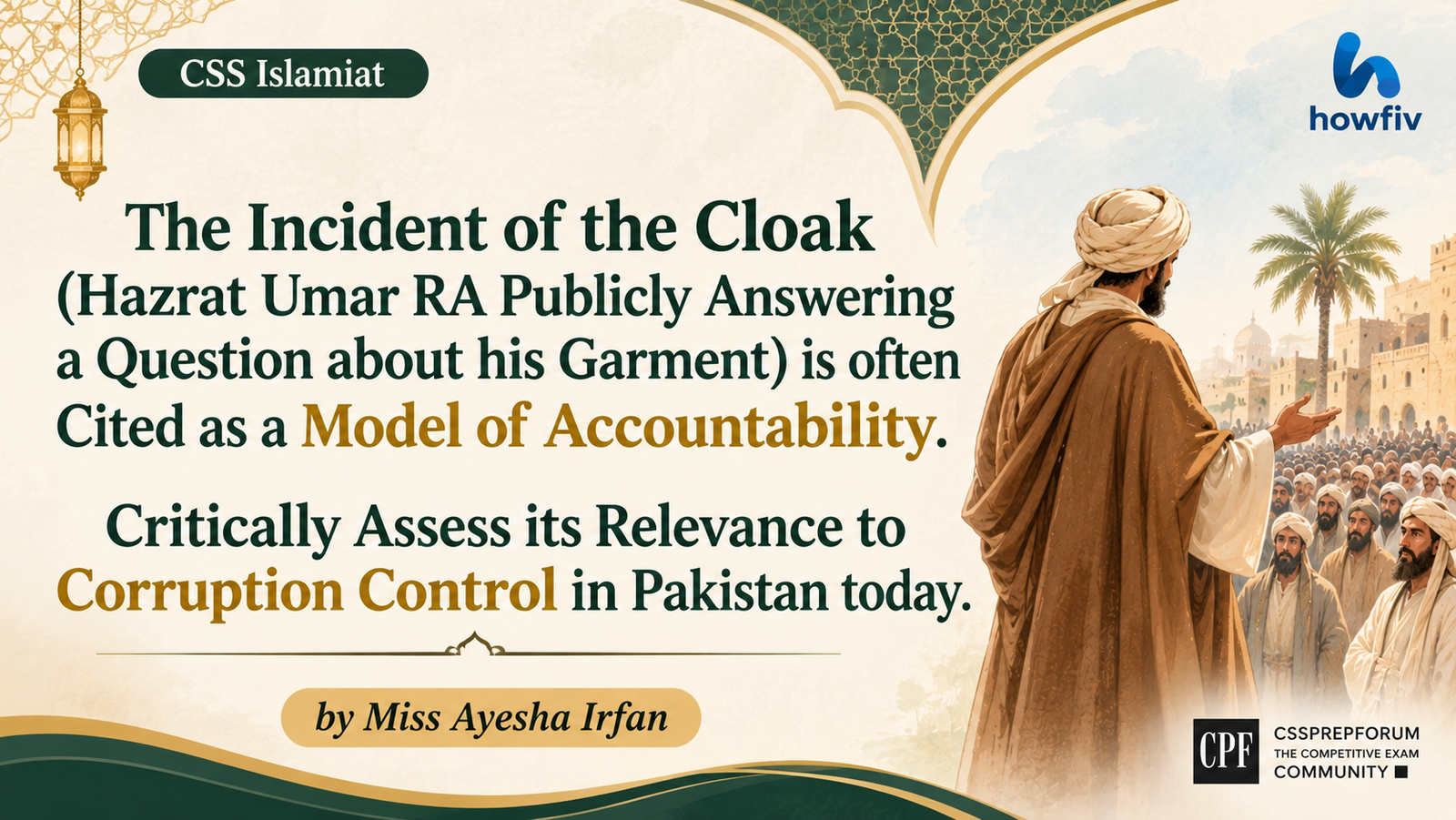
Corruption is one of the gravest obstacles to the progress of any society. It drains public resources, weakens trust in institutions, and deepens inequality. Islam addresses this problem at its root by treating public office as a trust (amanah) and not as a personal privilege. In the Islamic political tradition the ruler is answerable to Allah and also to the people he governs. Among the many examples of this principle, the incident of the cloak of Hazrat Umar (RA) is the one most often quoted in speeches, textbooks, and public debate when accountability of rulers is discussed. It is frequently presented as an ideal that modern Muslim states, including Pakistan, should follow.
This answer argues that the incident of the cloak is a valuable moral and political principle of accountability, but that on its own it is not a practical model for controlling corruption in a modern, large, and complex state like Pakistan. Its true relevance lies in the values it teaches, which must be combined with strong institutions, enforceable laws, and a culture of integrity.
The Incident of the Cloak: A Historical Model of Accountability
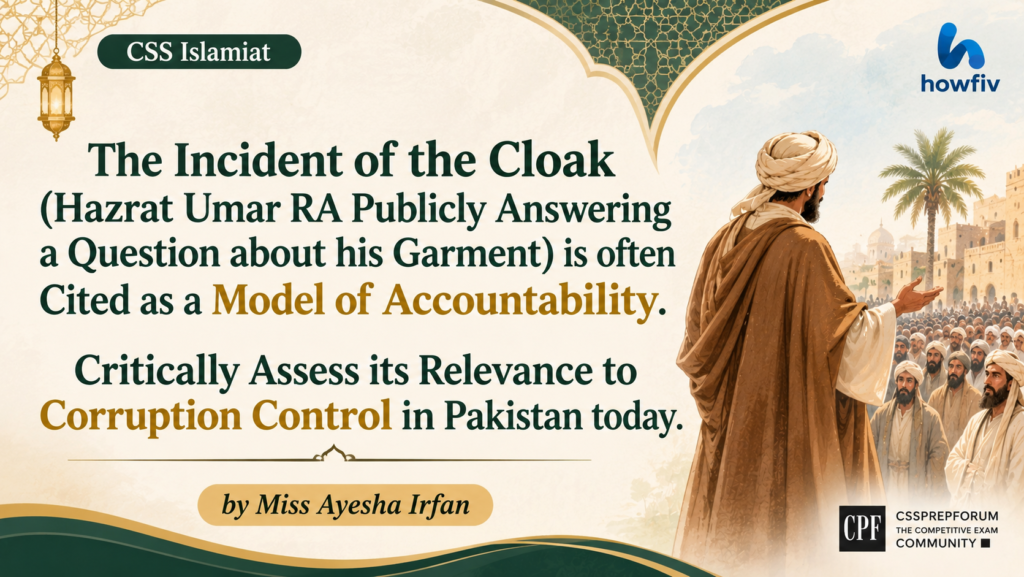
According to the account found in classical biographical literature, cloth from the state’s share arrived in Madinah and was distributed among the people, each receiving one sheet. One sheet was not enough to make a long garment for a tall man such as Umar (RA). One day, while addressing the people, Umar (RA) appeared wearing a garment that clearly needed more cloth than a single share. When he asked the people to listen and obey, a man from the audience, identified in the common version as Salman al-Farsi (RA), said that they would not listen or obey until he explained how he came to have a longer garment than everyone else. Umar (RA) did not take offense. He asked his son Abdullah (RA) to answer. Abdullah explained that he had given his own share to his father so that he could make a full garment. The people were satisfied and said that they would now listen and obey.
The incident teaches several lessons: First, no one is above questioning, because the head of the state was publicly asked about his personal conduct. Second, obedience is linked to integrity, since the listener tied the duty to listen and obey to a satisfactory explanation. Third, the incident shows transparency about personal benefit: the ruler gave an open and verifiable answer rather than asserting his authority. Finally, it shows that moral authority is the basis of lawful authority, because Umar’s willingness to be questioned strengthened his legitimacy instead of weakening it.
Islamic Foundation of Accountability in Governance
The principle of accountability in Islam does not rest on a single incident. It is established by the Quran, the Sunnah, and the practice of the Rightly Guided Caliphs.
The Quran
The Quran makes public office a trust and justice a duty. Allah says, “Indeed, Allah commands you to render trusts to whom they are due, and when you judge between people, to judge with justice” (4:58). The Quran also demands justice without favoritism: “O you who believe, stand firmly for justice, as witnesses for Allah, even if it be against yourselves or your parents and relatives” (4:135; see also 5:8). Obedience to those in authority is commanded, but not blindly, because the same verse refers disputes to Allah and His Messenger, which makes authority subject to the divine law (4:59).
The Quran also condemns the abuse of public wealth and power. “Do not consume one another’s wealth unjustly, nor offer it as bribes to the authorities in order to consume a portion of the people’s wealth unlawfully, while you know” (2:188), and “Whoever misappropriates, he will come with what he misappropriated on the Day of Resurrection” (3:161). At the same time, it lays down merit and honesty as the standard for appointments: “Indeed, the best one you can hire is the strong and the trustworthy” (28:26). The request of Prophet Yusuf (AS) to be placed in charge of the storehouses because he was a knowledgeable guardian shows the same pairing of honesty and competence. Finally, the Quran provides checks on power and on the concentration of wealth. Governance is to be by consultation, “Their affair is by consultation among themselves” (42:38; see also 3:159), and wealth must not circulate only among the rich: “So that it may not be a circulation among the rich among you” (59:7).
The Sunnah
The Sunnah builds on the same principle. The Prophet (PBUH) said, “Each of you is a shepherd, and each of you is responsible for his flock” (Bukhari, Muslim). This is the foundation of the idea that every holder of authority is answerable. He also warned, “There is no ruler whom Allah places in charge of subjects, who dies while cheating them, except that Allah forbids Paradise to him” (Bukhari, Muslim). The ruling on bribery is equally clear: “Allah has cursed the one who gives a bribe and the one who takes it” (Abu Dawud, Tirmidhi, Ibn Majah).
The most direct evidence for the principle behind the cloak incident is the case of Ibn al-Lutbiyya. The Prophet (PBUH) appointed a man to collect zakat. On returning, the man said, “This is for you, and this was given to me as a gift.” The Prophet (PBUH) rebuked him publicly and said that if he had stayed in his parents’ house, he would see whether gifts came to him (Bukhari, Muslim). In the same spirit he said, “Whoever we appoint to a post and provide him with a salary, whatever he takes beyond that is misappropriation (ghulul)” (Abu Dawud). This is clear evidence that an official must account for benefits received because of his position.
The Sunnah also establishes equality before the law. When people tried to intercede for a noble woman who had committed theft, the Prophet (PBUH) said that earlier nations were destroyed because they punished the weak and spared the powerful, and added, “By Allah, if Fatima, the daughter of Muhammad, were to steal, I would cut off her hand” (Bukhari, Muslim).
The Practice of the Rightly Guided Caliphs
Abu Bakr (RA), in his first address after becoming caliph, told the people that he had been given authority although he was not the best of them, asked them to help him if he did well and to correct him if he did wrong, and said that they should obey him only as long as he obeyed Allah and His Messenger (reported by Ibn Hisham and al-Tabari). He also accepted only a modest allowance from the treasury. Umar (RA) invited correction. It is reported that when he asked the people to correct him if they saw any crookedness in him, a man replied that they would straighten him with their swords, and Umar thanked Allah for such people. It is also reported that he accepted correction from a woman on the question of the dower (mahr). Reports mention that he sent Muhammad bin Maslama to investigate complaints against governors, that he took stock of governors’ wealth, and that he took action over unexplained gains. He also removed Khalid bin Walid from command, despite his great military record, after questions about the use of funds. These are reported in historical sources and are widely cited as proof that no one was above accountability. Ali (RA) agreed to appear before a judge in a dispute with a non-Muslim over a suit of armor and lost the case for lack of evidence, which is a well-known example of equality before law and of the independence of the Qadi. This evidence shows that the cloak incident is not an isolated story. It is one expression of a consistent Islamic principle: authority is a trust, and the trustee is answerable.
4. Corruption in Pakistan Today
Corruption in Pakistan takes many forms: bribery in public services, irregularities in procurement and contracts, tax evasion, misuse of public office, nepotism and favoritism in appointments, and elite capture of state resources.
International indicators show the seriousness of the problem. Transparency International’s Corruption Perceptions Index (CPI) 2025, released in February 2026, gave Pakistan a score of 28 out of 100 and ranked it 136th among 182 countries, compared with a score of 27 and a rank of 135th among 180 countries in the previous year. Pakistan’s score is well below the global average of about 42. The small improvement should not be exaggerated. Transparency International itself notes that scores are more meaningful than ranks because rankings change with the number of countries assessed, and the CPI measures perceptions of public-sector corruption rather than its exact extent.
The consequences are severe. Corruption discourages investment, weakens public services such as health and education, increases the cost of doing business, erodes trust in the state, and deepens the gap between the powerful and the ordinary citizen. Social factors add to the problem, including patronage networks, the culture of sifarish (recommendation), and public tolerance of “small” bribery. Against this background, the question is whether the example of Umar (RA) can help.

Relevance of the Cloak Incident to Pakistan (Arguments in Favor)
Moral standard for public officeholders
The incident sets a moral benchmark: a person in authority must be able to explain his lifestyle and his wealth. This is the ethical foundation of integrity in public service. It reminds officeholders in Pakistan that public office is a trust (4:58) and that unexplained benefits are a betrayal of that trust, as the Prophet’s (PBUH) rebuke of Ibn al-Lutbiyya shows.
Principle behind constitutional provisions
The principle of the incident is reflected in the constitutional framework of Pakistan. The Objectives Resolution, which is made a substantive part of the Constitution by Article 2A, declares that authority is a sacred trust to be exercised by the people within the limits prescribed by Allah. Articles 62(1)(f) and 63 require legislators to be honest and trustworthy (sadiq and ameen) and set grounds for disqualification. In 2017 the Supreme Court disqualified a sitting Prime Minister under Article 62(1)(f) for failure to disclose an asset, which shows the same logic of answerability at the highest level, although how these provisions are interpreted and applied has itself been the subject of debate. Article 25 guarantees the equality of citizens before the law, which reflects the Prophetic principle that the powerful cannot be spared. Article 19A recognizes the right of access to information, so that citizens can “ask the question” as the listener did in the incident. Finally, Article 227 requires that laws conform to the injunctions of Islam.
Asset declarations
Explaining one’s cloak is, in modern terms, the same as explaining one’s assets. Under the Elections Act 2017, members of legislatures are required to submit annual statements of their assets and liabilities, and civil servants are bound by service conduct rules that require declarations of assets. The rules on the treatment of gifts received by officials, such as the Toshakhana system under which gifts from foreign dignitaries must be deposited and can be retained only on payment, are a modern parallel to the hadith of Ibn al-Lutbiyya.
Public demand for accountability
Citizens in Pakistan today question their leaders through the media, social media, the courts, and public interest litigation. This is consistent with the spirit of the incident, in which an ordinary listener questioned the highest authority in public. The role of the media and an active civil society is therefore the modern form of what happened in Madinah.
Psychological and cultural resonance
Religious examples carry strong influence in Pakistani society, where the example of the Companions is part of the common understanding of right and wrong. Anti-corruption campaigns, the training of civil servants, sermons, and school curricula can use the example of Umar (RA) to build moral resistance to corruption. A value that has religious roots is more likely to be accepted than a rule that is seen as imposed from outside. For instance, In 2026, Pakistan introduced revised Civil Servants (Conduct) Rules requiring senior civil servants (BPS-17 and above) to publicly disclose their annual asset declarations, subject to protection of confidential personal information. This reform can be connected with the Islamic principle of Muhasabah (self-accountability), as exemplified by Hazrat Umar (RA), and can help develop a culture in which public officials are expected to explain their wealth.
Leadership by example
Visible honesty and simplicity at the top reduce tolerance of corruption below. When leaders explain their wealth and live modestly, the credibility of the system rises. Umar’s own life, which was marked by simplicity, shows that the moral authority of the ruler is a powerful anti-corruption tool. For instance, Pakistan’s Integrity Idol 2018, supported by UNDP, recognised Deputy Commissioner Shehryar Gul for his integrity and commitment to public service, including ensuring fair and transparent elections in his district. This demonstrates how recognising honest public officials can promote ethical leadership and encourage other civil servants to follow similar standards.
Critical Assessment: Limitations and Challenges
Despite its moral power, there are serious limitations in using the cloak incident as a model for corruption control today. The first limitation is scale and complexity. Umar’s Madinah was a small, face-to-face society where the ruler could be asked a question in a gathering. Pakistan is a large state of more than 240 million people with complex public finances, so one citizen’s public question cannot audit it. Linked to this is the difference between personal virtue and institutional design. The incident depended on the ruler’s piety and willingness to answer, whereas modern corruption control needs systems that work even when leaders are not virtuous. Institutions must be designed on the assumption that some officials will be tempted.
The second limitation concerns evidence and method. As noted, the narration is discussed by scholars, so it should be treated as illustrative, and arguments should be anchored in stronger sources such as the Quran and the authentic Hadith of Ibn al-Lutbiyya. Moreover, informal accountability is insufficient. Questioning in a public gathering has no modern equivalent unless there are a free media, independent courts, and enforcement powers, and a question without an enforceable consequence has limited value.
Third, accountability in Pakistan faces problems of practice. Accountability bodies have often been accused of being used selectively or for political victimization, which undermines their legitimacy. Changes in the law governing the National Accountability Bureau over the years have also been debated, with some arguing that they weakened accountability and others that they curbed misuse of the institution. In either case, accountability that is seen as selective loses public trust, which is the opposite of the equal treatment shown in the Prophetic example. Weak enforcement and delays add to the problem, since long court processes, low conviction rates, and weak protection for witnesses and whistleblowers allow corruption to continue without serious consequence.
Finally, there are social and practical obstacles. Fear of the powerful, patronage politics, family and tribal loyalties, and public tolerance of “minor” corruption make it hard for ordinary citizens to question authority as the listener did. The context of resources is also different: the caliph managed a small treasury, while modern corruption uses complex tools such as offshore companies, benami accounts, and procurement fraud, which a moral story cannot detect or stop and which require forensic audit, financial intelligence, and international cooperation. There is also a risk of symbolic use. Citing Umar’s example in speeches without action turns it into rhetoric, and if leaders praise the example but avoid transparency, public cynicism increases. In short, the incident gives the spirit of accountability but not the machinery.
Way Forward: Combining Islamic Principles with Modern Institutions
The most effective approach is to take the moral foundation from the Islamic tradition and build it into modern institutions. At the legal and institutional level, Pakistan needs independent and professional anti-corruption bodies (NAB, FIA, and the provincial Anti-Corruption Establishments), a strong Auditor General and Public Accounts Committees, and the equal application of law without political interference, which reflects the principle of equality before law shown in the Hadith of Fatima. Transparency must be added to this through mandatory and publicly accessible asset declarations for officials and legislators, e-procurement, digital land and tax records, and proactive disclosure under right-to-information laws. This is the modern way of answering the question “from where did you get this?” Strong legal protection for whistleblowers is also needed, because it reflects the spirit of allowing the common man to question the ruler.
People and appointments matter as much as laws. The strong and trustworthy should be appointed (28:26) through merit-based recruitment, together with adequate salaries so that officials are not pushed toward bribery, as Umar’s practice of fixed stipends for officials shows. Judicial independence is equally essential. The Qadi in early Islam was independent even of the caliph, as Ali’s case shows, and modern courts need the same independence, with timely and fair decisions.
Finally, values and example must support the system. Ethical education should teach amanah and taqwa and the Seerah-based model of integrity in schools, in training institutions such as the Civil Services Academy, and in Friday sermons. Senior leaders should set an example through visible simplicity and voluntary disclosure of assets, which gives credibility to every other reform. A free and responsible press and active citizen participation complete the picture, as they are the modern form of public questioning.
Conclusion
The incident of the cloak captures the essence of Islamic accountability: no ruler is above questioning, and the legitimacy of authority depends on honesty and transparency. It is supported by the Quran, by authentic Hadith such as the case of Ibn al-Lutbiyya, and by the consistent practice of the Rightly Guided Caliphs. It also has real value for Pakistan, where it offers moral guidance, supports constitutional principles, and has cultural influence. However, a critical assessment shows that the incident alone cannot control corruption in a modern state. Pakistan’s size, complex financial system, weak enforcement, and the problem of selective accountability require strong, independent, and transparent institutions that work regardless of the personal virtue of rulers. The incident provides the moral foundation, and institutions provide the means of enforcement. In a nutshell, Hazrat Umar’s example gives the conscience of accountability, and modern institutions must give it the machinery.
Important Note for CSS and PMS Aspirants
For aspirants preparing for competitive examinations, exploring solved past papers is essential to understand examiner expectations, analytical answer writing, and paper trends. Therefore, candidates are strongly encouraged to read the following comprehensive solved papers available on CSSPREPFORUM.
- CSS Solved Pakistan Affairs Past Papers
- CSS Solved Current Affairs Past Papers
- CSS Solved Islamiat Past Papers
- CSS Solved General Science and Ability Past Papers
Moreover, aspirants searching for the most credible and result-oriented teachers for CSS and PMS preparation can benefit from the following detailed guidance articles
- Who is the Best CSS PMS Islamiat Teacher in Pakistan?
- Who is the Best CSS PMS Pakistan Affairs Teacher in Pakistan?
- Who is the Best CSS Current Affairs Teacher in Pakistan?
- Who is the Best CSS GSA Teacher in Pakistan?
- Who is the Best CSS PMS English Essay and Precis Teacher in Pakistan?
- Who is the Best English Grammar Teacher in Pakistan?