CSS Solved Criminology Past Paper 2026 | Growing Polarization Among Youth Contribute to Hate Crimes

Question Breakdown
This question consists of three main parts that require explanation including growing polarization among youth and its contribution to hate crimes while using the lens of symbolic interactionism. This question inquires about the growing polarization among youth leading to hate crimes. The answer ought to be started with the explanation of polarization and symbolic interactionism. Then, the contribution of growing polarization among youth to hate crimes should be explained through the basic concepts of symbolic interactionism. To make the answer outstanding, one can add scholarly definitions, examples from Pakistan and various other countries as well as different criminological theories that are linked with it. Despite this, the quality of the answer can be enhanced by adding diagrams, relevant quotations and flow charts.
Outline
1-Introduction
2-Polarization among Youth and Hate Crimes
3-Symbolic Interactionism
4-Explaining Growing Polarization among Youth Leading to Hate Crimes through Symbolic Interactionism
- ✓Construction of “Us vs. Them”
- ✓Role of Stigmatization in Hate Crimes
- ✓Influence of Peer Groups
- ✓Identity Formation
- ✓Escalation from Prejudice to Hate Crime
- ✓Role of Political Rhetoric and Social Media
5-Critical Analysis
6-Conclusion
Answer to the Question
Introduction
In the contemporary era, polarization among youth is growing and has become a primary concern particularly, in socially and politically divided societies. Polarization can be defined as the extreme ideological positions adopted by individuals or groups towards opposing individuals or groups while developing hostility. This phenomenon is mostly exacerbated among youth through social media, political rivalries as well as identity politics. Due to the increased ideological divisions, intolerance and stereotyping prevails among individuals which leads to hate crimes. According to Symbolic Interactionism, social interactions, identities and meanings result in deviant behavior among individuals such as hate crimes. Erving Goffman delineated,
“Society establishes the means of categorizing persons and the complement of attributes felt to be ordinary.”
Polarization among Youth and Hate Crimes
Polarization can be defined as the increasing political, ideological and cultural divisions among factions where radical stance dominates and moderate notions decline.
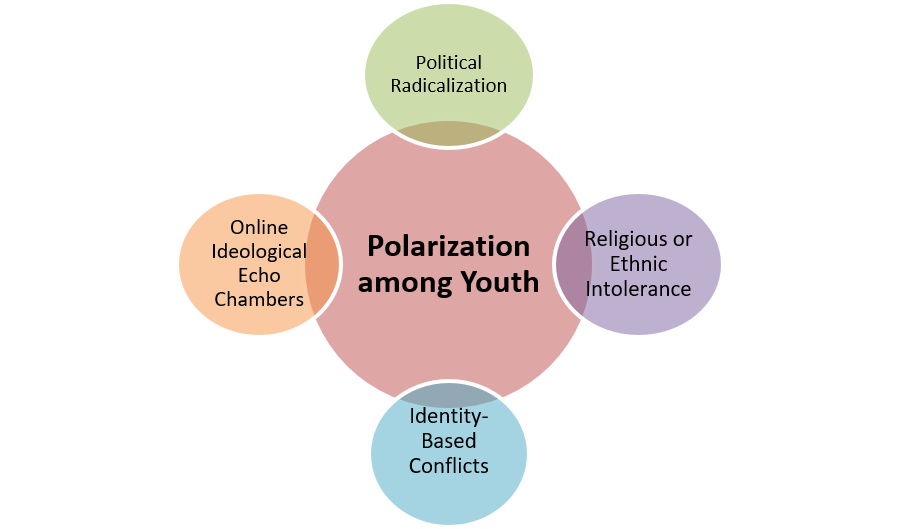
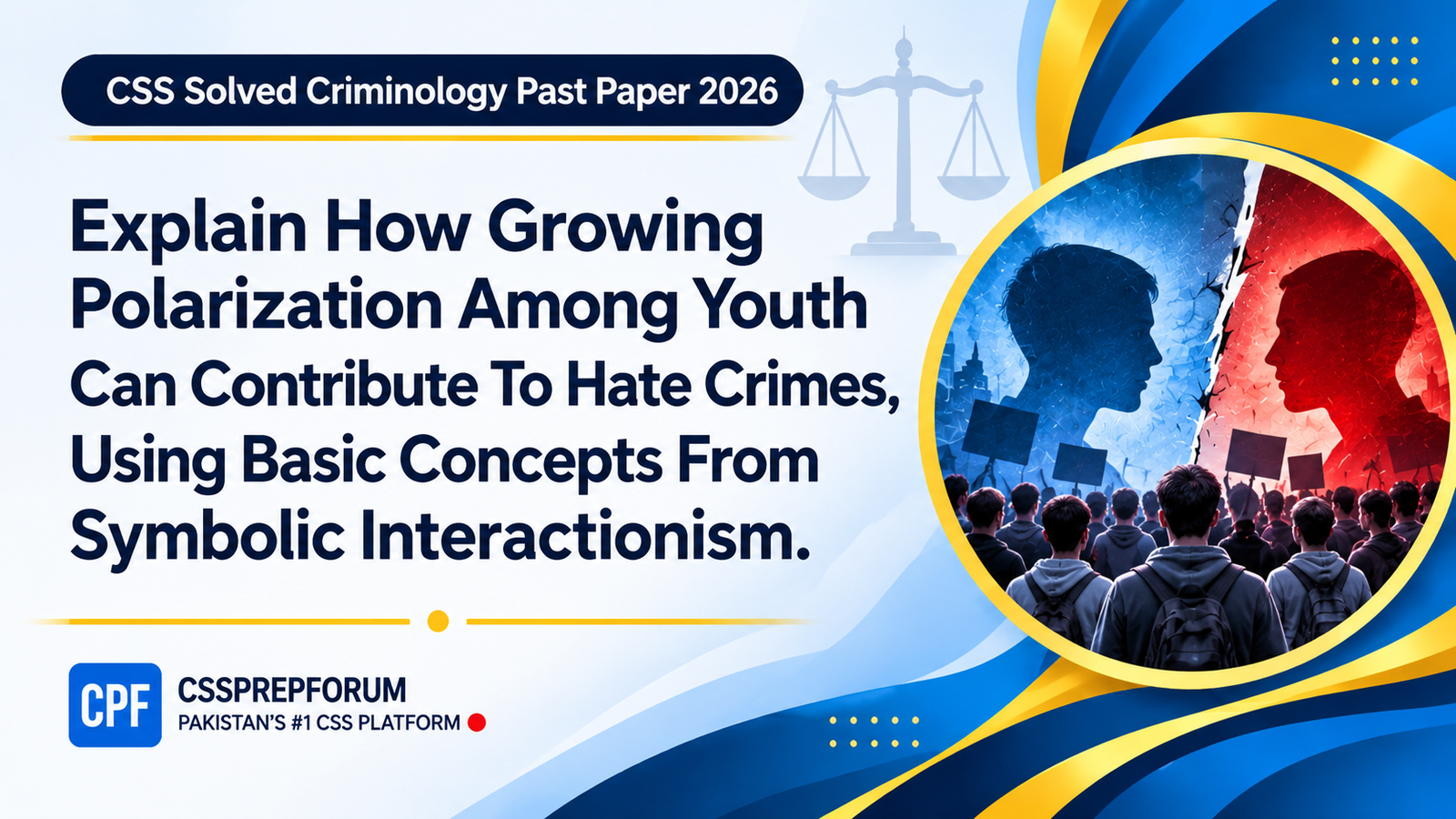
Figure 1: Polarization among Youth
Conflict, discrimination and hostility escalates into violence when youth considerably opposes groups with different ideology and notions. According to M. P. Muller, T. Santavicca and D. Miconi,
“Youth polarization involves the development of rigid and opposing identities among young individuals, often linked with radicalization and social conflict.” On the other hand, hate crimes are defined as, “Criminal acts motivated by bias or prejudice against a group defined by race, religion, ethnicity, or other social characteristics.” Furthermore, Barbara Perry explained in her book titled “In the Name of Hate: Understanding Hate Crimes”,
“Hate crime is a mechanism of power and oppression, intended to reaffirm the precarious hierarchies that characterize a given social order.”

Symbolic Interactionism
The proponents of Symbolic Interactionism Perspective are Max Weber, George Herbert Mead, George Simmel, Charles Horton Cooley and Erving Goffman. According to Symbolic Interactionism, people attach meaning to their interactions and actions of others. A person’s self is shaped through social interaction and the patterns in social world can be studied by looking at the underlying symbols of any interaction. Nonetheless, social reality is subjective and there is no rigid arrangement. In 1966, W. I. Thomas presented the Thomas Theorem in which he explained that the conditions and situations that are considered real will actually affect the humans in reality. For instance, if one assumes that a book is boring then, it will actually appear boring. Despite this, Symbolic Interactionism delineates that certain meanings are assigned to people after social interaction on the basis of which they act. Meanings are interpreted and modified continuously via communication. As a result, hate crimes and polarization among youth can be understood as behaviors that are shaped by socially constructed meanings regarding one’s identity, group affiliation as well as perceived threats.
Explaining Growing Polarization among Youth Leading to Hate Crimes through Symbolic Interactionism
Construction of “Us vs. Them”
Polarization among youth frequently results in substantial symbolic barriers among “in-groups” and “out-groups”. Within a group, youth may intensely align themselves with the political movements, ethnic or nationalist communities and religious factions. On the other hand, the “out-groups” are perceived and depicted as opponents of national values, threats to cultural identity, morally weak or harmful. These symbolic interpretations transform conventional societal boundaries into adversarial ones.
Role of Stigmatization in Hate Crimes
The youth that is polarized frequently give names such as “extremists”, “traitors”, “infidels” and “enemies of the nation”. Inequality becomes socially accepted behavior within the perspective of a group until it is linked with negative connotations. Recurrent labeling may result in exacerbation of conflict, social marginalization as well as radicalization on both sides. This approach has the ability to intensify animosity and increase the possibility of hate crimes.
Influence of Peer Groups
In polarized settings, ideological notions are reaffirmed by the peer groups and radical opinions gain societal acceptance. Furthermore, there is a possibility of normalization of violence against out-groups. Through online platforms, people primarily interact with people having similar opinions which create echo chambers. As a result, the stereotypes and prejudices are reinforced, misinformation is disseminated as well as hostility towards the opposing groups is exacerbated.
Identity Formation
Individuals determine their identities amid adolescence and early stages of adulthood. Nonetheless, young people growing up in polarized environments are more prone to define themselves in terms of group allegiance. This may lead to moral justification of animosity, dehumanizing opposing groups as well as resorting to violence in order to maintain group honour. Symbolic Interactionism delineates how social interactions, shared narratives and communication formulate these identities.
Escalation from Prejudice to Hate Crime
Stereotypes and prejudices often develop into hate crimes through different stages. At first, an out-groups is stigmatized and faces rumors as well as negative stereotypes. Then, that particular group is excluded and discriminated from the society leading to harassment and verbal abuse. This results in grievances and frustration among those individuals which is manifested in the form of direct violence and hate crimes. For example, FBI reported the rise in hate crimes in the United States which is considerably linked to political polarization and racial tensions.
Role of Political Rhetoric and Social Media
Political narratives and social media reinforce the disintegration among various groups as well as legalize hostility and shape meanings attached to a particular social group by youth. For instance, in identity-based political campaigns, religious extremism and nationalist propaganda, symbolic divisions among groups are fortified. For instance, in India, misinformation on social media fuels communal clashes leading to religious polarization among youth thus, resulting in mob violence and hate speech. Furthermore, hate speech on social media does not only contribute to intolerance and sporadic violence in Pakistan but also escalates sectarian tensions and political polarization among young populace.
Critical Analysis
Though Symbolic Interactionism adequately delineates the ways through which identities and meanings contribute to hate crimes however, it should be supported by more comprehensive structural perspectives. George Herbet Mead explains “the self is something which has a development; it is not initially there at birth but arises in the process of social experience”. Besides, polarization among youth is caused by economic disparity, weak institutions as well as political exploitation. Social media algorithms that favor emotionally charged material exacerbate symbolic differences even further. Consequently, hate crimes committed by youth cannot be completely explained through interpersonal interactions as institutional and technological aspects also influence them. Nonetheless, in order to mitigate youth polarization along with hate crimes, societies ought to adopt rigorous strategies such as promoting social integration and inter-group dialogue, fostering digital literacy, supporting inclusive political discussions, preventing hate speech through online platforms and encouraging resolution programs for community-based conflicts.
Conclusion
In conclusion, Symbolic Interactionism delineates that hate crimes committed by polarized youth are socially produced behaviors based on labelling, identity construction and interaction instead of spontaneous acts of violence. Young people create symbolic meanings that split society into antagonistic in-groups and out-groups through constant contact and shared narratives. When such meanings are strengthened by peer groups, political rhetoric and online echo chambers then, stereotypes may transform into hate crimes. Along with law enforcement, this predicament requires robust measures to ameliorate social interactions, foster inclusive social identities and promote tolerance. In the long run, ensuring social cohesiveness, democratic stability and peaceful coexistence depend upon minimizing youth polarization. According to Herbert Blumer,
“Human beings act toward things on the basis of the meanings that the things have for them.”

CSS Solved Past Papers’ Essays
Looking for the last ten years of CSS and PMS Solved Essays and want to know how Sir Kazim’s students write and score the highest marks in the essays’ papers? Then, click on the CSS Solved Essays to start reading them.
CSS Solved Essays
CSS Solved General Science & Ability Past Papers
Want to read the last ten years’ General Science & Ability Solved Past Papers to learn how to attempt them and to score high? Let’s click on the link below to read them all freely. All past papers have been solved by Miss Iqra Ali & Sir Ammar Hashmi, Pakistan’s top CSS GSA coach having the highest score of their students.