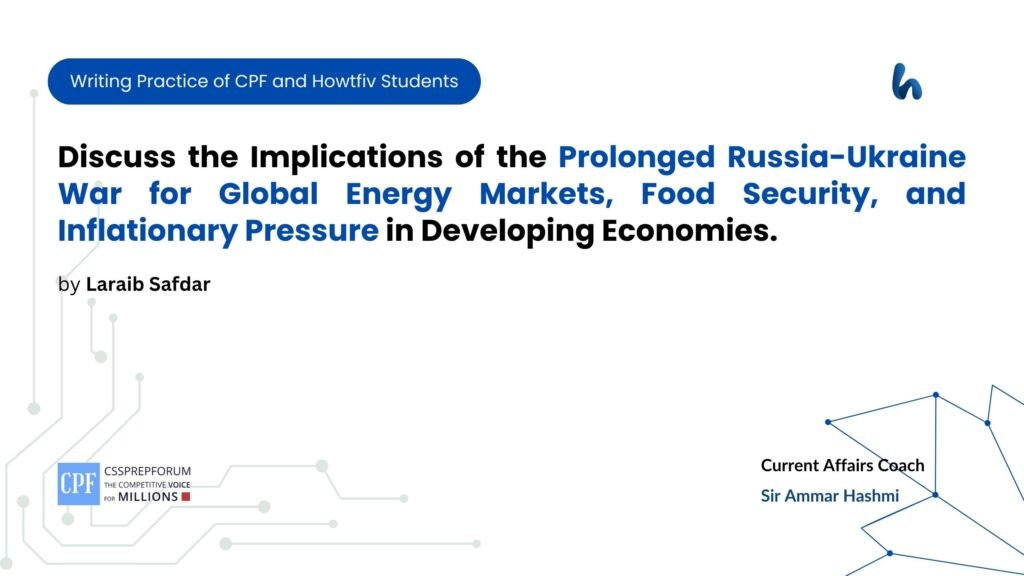
CSS Current Affairs | Implications of the Prolonged Russian-Ukraine War for Globe
The following assignment question for CSS Current Affairs is solved by Laraib Safdar under the supervision of Howfiv’s Pakistan Affairs and Current Affairs Coaches: Miss Iqra Ali and Sir Ammar Hashmi She learnt how to attempt 20 marks question and essay writing from Sir Syed Kazim Ali, Pakistan’s best CSS and PMS English essay and precis teacher with the highest success rate of his students. This solved question is attempted on the pattern taught by Sir to his students, scoring the highest marks in compulsory and optional subjects for years.

Outline
1-Introduction
2-Impact on Global Energy Markets
3-Impact on Global Food Security
4-Inflationary Pressures in Developing Economies
5-Broader Economic and Geopolitical Implications
6-Measures to Mitigate the Impact
7-Critical Analysis
8-Conclusion
Answer to the answer
Introduction
The Russia-Ukraine war, which began in February 2022, has evolved from a regional military conflict into one of the most significant geopolitical and economic crises of the twenty-first century. Since both Russia and Ukraine are major suppliers of energy, food grains, and agricultural inputs to international markets, the prolonged conflict has severely disrupted global supply chains and heightened economic uncertainty. Consequently, the war has triggered volatility in energy prices, undermined global food security, and intensified inflationary pressures, particularly in developing economies that rely heavily on imports. Therefore, the conflict has demonstrated how regional wars can generate far-reaching global consequences by affecting economic stability, human security, and sustainable development.
Impact on Global Energy Markets
Firstly, the prolonged conflict has significantly disrupted global energy markets because Russia is one of the world’s largest exporters of crude oil and natural gas. Consequently, sanctions imposed by Western countries, combined with Russian reductions in energy exports, created supply shortages and sharp increases in international oil and gas prices. Moreover, European countries were compelled to diversify their energy sources by increasing imports of liquefied natural gas (LNG) from alternative suppliers and accelerating investments in renewable energy. Therefore, the war fundamentally altered global energy trade patterns while exposing the vulnerability of countries dependent on a limited number of energy suppliers. For example, following the reduction in Russian gas supplies through pipelines such as Nord Stream, several European countries during 2022-23 experienced severe energy shortages and unprecedented increases in electricity and heating costs. Consequently, governments introduced emergency subsidies, rationing measures, and energy diversification strategies to reduce dependence on Russian energy exports. This episode demonstrated the extent to which geopolitical conflicts can destabilize global energy markets.
Impact on Global Food Security
Furthermore, the war has seriously threatened global food security because Russia and Ukraine together account for a substantial share of global exports of wheat, maize, barley, and sunflower oil. Consequently, military operations disrupted agricultural production, damaged transport infrastructure, and restricted exports through Black Sea ports. Moreover, fertilizer supplies were also affected because Russia and Belarus are major exporters of fertilizers, leading to increased agricultural production costs worldwide. As a result, food prices rose sharply, disproportionately affecting food-importing developing countries in Africa, Asia, and the Middle East. Therefore, the conflict intensified concerns regarding hunger, malnutrition, and food insecurity across vulnerable regions. For instance, the Black Sea Grain Initiative, brokered by the United Nations and Türkiye in 2022, temporarily facilitated the safe export of Ukrainian grain through the Black Sea despite ongoing hostilities. Consequently, global grain prices declined during the agreement’s implementation. However, repeated disruptions and the eventual suspension of the initiative renewed concerns regarding food shortages and international price volatility, highlighting the global significance of uninterrupted agricultural exports from the region.
Inflationary Pressures in Developing Economies
Moreover, the prolonged war has intensified inflationary pressures in developing economies through rising energy, food, and transportation costs. Since many developing countries depend heavily on imported fuel and essential commodities, increases in international prices rapidly translated into higher domestic inflation. Consequently, governments faced rising subsidy burdens, widening fiscal deficits, and declining foreign exchange reserves. Furthermore, central banks were compelled to raise interest rates to contain inflation, thereby slowing economic growth and increasing unemployment. Therefore, the conflict placed considerable strain on the macroeconomic stability of developing economies. For example, Pakistan experienced significant increases in fuel prices, electricity tariffs, transportation costs, and food inflation following the escalation of the Russia-Ukraine conflict. Consequently, higher import bills contributed to balance-of-payments difficulties, currency depreciation, and rising inflation, thereby increasing the cost of living for households and complicating fiscal management. Similar challenges were experienced by several other developing economies dependent on imported energy and food commodities.
Broader Economic and Geopolitical Implications
Additionally, the prolonged conflict has accelerated structural changes in the global economy. Countries have increasingly prioritized energy security, supply chain diversification, and strategic food reserves to reduce vulnerability to external shocks. Moreover, geopolitical divisions have intensified as Western sanctions against Russia reshaped international trade patterns and encouraged greater economic cooperation among non-Western powers. Consequently, the conflict has contributed to a more fragmented global economic order characterized by competing trade blocs and heightened strategic competition.
Measures to Mitigate the Impact
Furthermore, governments and international organizations have adopted various measures to reduce the adverse consequences of the conflict. Diversifying energy sources, investing in renewable energy, strengthening domestic agricultural production, expanding strategic food reserves, and enhancing regional trade cooperation can reduce dependence on vulnerable supply chains. Similarly, targeted social protection programs, fiscal discipline, and coordinated monetary policies can help developing countries manage inflationary pressures while protecting vulnerable populations. Therefore, long-term resilience requires both national reforms and international cooperation.
Critical Analysis
However, the Russia-Ukraine war has exposed deeper structural weaknesses within the global economy rather than merely creating temporary market disruptions. Excessive dependence on concentrated energy suppliers, limited diversification of food imports, and fragile global supply chains amplified the economic consequences of the conflict. While developed economies generally possessed greater financial capacity to absorb rising costs through subsidies and monetary interventions, developing countries faced disproportionately severe economic hardships because of limited fiscal space and greater dependence on imported commodities. Consequently, the war highlighted the urgent need for diversified supply chains, enhanced energy security, and more resilient food systems. Thus, the crisis demonstrated that economic globalization without adequate resilience leaves developing economies particularly vulnerable to external geopolitical shocks.
Conclusion
In conclusion, the prolonged Russia-Ukraine war has generated profound global economic consequences extending far beyond the battlefield. The disruption of energy supplies transformed international energy markets, interruptions in agricultural exports undermined global food security, and rising commodity prices intensified inflationary pressures across developing economies. Consequently, the conflict has reshaped global trade patterns, increased economic uncertainty, and exposed structural vulnerabilities in the international economic system. Ultimately, sustainable solutions require diplomatic efforts to restore peace alongside long-term strategies focused on energy diversification, food security, economic resilience, and strengthened international cooperation to mitigate the impact of future geopolitical crises.

CSS Solved Past Papers’ Essays
Looking for the last ten years of CSS and PMS Solved Essays and want to know how Sir Kazim’s students write and score the highest marks in the essays’ papers? Then, click on the CSS Solved Essays to start reading them.
CSS Solved Essays
CSS Solved Islamiyat Past Papers
Want to read the last ten years’ Islamiyat Solved Past Papers to learn how to attempt them and to score high? Let’s click on the link below to read them all freely. All past papers have been solved by Pakistan’s top CSS Islamiyat coaches having the highest score of their students.
CSS Solved Islamiyat
CSS Solved General Science & Ability Past Papers
Want to read the last ten years’ General Science & Ability Solved Past Papers to learn how to attempt them and to score high? Let’s click on the link below to read them all freely. All past papers have been solved by Pakistan’s top CSS GSA coachez having the highest score of their students.
CSS Solved General Science & Ability
CSS Solved Pakistan Affairs Past Papers
Want to read the last fifteen years’ Pakistan Affairs Solved Past Papers to learn how to attempt them and to score high? Let’s click on the link below to read them all freely. All past papers have been solved by Pakistan’s top CSS Pakistan Affairs coaches having the highest score of their students.
CSS Solved Pakistan Affairs
CSS Solved Current Affairs Past Papers
Want to read the last fifteen years’ Current Affairs Solved Past Papers to learn how to attempt them and to score high? Let’s click on the link below to read them all freely. All past papers have been solved by Pakistan’s top CSS Current Affairs coaches having the highest score of their students.
CSS Solved Current Affairs