Learn how Huntington, Fukuyama, and Taylor explain culture, democracy, and geopolitics, with practical Pakistan-focused examples for CSS and PMS exams.
Introduction: Why Do These Theories Matter?
International politics is not shaped by military power and economic interests alone. A country’s religious identity, political beliefs, historical experiences, and image of other countries can also influence its foreign policy.
For example, Pakistan’s relations with Saudi Arabia are influenced by religious ties as well as defence and economic interests. Its relations with Afghanistan, however, show that sharing the same religion does not prevent conflict. These examples help explain why international relations cannot be understood through a single factor.
Three thinkers offer useful ways to analyse these questions
- Samuel Huntington explains how cultural and religious differences may contribute to international conflict.
- Francis Fukuyama examines whether liberal democracy has become the leading model of political organisation.
- Peter Taylor, with Colin Flint, explains how states identify their friends, threats, and foreign-policy goals.
For CSS and PMS aspirants, these theories are useful when they help explain a real event. A strong answer introduces the theory, applies it to evidence, and then explains its limitations.
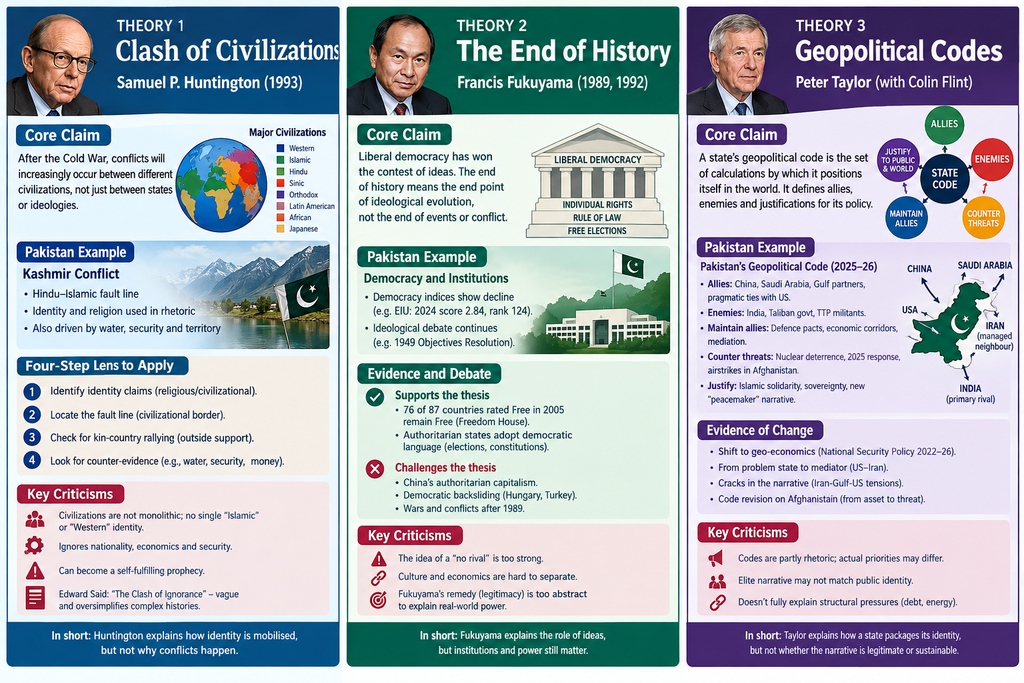
Quick Comparison of the Three Theories
1. Huntington’s Clash of Civilizations
- What did Huntington argue?
In his 1993 article The Clash of Civilizations?, published in Foreign Affairs, Samuel Huntington argued that cultural and civilizational differences would become important sources of conflict after the Cold War. He developed the argument further in his 1996 book, The Clash of Civilizations and the Remaking of World Order.
In simple terms, Huntington believed that countries and communities would not always fight over territory or economic interests. Differences in religion, culture, history, and values could also shape how they viewed one another.
He identified several major civilizations, including Western, Islamic, Hindu, Sinic, Japanese, and Orthodox civilizations. He argued that tensions could become particularly serious where different civilizations met.
His argument does not mean that every conflict is caused by religion or culture. It suggests that cultural identity can influence how a conflict develops and how people understand it.
- How can you apply this theory in an exam?
Use four simple questions
- Identity: Are the parties presenting the dispute in religious or cultural terms?
- Difference: Are their identities being used to explain why they oppose one another?
- External support: Are other countries supporting one side because of shared identity?
- Alternative explanations: Are territory, security, resources, or political interests more important than culture?
These questions help you test Huntington’s argument instead of simply agreeing with it.
- Example A: Pakistan-India tensions
The 2025 India-Pakistan crisis provides an example of how identity can influence a conflict. Following the Pahalgam attack in April 2025, tensions escalated through diplomatic measures and military action, before a ceasefire took effect on 10 May.
Huntington’s theory can help explain how religious and national identities influence political statements and public reactions in India and Pakistan. However, it cannot explain the entire crisis.
The dispute also involved Kashmir, competing security claims, terrorism allegations, military calculations, and nuclear deterrence. Water security became another major concern after India announced that it was placing the Indus Waters Treaty in abeyance. Pakistan disputed India’s position and continued to defend its treaty-based rights.
The important lesson is that identity may intensify a conflict, but it does not necessarily explain its main causes.
- Example B: Pakistan-Saudi Arabia relations
Pakistan and Saudi Arabia have longstanding religious, economic, and defence ties. On 17 September 2025, the two countries signed a Strategic Mutual Defence Agreement.
Huntington’s theory helps explain why shared Islamic identity can strengthen political cooperation. His idea of the kin-country syndrome refers to the tendency of countries or communities to support others with which they share a civilizational identity.
However, religious solidarity is only one part of this relationship. Defence cooperation, regional security, economic interests, and each country’s wider diplomatic relationships also matter. Shared religion does not mean that the two countries will agree on every international issue.
- Example C: Pakistan-Afghanistan conflict, a challenge to Huntington
Pakistan and Afghanistan share a Muslim-majority population and many cultural connections. Nevertheless, their relations have been strained by border tensions and security concerns, particularly Pakistan’s allegations that the Tehreek-e-Taliban Pakistan (TTP) operates from Afghan territory. The Afghan Taliban authorities have disputed Pakistan’s accusations.
The conflict shows that shared religion does not automatically produce political cooperation. Governments may prioritise national security, territorial control, and political survival over cultural similarities.
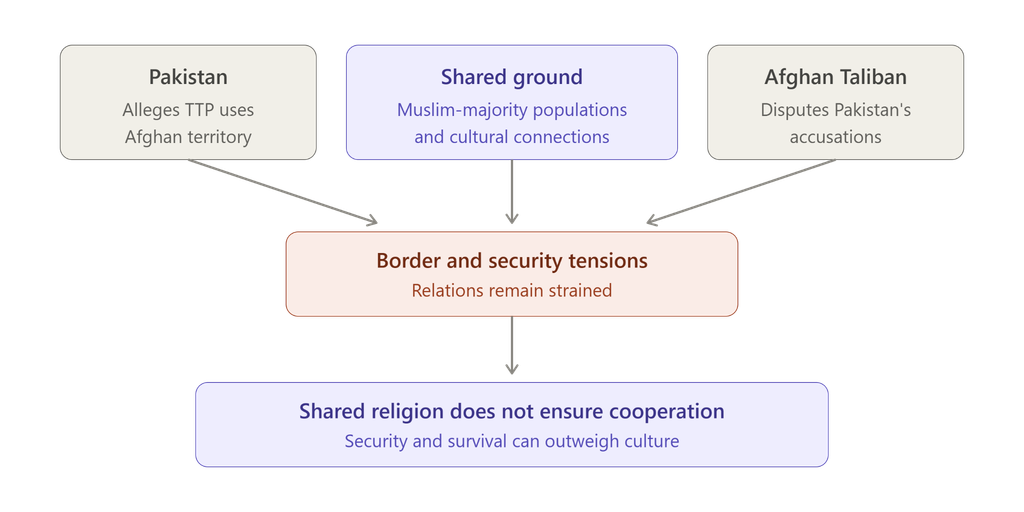
This is an important criticism of Huntington: conflict can occur between countries that share the same civilization, just as cooperation can occur between countries that belong to different civilizations.
Criticisms of the theory
Huntington’s theory is useful, but it has several limitations.
- Civilizations are not united political groups. People within the same religious or cultural community often disagree.
- It gives insufficient attention to economic interests, territorial disputes, domestic politics, and security concerns.
- It can encourage governments to portray conflicts as unavoidable cultural struggles.
- Edward Said criticised this approach in his 2001 essay The Clash of Ignorance, arguing that it oversimplifies complex societies and histories.
Model paragraph for CSS/PMS
Huntington’s Clash of Civilizations offers a partial explanation of Pakistan’s international relations. Religious identity can strengthen Pakistan’s ties with Saudi Arabia and influence the political framing of its disputes with India. However, Pakistan’s conflict with the Afghan Taliban demonstrates that shared religious identity does not prevent serious security disagreements. The theory is therefore useful for understanding how identity shapes political narratives, but it cannot replace an analysis of strategic interests, territory, and national security.
2. Fukuyama’s End of History
- What did Fukuyama mean?
In his 1989 essay The End of History?, Francis Fukuyama argued that liberal democracy had emerged as the strongest ideological model following the decline of communism. He expanded this argument in his 1992 book, The End of History and the Last Man. However, the phrase end of history is often misunderstood. Fukuyama did not mean that wars, political disputes, or major historical events would stop happening. He meant that the major ideological struggle over the best form of government might have reached its endpoint, with liberal democracy becoming the leading model.
Liberal democracy combines competitive elections, political rights, constitutional government, and limits on state power. Fukuyama argued that it had no equally convincing ideological rival as a model of political legitimacy.
In simple words, his argument was that countries might continue to disagree and fight, but liberal democracy had emerged as the leading ideal of government.
- How can you test Fukuyama’s argument?
Ask two questions
- Do countries still regard elections, constitutions, and political rights as important sources of legitimacy?
- Are democratic institutions actually functioning, or are governments weakening them while continuing to use democratic language?
These questions distinguish the popularity of an ideal from its practical implementation.
- Applying the theory to Pakistan
Pakistan’s political system provides a useful way to examine Fukuyama’s argument. Elections, constitutional government, parliamentary institutions, and democratic representation remain important parts of the country’s political debate. However, the effectiveness of these institutions and the balance of power between elected and unelected institutions remain subjects of continuing debate.
The Economist Intelligence Unit’s Democracy Index classified Pakistan as a hybrid regime in 2022 and an authoritarian regime in its 2023 and 2024 editions. These classifications reflect the index’s assessment of political participation, electoral processes, civil liberties, and institutional functioning.
This creates an important distinction. Democratic government may remain an accepted political ideal even when democratic institutions do not function effectively. Pakistan’s experience therefore helps test Fukuyama’s argument: the continued importance of democratic ideals does not guarantee the success of democratic institutions.
- Evidence for and against Fukuyama
There is evidence supporting part of his argument. Even governments that restrict political competition often use the language of elections, constitutions, and popular representation to justify their authority. This suggests that democratic legitimacy remains influential.
However, the picture is more complicated. China’s authoritarian political system, democratic backsliding in some countries, and the growth of populist nationalism challenge the idea that liberal democracy has settled the ideological question.
Freedom House reported in March 2026 that global freedom had declined for the twentieth consecutive year in 2025. This finding highlights the gap between the international importance of democratic ideals and the actual condition of political rights.
Fukuyama’s argument should therefore be assessed carefully. Continued conflict does not by itself disprove the theory, because he did not predict the end of all conflict. The more relevant question is whether liberal democracy remains the dominant political ideal despite challenges to its implementation.
Criticisms of the theory
- Authoritarian systems continue to offer alternatives to liberal democracy.
- Democratic institutions can weaken even where constitutions and elections remain in place.
- The theory focuses on ideological legitimacy but does not fully explain how power, economic interests, and political institutions shape actual outcomes.
- Countries may combine democratic institutions with religious, cultural, or national traditions rather than follow a single political model.
Model paragraph for CSS/PMS
Fukuyama’s End of History is better understood as an argument about the position of liberal democracy as a political ideal than as a prediction that conflict would disappear. Pakistan illustrates the difference between accepting democratic principles and maintaining effective democratic institutions. The country’s experience, alongside the wider decline in global freedom, shows that democratic ideals remain influential but their practical implementation is far from guaranteed. Fukuyama’s argument therefore remains useful, although it cannot fully explain the continued strength of authoritarian alternatives.
3. Peter Taylor’s Geopolitical Codes
- What are geopolitical codes?
Peter Taylor’s work, developed further with Colin Flint in political geography, helps explain how states understand their place in the world and decide how to deal with other countries.
A geopolitical code is a state’s way of identifying its allies, rivals, threats, and international objectives. It also includes the reasons a government gives to justify these choices to its own population and the wider world. For example, a government may describe another country as a strategic partner because of defence cooperation, or present a rival as a threat to national sovereignty. These descriptions help explain how states justify their foreign policies.
The concept can be understood through five questions
- Who are our allies?
- Who are our rivals or threats?
- How can we maintain friendly relations?
- How can we respond to threats?
- How can we explain these choices to the public and the international community?
The fifth question is particularly important. Governments do not merely make foreign-policy decisions; they also explain why those decisions are necessary.
- Applying the framework to Pakistan
Pakistan’s foreign policy can be examined through these five questions.
| Question | Pakistan-focused application |
| Who are its allies? | China is a longstanding strategic partner. Saudi Arabia and other Gulf states are important for defence and economic ties. |
| Who are its main threats? | India has traditionally been Pakistan’s principal strategic rival. Militancy and tensions with the Afghan Taliban authorities have also become major security concerns. |
| How does Pakistan maintain partnerships? | Through defence cooperation, diplomatic engagement, economic relations, and regional initiatives. |
| How does it respond to threats? | Through military preparedness, deterrence, border security, and diplomatic measures. |
| How does it justify its policies? | Through arguments about sovereignty, territorial integrity, national security, economic development, and, in some relationships, Islamic solidarity. |
This framework shows that Pakistan’s foreign policy cannot be explained through a single slogan or alliance. It involves several objectives that may sometimes support one another and sometimes conflict.
Is Pakistan’s geopolitical approach changing?
Three developments help illustrate the question.
1. Greater attention to economic security
Pakistan’s National Security Policy 2022–2026 placed economic security at the centre of its broader national-security approach. This reflected an effort to link national strength with economic stability and development.
The idea is straightforward: military preparedness matters, but a country also needs a stable economy, investment, energy security, and stronger trade relations to sustain its position.
2. Building relationships with different powers
Pakistan maintains close strategic ties with China, defence cooperation with Saudi Arabia, and working diplomatic relations with the United States. Its relationship with Iran is shaped by geographical proximity, border security, and regional developments.
These relationships demonstrate that Pakistan cannot pursue every foreign-policy objective through one alliance. It must balance different interests and avoid commitments that undermine other important relationships.
3. The changing relationship with Afghanistan
Pakistan’s earlier engagement with the Afghan Taliban did not prevent later tensions over militancy and border security. This illustrates how a country’s geopolitical code can change when its assessment of a former partner changes.
The example also shows why foreign policy must be judged by outcomes rather than official descriptions alone.
Why the concept matters for Pakistan’s mediation role
Pakistan’s reported mediation efforts between the United States and Iran in 2026 offer another way to apply the framework. Mediation can help a country present itself as a useful diplomatic partner rather than only as a state concerned with its immediate security problems.
However, a mediation role does not automatically mean that a country has become a major global power. Its influence depends on whether the parties trust it, whether it can communicate with both sides, and whether its efforts produce practical results.
The key analytical question is whether Pakistan can maintain credible relationships with different powers while protecting its own national interests.
Criticisms of the concept
- A government’s stated foreign policy may differ from its actual actions.
- Political leaders may use national security or religious solidarity to gain domestic support.
- The framework does not fully explain structural pressures such as debt, economic dependence, and limited military or diplomatic resources.
- A state may identify several competing objectives without having enough capacity to achieve all of them.
Model paragraph for CSS/PMS
Peter Taylor and Colin Flint’s geopolitical codes framework helps explain how Pakistan defines its allies, threats, and foreign-policy objectives. China remains a major strategic partner, Saudi Arabia is important for defence and economic relations, and the United States remains relevant to Pakistan’s diplomacy. At the same time, security tensions with Afghanistan show how quickly a relationship can change when national interests diverge. Pakistan’s challenge is to maintain a coherent foreign policy that balances security, economic development, and diplomatic credibility.
4. How to Use All Three Theories in One CSS Answer
A common mistake is to explain three theories separately without showing how they relate to the question. A stronger answer uses each theory to examine a different part of the same issue.
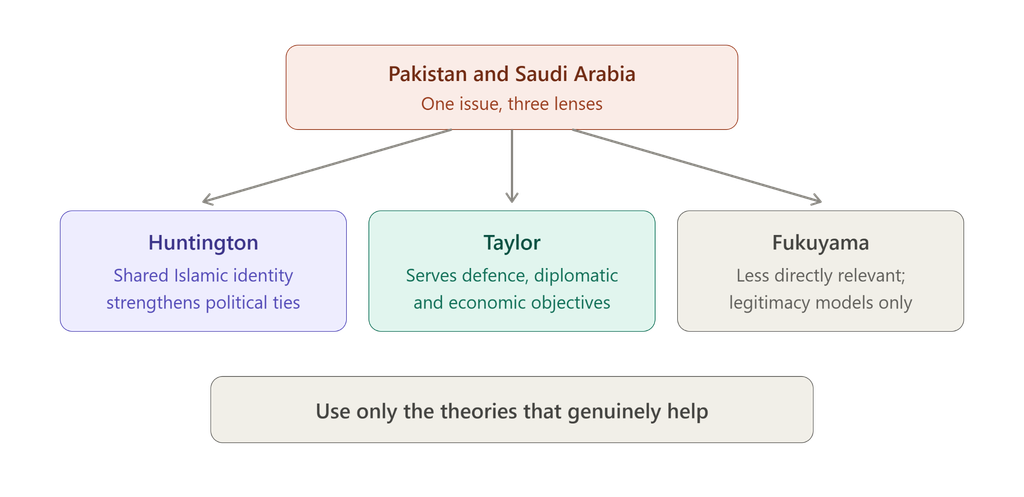
Consider Pakistan’s relations with Saudi Arabia.
- Huntington: Shared Islamic identity helps explain why religious solidarity can strengthen ties between the two countries.
- Taylor: Pakistan’s geopolitical code explains how the relationship serves defence, diplomatic, and economic objectives, and how the government justifies it.
- Fukuyama: His theory is less directly relevant to the bilateral defence relationship, but it can help assess broader questions about political legitimacy and the models of government states present as desirable.
The same method works for other issues. For Pakistan-Afghanistan tensions, Huntington helps test whether shared religion explains cooperation, while Taylor helps explain the shift in how Pakistan views the Afghan Taliban authorities. Fukuyama becomes relevant if the question also concerns competing political systems or democratic legitimacy.
Do not force all three theories into every answer. Use only those that genuinely help explain the issue.
5. A Simple Method for Applying Theory as Evidence
Use this four-step sequence when writing a CSS or PMS answer.
- Step 1: State the argument. Explain the theory in one or two sentences.
- Step 2: Provide an example. Select a relevant event or policy rather than listing several unrelated developments.
- Step 3: Explain the connection. Show precisely how the example supports or challenges the theory.
- Step 4: Evaluate the argument. Identify what the theory explains and what it leaves out.
For example, instead of writing, “Huntington’s theory applies to Pakistan’s relations with Saudi Arabia,” explain that shared Islamic identity strengthens the relationship, but defence cooperation and economic interests also shape it. This turns a name-drop into analysis.
6. Practice Questions for CSS and PMS
- To what extent does Huntington’s Clash of Civilizations explain Pakistan’s relations with India and Afghanistan?
- Does Pakistan’s political experience support or challenge Fukuyama’s End of History thesis?
- Apply the geopolitical codes framework to Pakistan’s foreign policy and identify its major priorities.
- Why does shared religious identity fail to prevent conflict between Pakistan and Afghanistan?
- How can Pakistan balance its relations with China, Saudi Arabia, the United States, and Iran?
- Compare Huntington and Taylor in explaining the role of identity in Pakistan’s foreign policy.
Common Mistakes to Avoid
- Do not claim that Huntington believed all conflicts are caused by religion.
- Do not say that Fukuyama predicted the end of wars or historical events.
- Do not confuse a state’s public explanation for its foreign policy with its actual strategic interests.
- Do not use examples without explaining how they support or challenge a theory.
- Do not treat rapidly changing political developments as settled facts. Verify dates, official statements, and current classifications before quoting them in an exam answer.
Conclusion
Huntington, Fukuyama, and Taylor help explain different aspects of international politics. Huntington highlights the role of cultural identity in conflict, Fukuyama examines the position of liberal democracy as a political ideal, and Taylor explains how states define and justify their foreign-policy choices.
For Pakistan Affairs and Current Affairs, the real value of these theories lies in their application. Pakistan’s relations with Saudi Arabia show how identity and strategic interests can reinforce one another, its tensions with Afghanistan challenge the idea that shared religion ensures cooperation, and its political institutions provide a case for examining the gap between democratic ideals and practice.
A high-scoring answer does not simply describe a theory. It uses evidence to test the theory, recognises its limitations, and reaches a balanced conclusion.

Important Note for CSS and PMS Aspirants
For aspirants preparing for competitive examinations, exploring solved past papers is essential to understand examiner expectations, analytical answer writing, and paper trends. Therefore, candidates are strongly encouraged to read the following comprehensive solved papers available on CSSPREPFORUM.
- CSS Solved Pakistan Affairs Past Papers
- CSS Solved Current Affairs Past Papers
- CSS Solved Islamiat Past Papers
- CSS Solved General Science and Ability Past Papers
Moreover, aspirants searching for the most credible and result-oriented teachers for CSS and PMS preparation can benefit from the following detailed guidance articles
- Who is the Best CSS PMS Islamiat Teacher in Pakistan?
- Who is the Best CSS PMS Pakistan Affairs Teacher in Pakistan?
- Who is the Best CSS Current Affairs Teacher in Pakistan?
- Who is the Best CSS GSA Teacher in Pakistan?
- Who is the Best CSS PMS English Essay and Precis Teacher in Pakistan?
- Who is the Best English Grammar Teacher in Pakistan?