CSS/PMS Islamiat | The Holy Prophet (PBUH) revolutionized the concept of leadership by shifting it from ‘Authority to Accountability
The Holy Prophet (PBUH) transformed leadership from mere authority to accountability by teaching that every ruler and official is responsible before Allah and the public. He instructed governors to protect public property, avoid corruption, and fulfill their duties with honesty and justice. This Prophetic model of executive liability established that no one is above the law and that public office is a trust (Amanah), not a privilege. Similar to the modern concept of the Rule of Law, it emphasizes transparency, responsibility, and equality before the law. It is also an important topic of Islamiat for CSS and PMS aspirants because it highlights the Islamic principles of ethical leadership and accountable governance.

Question breakdown
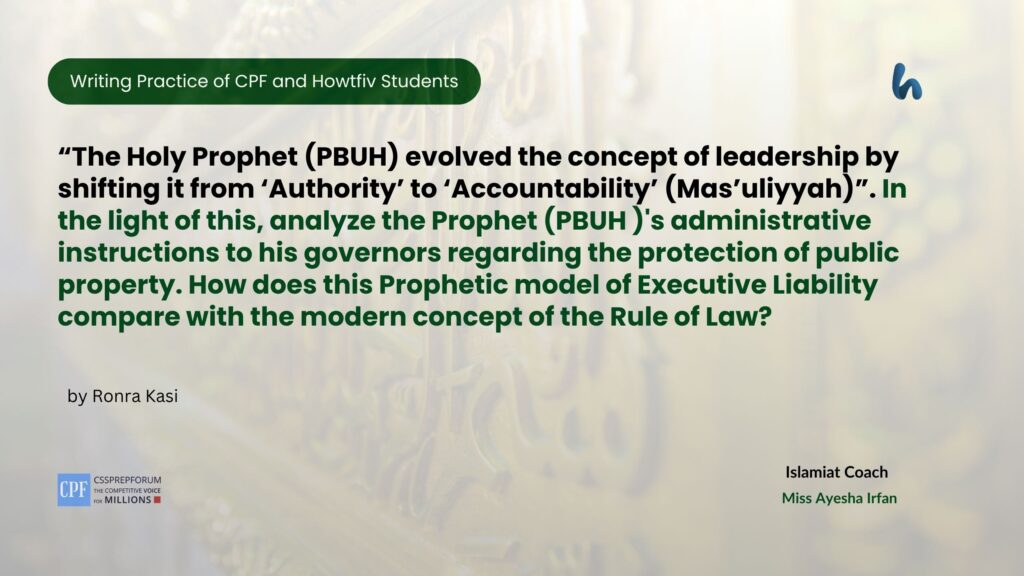
This question focuses on the Prophet’s (PBUH) shift from authority to accountability (Mas’uliyyah). It requires analyzing his specific administrative instructions to governors regarding the protection of public property and comparing this Executive Liability model to modern Rule of Law concepts, emphasizing that leadership is a trust subject to both legal and moral oversight.
1- Introduction
2- An Overview of Holy Prophet (PBUH) Administration from Authority to Accountability
3- Holy Prophet’s Administrative Instructions to the Governors
- Public Property as a Sacred Trust: Prophetic Instructions
- Protecting Public Wealth: From Market Oversight to State Treasury Integrity
- Every Administrator Answers of His Flock: The Shepherd Principle
- Institutionalizing Executive Liability: The Ibn al-Lutbiyya Precedent
- Leadership as Amanah: The Prophetic Revolution
4- How Does the Phrophetic Model of the Executive Compare with the Modern Concept of the Rule of Law?
- Divine Accountability vs. Constitutional Accountability: Convergences and Divergences
- Taqwa vs. External Audit: Internal Conscience as Superior Enforcement Mechanism
- Prophetic Impartiality vs. Constitutional Equality: Shared Foundations, Asymmetric Origins
- Procedural Law vs. Divine Reckoning: Where Modern Rule of Law Falls Structurally Short
- Mas’uliyyah vs. Elite Impunity: Governance Crisis and the Prophetic Standard
5- Conclusion
Answer to the Question
Introduction:
The Holy Prophet’s (PBUH) administrative instructions laid out the principles of creating a just and efficient system. He provides guidance to the governors regarding the protection of public property. Consequently, he redefined governance from absolute authority to unconditional accountability. Moreover, both the prophetic model of executive liability and the modern rule of law share the unvarying foundational principles; however, the modern rule of law remains structurally vulnerable. Therefore, this precisely reflects the gap created by the rule of law, which has abandoned the prophetic principles of leadership, prioritizing accountability over authority.
An Overview of the Holy Prophet (PBUH) Administration:
The Holy Prophet Muhammad (peace be upon him) established the first Islamic state in Madinah, serving as head of state, commander, and chief judge with centralized authority guided by the Quran and Sunnah, while emphasizing consultation. He divided territories into provinces such as Madinah, Makkah, Yemen, and others, appointing governors, tax collectors, and judges on merit, piety, and honesty. To Mu’adh ibn Jabal in Yemen, he instructed: first invite to tawhid, then five prayers; if accepted, collect zakat from the rich for the poor without hardship; treat people with ease, give glad tidings, and avoid harshness; judge by Quran, then Sunnah, then ijtihad; and fear the supplication of the oppressed. Core principles included impartial justice, equality, protection of life and property, no compulsion in religion, and welfare through taxes, fostering unity and accountability to Allah.
Holy Prophet’s (PBUH) Administrative Instructions to the Governors
The holy prophet briefed the governors on the protocols for protecting public property, emphasizing that any negligence would result in immediate disciplinary action and personal accountability.
- Public Property as Sacred Trust: Prophetic Instructions
To begin with, the Prophet (PBUH) instructed all governors to treat public property, zakat collections, and state resources as a sacred trust, strictly forbidding any personal use or acceptance of gifts from official duties. As a result, governors were required to manage state wealth solely for the welfare of the Ummah, ensuring complete separation between public funds and private benefit. For instance, the Holy Prophet ( PBUH) said that Allah commands you to deliver trusts to those worthy of them, and when you judge between people, to judge with justice. Excellent is the admonition Allah gives you. Allah is All-hearing, All-Seeing.” (Surah Al-Nisa 4:58). This Ayath directly instructs governors to treat public property as a sacred trust, mandating its protection solely for the Ummah without any personal gain. Hence, these prophetic models collectively safeguard public property as a divine trust, holding every governor accountable before Allah and the Ummah for eternal justice and integrity.
- Protecting Public Wealth: From Market Oversight to State Treasury Integrity
Additionally, the Prophet (PBUH) protected public wealth through direct market inspections against deception and by enforcing a complete separation between official treasury collections and any personal gifts or benefits. Similarly, his dual approach, from marketplace vigilance to strict treasury rules, guaranteed that state resources remained untouched by private interests and served only the collective good of the Ummah. For instance, the Prophet (PBUH) said, “Why did you not put the damp part on top so that people could see it? He who deceives us is not one of us.” (Sahih Muslim). This Hadith enforces treasury integrity by requiring governors to prevent any deception or personal misuse of public wealth at every level. Thus, these prophetic models collectively safeguard public property as a divine trust, holding every governor accountable before Allah and the Ummah for eternal justice and integrity.
- The Shepherd Principle: Every Administrator Answers for His Flock
Moreover, the Prophet (PBUH) established the Shepherd Principle in a clear hadith, declaring that every administrator and ruler is a shepherd who will be personally answerable before Allah for the welfare and protection of his flock. This principle made protection of public property a direct religious obligation, with every governor held responsible on the Day of Judgment for any loss or misuse. For instance, “It has been narrated by Ibn ‘Umar that the Holy Prophet (PBUH) said, “Beware. every one of you is a shepherd and every one is answerable for his flock (Sahih Bukhari). This Hadith makes every governor personally answerable before Allah for protecting public property as part of his flock on the Day of Judgment. In a word, these prophetic models collectively safeguard public property as a divine trust, holding every governor accountable before Allah and the Ummah for eternal justice and integrity.
- The Ibn al-Lutbiyya Precedent: Institutionalizing Executive Liability
In addition, in the Ibn al-Lutbiyya incident, the Prophet (PBUH) publicly rebuked a zakat collector from the pulpit for claiming personal gifts, thereby institutionalizing the principle that no executive official may misuse public office for private gain. This precedent established that every governor must return all official collections intact to the treasury, setting a lifelong standard of executive accountability. In particular, the Prophet (PBUH) said, “What is wrong with the official we appoint… that he says, ‘This is for you, and this is a gift for me’? Had he sat in his father’s or mother’s house, would such a gift have been presented to him?” (Sahih Bukhari). Consequently, this institutionalized executive liability compels every governor to return public collections intact to the treasury with zero tolerance for personal gain. Thus, these prophetic models collectively safeguard public property as a divine trust, holding every governor accountable before Allah and the Ummah for eternal justice and integrity.
- Leadership as Amanah: The Prophetic Revolution from Authority to Mas’uliyyah
Also, the Prophet (PBUH) revolutionized leadership by transforming it from mere authority into Amanah (a sacred trust), making every ruler and governor personally responsible (Mas’uliyyah) before Allah and the Ummah for public affairs. This shift turned governance into a divine duty that demands constant protection of public property and zero tolerance for personal gain. In particular, “Allah commands you to deliver trusts to those worthy of them; and when you judge between people, to judge with justice.” (Surah Al-Nisa 4:58). This Ayah establishes leadership as Amanah, requiring every governor to protect public property as a divine trust with complete justice and no personal ownership. Therefore, these prophetic models collectively safeguard public property as a divine trust, holding every governor accountable before Allah and the Ummah for eternal justice and integrity.

How does the Phrophetic model of the executive compare with the modern concept of the rule of law?
- Divine Accountability vs. Constitutional Accountability: Convergences and Divergences
On the other hand, the prophetic model of divine accountability before Allah on the Day of Judgment converges with constitutional accountability by placing checks on rulers, yet diverges by basing it on eternal Shariah rather than temporary human laws. In particular, according to Transparency International’s CPI 2025, Pakistan’s CPI score remains critically low at 28/100, ranking 136 out of 182 countries, indicating persistent elite capture despite constitutional mechanisms. Similarly, this highlights how modern constitutional accountability frequently fails to curb elite misuse of public property, whereas the prophetic divine model ensures unbreakable oversight through eternal Shariah and personal answerability before Allah on Judgment Day. Hence, these prophetic models collectively safeguard public property as a divine trust, holding every governor accountable before Allah and the Ummah for eternal justice and integrity.
- Taqwa vs. External Audit: Internal Conscience as Superior Enforcement Mechanism
Accordingly, in the prophetic system, Taqwa (fear of Allah) creates a superior internal conscience that enforces accountability more effectively than any external audit, enabling governors to remain honest without constant supervision. For instance, according to the World Justice Project Rule of Law Index 2025, Pakistan’s overall rule of law score declined 2.3% to 0.37, ranking 130 out of 143 countries, with sharp drops in constraints on government powers and absence of corruption. Consequently, this decline shows that external audits and constitutional checks alone prove insufficient against elite misconduct, whereas the prophetic reliance on Taqwa builds an internal moral force that permanently safeguards public property without needing endless external oversight. In a word, these prophetic models collectively safeguard public property as a divine trust, holding every governor accountable before Allah and the Ummah for eternal justice and integrity.
- Prophetic Impartiality vs. Constitutional Equality: Shared Foundations, Asymmetric Origins
At the same time, prophetic impartiality, which applied the same law even to the prophet’s own family, shares the foundation of equality with the constitutional rule of law but originates from divine revelation rather than human consent. As an illustration, according to Transparency International’s CPI 2025, Pakistan’s CPI score of 28/100 and rank 136/182 reveal ongoing elite favoritism that undermines constitutional equality and allows powerful figures to evade accountability for public property misuse. Accordingly, persistent elite favoritism demonstrates how constitutional equality often remains superficial in practice, while prophetic impartiality, rooted in divine command, enforces genuine equality and directly protects public property from any form of nepotism or selective justice. Thus, these prophetic models collectively safeguard public property as a divine trust, holding every governor accountable before Allah and the Ummah for eternal justice and integrity.
- Procedural Law vs. Divine Reckoning: Where Modern Rule of Law Falls Structurally Short
Along with this, modern procedural law falls structurally short of the Prophet (PBUH)’s divine reckoning on the Day of Judgment, which guarantees ultimate and infallible justice beyond the limits of any human court or procedure. To illustrate, according to the Justice Project Rule of Law Index 2025, Pakistan ranks 130/143 globally with an overall score of 0.37, showing repeated declines in procedural fairness, constraints on government powers, and the absence of corruption despite existing legal frameworks. Similarly, these structural weaknesses prove that modern procedural law repeatedly allows loopholes for powerful officials to misuse public property, whereas the prophetic divine reckoning ensures infallible justice that no procedural delay or influence can ever escape. Hence, these prophetic models collectively safeguard public property as a divine trust, holding every governor accountable before Allah and the Ummah for eternal justice and integrity.
- Mas’uliyyah vs. Elite Impunity: Governance Crisis and the Prophetic System
Last but not least, the Prophet’s system of Mas’uliyyah demands that every leader act as a shepherd personally answerable for public trust, offering a clear contrast to elite impunity and the governance crisis facing Pakistan today. For instance, according to Transparency International CPI 2025, Pakistan’s CPI score of 28/100 and rank 136/182 confirm ongoing elite impunity, where constitutional mechanisms fail to prevent misuse of public property by those in power. Furthermore, this low score and ranking expose how elite impunity continues to erode public trust and property in Pakistan, while the prophetic Mas’uliyyah system eliminates such gaps by making every governor personally answerable before Allah as a shepherd for the entire Ummah. Therefore, these prophetic models collectively safeguard public property as a divine trust, holding every governor accountable before Allah and the Ummah for eternal justice and integrity.
Conclusion
To summarize, the Prophet (PBUH) transformed public administration by establishing leadership as Amanah, public property as a sacred trust, and every governor as a shepherd personally answerable before Allah. Through the Ibn al-Lutbiyya precedent, market oversight, and divine accountability rooted in Taqwa, the prophetic model ensured zero tolerance for personal gain and unbreakable protection of state wealth. In contrast, modern constitutional systems often collapse under procedural loopholes and elite impunity, as Pakistan’s CPI score of 28/100 clearly demonstrates. Reviving this accountability-based system offers the only permanent solution for safeguarding public property
Important Note for CSS and PMS Aspirants
For aspirants preparing for competitive examinations, exploring solved past papers is essential to understand examiner expectations, analytical answer writing, and paper trends. Therefore, candidates are strongly encouraged to read the following comprehensive solved papers available on CSSPREPFORUM
- CSS Solved Pakistan Affairs Past Papers
- CSS Solved Current Affairs Past Papers
- CSS Solved Islamiat Past Papers
- CSS Solved General Science and Ability Past Papers
Moreover, aspirants searching for the most credible and result-oriented teachers for CSS and PMS preparation can benefit from the following detailed guidance articles
- Who is the Best CSS PMS Islamiat Teacher in Pakistan?
- Who is the Best CSS PMS Pakistan Affairs Teacher in Pakistan?
- Who is the Best CSS Current Affairs Teacher in Pakistan?
- Who is the Best CSS GSA Teacher in Pakistan?
- Who is the Best CSS PMS English Essay and Precis Teacher in Pakistan?
- Who is the Best English Grammar Teacher in Pakistan?