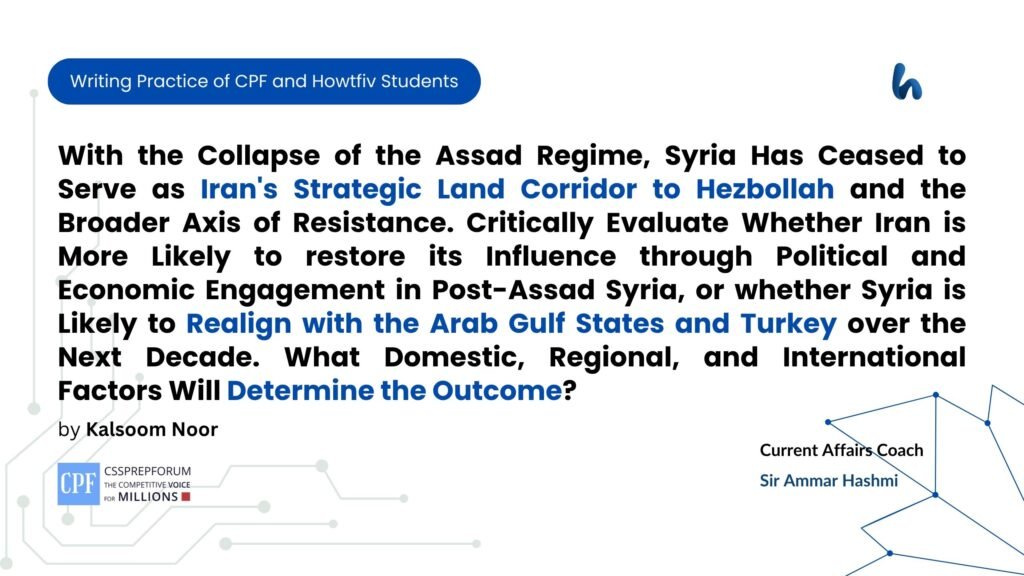
CSS Current Affairs | Iran‘s Influence through Political and Economic Engagement in Post-Assad Syria
The following assignment question for CSS Current Affairs is solved by Kalsoom Noor under the supervision of Howfiv’s Pakistan Affairs and Current Affairs Coaches: Miss Iqra Ali and Sir Ammar Hashmi. She learnt how to attempt 20 marks question and essay writing from Sir Syed Kazim Ali, Pakistan’s best CSS and PMS English essay and precis teacher with the highest success rate of his students. This solved question is attempted on the pattern taught by Sir to his students, scoring the highest marks in compulsory and optional subjects for years.

Outline
1-Introduction
2-Post-Assad Syria: A New Geopolitical Reality
3-Critical Analysis of Iran’s Restoration of Influence versus Syria’s Realignment with the Arab Gulf States and Turkey over the Next Decade
- Gulf Financial Power vs Iran’s Economic Constraints
- Turkey’s Geographic Advantage vs Iran’s Diminished Military Corridor
- Arab Reintegration vs Iran’s Regional Isolation
- Gulf-Turkey Partnership vs Iran’s Declining Regional Influence
4-Key Determinants of Syria’s Future Strategic Alignment
A-Domestic Factors
- Political Stability and Government Legitimacy
- Economic Recovery and Reconstruction
- Security Sector Reform and Control of Armed Groups
- National Reconciliation and Institutional Cohesion
B-Regional Factors
- Iran-Israel Strategic Rivalry
- Turkey’s Security and Geopolitical Interests
- Arab Gulf States’ Economic and Diplomatic Engagement
- The Future of Hezbollah and Iraq’s Strategic Role
C-International Factors
- United States’ Middle East Policy
- Russia’s Strategic Role in Syria
- China’s Economic and Geopolitical Engagement
- Western Sanctions, International Recognition, and UN Support
5-Critical Analysis
6-Conclusion
Answer to the question
Introduction
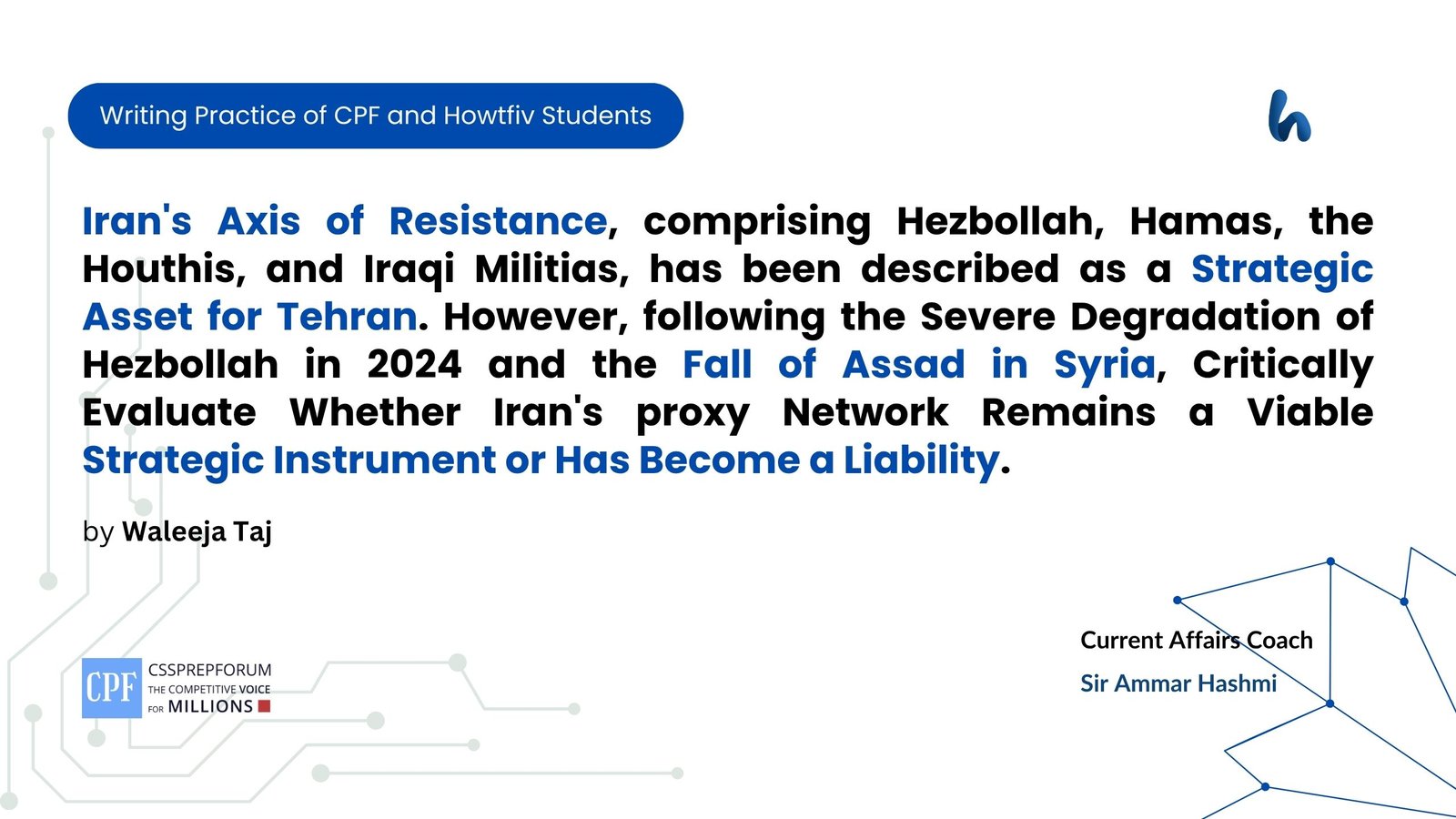
The fall of Bashar al-Assad’s government has significantly changed the geopolitical landscape of the Middle East. For decades, Syria served as Iran’s key ally and an important land corridor for supporting Hezbollah and the broader Axis of Resistance. However, the collapse of Assad’s regime has weakened Iran’s strategic position and created new opportunities for the Arab Gulf states and Turkey to expand their influence in Syria. As a result, an important question has emerged: will Iran be able to restore its influence through political and economic engagement, or is Syria more likely to move closer to the Arab Gulf states and Turkey in the coming decade? Although Iran still possesses political networks and regional influence, Syria’s urgent need for reconstruction, regional acceptance, and economic recovery makes its realignment with the Arab Gulf states and Turkey a more likely outcome. Nevertheless, this trajectory will depend on several domestic, regional, and international factors.
Post-Assad Syria: A New Geopolitical Reality
Following the collapse of Bashar al-Assad’s regime, Syria entered a new geopolitical phase characterized by political uncertainty, security fragmentation, and intensified regional competition. The fall of Assad not only disrupted Iran’s long-standing land corridor connecting Tehran to Hezbollah in Lebanon but also weakened the strategic foundation of the Axis of Resistance. At the same time, the emergence of a transitional political order created opportunities for regional actors, particularly the Arab Gulf states and Turkey, to expand their political, economic, and diplomatic influence in Syria. Moreover, with the country facing severe economic devastation and an urgent need for reconstruction, external powers have shifted their focus from military intervention to economic engagement and political partnerships. Consequently, post-Assad Syria has become a strategic arena where competing regional powers seek to shape the country’s future alignment and redefine the balance of power in the Middle East.
Critical Analysis of Iran’s Restoration of Influence versus Syria’s Realignment with the Arab Gulf States and Turkey over the Next Decade
The future strategic orientation of post-Assad Syria will largely depend on which external actors can offer greater political, economic, and security incentives to the new Syrian leadership. A comparative assessment of these competing strengths indicates that Syria is more likely to realign with the Arab Gulf states and Turkey over the next decade for the following reasons.
- Gulf Financial Power vs Iran’s Economic Constraints
Economic capacity is one of the strongest determinants of Syria’s future alignment. After more than a decade of conflict, Syria requires massive financial assistance to rebuild its infrastructure, revive public services, and stimulate economic growth. In this regard, the Arab Gulf states possess a clear advantage due to their substantial financial resources and proven ability to fund large-scale reconstruction and investment projects. In contrast, Iran’s prolonged economic crisis, international sanctions, high inflation, and limited fiscal capacity significantly constrain its ability to support Syria’s recovery at a comparable scale. Consequently, the new Syrian leadership is more likely to deepen its engagement with the Arab Gulf states, as economic reconstruction and long-term development are expected to take precedence over ideological or military partnerships.
- Turkey’s Geographic Advantage vs Iran’s Diminished Military Corridor
Geography and security considerations further strengthen the prospects of Syria’s realignment with Turkey over Iran’s restored influence. Sharing a long border with Syria, Turkey possesses a unique strategic advantage in shaping border security, facilitating trade, managing refugee repatriation, and influencing political developments in northern Syria. It also maintains established ties with several Syrian opposition groups, enabling it to play a significant role in Syria’s stabilization and reconstruction. In contrast, Iran’s influence has been considerably weakened by the collapse of Assad’s regime, which disrupted its strategic land corridor linking Tehran to Hezbollah in Lebanon. Moreover, continued Israeli airstrikes against Iranian-linked military infrastructure have further constrained Tehran’s ability to re-establish its previous military presence. Therefore, Turkey’s geographical proximity and security leverage provide it with a more sustainable and effective foundation for influencing Syria’s future than Iran’s increasingly constrained military strategy.
- Arab Reintegration vs Iran’s Regional Isolation
Syria’s pursuit of regional legitimacy and diplomatic reintegration also makes closer alignment with the Arab Gulf states more likely than a renewed dependence on Iran. After years of conflict and isolation, the new Syrian leadership requires political recognition, foreign investment, and broader regional acceptance to facilitate reconstruction and restore economic stability. The Arab Gulf states are better positioned to provide these opportunities by promoting Syria’s reintegration into the Arab political and economic framework and encouraging international engagement. In contrast, Iran continues to face regional mistrust, economic sanctions, and strategic rivalry with Israel and several Arab states, limiting its ability to secure wider diplomatic support for Syria. Consequently, aligning with the Arab Gulf states offers Damascus greater prospects for political legitimacy, economic cooperation, and regional integration, making this option more attractive than relying primarily on Iran.
- Gulf-Turkey Partnership vs Iran’s Declining Regional Influence
Finally, the growing strategic partnership between the Arab Gulf states and Turkey provides Syria with a more sustainable framework for long-term stability than Iran’s declining regional influence. Despite occasional differences, the Gulf states and Turkey increasingly share an interest in promoting a stable Syria that can facilitate regional security, economic connectivity, and refugee repatriation. Their combined economic resources, diplomatic outreach, and security capabilities enable them to play a constructive role in Syria’s post-conflict recovery. Conversely, Iran’s regional influence has weakened following the disruption of its strategic corridor through Syria, the degradation of its allied networks, and mounting economic and military pressures. Although Tehran is likely to retain some political and proxy influence, it lacks the capacity to restore the level of dominance it once enjoyed. Therefore, the Gulf-Turkey partnership offers Syria a more credible and sustainable path for regional integration and long-term development over the next decade.
Key Determinants of Syria’s Future Strategic Alignment
Although Syria’s realignment with the Arab Gulf states and Turkey appears to be the more probable outcome, its future strategic orientation is far from certain. The direction Syria ultimately adopts will depend on a range of interconnected domestic, regional, and international factors that will either facilitate or constrain the policies of the new Syrian leadership. The key determinants shaping this outcome are discussed below.
A-Domestic Factors
- Political Stability and Government Legitimacy: The ability of Syria’s new leadership to establish a stable and legitimate government will significantly influence its foreign policy orientation. A politically stable government with broad domestic support will be better positioned to pursue balanced regional relations and negotiate long-term partnerships.
- Economic Recovery and Reconstruction: Syria’s future alignment will largely depend on the availability of financial resources for reconstruction and economic revival. The country’s need for infrastructure development, employment generation, and public service restoration is likely to encourage stronger relations with external actors capable of providing sustained economic assistance.
- Security Sector Reform and Control of Armed Groups: The success of integrating or dismantling various armed factions and rebuilding national security institutions will determine the state’s capacity to exercise effective governance. Improved internal security will reduce external interference and allow Syria to pursue an independent and stable foreign policy.
- National Reconciliation and Institutional Cohesion: Lasting peace requires reconciliation among Syria’s diverse ethnic, religious, and political communities, along with the restoration of effective state institutions. Greater national unity and institutional cohesion will strengthen the government’s ability to make strategic foreign policy decisions based on national interests rather than factional or external pressures.
B-Regional Factors
- Iran-Israel Strategic Rivalry: The ongoing rivalry between Iran and Israel will remain a major determinant of Syria’s future strategic orientation. Continued Israeli efforts to prevent Iran’s military entrenchment in Syria could further weaken Tehran’s influence, whereas any reduction in regional tensions may create opportunities for Iran to gradually restore its political and economic presence.
- Turkey’s Security and Geopolitical Interests: Turkey’s policy towards Syria will significantly shape the country’s future alignment. Ankara’s concerns regarding Kurdish armed groups, border security, refugee repatriation, and regional influence will determine the extent of its political, military, and economic engagement with post-Assad Syria.
- Arab Gulf States’ Economic and Diplomatic Engagement: The willingness of the Arab Gulf states to invest in Syria’s reconstruction and support its diplomatic reintegration will be a decisive factor. Sustained financial assistance and political backing can strengthen Syria’s inclination towards the Arab bloc and reduce its dependence on Iran.
- The Future of Hezbollah and Iraq’s Strategic Role: The regional influence of Hezbollah and Iraq’s position as a geographical bridge between Iran and Syria will also affect Tehran’s ability to regain influence. A weakened Hezbollah and an Iraq that limits Iranian logistical access would further constrain Iran’s regional strategy, whereas stronger coordination among these actors could partially revive Iran’s influence in Syria.
C-International Factors
- United States’ Middle East Policy: The United States’ policy towards Syria and Iran will significantly influence Syria’s future strategic alignment. Continued sanctions on Iran, support for the Syrian Democratic Forces (SDF), and diplomatic engagement with Syria’s new leadership could encourage Damascus to strengthen ties with the Arab Gulf states and Turkey. Conversely, a reduced U.S. role in the region may create greater space for Iran to gradually rebuild its influence.
- Russia’s Strategic Role in Syria: Despite the fall of Assad, Russia is expected to remain an influential actor due to its military presence and long-standing strategic interests in Syria. Moscow’s willingness to engage with the new Syrian leadership and cooperate with regional powers will affect Syria’s political transition and determine the balance of external influence in the country.
- China’s Economic and Geopolitical Engagement: China’s growing economic presence in the Middle East could shape Syria’s post-conflict recovery. Through infrastructure investment, trade, and development initiatives, Beijing may contribute to Syria’s reconstruction while maintaining a neutral diplomatic approach. The extent of China’s economic engagement will influence Syria’s ability to diversify its foreign partnerships beyond traditional regional alliances.
- Western Sanctions, International Recognition, and UN Support: The future of Western sanctions, international recognition of Syria’s new government, and the role of the United Nations in facilitating political transition and reconstruction will be decisive. Greater international legitimacy and coordinated reconstruction assistance would encourage Syria to pursue broader regional and global engagement, whereas prolonged sanctions and diplomatic isolation could limit its options and increase dependence on a narrower set of external partners.
Critical Analysis
Although Iran is unlikely to regain the level of influence it enjoyed under the Assad regime, it would be premature to assume its complete exclusion from Syria’s future political landscape. Tehran still retains political networks, ideological influence, and longstanding ties with various actors inside Syria, enabling it to remain a relevant regional player. However, Syria’s urgent need for economic reconstruction, diplomatic legitimacy, and regional reintegration provides the Arab Gulf states and Turkey with stronger and more sustainable sources of influence than Iran’s increasingly constrained political and military strategy. Therefore, while Iran is expected to preserve a limited role, the overall balance of evidence suggests that Syria is more likely to pursue a pragmatic foreign policy centered on closer engagement with the Arab Gulf states and Turkey over the next decade.
Conclusion
In conclusion, the fall of the Assad regime has fundamentally reshaped Syria’s geopolitical landscape and opened a new phase of regional competition. Although Iran is likely to retain a degree of political influence through its longstanding networks, its ability to restore its pre-Assad dominance appears increasingly limited. In contrast, the Arab Gulf states and Turkey possess greater economic resources, diplomatic leverage, and strategic advantages to shape Syria’s post-conflict future. Nevertheless, the country’s ultimate strategic orientation will depend on the successful management of domestic challenges, regional dynamics, and international engagement in the years ahead.
CSS Solved Past Papers’ Essays
Looking for the last ten years of CSS and PMS Solved Essays and want to know how Sir Kazim’s students write and score the highest marks in the essays’ papers? Then, click on the CSS Solved Essays to start reading them.
CSS Solved Essays
CSS Solved Islamiyat Past Papers
Want to read the last ten years’ Islamiyat Solved Past Papers to learn how to attempt them and to score high? Let’s click on the link below to read them all freely. All past papers have been solved by Pakistan’s top CSS Islamiyat coaches having the highest score of their students.
CSS Solved Islamiyat
CSS Solved General Science & Ability Past Papers
Want to read the last ten years’ General Science & Ability Solved Past Papers to learn how to attempt them and to score high? Let’s click on the link below to read them all freely. All past papers have been solved by Pakistan’s top CSS GSA coachez having the highest score of their students.
CSS Solved General Science & Ability
CSS Solved Pakistan Affairs Past Papers
Want to read the last fifteen years’ Pakistan Affairs Solved Past Papers to learn how to attempt them and to score high? Let’s click on the link below to read them all freely. All past papers have been solved by Pakistan’s top CSS Pakistan Affairs coaches having the highest score of their students.
CSS Solved Pakistan Affairs
CSS Solved Current Affairs Past Papers
Want to read the last fifteen years’ Current Affairs Solved Past Papers to learn how to attempt them and to score high? Let’s click on the link below to read them all freely. All past papers have been solved by Pakistan’s top CSS Current Affairs coaches having the highest score of their students.
CSS Solved Current Affairs