CSS Current Affairs | Syria’s Post-Assad Fragmented Political Landscape
The following assignment question for CSS Current Affairs is solved by Laiba Eman under the supervision of Howfiv’s Pakistan Affairs and Current Affairs Coaches: Miss Iqra Ali and Sir Ammar Hashmi. She learnt how to attempt 20 marks question and essay writing from Sir Syed Kazim Ali, Pakistan’s best CSS and PMS English essay and precis teacher with the highest success rate of his students. This solved question is attempted on the pattern taught by Sir to his students, scoring the highest marks in compulsory and optional subjects for years.

Outline
1-Introduction
2-A Cursory Glance Over the Fragmented Power Landscape of Syria After Assad
3-Why is Syria Vulnerable to Instability like Post-2003 Iraq and Post-2011 Libya?
- Fragile and Divided Power Landscape
- Lack of Democratic Culture in Syria
- Deep Sectarian and Tribal Fragmentation
- Foreign Intervention and Their Proxies
- Domestic Socio-Economic Challenges
4-Recommendations for Achieving Stability in Syria
5-Conclusion
Answer to the Question
Introduction
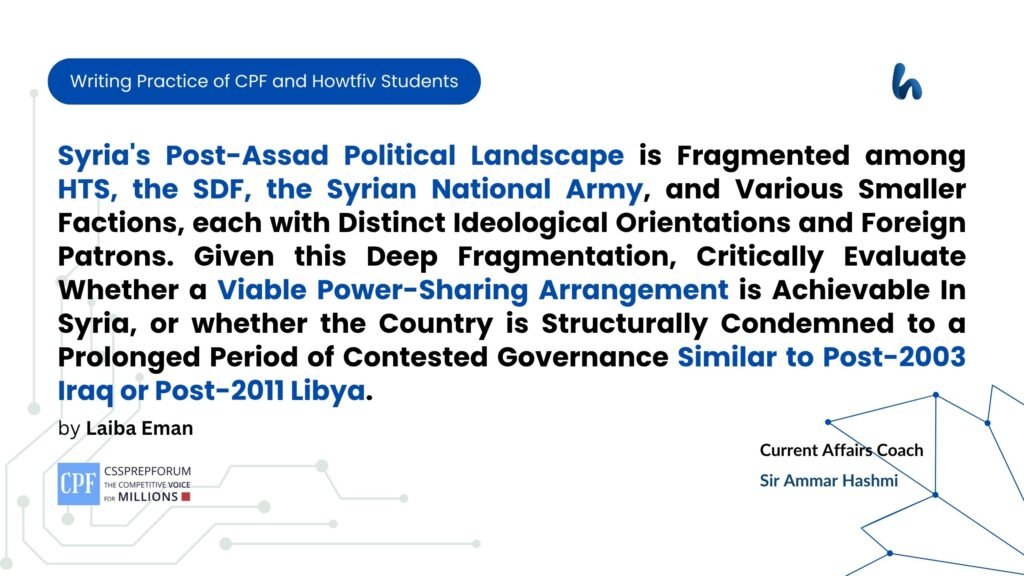
The fall of the Assad regime in 2024 raised multiple questions about Syria’s future. The major concern was whether the new government could succeed in achieving what Assad failed to do, or whether it would become a vulnerable state like Iraq after Saddam Hussein and Libya after Gaddafi. Currently, after a year since Assad’s fall, little to no improvement has been seen in Syria. Although, unlike Libya and Iraq, Syria has international recognition and powers like the US are easing sanctions on Syria, the presence of other powerful armed groups with opposing ideologies and motives is a major threat. Moreover, the lack of democratic culture, fragile alliances of armed groups competing for power, the presence of ISIS and other hostile groups, foreign intervention through proxies, and socioeconomic challenges are the major reasons that make international experts doubtful about the stable and prosperous future of Syria. Therefore, the new government requires more inclusive and nuanced approaches to prevent Syria from the consequences Iraq and Libya experienced after regime change.
A Cursory Glance Over Fragmented Power Landscape of Syria After Assad
A glimpse into Syria’s recent history reveals that the Assad family ruled the country with an iron fist for decades. However, the Arab Spring in 2011 ignited a devastating civil war that tore the country apart, pitting Bashar al-Assad’s government against a diverse coalition of opposition forces, including jihadist groups, Kurdish militias, and other rebel factions. The final blow came through a coordinated offensive led by three major groups: Hayat Tahrir al-Sham (HTS), the Southern Front, and Kurdish forces. These groups also received varying degrees of foreign support, from Türkiye, the United States, and Gulf countries. Although Iran and Russia remained steadfast supporters of Bashar al-Assad, his political rigidity, ineffective governance, and declining military position ultimately enabled opposition forces to remove him from power, reshaping the balance of power in the Middle East and undermining Russian and Iranian strategic interests. The fall of the Assad regime was widely celebrated by many Syrians, who hoped for a prosperous and peaceful future. Nevertheless, Syria’s future remains uncertain. The country continues to be a deeply fragmented nation, scarred by years of civil war, economic sanctions, institutional collapse, and social divisions. Addressing these complex challenges requires visionary political leadership, effective diplomacy, and strong administrative competence, qualities that the current government has yet to demonstrate consistently.
Why is Syria Vulnerable to Instability like Post-2003 Iraq and Post-2011 Libya?
The Fall of the Assad regime, facilitated by foreign involvement, has reminded many international experts of Iraq’s Saddam Hussein and Libya’s Muammar Gaddafi. Although Syrians are hopeful because, unlike Iraq and Libya, Syria has established an internationally recognized stable government, experts remain doubtful, as no major improvement has been seen during the past year under the new government. The vision of a democratic and prosperous Syria remains distant due to persistent political fragmentation, the proliferation of armed groups, foreign interference, and deep-rooted economic and institutional challenges.
- Fragile and Divided Power Landscape
First, one of the primary reasons for Syria’s continued vulnerability to instability is its weak and fragmented political landscape. Although, unlike Iraq after 2003 and Libya after 2011, Syria has avoided a complete power vacuum, political authority remains divided among three major factions with competing ideologies, making the country’s future increasingly uncertain. Among these factions, Kurdish militias continue to seek greater autonomy or independence, a development that could trigger armed confrontation with the central government. Moreover, the continued presence of ISIS poses another serious threat, as the group is likely to exploit any political or security vacuum to undermine the government and revive its ambition of establishing an Islamic state in Syria.
- Lack of Democratic Culture in Syria
Second, Syria has never experienced a democratic system of governance. After decades of authoritarian rule under the Assad family, the country lacks well-developed political parties, democratic institutions, and an effective electoral framework. Following the Arab Spring, public demands for political reform in 2011 ignited a civil war that ultimately culminated in the fall of the Assad regime and the establishment of a transitional government in 2024. However, Syria’s long-standing aspiration for democracy has yet to be realized. Although parliamentary elections were held in 2025, they were largely symbolic because only members of an Electoral College appointed by the government were granted voting rights. Moreover, President Ahmed al-Sharaa has stated that Syria will eventually adopt democracy and a fair electoral system, but achieving this objective requires competitive political parties, well-established institutions, an independent judiciary, and, above all, a genuine democratic commitment from the government. Syria currently lacks many of these prerequisites; therefore, international experts remain concerned that the country may drift toward another authoritarian regime or descend into a prolonged power struggle similar to those witnessed in Iraq and Libya.
- Deep Sectarian and Tribal Fragmentation
The third major challenge to Syria’s stability lies at the social level. Syrian society remains deeply divided along sectarian and ethnic lines, particularly between Sunni and Shia communities, with longstanding sectarian tensions continuing to undermine national cohesion. The rise in Sunni-Shia tensions following the change in government, coupled with reports of targeted killings, the marginalization of the Alawite community, and persistent tribal rivalries, has further deepened social divisions. Consequently, the post-Assad transition has been marred by sectarian violence and a critical lack of minority representation in central security institutions, prompting fears that Syria could experience prolonged state fragmentation similar to that witnessed in post-Saddam Iraq and post-Gaddafi Libya.
- Foreign Intervention and Their Proxies
Another grave threat that mirrors the post-regime instability witnessed in Iraq and Libya is foreign intervention through proxy warfare. Syria has long served as a proxy battleground for major regional and global powers, particularly Moscow and Washington. The United States has supported several opposition groups, while Russia has backed the Assad regime for decades. Moreover, Iran, Türkiye, and Israel also have significant strategic interests in Syria. During Bashar al-Assad’s rule, Iran used Syrian territory as a logistical corridor to supply weapons to Hezbollah in its confrontation with Israel, thereby prompting repeated Israeli military intervention in Syria. Although the fall of Assad has weakened Russian and Iranian influence, Türkiye’s continued support for Syrian opposition factions has enhanced its strategic leverage. However, Ankara’s objectives may clash with those of the United States and Russia, particularly if it intensifies military operations against Kurdish groups in northern Syria. Any escalation of rivalry among these external powers could further destabilize Syria and transform it once again into a battleground for proxy conflicts.
- Domestic Socio-Economic Challenges
Finally, years of conflict have devastated Syria’s socioeconomic fabric. Although the government is attempting to attract foreign investment following the easing of international sanctions, no significant economic recovery has yet been observed. Persistent unemployment, widespread poverty, damaged infrastructure, and weak state institutions continue to undermine economic stability. If the government fails to address these challenges effectively, growing public dissatisfaction could trigger renewed civil unrest and even another civil war.
Recommendations for Achieving Stability in Syria
Therefore, to prevent Syria from following the trajectories of Iraq and Libya, the government must adopt a more inclusive, comprehensive, and sustained approach to addressing its political, social, and economic challenges. First, it should implement a practical power-sharing arrangement that ensures meaningful political representation for all major ethnic, religious, and political groups. Second, the government must curb sectarian violence and end the marginalization of minority communities through the strict enforcement of law and the protection of fundamental rights. Finally, it should leverage its improving diplomatic relations with regional and international partners to attract foreign investment, rebuild critical infrastructure, and generate sustainable employment opportunities for the country’s youth.
Conclusion
In conclusion, Syria’s future remains uncertain, as the country continues to exhibit many of the structural vulnerabilities that plunged post-2003 Iraq and post-2011 Libya into prolonged instability. Political fragmentation, sectarian divisions, foreign intervention, weak democratic institutions, and severe socioeconomic challenges continue to threaten national stability. Nevertheless, with inclusive governance, equitable power-sharing, the protection of minority rights, institutional strengthening, and sustained economic recovery, Syria can still avoid repeating the trajectories of Iraq and Libya and move toward lasting peace and prosperity.

CSS Solved Past Papers’ Essays
Looking for the last ten years of CSS and PMS Solved Essays and want to know how Sir Kazim’s students write and score the highest marks in the essays’ papers? Then, click on the CSS Solved Essays to start reading them.
CSS Solved Essays
CSS Solved Islamiyat Past Papers
Want to read the last ten years’ Islamiyat Solved Past Papers to learn how to attempt them and to score high? Let’s click on the link below to read them all freely. All past papers have been solved by Pakistan’s top CSS Islamiyat coaches having the highest score of their students.
CSS Solved Islamiyat
CSS Solved General Science & Ability Past Papers
Want to read the last ten years’ General Science & Ability Solved Past Papers to learn how to attempt them and to score high? Let’s click on the link below to read them all freely. All past papers have been solved by Pakistan’s top CSS GSA coachez having the highest score of their students.
CSS Solved General Science & Ability
CSS Solved Pakistan Affairs Past Papers
Want to read the last fifteen years’ Pakistan Affairs Solved Past Papers to learn how to attempt them and to score high? Let’s click on the link below to read them all freely. All past papers have been solved by Pakistan’s top CSS Pakistan Affairs coaches having the highest score of their students.
CSS Solved Pakistan Affairs
CSS Solved Current Affairs Past Papers
Want to read the last fifteen years’ Current Affairs Solved Past Papers to learn how to attempt them and to score high? Let’s click on the link below to read them all freely. All past papers have been solved by Pakistan’s top CSS Current Affairs coaches having the highest score of their students.
CSS Solved Current Affairs