CSS Current Affairs | Fall of Assad’s Government Altering Iran’s Strategic Land Corridor
The following assignment question for CSS Current Affairs is solved by Dua Batool under the supervision of Howfiv’s Pakistan Affairs and Current Affairs Coaches: Miss Iqra Ali and Sir Ammar Hashmi. She learnt how to attempt 20 marks question and essay writing from Sir Syed Kazim Ali, Pakistan’s best CSS and PMS English essay and precis teacher with the highest success rate of his students. This solved question is attempted on the pattern taught by Sir to his students, scoring the highest marks in compulsory and optional subjects for years.

Outline
1-Introduction
2-Overview of the Fall of Bashar al-Assad’s Government
3-Understanding Iran’s Strategic Land Corridor and the Axis of Resistance
4-Long-term Implications for Iranian Regional Influence
- Weakening Iran’s strategic depth in the Levant
- Disruption of military logistics and arms transfers
- Declining regional deterrence against Israel
- Erosion of Iran’s geopolitical influence in Syria
- Strengthening rival regional powers
5-Implications for the Future Coherence of the Axis of Resistance
- Weakening Hezbollah’s operational capability
- Declining organizational cohesion of the Axis
- Increasing operational autonomy of proxy groups
- Fragmentation of Iran’s regional deterrence architecture
- Transition toward decentralized asymmetric warfare
6-Critical Analysis
7-Conclusion
Answer to the question
Introduction
The fall of Bashar al-Assad’s government in December 2024 marked a major geopolitical setback for Iran by disrupting its strategic land corridor linking Tehran to Beirut through Baghdad and Damascus, thereby reshaping the regional balance of power and the operational dynamics of the Axis of Resistance. This development has undermined Iran’s strategic depth in the Levant, disrupted military logistics and arms transfers, weakened its deterrence against Israel, reduced its geopolitical influence in Syria, and created opportunities for rival regional powers to expand their influence. Simultaneously, it has affected the future coherence of the Axis of Resistance by diminishing Hezbollah’s operational capability, weakening organizational cohesion, increasing the autonomy of proxy groups, fragmenting Iran’s regional deterrence architecture, and accelerating a shift toward decentralized asymmetric warfare. Thus, the collapse of the Assad government is likely to have profound and enduring implications for both Iranian regional influence and the future unity of the Axis of Resistance.
Overview of the Fall of Bashar al-Assad’s Government
Assessing the long-term implications for Iran’s regional influence and the future coherence of the Axis of Resistance requires an overview of the fall of Bashar al-Assad’s government. The fall of Bashar al-Assad’s government in December 2024 marked a historic turning point in Middle Eastern geopolitics. After years of civil conflict, sustained military pressure from opposition forces, and diminishing external support, the collapse of the Assad regime ended Iran’s most reliable Arab ally and disrupted the regional strategic order. The event not only transformed Syria’s domestic political landscape but also reshaped the broader regional geopolitical environment, making it one of the most consequential developments in contemporary Middle Eastern politics.

Understanding Iran’s Strategic Land Corridor and the Axis of Resistance
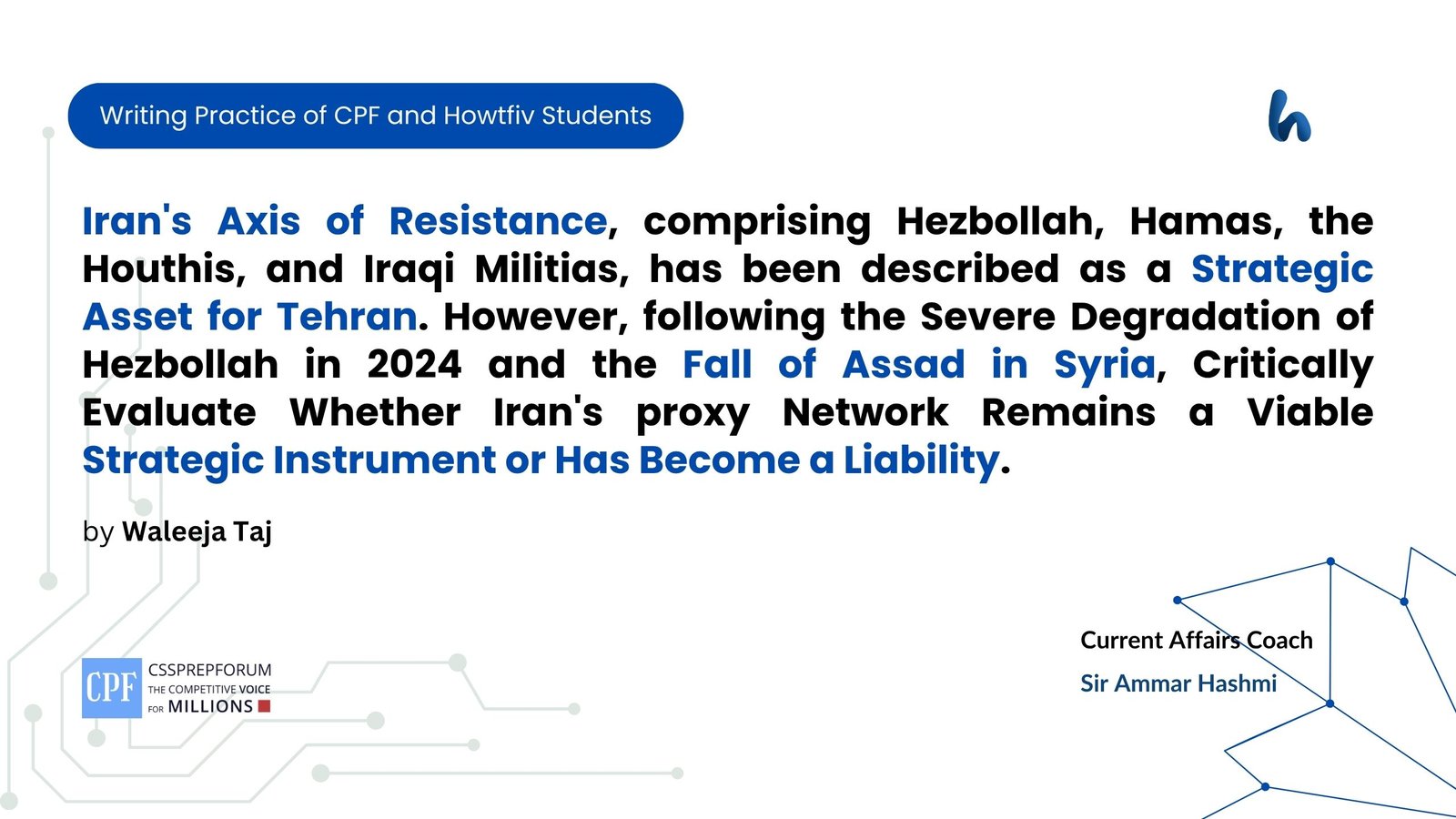
Central to assessing the consequences of Assad’s fall is an understanding of Iran’s strategic land corridor and the Axis of Resistance. Iran’s strategic land corridor refers to the overland route connecting Tehran to Beirut through Iraq and Syria, enabling the movement of military personnel, weapons, logistics, and political influence across the region. This corridor has served as the backbone of the Axis of Resistance, an Iran-led network comprising Hezbollah, Iraqi militias, the former Syrian government, and other allied non-state actors, designed to project Iranian influence, deter Israel, and counter Western and regional adversaries. Consequently, any disruption to this corridor directly undermines the operational effectiveness and strategic coherence of the Axis.
Long-Term Implications for Iranian Regional Influence
- Weakening Iran’s strategic depth in the Levant
Building on this, one of the most significant long-term implications for Iranian regional influence is the weakening of its strategic depth in the Levant following the fall of Bashar al-Assad’s government. For over a decade, Syria served as Iran’s principal Arab ally and a forward operating base from which Tehran projected military, political, and ideological influence across the Eastern Mediterranean. For example, the International Institute for Strategic Studies (IISS) identified Syria as the cornerstone of Iran’s forward-defence doctrine, hosting Islamic Revolutionary Guard Corps (IRGC) personnel, military infrastructure, and logistical hubs supporting Iran’s regional operations. With the collapse of Assad’s regime, Iran has lost this indispensable strategic platform, restricting its ability to sustain a forward military presence and shape regional security dynamics. Thus, this development has long-term implications for Iranian regional influence by substantially weakening Iran’s strategic depth in the Levant and constraining its ability to project power beyond its borders.
- Disruption of Military Logistics and Arms Transfers
Another major long-term implication for Iranian regional influence is the disruption of Iran’s military logistics and arms transfer network across the Levant. The Tehran-Baghdad-Damascus-Beirut land corridor was Iran’s most efficient route for transporting advanced missiles, drones, weapons, military advisers, and financial assistance to Hezbollah and other members of the Axis of Resistance. The loss of this secure logistical artery has complicated Tehran’s ability to maintain uninterrupted military assistance to its regional proxies. For instance, following the regime’s fall, international security assessments reported the breakdown of this overland corridor, forcing Iran to depend increasingly on air and maritime routes that are costlier, slower, and more vulnerable to Israeli surveillance and interdiction. Hence, the collapse of the land corridor has profoundly disrupted Iran’s military logistics and arms transfers, reducing the operational effectiveness of its regional proxy network.
- Declining Regional Deterrence against Israel
A further long-term implication for Iranian regional influence is the decline in Iran’s regional deterrence against Israel. The loss of Syria has significantly weakened Iran’s regional deterrence against Israel by undermining its ability to coordinate pressure across multiple fronts. Iran’s security strategy relied on integrating Hezbollah in Lebanon, allied militias in Syria and Iraq, and Palestinian resistance groups into a unified deterrence network capable of imposing strategic costs on Israel. For instance, Syria functioned as the critical geographical bridge facilitating force deployment, intelligence sharing, and weapons transfers among these allied groups, making it central to Iran’s “forward defence” doctrine. Without secure access to Syrian territory, Tehran’s capacity to sustain coordinated military pressure has diminished, while Israel enjoys greater operational freedom to target Iranian assets and disrupt proxy networks. Therefore, the weakening of Iran’s regional deterrence against Israel represents a major long-term implication of Assad’s fall, diminishing Tehran’s ability to project credible military influence across the region.
- Erosion of Iran’s Geopolitical Influence in Syria
The fall of the Assad regime has also had profound long-term implications for Iranian regional influence by eroding Tehran’s geopolitical position in Syria, ending years of extensive political, military, and economic investment. Throughout the Syrian civil war, Tehran invested billions of dollars to preserve Assad’s government and secure long-term influence over Syria’s political institutions, security apparatus, and regional orientation. With Assad’s removal, a new Syrian leadership has emerged that is considerably less dependent on Tehran and increasingly open to engagement with alternative regional actors. This political transition has reduced Iran’s leverage over Syria’s domestic and foreign policy while limiting its ability to shape future regional developments. Consequently, the erosion of Iran’s geopolitical influence in Syria constitutes a significant long-term implication, reducing Tehran’s political and strategic leverage in the Levant.
- Strengthening Rival Regional Powers
Another important long-term implication for Iranian regional influence is the strengthening of rival regional powers at Iran’s expense. The weakening of Iran’s position in Syria has created strategic opportunities for rival regional powers to expand their influence and reshape the Middle Eastern balance of power. As Tehran’s influence has receded, competing regional actors have sought to fill the resulting geopolitical vacuum through greater diplomatic, military, and economic engagement. For example, Israel has gained increased operational freedom to strike Iranian infrastructure and disrupt proxy networks, Turkey has expanded its political and military influence in northern Syria, while Gulf Arab states have intensified diplomatic outreach and sought a greater role in Syria’s reconstruction and future governance. These developments collectively reflect a regional realignment that favours Iran’s competitors at Tehran’s expense. Thus, the strengthening of rival regional powers is a major long-term implication of Assad’s fall, further diminishing Iranian regional influence and reshaping the regional balance of power in favour of its competitors.
Implications for the Future Coherence of the Axis of Resistance
- Weakening Hezbollah’s operational capability
As Iran’s regional influence has diminished following the collapse of the Assad regime, its capacity to sustain the Axis of Resistance has also weakened. One of the most significant long-term implications for the future coherence of the Axis of Resistance is the weakening of Hezbollah’s operational capability. Hezbollah has long depended on Iran’s strategic land corridor through Syria for the continuous supply of advanced missiles, drones, precision-guided munitions, military equipment, and logistical support. For example, Syria served for years as the principal transit route through which the Islamic Revolutionary Guard Corps (IRGC) transferred sophisticated weapons to Hezbollah, enabling the group to build one of the region’s most formidable non-state military forces. The collapse of the Assad regime has severely disrupted this supply chain, limiting Hezbollah’s ability to replenish its arsenal and sustain long-term military readiness. Thus, the weakening of Hezbollah’s operational capability has significant long-term implications for the future coherence of the Axis of Resistance by reducing the military strength of its most powerful constituent.
- Declining Organizational Cohesion of the Axis
Another major long-term implication for the future coherence of the Axis of Resistance is the declining organizational cohesion of the alliance. The Axis of Resistance functioned as a coordinated network in which Syria served as the geographical and logistical bridge connecting Iran with Hezbollah and other allied groups across the region. For example, Syria hosted joint command centres, logistical hubs, and communication networks that facilitated intelligence sharing, military coordination, and synchronized operations among Iran-backed militias in Lebanon, Iraq, and Syria. With the collapse of Assad’s government, this central coordinating platform has largely disappeared, making collective planning and coordinated military operations increasingly difficult. Hence, the declining organizational cohesion of the Axis has profound long-term implications for the future coherence of the Axis of Resistance by weakening coordination among its constituent groups.
- Increasing Operational Autonomy of Proxy Groups
Another important long-term implication for the future coherence of the Axis of Resistance is the increasing operational autonomy of Iran’s proxy groups. As Tehran’s ability to provide centralized leadership and logistical support weakens, individual members of the Axis are increasingly compelled to pursue their own domestic political, security, and strategic priorities. For example, the Iraqi Popular Mobilization Forces, Hezbollah, Hamas, and the Houthis operate within distinct national environments and face different political and military challenges, making independent decision-making more likely as Iranian coordination declines. This gradual divergence of priorities reduces the unity of purpose that previously characterized the Axis under Iran’s leadership. Consequently, the increasing operational autonomy of proxy groups has significant long-term implications for the future coherence of the Axis of Resistance by making it a less unified and centrally directed alliance.
- Fragmentation of Iran’s Regional Deterrence Architecture
A further long-term implication for the future coherence of the Axis of Resistance is the fragmentation of Iran’s regional deterrence architecture. Iran’s deterrence strategy relied on integrating allied militias across Lebanon, Syria, Iraq, and Palestine into a coordinated security network capable of responding collectively to regional threats. For example, Syria acted as the geographical centre of this deterrence framework by facilitating the movement of personnel, weapons, intelligence, and operational coordination among Iran’s regional partners. The loss of Syria as this strategic hub has fragmented the integrated deterrence system, reducing its ability to function as a unified security architecture. Therefore, the fragmentation of Iran’s regional deterrence architecture has major long-term implications for the future coherence of the Axis of Resistance by weakening its collective deterrent capacity.
- Transition toward Decentralized Asymmetric Warfare
Another significant long-term implication for the future coherence of the Axis of Resistance is its transition toward decentralized asymmetric warfare. As centralized coordination through Syria becomes increasingly difficult, Iran and its allied groups are expected to rely more heavily on localized missile strikes, drone operations, cyber capabilities, and guerrilla tactics instead of integrated regional military campaigns. For example, security analysts increasingly assess that Iran is adapting its regional strategy by empowering individual proxy groups to conduct independent asymmetric operations suited to their respective theatres rather than depending on a centrally coordinated military network. Although this adaptation allows the Axis to survive despite the loss of Syria, it fundamentally transforms the nature of its operations and command structure. Thus, the transition toward decentralized asymmetric warfare has significant long-term implications for the future coherence of the Axis of Resistance by transforming it from a tightly coordinated alliance into a looser and more decentralized network.
Critical Analysis
The fall of Bashar al-Assad’s government has fundamentally reshaped Iran’s regional strategic environment by severing its most reliable land corridor to the Levant and weakening the institutional coherence of the Axis of Resistance. Although Iran retains influence through its proxy networks, ideological outreach, and asymmetric military capabilities, these instruments can only partially compensate for the loss of Syria’s strategic geography. As a result, Iran is likely to face greater logistical constraints, higher operational costs, and reduced coordination among its regional allies. Consequently, the Axis of Resistance is expected to persist, but in a less cohesive, more decentralized, and strategically constrained form, limiting Iran’s ability to project power and shape regional dynamics with the same effectiveness as before.
Conclusion
In conclusion, the collapse of Bashar al-Assad’s government marks a decisive turning point in Iran’s regional strategy and the evolution of the Axis of Resistance. It has weakened Iran’s strategic depth, disrupted military logistics, diminished regional deterrence, reduced its geopolitical influence in Syria, and facilitated the rise of rival regional powers. Simultaneously, it has weakened Hezbollah’s operational capability, fragmented Iran’s regional deterrence architecture, and accelerated the transition of the Axis toward a more decentralized and less coordinated structure. Therefore, the fall of the Assad government constitutes a long-term strategic setback that is likely to constrain Iran’s regional influence and undermine the future coherence of the Axis of Resistance.

CSS Solved Past Papers’ Essays
Looking for the last ten years of CSS and PMS Solved Essays and want to know how Sir Kazim’s students write and score the highest marks in the essays’ papers? Then, click on the CSS Solved Essays to start reading them.
CSS Solved Essays
CSS Solved Islamiyat Past Papers
Want to read the last ten years’ Islamiyat Solved Past Papers to learn how to attempt them and to score high? Let’s click on the link below to read them all freely. All past papers have been solved by Pakistan’s top CSS Islamiyat coaches having the highest score of their students.
CSS Solved Islamiyat
CSS Solved General Science & Ability Past Papers
Want to read the last ten years’ General Science & Ability Solved Past Papers to learn how to attempt them and to score high? Let’s click on the link below to read them all freely. All past papers have been solved by Pakistan’s top CSS GSA coachez having the highest score of their students.
CSS Solved General Science & Ability
CSS Solved Pakistan Affairs Past Papers
Want to read the last fifteen years’ Pakistan Affairs Solved Past Papers to learn how to attempt them and to score high? Let’s click on the link below to read them all freely. All past papers have been solved by Pakistan’s top CSS Pakistan Affairs coaches having the highest score of their students.
CSS Solved Pakistan Affairs
CSS Solved Current Affairs Past Papers
Want to read the last fifteen years’ Current Affairs Solved Past Papers to learn how to attempt them and to score high? Let’s click on the link below to read them all freely. All past papers have been solved by Pakistan’s top CSS Current Affairs coaches having the highest score of their students.
CSS Solved Current Affairs