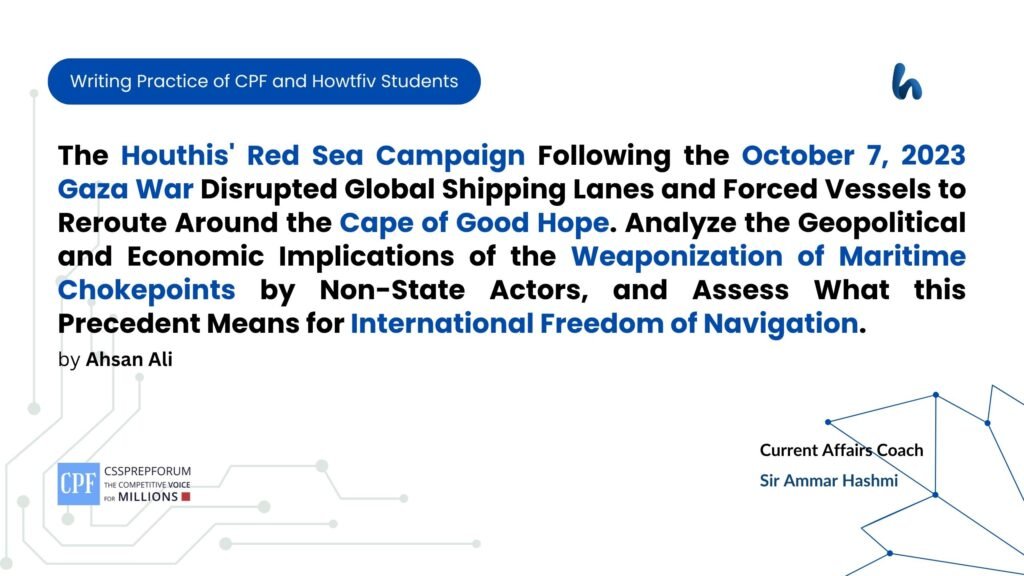
CSS Current Affairs | Geopolitical and Economic Implications of the Weaponization of Maritime Chokepoints by Non-State Actors
The following assignment question for CSS Current Affairs is solved by Ahsan Ali under the supervision of Howfiv’s Pakistan Affairs and Current Affairs Coaches: Miss Iqra Ali and Sir Ammar Hashmi. She learnt how to attempt 20 marks question and essay writing from Sir Syed Kazim Ali, Pakistan’s best CSS and PMS English essay and precis teacher with the highest success rate of his students. This solved question is attempted on the pattern taught by Sir to his students, scoring the highest marks in compulsory and optional subjects for years.
Outline
1-Introduction
2-Brief Overview of the Houthis and the Red Sea Crisis
3-Geopolitical and Economic Implications of the Weaponization of Maritime Chokepoints by Non-State Actors
- Geopolitical Implications
- Shifting regional and global power dynamics
- Increased militarization of strategic maritime chokepoints
- Economic Implications
- Disruption of global trade and supply chains
- Rising shipping, insurance, and energy transportation costs
4-Implications for International Freedom of Navigation
- Erosion of the principle of freedom of navigation in international waters
- Greater need for multinational maritime security cooperation
- Strengthening international maritime law and collective enforcement mechanisms
5-Critical Analysis
6-Conclusion
Answer to the question
Introduction
The Weaponization of maritime chokepoints by non-state actors has emerged as a significant challenge to contemporary international security and the global trading system. Strategic waterways are vital to the uninterrupted flow of commerce, making them attractive targets for armed groups seeking political and military leverage. According to the United Nations Conference on Trade and Development, disruptions in the Red Sea following the Houthi attacks significantly affected global maritime transport and trade. This demonstrates that even non-state actors can exploit strategic sea routes to generate consequences extending well beyond the immediate conflict zone. Thus, the Houthi Red Sea campaign warrants an examination of its geopolitical and economic implications, as well as its impact on the principle of international freedom of navigation.
Brief Overview of the Houthis and the Red Sea Crisis
The Houthis, also known as Ansar Allah, have grown from a local armed movement in Yemen into an important regional actor. After years of fighting the Yemeni government and the Saudi-led coalition, they strengthened their control over large parts of northern Yemen, including the capital, Sana’a. Their role took a new turn after the October 7, 2023, Gaza conflict. In support of Palestine, the Houthis began targeting Israel and attacking commercial vessels in the Red Sea and around the Bab el-Mandeb Strait, particularly ships they claimed were linked to Israel and its allies. These attacks brought the Houthis directly into a wider regional conflict and disrupted one of the world’s most important shipping routes. As a result, what was largely seen as a Yemeni armed group became a serious concern for international trade and maritime security.
Geopolitical and Economic Implications of the Weaponization of Maritime Chokepoints by Non-State Actors
- Geopolitical implications
- Shifting regional and global power dynamics
Houthi attacks have altered regional and global power dynamics by expanding non-state actors’ strategic influence over international maritime affairs. The campaign compelled regional powers and major naval states to reassess their security strategies in the Red Sea and the wider Middle East. According to the International Institute for Strategic Studies, the Red Sea crisis has intensified strategic competition among regional and global powers while increasing the geopolitical importance of maritime security. This suggests that non-state actors are increasingly able to influence interstate relations and shape major powers’ strategic calculations. Therefore, the Houthi campaign has redefined traditional geopolitical dynamics by enhancing the strategic relevance of maritime chokepoints.
- Increased militarization of strategic maritime chokepoints
The Weaponization of maritime chokepoints has accelerated the militarization of strategic sea lanes. In response to the Houthi attacks, several countries expanded naval deployments and maritime surveillance operations to safeguard commercial shipping. The North Atlantic Treaty Organization has repeatedly emphasized that secure maritime routes are essential for collective security and international stability. This demonstrates that persistent threats from non-state actors encourage greater military presence in strategic waterways, increasing the risk of regional confrontation. Hence, maritime insecurity has transformed strategic chokepoints into increasingly militarized zones.
- Economic implications
- Disruption of global trade and supply chains
The Houthi attacks severely disrupted global trade by interrupting one of the world’s busiest maritime corridors. As shipping companies diverted vessels around the Cape of Good Hope, transit times lengthened, and supply chains became less efficient. The International Monetary Fund reported that the Red Sea disruptions significantly reduced shipping through the Suez Canal, adversely affecting global trade flows. This demonstrates how localized maritime insecurity can produce widespread economic consequences for producers, consumers, and international markets. Therefore, the disruption of Red Sea shipping exposed the vulnerability of global supply chains to geopolitical instability.
- Rising shipping, insurance, and energy transportation costs
The Weaponization of maritime chokepoints substantially increased the cost of international shipping and energy transportation. Longer shipping routes and heightened security risks raised freight charges, insurance premiums, and fuel consumption for commercial vessels. According to the International Energy Agency, the Red Sea crisis increased uncertainty in global energy transportation by affecting important oil and liquefied natural gas shipping routes. This illustrates that instability in critical maritime corridors directly contributes to higher transportation costs and greater volatility in international energy markets. Consequently, maritime insecurity has imposed significant economic burdens on global trade and energy security.
Implications for International Freedom of Navigation
- Erosion of the principle of freedom of navigation in international waters
The Houthi campaign has challenged the long-standing principle of freedom of navigation by demonstrating that non-state actors can disrupt lawful maritime transit. Such attacks undermine confidence in the security of international sea lanes that facilitate global commerce. The International Maritime Organization has consistently stressed that safe and secure navigation is fundamental to international shipping and global trade. This highlights that persistent threats to commercial vessels weaken the practical implementation of freedom of navigation despite its legal recognition. Thus, the Red Sea crisis has exposed significant vulnerabilities in protecting navigational freedoms.
- Greater need for multinational maritime security cooperation
The Red Sea crisis has reinforced the necessity for stronger multinational cooperation to safeguard strategic waterways. Since maritime threats transcend national borders, coordinated naval operations are essential to ensuring uninterrupted global trade. The Combined Maritime Forces continues to coordinate multinational efforts to enhance maritime security and deter threats across key international sea lanes. This demonstrates that collective security mechanisms are increasingly indispensable in responding to asymmetric maritime threats posed by non-state actors. Therefore, sustained international cooperation remains crucial for protecting freedom of navigation.
- Strengthening international maritime law and collective enforcement mechanisms
The growing threat posed by non-state actors underscores the need to strengthen international maritime law and its enforcement mechanisms. Existing legal frameworks require more effective implementation to deter attacks against commercial shipping and hold perpetrators accountable. The International Tribunal for the Law of the Sea emphasizes the peaceful application and enforcement of international maritime law to preserve stability at sea. This suggests that legal norms alone are insufficient without credible collective enforcement by the international community. Hence, strengthening maritime governance is essential to preserving freedom of navigation in an increasingly contested maritime environment.
Critical Analysis
The Houthi Red Sea campaign demonstrates that relatively weak non-state actors can impose disproportionate geopolitical and economic costs by exploiting strategic maritime chokepoints. This development reflects a broader transformation in modern conflict, where asymmetric capabilities increasingly challenge conventional military superiority and international legal norms. The Stockholm International Peace Research Institute has observed that the growing accessibility of advanced missile and drone technologies is reshaping contemporary security threats by empowering non-state actors. This evidence suggests that safeguarding international maritime order now requires not only military deterrence but also stronger legal frameworks, intelligence sharing, and multilateral cooperation. Therefore, the Red Sea crisis should be viewed as a strategic warning that preserving freedom of navigation demands comprehensive international responses to evolving asymmetric threats.
Conclusion
In conclusion, the Houthis Red Sea campaign has demonstrated how the Weaponization of maritime chokepoints by non-state actors can generate far-reaching geopolitical and economic consequences beyond a regional conflict. By disrupting one of the world’s most strategic trade routes, the crisis exposed the vulnerability of global commerce and challenged the existing maritime security framework. It also highlighted the growing capacity of non-state actors to influence international relations and undermine the principle of freedom of navigation. Addressing such threats requires stronger international cooperation, effective maritime governance, and robust collective security mechanisms to safeguard critical sea lanes. Thus, preserving freedom of navigation in the twenty-first century will depend on the international community’s ability to adapt to evolving asymmetric maritime threats while upholding the rules-based international order.

CSS Solved Past Papers’ Essays
Looking for the last ten years of CSS and PMS Solved Essays and want to know how Sir Kazim’s students write and score the highest marks in the essays’ papers? Then, click on the CSS Solved Essays to start reading them.
CSS Solved Essays
CSS Solved Islamiyat Past Papers
Want to read the last ten years’ Islamiyat Solved Past Papers to learn how to attempt them and to score high? Let’s click on the link below to read them all freely. All past papers have been solved by Pakistan’s top CSS Islamiyat coaches having the highest score of their students.
CSS Solved Islamiyat
CSS Solved General Science & Ability Past Papers
Want to read the last ten years’ General Science & Ability Solved Past Papers to learn how to attempt them and to score high? Let’s click on the link below to read them all freely. All past papers have been solved by Pakistan’s top CSS GSA coachez having the highest score of their students.
CSS Solved General Science & Ability
CSS Solved Pakistan Affairs Past Papers
Want to read the last fifteen years’ Pakistan Affairs Solved Past Papers to learn how to attempt them and to score high? Let’s click on the link below to read them all freely. All past papers have been solved by Pakistan’s top CSS Pakistan Affairs coaches having the highest score of their students.
CSS Solved Pakistan Affairs
CSS Solved Current Affairs Past Papers
Want to read the last fifteen years’ Current Affairs Solved Past Papers to learn how to attempt them and to score high? Let’s click on the link below to read them all freely. All past papers have been solved by Pakistan’s top CSS Current Affairs coaches having the highest score of their students.
CSS Solved Current Affairs