CSS Pakistan Affairs | Digital Authoritarianism and Kashmiri Resistance
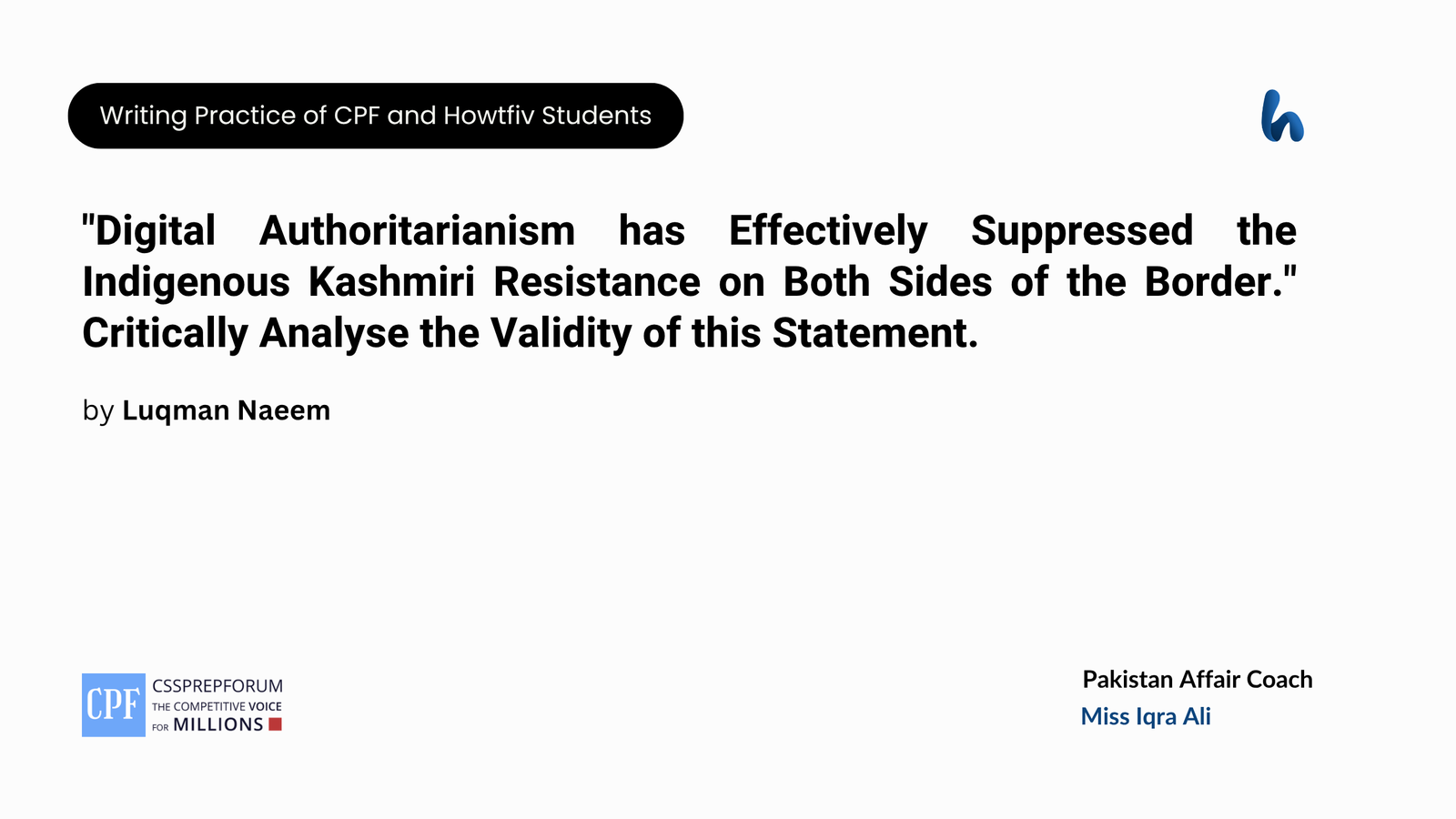
The following question of CSS Pakistan Affairs is solved by Luqman Naeem under the supervision of Howfiv’s Pakistan Affairs and Current Affairs Coaches: Miss Iqra Ali and Sir Ammar Hashmi. He learnt how to attempt 20 marks question and essay writing from Sir Syed Kazim Ali, Pakistan’s best CSS and PMS English essay and precis teacher with the highest success rate of his students. This solved question is attempted on the pattern taught by Sir to his students, scoring the highest marks in compulsory and optional subjects for years.

Outline
1- Introduction
2- Historical Background and Current Overview of the Kashmir Issue
3- Critical Analysis of Digital Authoritarianism, suppressing Kashmiri Resistance on Both Sides of the Border
- ✓Record Internet Blackout
- Evidence: Amnesty International Report on 2019 revocation: a complete 213-day blackout
- ✓Information Blockade
- Evidence: Information Technology (IT) Act, 2000 & Amendments: Section 69A allows the government to issue blocking orders for Flagged content.
- ✓Algorithmic Censorship
- Evidence: Amid the Phalagam crisis, massive pro-Kashmir accounts were blocked by India, Amnesty International 2026
- ✓Pervasive Cyber Surveillance
- Evidence: Aggressive activities of the Cyber Crime Coordination Centre, controlled by the DG police of an Indian state. Outlawed unauthorised VPNs
- ✓Telecom Services Suspension
- Evidence: Temporary Suspension of Telecom Services Rules (2017): It provides authorities the power to order total internet blackouts during periods of civil unrest.
- ✓Blocking Digital Access to Human Rights Organizations
- Evidence: Amnesty International Report on Multi-Month Shutdown, 2026: preventing social activists from avoiding data leakage of suppression
- ✓AI: a New Tool
- Evidence: CCTVs at main highways integrated with AI facial recognition in 2022 and doctored media to propagate the state’s narrative through deepfake and generative AI
- ✓Containment of Independent Digital Media
- Evidence: Section 505 of the Indian Penal Code with a penalty of 3 years in prison for sharing pro-Kashmiri content
- ✓Limited Space for Freedoms to Manoeuvre
- Evidence: The Unlawful Activities Prevention Act (UAPA), frequently weaponized to target online speech; it allows authorities to designate individuals as terrorists based on secret evidence. Journalists and activists are routinely charged under Section 13 for pro-Kashmir content
4-Conclusion

Introduction
The intersection of digital technology and state power has fundamentally reshaped the landscape of modern geopolitical conflicts, turning cyberspace into a primary battlefield for narrative control. The assertion that digital authoritarianism has effectively crushed the indigenous Kashmiri resistance across the volatile borderlands stands as a critically complex proposition. In an era where information flow defines political mobilization, the deployment of pervasive cyber-surveillance, algorithmic censorship, and prolonged infrastructural blackouts has drastically raised the cost of political dissent. These sophisticated digital strategies have undoubtedly succeeded in suppressing the visible, online expressions of resistance and severing local activists from global advocacy networks. However, equating the temporary containment of digital communication with the absolute eradication of a movement is an analytical miscalculation. The resistance in Kashmir is inherently deep-rooted, born out of decades of profound socio-political grievances and a historical struggle for self-determination rather than fleeting digital trends. When states weaponize digital landscapes to enforce compliance, the indigenous movement does not disappear; instead, it mutates, shifting toward resilient, low-tech, and subterranean modes of survival. Therefore, while digital authoritarianism has successfully masked the external symptoms of unrest on the global stage, it has simultaneously deepened the local population’s sense of alienation. Ultimately, technology acts as an amplifier rather than the source of resistance, meaning that high-tech suppression cannot permanently dissolve a struggle anchored in unresolved human and political rights.
Historical Background and Current Overview of the Kashmir Issue
The roots of the Kashmir conflict trace back to the 1947 partition of the British subcontinent. During this chaotic split, princely states were given the choice to join either India or Pakistan based on their geography and demographics. Kashmir, a Muslim-majority region ruled by a Hindu Maharaja, quickly became a flashpoint. Facing a local rebellion and tribal incursions, the ruler hastily signed an instrument of accession to India in exchange for military support. Furthermore, this decision instantly triggered the first Indo-Pakistani war, leading to a permanent United Nations-monitored ceasefire line that sliced the region into two heavily militarized zones. Today, Kashmir remains one of the world’s oldest unresolved disputes and a dangerous nuclear flashpoint. On one side, Indian-administered Jammu and Kashmir experienced a massive geopolitical shift in August 2019, when India revoked its special autonomous status, putting it under direct federal control amid tight security and communication lockouts. On the other side, Pakistan-administered Azad Kashmir continues to demand self-determination under UN resolutions. Decades of heavy militarization, political deadlocks, and frequent cross-border tensions have deeply strained relations between the two nuclear neighbours. More importantly, this ongoing territorial tug-of-war has taken a massive human toll, leaving generations of local Kashmiris trapped in a cycle of instability, restricted freedoms, and unfulfilled promises.
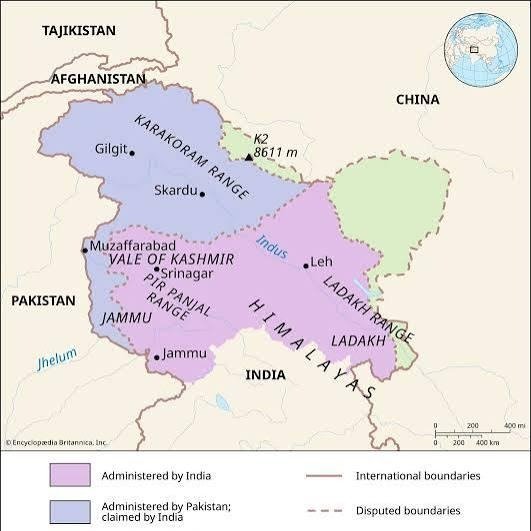
Map Showing Kashmir divided between Pakistan and India
Critical Analysis of Digital Authoritarianism, suppressing Kashmiri Resistance on Both Sides of the Border
- Record Internet Blackout
The revocation of Jammu and Kashmir’s special autonomous status in August 2019 marked a turning point in the region’s history, driven heavily by unprecedented digital suppression. To prevent public mobilization and control the narrative, Indian authorities enforced a total communications lockdown. According to an authoritative Amnesty International report, this blockade resulted in a complete 213-day internet blackout, setting a global record for the longest continuous internet shutdown imposed in a democratic country. This prolonged digital siege went far beyond blocking social media; it severed the primary lifeline of millions of ordinary citizens. Local businesses collapsed, healthcare services were severely disrupted, and students were completely cut off from educational resources, costing the local economy over $1 billion. More importantly, this blackout created an information vacuum that isolated Kashmiris from each other and the outside world. By disabling mobile networks and high-speed internet, the state effectively paralyzed the coordination of local civilian protests and human rights monitors. While this extreme measure successfully suppressed the visible, public signs of resistance during a critical geopolitical shift, it did not heal the underlying political wounds. Instead, the forced isolation deeply intensified the community’s sense of alienation, turning a temporary technological shutdown into a permanent symbol of structural grievance and heavy-handed state control.
- Information Blockade
The strategic deployment of information blockades serves as a primary pillar of digital authoritarianism along the contested border. Rather than relying solely on physical infrastructure shutdowns, authorities frequently use legal frameworks to surgically purge dissenting narratives from the digital sphere. A key instrument for this narrative control is Section 69A of India’s Information Technology (IT) Act, 2000, along with its subsequent stringent amendments. This specific legal provision empowers the central government to issue mandatory, confidential blocking orders to internet service providers and global social media corporations regarding any flagged content deemed a threat to national security or public order. Under the umbrella of Section 69A, thousands of pro-Kashmiri digital accounts, independent journalistic pages, and community hashtags have been systematically shadow-banned, geo-blocked, or permanently deleted. By criminalizing online political expression and forcing international tech giants to comply with state-directed censorship, this regulatory mechanism effectively sanitizes the digital ecosystem. Local tech users are left isolated, unable to access diverse viewpoints or share real-time human rights documentation with global audiences. Ultimately, these targeted legal blockades achieve a dual purpose: they erase indigenous regional grievances from international media feeds while creating an atmosphere of fear that forces digital self-censorship.
- Algorithmic Censorship
Algorithmic censorship marks a dangerous evolution in digital authoritarianism, shifting state control from visible infrastructure shutdowns to invisible code. By manipulating corporate platform algorithms, authorities can silently delete or suppress political narratives before they reach a global audience. Rather than removing content manually, automated systems are programmed to flag, shadow-ban, or completely block specific keywords, hashtags, and regional accounts linked to political mobilization. A striking manifestation of this mechanism occurred in the wake of the volatile security crisis in Pahalgam. According to human rights monitoring documentation, including updates reviewed by Amnesty International and digital rights observers, Indian authorities executed a massive, automated crackdown targeting thousands of pro-Kashmir social media accounts. Major international platforms complied with extensive government block directives, resulting in the sudden narrative erasure of local journalists, activists, and civilian users. This systematic purging creates an artificial informational vacuum, rendering local human rights violations invisible to the international community. By weaponizing algorithms, the state effectively automates the suppression of indigenous voices, forcing a climate of digital self-censorship where online dissent is penalised before it can even be published.
- Pervasive Cyber Surveillance
Pervasive cyber surveillance has transformed the regional digital landscape into a high-tech panopticon, stripping citizens of their fundamental right to digital privacy. This aggressive electronic policing is spearheaded by the specialized Cyber Crime Coordination Centre, operating under the direct control and command of the Director General of Police. This central hub deploys advanced data-scraping tools, metadata analysis, and digital tracking systems to monitor the online footprints, communications, and social connections of everyday citizens, journalists, and potential dissidents in real time. To ensure absolute monitoring and prevent any evasion of this electronic net, state authorities have officially outlawed the use of unauthorized Virtual Private Networks (VPNs). By criminalizing these vital encryption tools, the state leaves internet users exposed, making it virtually impossible to bypass domestic firewalls or communicate anonymously. The aggressive activities of this coordination center have effectively institutionalized a deep-seated culture of fear. Local youth and human rights activists face the constant threat of physical raids, arbitrary detentions, or formal charges based solely on their private chats or flagged social media likes. Ultimately, this intense cyber surveillance successfully suffocates the indigenous resistance by eliminating safe, anonymous spaces for digital coordination, forcing an absolute atmosphere of self-censorship across the population
- Telecom Services Suspension
The institutionalization of digital authoritarianism heavily relies on statutory frameworks that legalize the absolute control of communication infrastructure. A primary mechanism for this state-directed isolation is the Temporary Suspension of Telecom Services Rules, 2017. This specific legal framework empowers designated federal and regional home ministry authorities to order the immediate and total shutdown of mobile data, internet services, and telecommunications networks during periods of civil unrest or whenever a vaguely defined public safety threat is declared. By invoking these rules, state apparatuses can legally paralyze the digital nervous system of the entire population at a moment’s notice. The arbitrary implementation of these regulations turns what should be an extraordinary emergency measure into a routine administrative tool to preemptively stifle political assembly and indigenous resistance. When telecom services are suspended, local human rights defenders, journalists, and ordinary citizens are instantly cut off from emergency health services, digital banking, and global information networks. Ultimately, the 2017 telecom rules provide a permanent legal cover for creating intentional information blackouts, allowing the state to systematically suppress localized dissent, block the documentation of ground realities, and maintain absolute narrative control without judicial oversight.
- Blocking Digital Access to Human Rights Organizations
Digital authoritarianism along the borderlands extends far beyond monitoring local citizens; it systematically targets international oversight to prevent the global exposure of state actions. A primary strategy involves blocking digital access for independent global watchdogs, effectively severing their communication with local contacts. According to an Amnesty International report documenting a multi-month shutdown, state authorities deliberately blocked digital platforms and communication channels utilized by human rights organizations. This tactical digital blockade was specifically engineered to isolate social activists on the ground and prevent the outward leakage of documented data regarding state-sponsored suppression. By cutting off secure digital channels, the state creates a closed information ecosystem where localized abuses go unrecorded. Activists and field researchers find themselves unable to securely upload evidence, share eyewitness testimonies, or transmit real-time data regarding arbitrary detentions and crackdowns to international platforms. This deliberate blocking of human rights organizations acts as an informational shield for state forces, granting them near-total operational impunity. Ultimately, this multi-month digital isolation successfully disrupts the vital pipeline connecting local grassroots resistance with global advocacy networks, ensuring that structural violence remains invisible to international legal and diplomatic bodies.
- AI: a New Tool
The integration of Artificial Intelligence (AI) has introduced a dangerous new dimension to digital authoritarianism, transforming regional surveillance from a reactive tool into a predictive, automated weapon. Since 2022, state authorities have aggressively upgraded physical monitoring infrastructure by installing high-definition CCTV camera networks across all major highways and critical transit chokepoints. These cameras are fully integrated with AI-driven facial recognition software, allowing the state to track, identify, and log the real-time physical movements of activists, journalists, and ordinary citizens without their consent, effectively eliminating public anonymity. Beyond physical tracking, AI is being heavily weaponized in the cognitive domain to manipulate public perception and dismantle the indigenous narrative. State apparatuses deploy generative AI and deepfake technologies to create doctored media, fabricating highly realistic videos and audio recordings to defame local resistance leaders or distort historical facts. This synthetic content is systematically pushed through coordinated online networks to propagate the state’s official narrative while sowing internal confusion and distrust within the community. Ultimately, by combining omnipresent facial recognition with weaponized generative AI, the state has built a sophisticated digital matrix that not only physically monitors the population but actively manufactures consent and erases authentic political dissent.
- Containment of Independent Digital Media
The systematic containment of independent digital media serves as a foundational pillar of state-directed narrative control in the region. To completely dismantle the digital infrastructure of the indigenous resistance, authorities have heavily weaponized long-standing legal frameworks to criminalize independent online journalism and citizen reporting. A primary legal weapon used for this systemic media suppression is Section 505 of the Indian Penal Code, which deals with statements conducing to public mischief. Under this stringent provision, the state imposes severe penalties, including up to three years in prison, for individuals and digital media outlets found sharing or amplifying pro-Kashmiri content. By broadly interpreting Section 505, state authorities routinely classify independent reporting on local human rights violations, civilian protests, or political grievances as anti-state propaganda or threats to national security. This aggressive legal targeting has created an existential crisis for local digital journalists, editors, and social media commentators. Facing the immediate threat of arbitrary arrest, prolonged detention, and financial ruin, many independent digital outlets have been forced to permanently shut down or severely alter their editorial policies. Ultimately, the weaponization of Section 505 establishes a climate of absolute fear, institutionalizing pervasive self-censorship and ensuring that independent digital platforms cannot counter the state’s official narrative.
- Limited Space for Freedoms to Manoeuvre
The structural containment of digital expression reaches its peak through the weaponization of draconian anti-terror laws, which have severely restricted the space for political manoeuvrability. The primary legislative tool used to muzzle online dissent is the Unlawful Activities Prevention Act. This highly controversial framework grants state authorities the sweeping power to designate ordinary citizens, social activists, and independent journalists as terrorists based entirely on secret intelligence that is withheld from the public and the accused, making legal defence nearly impossible. Under this legal dragnet, local journalists and human rights defenders are routinely targeted and booked under Section 13 of the UAPA for merely creating, sharing, or liking pro-Kashmiri content online. By equating peaceful political expression and independent digital reporting with incitement to terrorism, the state has effectively criminalized the documentation of ground realities. The broad application of the UAPA carries severe consequences, including prolonged pre-trial detention without bail, which destroys the personal and professional lives of those accused. Ultimately, this aggressive weaponization of anti-terror legislation eliminates any remaining safe spaces for digital advocacy, creating an overwhelming atmosphere of fear that forces total compliance and silences the indigenous narrative.
Conclusion
In conclusion, the assertion that digital authoritarianism has effectively suppressed the indigenous Kashmiri resistance through a sophisticated matrix of record-breaking communication blackouts, aggressive legal blockades under frameworks like Section 69A of the IT Act, automated algorithmic censorship, and pervasive surveillance centers states has undeniably paralyzed the visible digital ecosystem. These measures have effectively raised the cost of cyber-activism, induced widespread self-censorship, and temporarily severed the vital pipeline connecting local human rights defenders with international oversight bodies. However, mistaking the enforced silence of digital spaces for the absolute erasure of a historical movement represents a fundamental analytical error. Because the Kashmiri struggle is rooted in deep-seated political, socio-economic, and human rights grievances rather than internet trends, it possesses an organic resilience that technology cannot easily dissolve. Shutting down the digital landscape has merely forced the indigenous movement to adapt, mutate, and revert to subterranean, low-tech methods of survival and coordination. Ultimately, while digital authoritarianism has proven highly efficient as a tactical mechanism to hide unrest from global screens, it remains structurally incapable of resolving the underlying conflict. Far from crushing the resistance, high-tech suppression has intensified local alienation, proving that digital walls cannot permanently contain a deeply rooted human struggle for self-determination.
Answer to the Question

CSS Solved Past Papers’ Essays
Looking for the last ten years of CSS and PMS Solved Essays and want to know how Sir Kazim’s students write and score the highest marks in the essays’ papers? Then, click on the CSS Solved Essays to start reading them.
CSS Solved Essays
CSS Solved Islamiyat Past Papers
Want to read the last ten years’ Islamiyat Solved Past Papers to learn how to attempt them and to score high? Let’s click on the link below to read them all freely. All past papers have been solved by Pakistan’s top CSS Islamiyat coaches having the highest score of their students.
CSS Solved Islamiyat
CSS Solved General Science & Ability Past Papers
Want to read the last ten years’ General Science & Ability Solved Past Papers to learn how to attempt them and to score high? Let’s click on the link below to read them all freely. All past papers have been solved by Pakistan’s top CSS GSA coachez having the highest score of their students.
CSS Solved General Science & Ability
CSS Solved Pakistan Affairs Past Papers
Want to read the last fifteen years’ Pakistan Affairs Solved Past Papers to learn how to attempt them and to score high? Let’s click on the link below to read them all freely. All past papers have been solved by Pakistan’s top CSS Pakistan Affairs coaches having the highest score of their students.
CSS Solved Pakistan Affairs
CSS Solved Current Affairs Past Papers
Want to read the last fifteen years’ Current Affairs Solved Past Papers to learn how to attempt them and to score high? Let’s click on the link below to read them all freely. All past papers have been solved by Pakistan’s top CSS Current Affairs coaches having the highest score of their students.
CSS Solved Current Affairs