Understand World-Systems Theory, economic power structures, and core–periphery relationships through Pakistan’s economy and current affairs.
Why do some countries control advanced technology, global finance, and major industries, while others struggle with debt, limited exports, and dependence on imported goods? The answer lies partly in how economic power is distributed across the global system. World-Systems Theory explains why countries participate in the same global economy but do not enjoy equal benefits from it.
Developed by sociologist Immanuel Wallerstein, the theory views the world as an interconnected capitalist economy in which countries occupy different economic positions. Some specialise in high-value industries and control technology and finance, while others depend more heavily on raw materials, low-value production, or external financing. These relationships can reinforce global inequality and make economic development more difficult for less industrialised countries.
For CSS and PMS aspirants, World-Systems Theory provides a useful way to analyse Pakistan’s export structure, external financing, relations with major economic powers, and efforts to achieve sustainable growth. Its two important concepts, economic power structures and core-periphery relationships, help explain why development depends not only on domestic resources but also on a country’s position in the global economy.
Understanding World-Systems Theory
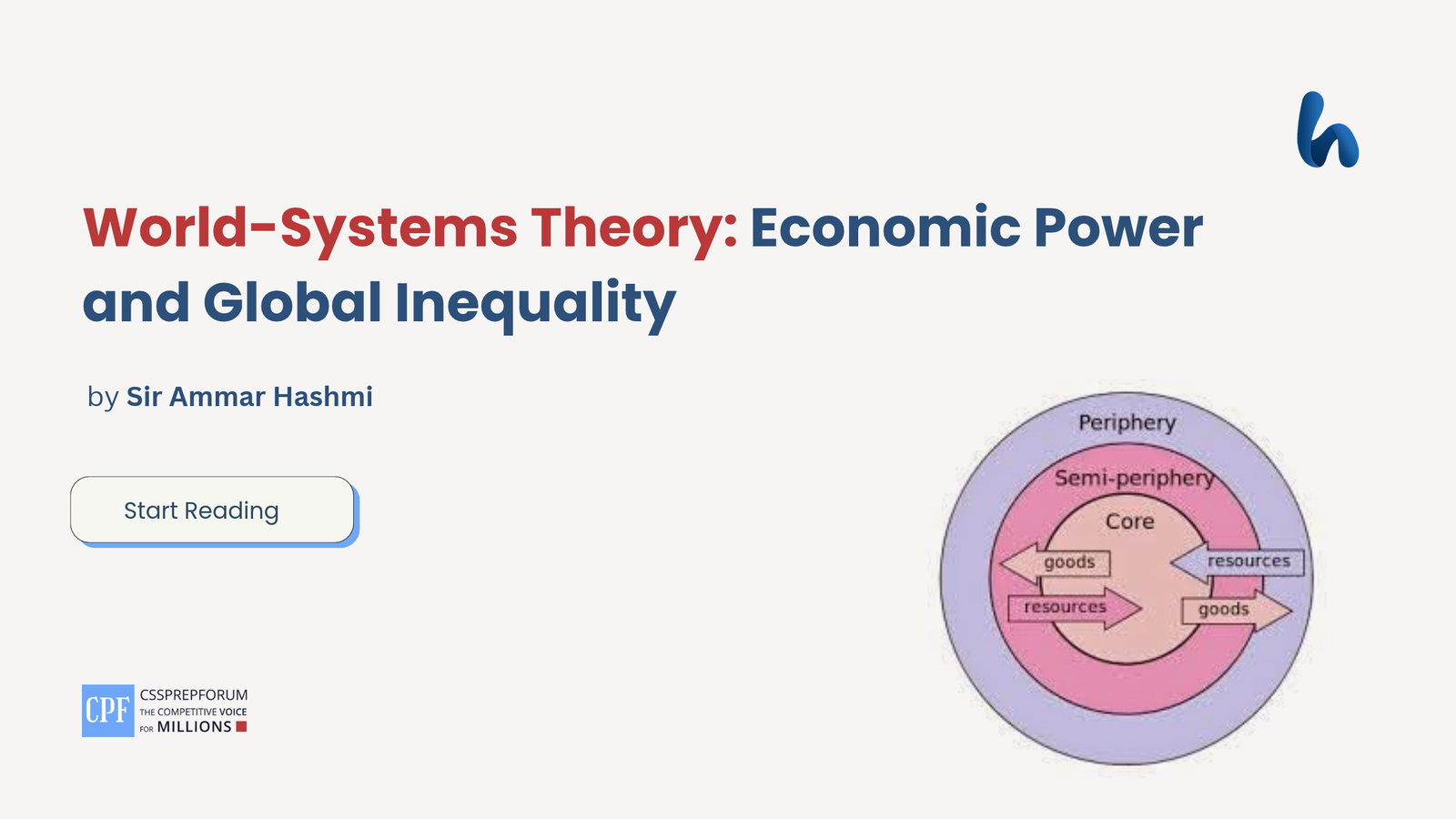
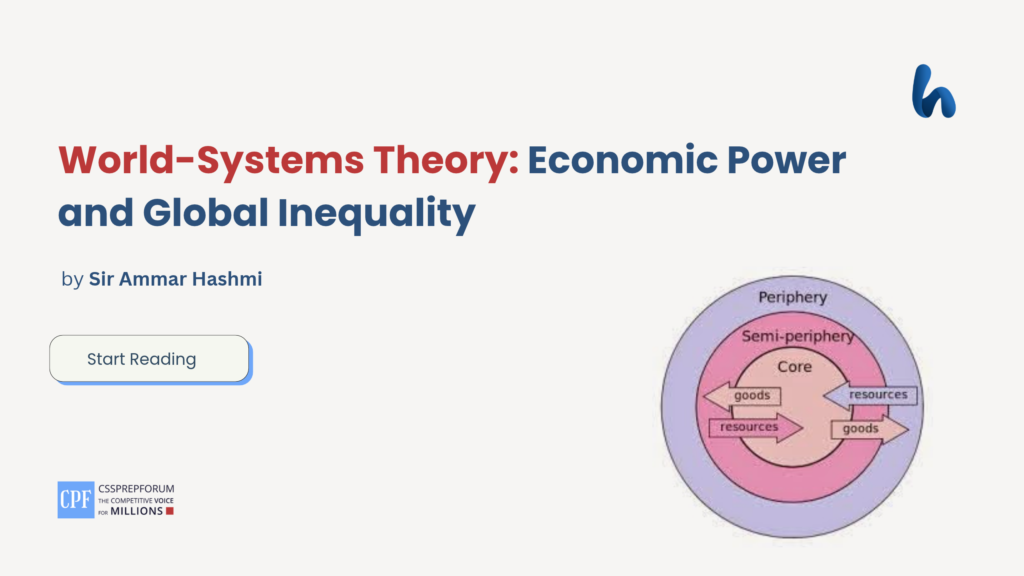
Wallerstein divided the global economy into three broad categories: core, semi-periphery, and periphery. These categories describe how countries participate in international production, trade, finance, and technology. They are not simply geographical labels, nor are they permanent classifications.
Core countries generally possess advanced industries, influential financial institutions, powerful multinational companies, and valuable technologies. The United States and Germany are commonly used as examples because of their strong industrial, financial, and technological capabilities. Semi-peripheral countries, such as Brazil and Türkiye, combine industrial strengths with continued dependence on more powerful economies in certain sectors. Peripheral economies tend to have less control over finance and technology and may depend more heavily on primary commodities or lower-value production.
Pakistan can be analysed through this framework, particularly in relation to its export concentration and external financing needs. However, it would be inaccurate to classify the country as peripheral in every sector. Its textile industry, agricultural production, and growing digital services have different strengths and limitations.
Economic Power Structures: Who Controls the Global Economy?
Economic power is not determined by the size of a country’s economy alone. It also depends on who controls technology, finance, markets, and the most profitable stages of production. Countries that dominate these areas can influence prices, investment decisions, and the conditions under which other economies participate in global trade.
Consider the example of a cotton shirt. One country grows the cotton, another turns it into fabric and clothing, while a company elsewhere designs the product, owns the brand, and sells it internationally. Although several countries contribute to production, they may not receive equal returns. Businesses controlling advanced technology, branding, and distribution can capture a substantial share of the final value.
This illustrates a central argument of World-Systems Theory: the position a country occupies in global production can influence how much wealth it generates and retains. Countries that move towards research, advanced manufacturing, and higher-value services may gain more economic opportunities than those that remain concentrated in low-value activities.
Pakistan’s export structure: A challenge of value addition
Pakistan’s export structure provides a practical example of this argument. According to the Pakistan Economic Survey 2025-26, textile and apparel exports reached approximately US$13.58 billion during July-March FY2026, accounting for 59.7% of the country’s total exports during those nine months. Total exports declined by 8% compared with the same period of the previous fiscal year, while textile and apparel exports fell by 0.5%. These figures cover nine months, not the full financial year.
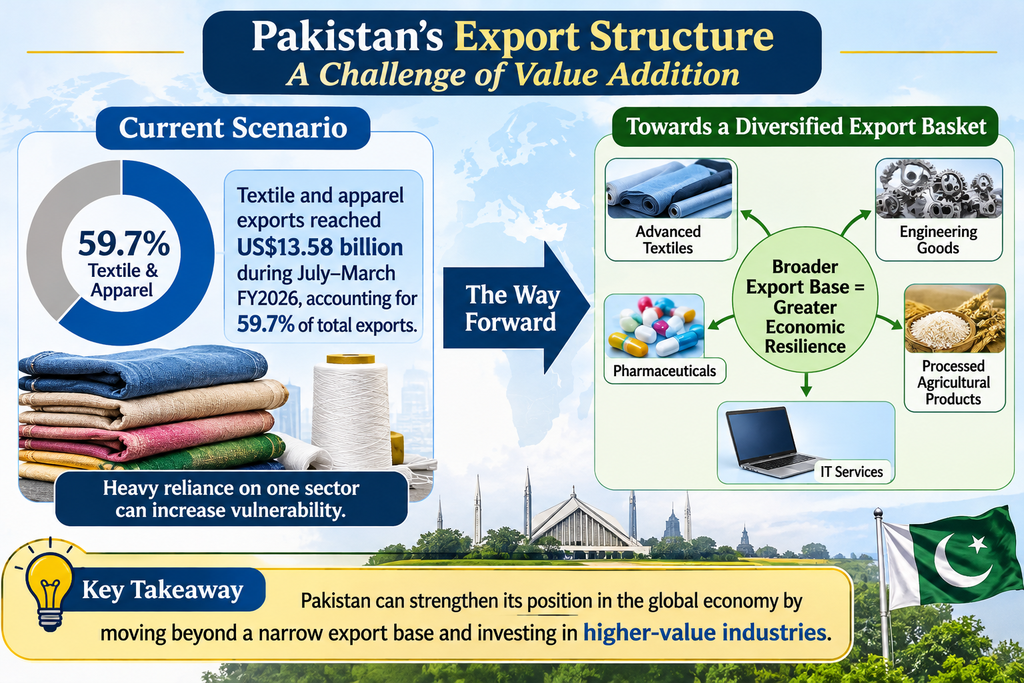
Pakistan’s export structure: Heavy reliance on textiles highlights the need for export diversification and greater investment in higher-value industries.
This concentration makes Pakistan vulnerable to changes in international demand, production costs, and competition. Although the textile industry provides employment and export earnings, the country can strengthen its position by moving towards advanced textiles, better product design, stronger brands, and improved processing. Expanding engineering goods, pharmaceuticals, processed agricultural products, and information technology services can also help diversify export earnings.
The issue, therefore, is not that textile exports are undesirable. Rather, Pakistan needs to retain more value from existing industries while developing new areas of production. This is how World-Systems Theory helps aspirants connect economic power with Pakistan’s long-term development challenges.
Core-Periphery Relationships: Why Does Global Inequality Persist?
Core-periphery relationships explain how unequal economic positions can reinforce one another. Economies with advanced industries often have better access to technology, finance, and international markets. Countries with weaker industrial bases may depend on imported machinery, foreign investment, or external borrowing to sustain economic activity.
Three mechanisms help explain this relationship.
- First, unequal value chains can allow firms controlling technology, branding, and distribution to earn more than those supplying raw materials or performing basic manufacturing.
- Second, dependence on imports can expose domestic industries to rising costs when exchange rates weaken, or international supply chains are disrupted.
- Third, external financing pressures can limit economic choices when a country repeatedly needs foreign exchange to meet its international payment obligations.
These mechanisms can reinforce one another. Limited industrial capacity may restrict export earnings, weak export earnings can increase pressure on foreign exchange, and financing difficulties may constrain investment in new industries. Nevertheless, these outcomes are not inevitable. Countries can improve their position through education, technological development, productive investment, and effective economic policies.
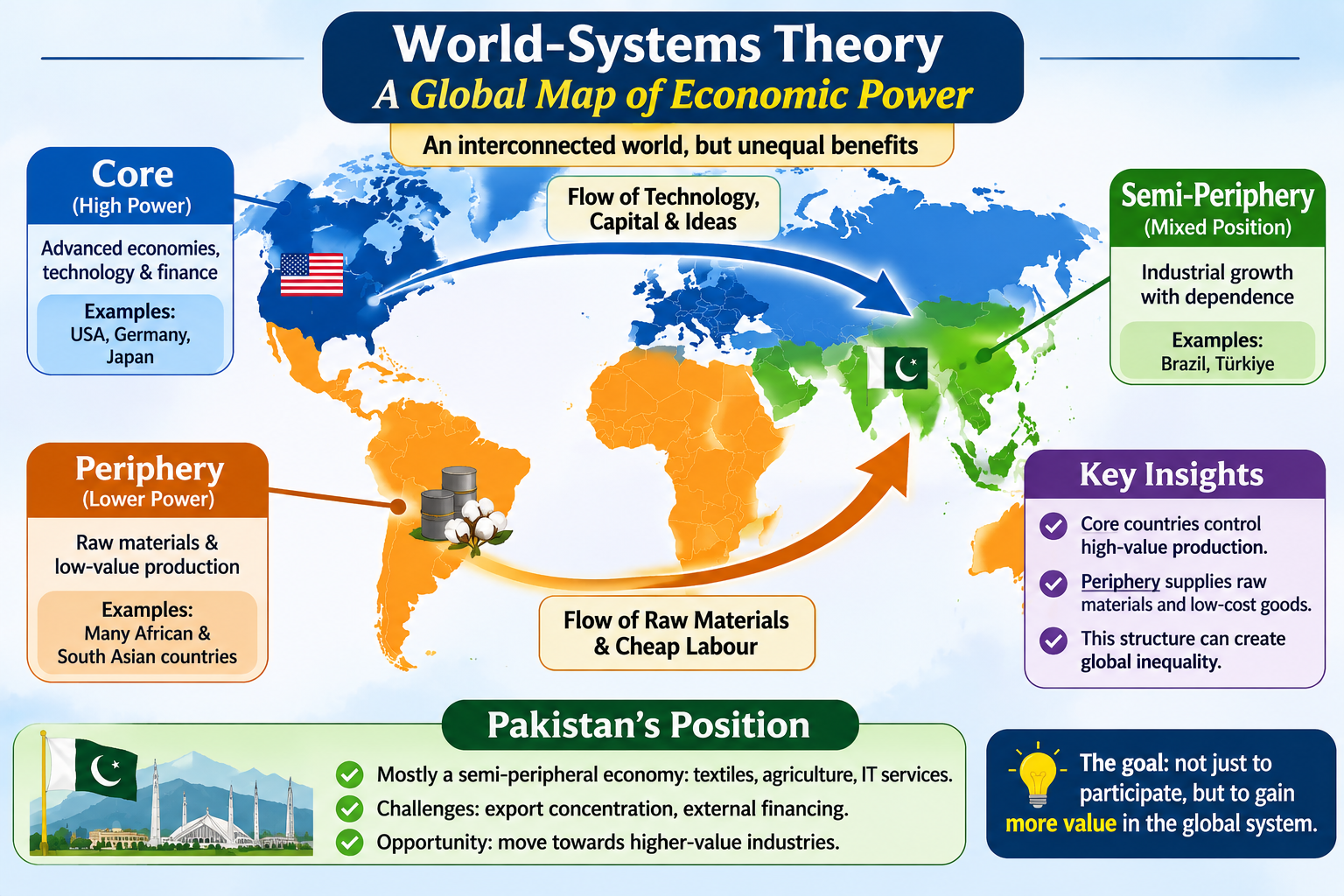
World-Systems Theory: How economic power, technology, capital, raw materials, and labour move between core, semi-peripheral, and peripheral economies.
Pakistan’s IMF programme: External financing and economic choices
Pakistan’s relationship with the International Monetary Fund provides a useful case study. On 7 October 2026, the IMF announced a staff-level agreement with Pakistan on the fourth review of its Extended Fund Facility and the third review of its Resilience and Sustainability Facility. The agreement was still subject to approval by the IMF Executive Board.
From the perspective of World-Systems Theory, Pakistan’s recurring financing needs raise important questions about its position in the global economy. Why does the country struggle to generate sufficient foreign exchange? How can it increase exports and domestic productivity? And how can external financing support long-term development rather than merely address immediate pressures?
These questions should not lead to the conclusion that international lenders are solely responsible for Pakistan’s economic difficulties. Domestic fiscal weaknesses, low productivity, limited export diversification, and policy uncertainty also contribute. IMF financing can provide support during financial difficulties, but sustainable progress requires a stronger productive economy capable of generating exports, employment, and investment.
Pakistan and China: Can Foreign Investment Strengthen Economic Independence?
The China-Pakistan Economic Corridor (CPEC) provides another useful application of World-Systems Theory. Its infrastructure and energy projects offer opportunities to improve connectivity and support economic activity. However, the long-term value of foreign investment depends on what it enables the host country to produce.
For Pakistan, the important questions concern the wider economic effects of these projects. Does improved infrastructure reduce transport and production costs? Are local workers gaining technical skills? Are domestic firms becoming more competitive? Does investment help Pakistani businesses produce higher-value goods for export?
If investment improves industrial productivity, develops local skills, and strengthens export capacity, it can help Pakistan improve its position in the global economy. If these wider benefits remain limited, infrastructure investment alone may not transform the country’s productive structure.
This analysis does not assume that China is exploiting Pakistan. Instead, it applies the theory to assess the distribution of benefits, costs, risks, and bargaining power within an economic relationship. The same approach can be used to examine Pakistan’s partnerships with other countries.
Current Affairs: Can Pakistan Move Beyond Economic Stabilisation?
Pakistan’s recent economic performance illustrates the difference between stabilisation and structural transformation. The World Bank’s Pakistan Development Update, published on 22 October 2026, reported that real GDP growth increased to 3.7% in FY2026 from 3.2% in FY2025. It also emphasised that deeper structural reforms would be necessary to support sustained growth.
Economic stabilisation can reduce immediate pressures, but it does not automatically create competitive industries or high-quality employment. For Pakistan to improve its position in the global economy, it needs to strengthen the foundations of production and exports.
Several priorities follow from this analysis. Pakistan needs to diversify exports, improve industrial productivity, develop technical and digital skills, attract productive investment, and strengthen institutions. It must also ensure that infrastructure and financing support activities that generate long-term economic value. These measures can help the country benefit more from international trade and investment while reducing its vulnerability to external shocks.
Other Applications in Current Affairs
World-Systems Theory is also useful for analysing global trade competition. Changes in tariffs, subsidies, and market requirements can create opportunities for some countries while putting pressure on others. Pakistan needs competitive industries that can respond to these changes and meet international standards.
The digital economy provides another example. Countries with strong technological skills, research capacity, and digital businesses can participate in higher-value services. Pakistan can benefit from this opportunity by improving technical education, digital infrastructure, and access to international markets.
Climate finance also reflects unequal economic capabilities. Countries differ in their resources to prepare for disasters, adapt to climate change, and finance recovery. Pakistan therefore needs international cooperation and climate finance alongside effective domestic planning and resilient infrastructure. In each case, the theory encourages aspirants to examine the distribution of resources, opportunities, and bargaining power. However, it should be combined with evidence about the specific issue rather than used as a complete explanation for every international development.
Criticisms of World-Systems Theory
Although World-Systems Theory offers a useful explanation of global inequality, it has limitations. It can overemphasise external economic structures while giving insufficient attention to domestic governance, education, taxation, and policy decisions. Countries facing similar international conditions can achieve different outcomes because their institutions and development strategies differ.
The theory’s categories can also be too broad. A country may possess advanced industries in one sector while remaining dependent on foreign technology in another. Furthermore, international trade, investment, and financing can support development when countries manage them effectively.
Pakistan’s economic challenges, therefore, cannot be explained by global inequality alone. Domestic reforms, productive investment, institutional capacity, and policy implementation also shape its development prospects. A balanced analysis must examine both international constraints and domestic responsibilities.
How to Apply World-Systems Theory in CSS and PMS Answers
A strong answer should explain the theory, support the argument with evidence, and assess possible solutions. Aspirants can follow four steps
- Identify the global structure: Explain who controls technology, finance, markets, or high-value production.
- Connect it to Pakistan: Use a relevant example, such as textile exports, external financing, or CPEC.
- Analyse the consequences: Explain how the relationship affects employment, exports, economic choices, or industrial growth.
- Evaluate the response: Recommend realistic reforms while considering both international constraints and domestic weaknesses.
For example, when answering a question about Pakistan’s economic sovereignty, do not simply describe the country as peripheral. Explain how export concentration can contribute to foreign-exchange pressures, discuss the role of domestic economic policies, and suggest ways to strengthen productive capacity. This approach produces a more analytical answer than relying on theory alone.
Practice questions
- How does World-Systems Theory explain global economic inequality?
- Examine Pakistan’s export structure through the lens of core-periphery relationships.
- Does dependence on external financing limit economic sovereignty? Discuss with reference to Pakistan.
- How can Pakistan gain greater value from international trade and investment?
Conclusion
World-Systems Theory explains why countries do not benefit equally from the global economy. Control over technology, finance, markets, and high-value production can give some economies lasting advantages, while others face greater challenges in developing competitive industries.
For Pakistan, the lesson is not to withdraw from the global economy or blame every problem on powerful countries. Instead, the country needs to use international trade, investment, and cooperation to strengthen domestic production, diversify exports, improve skills, and create sustainable economic opportunities. Pakistan’s long-term progress will depend on moving beyond repeated economic stabilisation towards productive growth and greater economic resilience.
Important Note for CSS and PMS Aspirants
For aspirants preparing for competitive examinations, exploring solved past papers is essential to understand examiner expectations, analytical answer writing, and paper trends. Therefore, candidates are strongly encouraged to read the following comprehensive solved papers available on CSSPREPFORUM.
- CSS Solved Pakistan Affairs Past Papers
- CSS Solved Current Affairs Past Papers
- CSS Solved Islamiat Past Papers
- CSS Solved General Science and Ability Past Papers
Moreover, aspirants searching for the most credible and result-oriented teachers for CSS and PMS preparation can benefit from the following detailed guidance articles
- Who is the Best CSS PMS Islamiat Teacher in Pakistan?
- Who is the Best CSS PMS Pakistan Affairs Teacher in Pakistan?
- Who is the Best CSS Current Affairs Teacher in Pakistan?
- Who is the Best CSS GSA Teacher in Pakistan?
- Who is the Best CSS PMS English Essay and Precis Teacher in Pakistan?
- Who is the Best English Grammar Teacher in Pakistan?