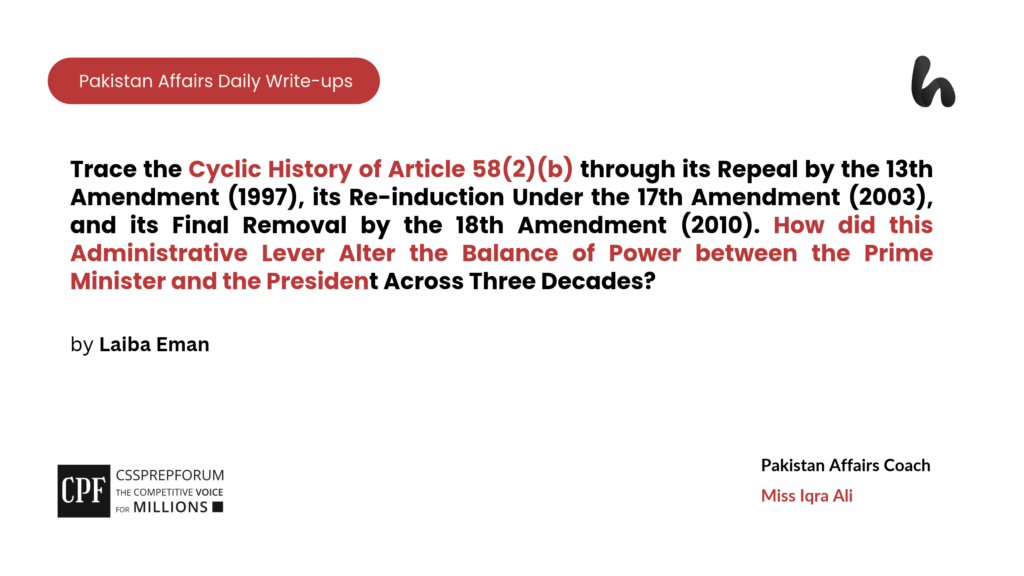
The following assignment question for CSS Pakistan Affairs is solved by Laiba Eman under the supervision of Howfiv’s Pakistan Affairs and Current Affairs Coaches: Miss Iqra Ali and Sir Ammar Hashmi. She learnt how to attempt 20 marks question and essay writing from Sir Syed Kazim Ali, Pakistan’s best CSS and PMS English essay and precis teacher with the highest success rate of his students. This solved question is attempted on the pattern taught by Sir to his students, scoring the highest marks in compulsory and optional subjects for years.

Outline
1- Introduction
2– Establishment and Removal of Article 58 (2)(b): A Cyclic History
3- How Did This Article Alter the Balance of Power Between the Prime Minister and the President across Three Decades?
- 1973 – 1985: The Period of Original Parliamentary Balance
- 1985 – 1997: The Era of Powerful President in Semi-Presidential System
- 1997 – 1999: The Duration of Restoration of Parliamentary Spirit
- 1999 – 2010: The Phase of Revival of Presidential Authority
- 2010 – Onwards: An Epoch of Return of Parliamentary Supremacy
4- Critical Analysis
5- Conclusion
Answer to the Question
Introduction
An examination of the Pakistan’s constitutional history reveals several steps that damaged the already fragile democratic structure. The third Constitution of Pakistan, implemented in 1973, introduced parliamentary system with President as a ceremonial head; however, the third martial law suspended the constitution on 5th July 1977 and the balance of power once again shifted to a dictator, the General Zia ul Haq. Zia restored constitution, became president through a fraud referendum, and introduced notorious 8th amendment in the constitution in 1985. Under the amendment, Article 58 (2)(b) had been introduced that give the president discretionary powers to dissolve the National Assembly of Pakistan and dismiss the elected governments. Through this Article, four governments had been removed in a decade. The musical chair of governments and frequent change of PMs had made Pakistan internally and externally vulnerable. Following that, the parliamentary spirit had been revived when article 58 (2)(b) was removed through 13th amendment; however, this success did not last for a long time as the 4th martial law suspended constitution and reintroduced the Article though 17th amendment. The history repeated itself; a strong president ruled the country with hand-picked governments. Finally, this article was permanently removed in the landmark 18th amendment. The Article 58 (2)(b) proved to be the “sword of Damocles” for Parliament. Although, its permanent removal through 18th amendment has strengthen democratic culture in Pakistan, the damage it has done to the power-sharing mechanism has not yet cured completely.
Establishment and Removal of Article 58 (2)(b): A Cyclic History
Article 58 (2)(b) was the historic provision in the constitution of Pakistan that empowered President to unilaterally dissolve the national assembly and dismiss the Prime Minister. It was first introduced by general Zia-Ul-Haq in 1985 under 8th amendment that shifted Pakistan’s system to a semi-presidential regime. The president can invoke this Clause if in his discretion a federal government could no longer function in accordance with the constitution, and a new appeal to the electorate was necessary. This article was misused by president for personal gains; four elected governments were dismissed in a decade using the article. Although article was removed through 13th amendment by civilian government, it was reintroduced by another military dictator through 17th amendment. Finally, under 18th amendment, first, all the ways to martial law were closed by amending article 6 that now declared suspension, abrogation, and conspiracy to suspend or abrogate constitution as a crime subject to heigh treason. After closing the doors to martial law, the article 58 (2)(b) was also removed and Pakistan regained its parliamentary spirit. The 18th amendment has closed a very dark chapter of the constitutional history of Pakistan. However, its aftershocks are still affecting Pakistan political system.
How Did This Article Alter the Balance of Power Between the Prime Minister and the President across Three Decades?
- 1973 – 1985: The Period of Original Parliamentary Balance
The 1973’s Constitution of Pakistan establishes a parliamentary democracy where executive authority is concentrated in the Prime Minister, making the President a ceremonial Head of State. As the real executive, the Prime Minister is the head of the federal government and leader of the majority in the National Assembly. The Prime Minister appoints the cabinet and controls the day-to-day administration of the state. On the other hand, the President is primarily a figurehead who must act on and in accordance with the binding advice of the Prime Minister. Moreover, the President appoints the Prime Minister, but he is constitutionally bound to appoint the Member of the National Assembly who commands the confidence and majority support of the house. The president did not hold the unilateral power to dismiss the 1973 constitution; the Constitution reserved power for the elected representatives of the state to establish a strong democratic and participatory Governance structure. However, successive military and political regimes altered this dynamic.
- 1985 – 1997: The Era of Powerful President in Semi-Presidential System
The 1985 Eighth Amendment shifted Pakistan’s government from a pure parliamentary system to a semi-presidential one. It heavily tilted the balance of power in favor of the President by giving them unilateral authority to appoint key officials, dismiss the Prime Minister, and dissolve the National Assembly under Article 58(2)(b). This power shift allowed the President to arbitrarily dissolve the lower house of parliament and fire the Prime Minister if, in his opinion, the government could not be run in accordance with the Constitution. Moreover, the President gained significant autonomy in appointing the services chiefs and provincial governors. Although the original 1973 text defined the Prime Minister as the “Chief Executive,” this amendment redefined the executive authority so that the Prime Minister operated in a more subordinate, check-and-balance relationship with the presidency. These sweeping presidential powers created irreversible damage to Pakistan. were later repealed by the Thirteenth Amendment in 1997.
- 1997 – 1999: The Duration of Restoration of Parliamentary Spirit
Experiencing the horrors of 58 (2)(b), the civilian government enacted13th Amendment in 1997 that restored the original parliamentary spirit of the 1973 Constitution by decisively shifting the balance of power to the Prime Minister. It stripped the President of discretionary powers to dissolve the National Assembly and diminished their unilateral authority over key appointments. The amendment abolished Article 58(2)(b); the President lost the authority to dissolve the federal cabinet without the Prime Minister’s advice. He was bound to act strictly on the advice of the Prime Minister for appointments such as the Chairman of the Joint Chiefs of Staff Committee and the services chiefs. Moreover, under the amendment, Provincial governors could no longer be appointed or removed at the President’s discretion; this power was transferred directly to the Prime Minister. Following the 13th Amendment, the President essentially became a ceremonial Head of State, leaving executive, legislative, and administrative dominance firmly in the hands of the Prime Minister.
- 1999 – 2010: The Phase of Revival of Presidential Authority
Unfortunately, on October 12,1999, another military dictator ousted the elected government of its power and to tighten his grip on power, he introduced the 17th Amendment in the constitution. The amendment retained the President’s sweeping powers to dissolve the National Assembly and dismiss the Prime Minister under Article 58(2)(b), but subjected them to mandatory Supreme Court review. While the Prime Minister served as the chief executive, the President retained ultimate overriding authority over the legislature. Following this amendment, the balance of power shifted to the president as he held the unilateral discretion to dissolve the National Assembly, effectively dismissing the Prime Minister. The amendment attempted to establish a check by requiring the Supreme Court to approve this action, though judicial independence remained heavily contested during this era. The Prime Minister retained executive authority over internal and foreign policy but was legally obligated to keep the President informed on all major matters. In practice, the Prime Minister functioned under the shadow of the President’s dismissal powers. This hybrid arrangement effectively created a semi-presidential system, which ultimately remained in place until the 18th Amendment in 2010 restored the original parliamentary spirit by stripping the President of these powers and transferring them to the Prime Minister.
- 2010 – Onwards: An Epoch of Return of Parliamentary Supremacy
The 18th Amendment stripped the President of discretionary executive powers and restored his role as a ceremonial head of state. It solidified absolute executive authority in the Prime Minister. The President’s power to unilaterally dissolve the National Assembly under Article 58(2)(b) was completely abolished, ensuring parliamentary stability. Currently, the President is constitutionally bound to act on the Prime Minister’s advice in all matters. Moreover, the amendment removed President’s authority to independently appoint provincial governors, services chiefs, and the chief election commissioner. These appointments are now made on the binding advice of the Prime Minister. The President can no longer declare a state of emergency unilaterally without the Prime Minister’s approval. The Prime Minister is only required to “keep the President informed” on policy matters, replacing former consultation mandates.
Critical Analysis
Article 58(2)(b) fundamentally transformed Pakistan’s constitutional architecture by replacing the spirit of parliamentary sovereignty with an executive imbalance that empowered an unelected president over an elected prime minister. Although its proponents like Pervaiz Musharaff justified the provision as a necessary system of checks and balances to prevent the return of corruption, poor governance, and institutional collapse, its practical application demonstrated that it became a political instrument rather than an accountability mechanism. Between 1988 and 1996, successive presidents repeatedly dissolved elected governments, preventing democratic institutions from completing their constitutional tenure and weakening political parties, parliament, and civilian supremacy. The multiple interventions in parliamentary system have corrupted the power sharing mechanism so much that could not be completely cured through the 18th amendment. For instance, the complete concentration of executive authority in the Prime Minister after the 18th Amendment has also generated concerns regarding excessive centralization of power and weaker institutional checks within the parliamentary system. Therefore, Pakistan’s constitutional experience suggests that democratic stability depends neither on presidential dominance nor unchecked prime ministerial authority, but on strong constitutional institutions, judicial independence, parliamentary accountability, and an unwavering commitment to constitutionalism.
Conclusion:
In conclusion, Article 58(2)(b) remained one of the most controversial constitutional provisions in Pakistan’s democratic history because it repeatedly altered the balance of power between the President and the Prime Minister. Introduced through the Eighth Amendment, removed by the Thirteenth Amendment, revived under the Seventeenth Amendment, and finally abolished through the landmark Eighteenth Amendment, its constitutional journey reflects Pakistan’s prolonged struggle between authoritarian intervention and parliamentary democracy. Although its permanent removal restored parliamentary supremacy and reduced presidential interference in elected governments, sustainable democratic governance ultimately depends on strengthening constitutional institutions, political maturity, judicial impartiality, and respect for the democratic mandate rather than redistributing constitutional powers.

CSS Solved Past Papers’ Essays
Looking for the last ten years of CSS and PMS Solved Essays and want to know how Sir Kazim’s students write and score the highest marks in the essays’ papers? Then, click on the CSS Solved Essays to start reading them.
CSS Solved Essays
CSS Solved Islamiyat Past Papers
Want to read the last ten years’ Islamiyat Solved Past Papers to learn how to attempt them and to score high? Let’s click on the link below to read them all freely. All past papers have been solved by Pakistan’s top CSS Islamiyat coaches having the highest score of their students.
CSS Solved Islamiyat
CSS Solved General Science & Ability Past Papers
Want to read the last ten years’ General Science & Ability Solved Past Papers to learn how to attempt them and to score high? Let’s click on the link below to read them all freely. All past papers have been solved by Pakistan’s top CSS GSA coachez having the highest score of their students.
CSS Solved General Science & Ability
CSS Solved Pakistan Affairs Past Papers
Want to read the last fifteen years’ Pakistan Affairs Solved Past Papers to learn how to attempt them and to score high? Let’s click on the link below to read them all freely. All past papers have been solved by Pakistan’s top CSS Pakistan Affairs coaches having the highest score of their students.
CSS Solved Pakistan Affairs
CSS Solved Current Affairs Past Papers
Want to read the last fifteen years’ Current Affairs Solved Past Papers to learn how to attempt them and to score high? Let’s click on the link below to read them all freely. All past papers have been solved by Pakistan’s top CSS Current Affairs coaches having the highest score of their students.
CSS Solved Current Affairs