CSS Pakistan Affairs | How Pakistan Can Reform Its Agricultural Sector
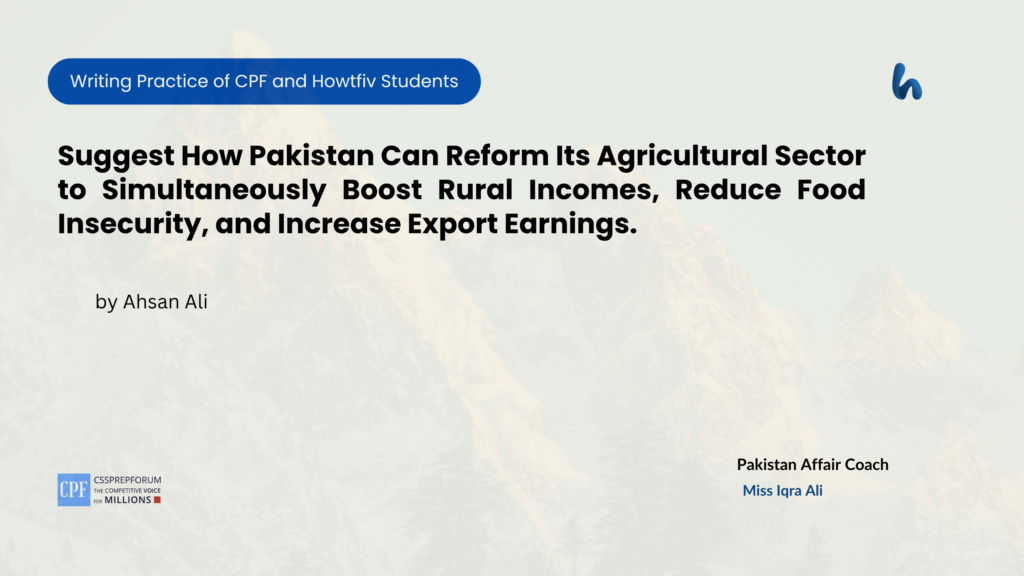
The following question of CSS Pakistan Affairs is solved by Ahsan Ali under the supervision of Howfiv’s Pakistan Affairs and Current Affairs Coaches: Miss Iqra Ali and Sir Ammar Hashmir. She learnt how to attempt 20 marks question and essay writing from Sir Syed Kazim Ali, Pakistan’s best CSS and PMS English essay and precis teacher with the highest success rate of his students. This solved question is attempted on the pattern taught by Sir to his students, scoring the highest marks in compulsory and optional subjects for years.

Outline
1- Introduction
2- How Pakistan Can Boost Rural Incomes Through Agricultural Reforms
- a. Land Reforms and Equitable Distribution of Agricultural Resources
- b. Expanding Agricultural Credit and Farmer Financial Support
- c. Mechanization and Technological Modernization of Agriculture
3- How Pakistan Can Reduce Food Insecurity Through Agricultural Reforms
- a. Irrigation Reforms and Efficient Water Resource Management
- b. Crop Diversification and Climate-Resilient Agricultural Practices
- c. Strengthening Storage Infrastructure and Food Supply Chains
4- How Pakistan Can Increase Export Earnings Through Agricultural Reforms
- a. Developing Value-Added Agro-Based Industries
- b. Improving Quality Standards and Global Competitiveness
- c. Diversifying Agricultural Export Markets and Trade Networks
5- Critical Analysis
6- Conclusion

Answer to the Question
Introduction
Agriculture remains the backbone of Pakistan’s economy and is central to the country’s economic stability and development. The sector plays a vital role in providing employment opportunities, ensuring food availability, and generating export revenue for national growth. According to the Pakistan Bureau of Statistics, agriculture contributes nearly 23% to Pakistan’s GDP and employs approximately 37% of the national labor force. This highlights that the performance of the agricultural sector directly determines the economic wellbeing of millions of rural households and the country’s food and trade security. Therefore, comprehensive agricultural reforms are essential for Pakistan to achieve sustainable growth, food security, and stronger export competitiveness.
How Pakistan Can Boost Rural Incomes Through Agricultural Reforms
- a. Land Reforms and Equitable Distribution of Agricultural Resources
Unequal land ownership remains one of the biggest structural barriers to rural prosperity in Pakistan. Large landholdings concentrated among a small elite prevent small farmers from accessing productive resources and benefiting fairly from agricultural growth. According to the Food and Agriculture Organization, nearly 80% of farms in Pakistan are small holdings, yet a major share of agricultural land remains concentrated among powerful landlords. This concentration limits economic opportunities for small farmers and perpetuates rural inequality across agricultural communities. Hence, equitable land reforms are necessary to ensure fair resource distribution and improve rural incomes sustainably.
- b. Expanding Agricultural Credit and Farmer Financial Support
Limited access to formal agricultural finance significantly restricts the productive capacity of Pakistani farmers. Small farmers often rely on informal lenders charging high interest rates, which traps them in debt and prevents investment in better farming inputs. According to the State Bank of Pakistan, agricultural credit disbursement exceeded PKR 2.2 trillion in 2024, yet a substantial number of small farmers remain excluded from institutional financing systems. This demonstrates that despite increasing credit availability, financial access remains unequal for vulnerable farming communities. Therefore, expanding accessible agricultural finance is essential to increase productivity and strengthen rural incomes.
- c. Mechanization and Technological Modernization of Agriculture
Technological backwardness continues to reduce agricultural productivity and farmer profitability in Pakistan. Many farmers still rely on traditional cultivation methods, outdated machinery, and low-quality seeds that lower production efficiency. According to the World Bank, Pakistan’s average wheat yield remains around 3 tons per hectare, significantly lower than in countries where yields exceed 7 tons due to modern farming technology. This productivity gap shows how technological limitations directly reduce output and prevent farmers from maximizing income potential. Thus, promoting agricultural mechanization is critical for improving productivity and increasing rural prosperity.
How Pakistan Can Reduce Food Insecurity Through Agricultural Reforms
- a. Irrigation Reforms and Efficient Water Resource Management
Water scarcity remains one of the most serious threats to agricultural sustainability and food security in Pakistan. Pakistan’s agriculture heavily depends on irrigation, but outdated canal systems and inefficient water usage significantly reduce crop productivity. According to the World Bank, nearly 90% of Pakistan’s freshwater resources are consumed by agriculture, while almost 60% of irrigation water is lost due to poor infrastructure and inefficient distribution systems. This indicates that inefficient water management directly reduces agricultural output and weakens the country’s ability to ensure sufficient food production. Therefore, irrigation reforms are essential to improve water efficiency and strengthen long-term food security.
- b. Crop Diversification and Climate-Resilient Agricultural Practices
Overdependence on a few major crops has made Pakistan’s agricultural sector increasingly vulnerable to food shortages and climate-related shocks. The continued focus on wheat, sugarcane, and cotton reduces agricultural flexibility and limits the production of nutritionally important food crops. According to the Food and Agriculture Organization, climate change could reduce Pakistan’s major crop productivity by nearly 8–10% by 2050 if climate-resilient agricultural practices are not adopted. This demonstrates that monoculture farming and weak climate adaptation policies threaten both agricultural stability and future food availability. Hence, crop diversification and climate-smart agriculture are necessary to protect Pakistan against growing food insecurity.
- c. Strengthening Storage Infrastructure and Food Supply Chains
Post-harvest losses continue to undermine food availability despite sufficient agricultural production in Pakistan. Weak storage systems, inadequate transportation infrastructure, and inefficient supply chains cause a substantial portion of food production to be wasted before reaching consumers. According to the Ministry of National Food Security and Research, Pakistan loses approximately 30–40% of its fruit and vegetable production annually because of poor storage and transportation facilities. This means that a significant share of available food is wasted, which artificially increases shortages and contributes to rising food prices. Therefore, improving storage and supply chain infrastructure is crucial for reducing food insecurity and ensuring stable food availability.
How Pakistan Can Increase Export Earnings Through Agricultural Reforms
- a. Developing Value-Added Agro-Based Industries
Pakistan’s agricultural exports remain limited because the country primarily exports raw agricultural commodities instead of processed goods. The absence of strong agro-processing industries prevents the country from capturing higher value from its agricultural production. According to the State Bank of Pakistan, textiles, rice, and other primary agricultural products account for nearly 60% of Pakistan’s export basket, while processed agricultural exports remain comparatively underdeveloped. This shows that Pakistan loses significant export revenue by failing to move toward higher-value processed agricultural products. Thus, developing agro-based industries is necessary to increase export earnings and improve international competitiveness.
- b. Improving Quality Standards and Global Competitiveness
Weak quality standards continue to limit Pakistan’s ability to compete effectively in international agricultural markets. Many Pakistani agricultural products fail to meet modern packaging, certification, and sanitary standards required by advanced importing countries. According to the Trade Development Authority of Pakistan, Pakistan has repeatedly faced export restrictions because several agricultural products failed to meet European sanitary and phytosanitary standards. This reflects that low product quality directly restricts access to premium international markets and reduces export potential. Therefore, improving quality standards is essential to strengthening Pakistan’s agricultural competitiveness globally.
- c. Diversifying Agricultural Export Markets and Trade Networks
Dependence on limited export markets has constrained Pakistan’s ability to maximize agricultural export earnings. Heavy reliance on a narrow range of trading partners increases economic vulnerability and restricts opportunities for export expansion. According to the World Trade Organization, Pakistan’s exports remain highly concentrated in a few destinations, with the United States, China, and the European Union accounting for a dominant share of overall export trade. This concentration reduces resilience because economic slowdowns or trade restrictions in these markets can significantly affect national export revenues. Hence, diversifying export destinations and strengthening trade networks are essential for expanding agricultural export earnings sustainably.
Critical Analysis
Pakistan’s agricultural sector has historically suffered from policy inconsistency and the absence of deep structural reforms despite its economic importance. Successive governments have focused on temporary subsidies and short-term production increases rather than addressing long-standing institutional weaknesses within the sector. According to the Economic Survey of Pakistan and historical policy trends reflected in your uploaded document, agriculture has repeatedly experienced production growth without meaningful structural reform, particularly in land redistribution, mechanization, and institutional modernization. This demonstrates that temporary policy interventions have improved short-term output but failed to create sustainable agricultural transformation over the long term. Therefore, without structural reforms and strong institutional commitment, Pakistan cannot fully achieve agricultural-led economic development.
Conclusion
In conclusion, agricultural reform is indispensable for transforming Pakistan’s economy and ensuring long-term national development. A productive agricultural sector can simultaneously improve rural livelihoods by increasing farmer incomes and reducing structural poverty across rural communities. Sustainable reforms can also strengthen domestic food production and protect the country against growing food insecurity caused by climate change and population growth. Similarly, a modern and export-oriented agricultural system can significantly increase foreign exchange earnings by improving Pakistan’s competitiveness in international markets. Therefore, comprehensive agricultural transformation remains essential for building a prosperous, food-secure, and economically resilient Pakistan.

CSS Solved Past Papers’ Essays
Looking for the last ten years of CSS and PMS Solved Essays and want to know how Sir Kazim’s students write and score the highest marks in the essays’ papers? Then, click on the CSS Solved Essays to start reading them.
CSS Solved Essays
CSS Solved Islamiyat Past Papers
Want to read the last ten years’ Islamiyat Solved Past Papers to learn how to attempt them and to score high? Let’s click on the link below to read them all freely. All past papers have been solved by Pakistan’s top CSS Islamiyat coaches having the highest score of their students.
CSS Solved Islamiyat
CSS Solved General Science & Ability Past Papers
Want to read the last ten years’ General Science & Ability Solved Past Papers to learn how to attempt them and to score high? Let’s click on the link below to read them all freely. All past papers have been solved by Pakistan’s top CSS GSA coachez having the highest score of their students.
CSS Solved General Science & Ability
CSS Solved Pakistan Affairs Past Papers
Want to read the last fifteen years’ Pakistan Affairs Solved Past Papers to learn how to attempt them and to score high? Let’s click on the link below to read them all freely. All past papers have been solved by Pakistan’s top CSS Pakistan Affairs coaches having the highest score of their students.
CSS Solved Pakistan Affairs
CSS Solved Current Affairs Past Papers
Want to read the last fifteen years’ Current Affairs Solved Past Papers to learn how to attempt them and to score high? Let’s click on the link below to read them all freely. All past papers have been solved by Pakistan’s top CSS Current Affairs coaches having the highest score of their students.
CSS Solved Current Affairs