CSS/PMS Paksiatn Affairs | Trace the History of the 1893 Durand Line Agreement
The 1893 Durand Line Agreement remains a key source of dispute between Pakistan and Afghanistan. Within CSS Pakistan Affairs, understanding its legal status and Afghan opposition is essential for analyzing border conflicts, regional security, and bilateral relations.

Question Breakdown
The question requires a historical exploration of the 1893 boundary agreement and a critical look at its role as a persistent source of tension between Pakistan and Afghanistan. It focuses on the legal standing of the border under international law and the various political and ethnic justifications used by different Afghan governments to reject its legitimacy. Furthermore, it evaluates how this dispute impacts regional security and the specific arguments used by regimes ranging from the Monarchy to the Taliban.
Outline
1- Introduction
2- Historical Background of the Durand Line Agreement of 1893
3- Why the Legal Status of the Durand Line Remains a Cornerstone of Conflict
- Legal Inheritance under the Principle of Uti Possidetis Juris
- The Durand Treaty Expires in 100 Years Myth
- The Bisection of the Pashtun Heartland
- Conflict between International Law And Tribal Culture
4- How Have Successive Afghan Regimes Justified Their Refusal to Non-Recognition
- The Monarchy: The 1949 Loya Jirga And the Claim of Expired Contracts
- The Republic Era: Promotion of the Pashtunistan Issue for Domestic Unity
- The Taliban Regimes: Islamic Brotherhood Vs. Ethnic Nationalism
- The Post-2001 Republic: Using the Border as a Diplomatic Leverage
5- Critical Analysis
6- Conclusion
Answer to the Question
Introduction
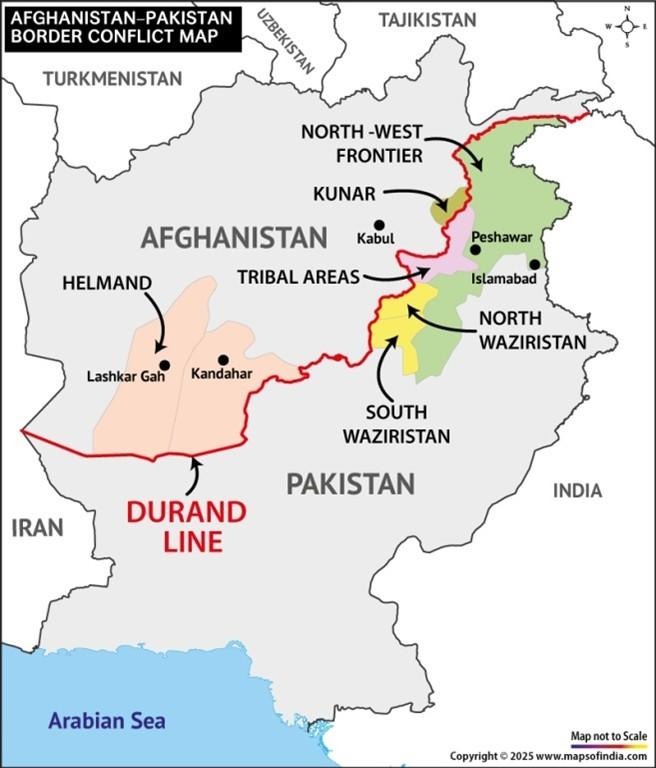
The relationship between Pakistan and Afghanistan is mostly defined by a 2,640-kilometer border known as the Durand Line. This line is not just a boundary on a map but also a major source of political conflicts. Back in 1893, the British drew this line to separate British India from Afghanistan, a shield against Russia. Today, Pakistan says that the border is completely legal and permanent under international law because Pakistan inherited it when it became independent in August 1947. Afghanistan, however, completely refuses to accept it. This disagreement causes constant conflict between the two nations, because the border divides the Pashtun ethnic group. While history shows that the former Afghan rulers accepted the line multiple times, later the governments in Kabul realized they could use the border dispute to make their own people feel patriotic. In short, this is a clash between old colonial laws and modern ethnic politics, and it remains the biggest hurdle to peace in the region.
Historical Background of the Durand Line Agreement of 1893
To understand why this border causes so much trouble today, we have to look back at how the British and Russian empires were fighting for power in Asia during the 1800s. This rivalry was known as “the Great Game.” The British in the subcontinent sought a buffer zone to keep the Russian empire away from their territory. A British official, Sir Mortimer Durand, went to Kabul to negotiate with the Afghan ruler of that time, Amir Abdur Rahman Khan. On November 12, 1893, they signed a seven-article agreement. Historical records show that the Amir agreed willingly because the British agreed to give him a lot of money, increasing his annual subsidy to 1.8 million rupees, and allowed him to import weapons to defend his country. It is crucial to note that the Durand Line was not only signed once but later on; other Afghan rulers also accepted this same border in new treaties, such as the 1905 Treaty of Kabul, the 1919 Treaty of Rawalpindi, and the Anglo-Afghan Treaty of 1921. This shows that for a long time, the Afghan state legally accepted the line.
Why the Legal Status of the Durand Line Remains a Cornerstone of Conflict
After understanding the historical background of the boundary, it is crucial to understand how its legal standing continues to cause regional clashes. Positioned at the center of a territorial clash, it highlights the international law clashes directly with local ethnicity, creating instability, which is explored in the following discussion.
- Legal Inheritance under the Principle of Uti Possidetis Juris
To begin with, Pakistan holds a very strong legal position because it followed global rules about border inheritance. Whenever a new country gains independence from a colonial power, it can automatically have the old international borders of that land. For instance, the global community depends on a legal rule called Uti Possidetis Juris, which states that old colonial lines become official borders after independence. This international law stops new countries from fighting endless wars over maps. As the only legal successor of British India in this region, Pakistan took over all the rights and rules of the 1893 treaty. Therefore, international law fully supports Pakistan’s right to the land and views the Durand line as a permanent reality that one side cannot change on its own.
- The Durand Treaty Expires in 100 Years Myth
Furthermore, a major cause of diplomatic tension is a popular historical myth about how long the original agreement was supposed to last. Many Afghan nationalists claim that the border treaty was a temporary lease that finished automatically after a hundred years. To check this claim, legal experts have carefully reviewed the original text of the 1893 Durand Line Agreement, and they found nothing regarding the 100-year limit or any end date. This lack of an end date proves that just like any standard border agreement between two nations, this treaty was also meant to last forever. The “100-year lease” story is a political tool used to confuse ordinary people and create anti-Pakistan policies. Hence, the expiry argument holds no value under international law and only harms relations between the neighbors.
- The Bisection of the Pashtun Heartland
Moreover, the conflict continues because the political line on the map directly cuts through the ethnic tribes on the ground. The British drew the Durand line purely for military security, completely ignoring the local towns, families, and old pathways. For example, the boundary cut right through the traditional lands of big Pashtun tribes, like the Mohmand, Shinwari, and Waziri clans, putting halves of the same families into two different states. This division means that visiting family or moving animals to traditional grazing lands suddenly became illegal border crossings under state rules. As a result, the local people have always seen the border as an artificial barrier rather than a real boundary. This deep social grievance makes it very easy for political leaders to exploit local anger and keep the area unstable.
- Conflict between International Law and Tribal Culture
In addition, the legal clashes continue because the formal rules of modern states clash with the ancient traditional laws of the border tribes. The local people live by honor and free movement, due to which they completely reject the idea of using passports or visas to cross their ancestral lands. For instance, the Pashtun tribes have traditionally followed a cultural code called Pashtunwali, which demands free movement and open hospitality across the mountains regardless of the government laws. When central governments try to enforce strict border controls on these communities, it creates local anger and resistance. This mismatch between top-down colonial mapping and bottom-up cultural customs keeps the border zone in a state of permanent trouble. Therefore, the dispute is not just an argument between two governments, but a deeper conflict between state laws and traditional ways of life.
How Have Successive Afghan Regimes Justified Their Refusal for Non-Recognition
At the same time, at the diplomatic level, different Afghan governments have created unique arguments to challenge the validity of the line. Despite changing their political systems many times over the decades, almost every regime in Kabul has used specific historical, political, or religious points to justify their refusal to recognize the border.
- The Monarchy: The 1949 Loya Jirga and the Claim of Expired Contracts
Additionally, the early Afghan Monarchy started the policy of rejecting the border by arguing that the colonial treaties lost their legal value once the British left the subcontinent. King Zahir Shah’s government believed that the departure of the British cancelled all previous land deals. For example, after a series of border fights, the Afghan government held a Grand Assembly called a Loya Jirga in 1949, which officially passed a resolution declaring the 1893 agreement dead. The government used this assembly to tell the world that the entire border contract ended along with British rule. This political move allowed the Monarchy to distract the public and hide its own internal weaknesses by creating an external border enemy. Therefore, this action became a dangerous pattern where rejecting the border became a requirement for every Afghan leader wanting to prove their national pride.
- The Republic Era: Promotion of the Pashtunistan Issue for Domestic Unity
Subsequently, in the 1970s, Afghanistan’s new leaders shifted their strategy. Instead of arguing about old legal papers, they used ethnic nationalism to challenge Pakistan’s territory. For instance, President Sardar Daoud Khan even pushed for a new state called “Pashtunistan.” He argued that Pashtun tribes in Pakistan should break away and join Afghanistan. This move allowed Kabul to use tribal loyalties to keep the border unstable and challenge Pakistan’s power. It was also a perfect way to distract Afghan citizens from bad economic and political problems. Because of this, a quiet legal argument turned into a messy political fight over ethnic identity.
- The Taliban Regimes: Islamic Brotherhood vs. Ethnic Nationalism
In contrast to the nationalist regimes, the Taliban took a completely different path. They used religion instead of nationalism to reject the Durand line. Even though Pakistan helped the Taliban diplomatically for many years, but they still refuses to accept the international Durand line. For example, recently, Taliban fighters have even torn down high-tech security fences and cameras installed by the Pakistani military in the areas like Dand-e-Patan. The Taliban leadership argues that these borders are un-Islamic and unfairly divide Muslims. This religious stance helps them to stay popular within local tribes without looking weak. Ultimately, even a deeply religious government in Kabul prefers tribal loyalties over official international laws.
- The Post-2001 Republic: Using the Border as a Diplomatic Leverage
In addition, the Western-backed democratic governments that ruled Kabul after 2001 also kept the border dispute active to use it as a shield against Pakistan. Presidents Hamid Karzai and Ashraf Ghani often blamed Pakistan for their own security failures just to look virtuous globally. For instance, whenever cross-border attacks happened, Kabul would refuse to hold joint border safety meetings. They feared that cooperating would look like they legally accepted the Durand Line. This stance kept the border issue wide open, giving them a bargaining chip to pressure Pakistan during peace talks. It proves that even a modern democracy in Afghanistan could not drop this policy because the political pressure at home was just too high.
Critical Analysis
The Durand Line dispute shows a massive gap between international law and regional political survival. Pakistan uses global rules about state succession to protect its borders. Meanwhile, Afghanistan uses old historical anger to keep its weak country united. This is clearly with every government Kabul has ever had. Whether they were kings, communists, democrats, or the Taliban, every single leader used the border issue to look strong at home and unite divided Pashtun tribes against an outside neighbor. However, a critical evaluation reveals a huge contradiction. Afghanistan constantly asks Pakistan to respect its independence, yet refuses to accept the exact border line that defines that independence. On top of that, Pakistan’s massive security fence has stopped terrorists from crossing over, but it has also hurt local trade and upset diplomats. It shows that even if the border is legally solid under global rules, the real world requires both sides to stop acting defensively and start working together on trade. Ultimately, the border is trapped between Pakistan’s demand for a permanent line and Afghanistan’s need to keep things complicated for its own political gain.
Conclusion
In a nutshell, tracing the history of the Durand Line from 1893 to the current border clashes reveals a deep struggle between international law and ethnic nationalism. While historical evidence and the rules of state succession clearly protect Pakistan’s sovereignty over the border, successive Afghan regimes have continuously manufactured legal, ethnic, and religious arguments to reject it. This ongoing refusal keeps the border unstable, directly affecting regional trade and counter-terrorism efforts. To resolve this issue, both states must move away from old historical debates and focus on modern border management. Transforming the Durand Line from a political battlefield into a safe and secure gateway for legal trade is the only way forward for the peace and prosperity of both nations.
Important Note for CSS and PMS Aspirants
For aspirants preparing for competitive examinations, exploring solved past papers is essential to understand examiner expectations, analytical answer writing, and paper trends. Therefore, candidates are strongly encouraged to read the following comprehensive solved papers available on CSSPREPFORUM.
- CSS Solved Pakistan Affairs Past Papers
- CSS Solved Current Affairs Past Papers
- CSS Solved Islamiat Past Papers
- CSS Solved General Science and Ability Past Papers
Moreover, aspirants searching for the most credible and result-oriented teachers for CSS and PMS preparation can benefit from the following detailed guidance articles
- Who is the Best CSS PMS Islamiat Teacher in Pakistan?
- Who is the Best CSS PMS Pakistan Affairs Teacher in Pakistan?
- Who is the Best CSS Current Affairs Teacher in Pakistan?
- Who is the Best CSS GSA Teacher in Pakistan?
- Who is the Best CSS PMS English Essay and Precis Teacher in Pakistan?
- Who is the Best English Grammar Teacher in Pakistan?