Looking for the CSS 2014 essay “Postmodern Ethos: A Challenge to the West“? Cssprepforum is Pakistan’s largest community with all CSS past paper essays and CSS solved essays. Continue reading!
Saira Shujaat, a student of Sir Syed Kazim Ali, has attempted the CSS 2014 essay “Postmodern Ethos: A Challenge to the West” using Sir Kazim’s proven essay writing pattern and strategy. As Pakistan’s leading CSS and PMS English Essay and Precis coach, Sir Syed Kazim Ali has been the only English mentor with the highest success rate of his students in Essays and Precis for over a decade. The essay is uploaded to help other competitive aspirants learn and practice essay writing techniques and patterns to qualify for the essay paper.
Outline
1-Introduction
While the ethical framework that succeeded modernity is often praised for advancing diversity and inclusivity in Western societies, in reality, the contested objective truth, questioned scientific authority, and eroded universal liberal values clearly demonstrate that postmodern ethos is a challenge to the West, thereby undermining the shared framework necessary for a cohesive, pluralistic society.
2-Debunking the term ‘Postmodern Ethos’
3-Emergence of postmodern ethos as a critique of modernity
4-Enlightenment foundations of the West: What the postmodern ethos challenges
5-How postmodern ethos poses a challenge to the West?
✓ Challenging Objective Truth
Evidence: Encyclopedia Britannica stating postmodern ethos challenges the idea of objective truth by rejecting the existence of a reality independent of human perception and language, contending that what we call truth is shaped by social and linguistic frameworks
✓ Questioning Scientific Authority
Evidence: A 2023 Pew Research Center report showing Americans’ trust in scientific authority dropped from 39% in 2020 to just 23% by 2023
✓ Eroding Universal Liberal Values
Evidence: Freedom House (2024) reporting the 18th consecutive year of democratic decline, particularly in liberal Western democracies
✓ Fragmenting Political Identity and Cohesion
Evidence: The OECD Trust and Social Cohesion Index (2023) recording a rise in political polarization across 70 percent of member states
• ✓ Declining Public Trust in Institutions
Evidence: According to the Edelman Trust Barometer (2024), public trust in governments and media across Western democracies dropping below 50 percent
✓ Politicizing Western Educational Curricula
Evidence: UNESCO’s Global Education Monitoring Report (2022) noting the drift in humanities curricula from objective inquiry towards ideological indoctrination
✓ Weaponizing Identity Politics in Governance
Evidence: The World Economic Forum (2023) warning that ideological overcorrection in workplaces threatens fair competition and innovation
✓ Undermining the Meritocratic Ideal
Evidence: Harvard Kennedy School (2023) concluding that identity-based discourse in Western societies has “deepened ideological divides and weakened meritocratic structures”
✓ Increasing Vulnerability to Foreign Disinformation
Evidence: The European Commission (2024) revealing that Russia and China systematically exploit Western media ecosystems through disinformation campaigns
6-How do critics justify the claim that postmodern ethos has not challenged Western thought?
✓ Postmodern ethos has promoted necessary diversity and inclusivity by giving voice to marginalized identities and dismantling oppressive power structures.
Refutation: While the concept of inclusivity is laudable for a modern society, postmodern ethos has done so by overemphasizing categorical differences and framing all interactions through a rigid “oppressor/oppressed” binary, thereby undermining the concept of a shared humanity and a common civic project.
✓ The challenges faced by the West are primarily economic and geopolitical, such as globalization and inequality, not philosophical.
Refutation: Economic and political factors are indeed real, but this view overlooks the role of epistemic foundations in shaping collective response to these crises. Postmodern skepticism has weakened consensus-building and policy coordination, thus failing to address economic and governance challenges.
7-Overcoming the challenges posed by postmodern ethos to the West
✓ Rebuilding respect for scientific authority
✓ Regaining public trust in institutions through transparency and civic accountability
✓ Restoring universal liberal values
8-Conclusion
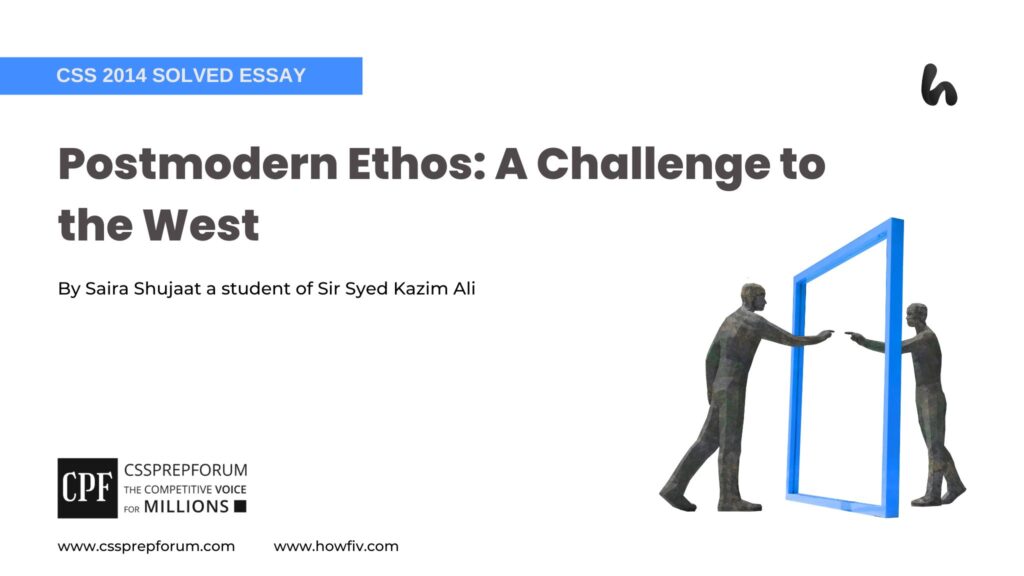
Postmodern Ethos: A Challenge to the West
Human civilization has continuously evolved through ideas, philosophies, and ethical codes that shape societies. From the tribal codes of honor to the universal laws of religion, the West, like other civilizations, framed its civic life around shared values of morality, justice, and social order. However, the rise of postmodern ethos in the late twentieth century shifted the moral compass. What was once considered universal and absolute became subject to skepticism, relativism, and deconstruction. Undoubtedly, the West, which once championed Enlightenment ideals, now struggles with the postmodern ethos that undermines its ethical foundation. The results are challenged objective truth, suspected scientific authority, and eroded universal liberal values. Moreover, the lack of public trust in institutions undermines institutional legitimacy, and the rise of identity-focused politics leads to governance dysfunction. But still, critics argue that postmodern ethos has promoted inclusivity and diversity in Western culture and that the West’s crises are primarily economic and geopolitical rather than philosophical. Nevertheless, this view overlooks how such inclusivity has come at the expense of shared humanity and a common civic project, while the postmodern ethos has simultaneously affected public compliance and policy coordination, both necessary for addressing economic and geopolitical challenges. Thus, overcoming the perils of postmodern ethos is indispensable. Promoting objective truth, reinstating scientific authority, and regaining public trust in institutions can be effective measures for achieving holistic progress in the West. This essay discusses postmodern ethos as a fundamental challenge to Western society and potential pathways to address it.
Before analyzing the emergence of postmodern ethos as a critique of modernity, it is essential to clarify what the term ‘postmodern ethos’ denotes. It is a pervasive set of assumptions characterized by radical skepticism toward universal truth, the deconstruction of grand narratives, and the prioritization of subjective experience and identity. Instead of seeking a single reality, it views knowledge as relative, subjective, and a tool of power. Postmodernists believe that language, history, and science are not neutral but are merely “narratives” created by dominant groups, such as governments or media, to justify their power and oppress others. Consequently, this philosophical stance encourages the deconstruction of all grand narratives, such as the idea of “Progress,” “The Nation,” or “Universal Justice,” contending that these claims mask power relations and therefore require critical deconstruction.
Analyzing the emergence of postmodern ethos, this concept primarily emerged as a reaction against modernism, beginning to coalesce in the mid-to-late twentieth century. The concept of modernism was grounded in universal truth, rational progress, and the power of reason and science. However, the unprecedented violence of the two World Wars and the collapse of utopian political projects, most notably communism, shattered the belief in these Enlightenment promises. This historical disillusionment created wide skepticism towards the “grand narratives” that claimed moral or scientific authority. Although the term was first used in various disciplines, such as art and architecture, it was most famously introduced into philosophical and cultural theory by Jean-François Lyotard’s 1979 work, The Postmodern Condition. Lyotard described postmodernism as “incredulity toward meta-narratives,” a stance that fundamentally questioned the Enlightenment’s assumptions about objective truth, universal reason, and historical progress.
To understand the challenges posed by postmodern ethos to the West, it is necessary to identify what is being challenged. The Western liberal order rests upon Enlightenment principles that depend on shared epistemology and universal norms. Postmodern ethos directly contests these foundations by rejecting objective truth and redefining it as a social construct shaped by power; by undermining universal reason and portraying it as a culturally contingent, Western tool for domination; and by displacing individual autonomy with identity-based group positioning in systemic power hierarchies. Furthermore, it challenges the foundational ethics of modernity by rejecting universal moral principles and replacing them with ethical relativism rooted in context and discourse. In doing so, postmodern ethos destabilizes the intellectual coherence upon which Western institutions and values traditionally rely.
The following arguments discuss how the advent of postmodern ethos has precipitated a paradigm shift, thereby posing profound epistemological, ontological, and cultural challenges to the dominant Western worldview and its hitherto unbeatable metanarratives.
To begin with, postmodern ethos rejects the principle of objective, verifiable truth, undermining the Enlightenment’s faith in rational, evidence-based inquiry. It has blurred the boundary between truth and narrative, leaving society uncertain about what constitutes factual knowledge. This is supported by Encyclopedia Britannica, which notes that postmodern ethos rejects the existence of a reality independent of human perception and language, contending that what people call ‘truth’ is shaped by social and linguistic frameworks rather than an external, verifiable reality. Thus, postmodern skepticism tangibly undermines societal trust in objective, universally accepted truths.
Building on this, postmodern ethos fundamentally questions scientific authority by privileging multiple, situated interpretations over the discovery of objective truth, undermining the traditional epistemic authority of science. In this framework, science is not regarded as a value-neutral pursuit of truth but rather as one of many socially and historically constructed “narratives”. This erosion of truth is evident in a 2023 Pew Research Center report, which shows that the proportion of Americans who have strong confidence in scientific authority dropped from 39% in 2020 to just 23% by 2023, indicating a notable erosion of trust in science as an epistemic foundation. By framing science as one narrative among many, postmodern ethos weakens public trust in scientific authority, directly challenging the Enlightenment’s ideal of objective knowledge.
Moreover, the Western project is fundamentally anchored in universal liberal values, which postmodern ethos now challenges. By rejecting universal truths, postmodern ethos fosters moral relativism, leaving no moral principles or objective standards of good, directly contradicting liberal values, such as freedom, justice, and equality before law. This tension is reflected in Freedom House’s 2024 report, which notes the 18th consecutive year of democratic decline, particularly in liberal Western democracies. The report illustrates how the erosion of these principles correlates with declining social cohesion and institutional resilience. Therefore, postmodern ethos erodes universal liberal values, weakening the moral coherence that sustains democratic governance and civic solidarity.
In addition, postmodern ethos, by negating “grand narratives”, like nationhood, class, and shared civic projects, elevates subjective and micro-political identities. By prioritizing micro-political identities over shared civic values, it contributes to polarization and undermines social cohesion in Western societies. According to the Organisation for Economic Co-operation and Development (OECD) Trust and Social Cohesion Index 2023, 70 percent of member states have experienced increased political polarization, illustrating how the emphasis on fragmented identities weakens communal cohesion. Consequently, postmodern ethos fragments political communities, allowing ideological and cultural tribes to dominate civic life and weaken democratic consensus.
Furthermore, postmodern skepticism and criticism of grand narratives, such as the idea of continuous progress and the state acting in everyone’s best interest, have left citizens distrustful of key institutions, including government, media, and even science that once formed the backbone of the Western order. By emphasizing personal identity and subjective experience, postmodern ethos encourages reliance on personal beliefs over established facts, thus fostering suspicion towards large, centralized systems. The Edelman Trust Barometer (2024) confirms this trend, reporting that public trust in governments and media across Western democracies has dropped below 50 percent, reflecting the influence of postmodern skepticism.Thus, postmodern relativism undermines civic faith, replacing collective legitimacy with individual cynicism.
Adding to it, postmodern ethos has equally affected Western curricula, which were once the guardians of intellectual rigor. Education has shifted from objective inquiry towards debates dominated by ideological subjectivity and identity-focused critiques. This shift is reported in UNESCO’s Global Education Monitoring Report 2022, which highlights a drift in humanities curricula from objective inquiry toward ideological indoctrination. Hence, postmodern ethos’ deep infiltration into education prioritizes identity-based critiques over core knowledge transmission, potentially weakening the development of a shared cultural and civic foundation.
Furthermore, postmodern ethos’ emphasis on political identity has frequently intensified polarization within governance and public discourse. By emphasizing systems of power and oppression, postmodern political identity filters every issue through the lens of group affiliations. Moreover, policy debates have become zero-sum conflicts between perceived oppressors and the oppressed, undermining efforts to reach common-ground solutions. The World Economic Forum (2023) reported that ideological overcorrection, an extension of identity-focused politics, threatens fair competition and innovation in workplaces, illustrating the broader societal consequence of this trend. Hence, these political affiliations lead to internal power struggles and potential diversion from core institutional goals and missions.
Additionally, meritocracy in the Western viewpoint rests on the belief that reason, science, and objective standards determine individual merit and social advancement. In contrast, postmodern ethos perceives knowledge as relative and plural, contradicting the idea of a single, objective merit applicable to all equally. This ideological shift challenges merit-based evaluation systems. A 2023 study by the Harvard Kennedy School concluded that identity-based discourse in Western societies has “deepened ideological divides and weakened meritocratic structures.” Moreover, postmodern thought views merit as a social construct designed to legitimize existing power hierarchies rather than reward competence. In consequence, this erosion of meritocratic ideals demoralizes the workforce, contributing to a decline in institutional excellence as the foundational belief in fair reward comes under suspicion.
Last but not least, the postmodern relativization of truth has left Western democracies defenseless against external manipulation. The widespread acceptance of epistemic relativism, the idea that all narratives are equally valid, has weakened societies’ ability to differentiate facts from falsehood, creating fertile ground for foreign malign influence. In this context, the European Commission (2024) revealed that Russia and China systematically exploit Western media ecosystems through disinformation campaigns aimed at destabilizing Western cohesion. When objective truth is reduced to competing narratives, state-sponsored disinformation campaigns are merely viewed as alternative perspectives. Thus, postmodern skepticism toward truth has undermined informational resilience, exposing Western democracies to strategic manipulation from hostile external actors.
Analyzing the opposing viewpoints after analyzing the central maxim, opponents of this perspective argue that postmodern ethos has promoted necessary diversity and inclusivity within Western societies by empowering marginalized communities and dismantling oppressive power structures. While diversity can indeed strengthen social cohesion when anchored in shared civic values, postmodern ethos has done so by hyperfocusing on difference and viewing every relationship through a rigid oppressor-oppressed binary, thereby prioritizing difference over common humanity. Rather than fostering inclusion, this concept weakens shared humanity and a common civic project. Evidence from the Pew Research Center shows that identity-based polarization has eroded Americans’ belief in common national goals, with opposing groups increasingly viewing each other as moral adversaries rather than fellow citizens. Such deterioration of generalized trust aligns with postmodern ethos’ emphasis on suspicion and power-centric interpretation, suggesting that its model of inclusivity has inadvertently undermined the social cohesion it claims to promote.
Moreover, contenders also posit that challenges faced by the West are primarily economic and geopolitical, such as inequality, globalization, and strategic competition, rather than philosophical or intellectual. Although the economic and political factors are real, this view overlooks the role of epistemic foundations in shaping collective responses to these crises. The erosion of shared truth frameworks under postmodern skepticism has weakened consensus-building, policy coordination, and public compliance, thereby intensifying economic and governance challenges. The OECD Trust and Social Cohesion Index (2023) reports that Western societies experiencing epistemic fragmentation struggle to achieve agreement on major global crises, including economic recovery, climate action, and public health policy. This evidence demonstrates that philosophical disunity does not merely coexist with material crises; it amplifies them by paralyzing collective decision-making. Hence, postmodern erosion of shared truth has indirectly transformed manageable economic and geopolitical problems into systemic governance failures.
After analyzing how postmodern ethos is a significant challenge to the West, making conscious efforts for the restoration of truth, ethics, and civic solidarity is essential. To start with, rebuilding scientific authority in the face of postmodern skepticism demands renewed commitment to scientific rationalism and public engagement. This involves strengthening respect for the scientific method, encouraging critical inquiry, and communicating how scientific knowledge evolves through testing, falsifiability, and peer review rather than absolute claims. Thus, by emphasizing evidence-based reasoning and openness to revision, science can reclaim its role as a trusted epistemic foundation without reverting to dogmatism.
Likewise, restoring institutional legitimacy requires strengthening transparency and civic accountability across government, media, and regulatory bodies. In this regard, implementing clear oversight mechanisms, rule-based decision-making, and robust accountability frameworks can rebuild the public confidence that perceptions of power misuse and elite capture have eroded. By ensuring that institutions operate openly, fairly, and consistently, citizens are more likely to trust their authority and effectiveness. Such trust is essential for maintaining social stability, democratic resilience, and the overall cohesion of Western institutions in the face of postmodern skepticism.
Similarly, restoring universal liberal values requires reaffirming equality, justice, and individual rights as the foundation of society. Civic education, public policy, and media should emphasize shared ethical standards that transcend group identities, teaching citizens to balance personal or communal interests with the common good. Furthermore, encouraging dialogue rooted in universal principles, rather than fragmented identity politics, can strengthen social cohesion, rebuild moral coherence, and ensure that diversity and inclusivity reinforce, not undermine, the shared values central to liberal democracies.
To sum up, postmodern ethos, despite being a critique of emerging rigid modernity, has ultimately challenged the philosophical foundations of Western societies. By undermining the Enlightenment’s foundational principles, it has shaken the moral, cultural, and educational pillars of the West. The consequences are eroded universal liberal values, challenged objective truths, suspicion of scientific authority, undermined meritocratic ideals, and weaponized identity politics. Yet the path forward is neither nostalgic nor reactionary. It demands deliberate restoration of objective truths, renewed commitment to merit and scientific rigor, and re-establishing institutional trust through accountability. Only strengthening these foundations can help the West transcend the fragmentation caused by postmodern ethos and reclaim social cohesion to face the challenges of the twenty-first century.
CSS 2014 Solved Essays!
Interested in learning all the CSS 2014 Solved Essays? Click on any to continue reading. Each essay is meticulously attempted by Sir Syed Kazim Ali’s students, who have either qualified for CSS or PMS or secured the highest marks in the essay paper.
1- Literature as a Great Cultural Artifact
2- Language is a Fit Data for Research in Humanities and Social Science
3- Privatizing Higher Education-generating Knowledge or Making more Money for the Opulent
4- Women Sportspersons are new Ambassadors of the Soft Image of Pakistan
10- Violence is the Last Refuge of the Incompetent.
CSS Solved Past Papers’ Essays
Looking for the last ten years of CSS and PMS Solved Essays and want to know how Sir Kazim’s students write and score the highest marks in the essays’ papers? Then, click on the CSS Solved Essays to start reading them.
Want to read the last ten years’ General Science & Ability Solved Past Papers to learn how to attempt them and to score high? Let’s click on the link below to read them all freely. All past papers have been solved by Miss Iqra Ali & Sir Ammar Hashmi, Pakistan’s top CSS GSA coach having the highest score of their students.
Welcome to Cssprepforum, Pakistan’s largest learning management system (LMS) with millions of questions along with their logical explanations educating millions of learners, students, aspirants, teachers, professors, and parents preparing for a successful future.
Founder:Syed Kazim Ali Founded: 2020 Phone: +92-332-6105-842 +92-300-6322-446 Email: howfiv@gmail.com Students Served: 10 Million Daily Learners: 50,000 Offered Courses:Visit Courses