Learn all uses of the prepositions IN, ON, and AT for Time and Location, with rules, examples, and practice MCQs designed to the standard of Pakistan’s most competitive exams.
Table of Contents
- Introduction — Why Prepositions Cost You Marks
- The Core Idea — AT, IN, ON in One Sentence
- Preposition IN — Uses for Time
- Preposition ON — Uses for Time
- Preposition AT — Uses for Time
- Preposition IN — Uses for Location
- Preposition ON — Uses for Location
- Preposition AT — Uses for Location
- Critical Contrasts That Exams Always Test
- 500 Practice MCQs — Section-Wise
- Master Summary Table
- Frequently Asked Questions
Why Prepositions Cost You Marks
Of all the topics in English grammar, prepositions are the most deceptively difficult. Students who can write flawless essays and construct complex sentences still lose marks in CSS, PMS, GMAT, and GRE examinations because of a single wrongly chosen preposition.
The three prepositions IN, ON, and AT are the most frequently tested in every major competitive examination in Pakistan, India, and globally. They appear in error-detection questions, sentence correction MCQs, fill-in-the-blank exercises, and even in precis writing evaluations where incorrect preposition use lowers marks.
What makes these three so challenging is that each one governs both time and location. And the rules for each domain are completely different. A student who knows that on Monday is correct for time may incorrectly write on the car for location, not realising that location inside a vehicle requires in the car.
This article presents the complete, definitive guide to all uses of IN, ON, and AT, covering six core domains, more than 100 illustrative examples, the most important contrasts tested in exams, and a bank of 500 MCQs designed to the standard of CSS, GMAT, GRE, UPSC, and IELTS.
The Core Idea: AT, IN, ON in One Sentence
Before memorising rules, internalise the following mental images. They will guide you whenever you are unsure
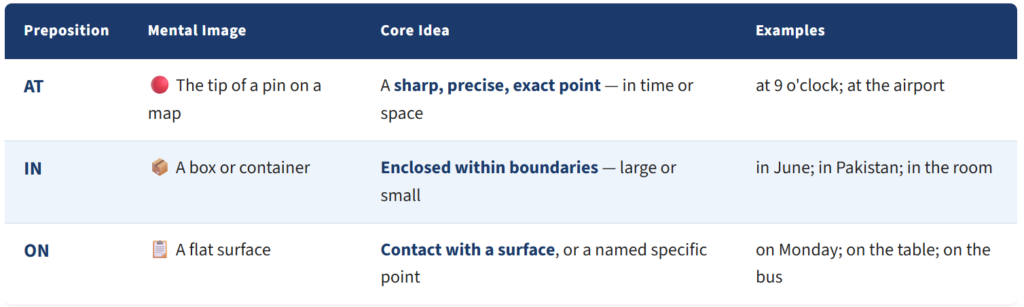
These three mental images resolve the vast majority of preposition questions.
- If a location or time can be enclosed within boundaries, use IN.
- If it can be marked with a pin on a map or clock, use AT.
- If it involves contact with a surface or a named specific occasion, use ON.
Preposition IN: Uses for Time
The preposition IN governs all time expressions that represent broad periods, named stretches of time, or containers of time, months, years, centuries, seasons, parts of the day, eras, and lengths of duration.
Use 1: Parts of the Day
Examples
- He revises his CSS notes in the morning before going to work.
- The Prime Minister addressed the nation in the evening after the crisis.
- She holds her office meetings in the afternoon every weekday.
Exam Trap
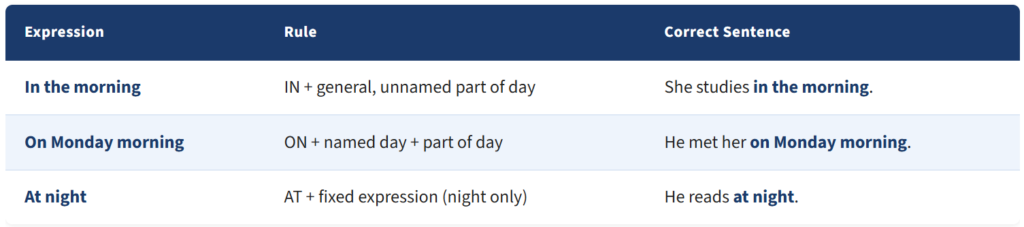
- AT night, not IN the night. Night is the only part of the day that takes AT, not IN. This is one of the most tested distinctions in CSS and IELTS.
- ON Monday morning, when a day name is added before morning/afternoon/evening, the preposition changes from IN to ON.
Use 2: Months, Years, Decades, Centuries, Eras, Epochs, Seasons
All named units of time larger than a single day take IN. Think of each of these as a container within which events take place.
Examples
- Pakistan gained independence in August 1947.
- Shakespeare lived and wrote in the 16th century.
- The world transformed beyond recognition in the 1990s.
- The subcontinent flourished in the Mughal era.
- Great mammals evolved in the Pleistocene Epoch.
- The cherry blossoms bloom in the spring.
Use 3: Long or General Periods (Past, Present, Future)
We use IN with broad, general periods of time. This includes the past, the present, and the future.
Examples
- In the past, women were denied access to education in many societies.
- In the present era, artificial intelligence is reshaping every profession.
- Renewable energy will dominate the global market in the near future.
- In those days, travelling from Lahore to Delhi took several weeks.
In future vs. In the future: A Critical Distinction
In future (no article) = From now on / henceforth, used as a warning or instruction.
- In future, do not submit your assignments late.
In the future (with the) = At some point ahead in time, a prediction.
- Robots will replace many jobs in the future.
Use 4: Lengths of Time (Future Completion)
We use IN to say how long something will take or after how much time something will happen. This use always points forward in time.
Examples
- The doctor will see you in ten minutes.
- She will complete the motorway project in two years.
- The results will be declared in a week.
Exam Trap
IN vs. FOR vs. WITHIN
- I will call you in five minutes. (after five minutes pass)
- I waited for five minutes. (throughout five minutes)
- Call me within five minutes. (before five minutes are over)
4. Preposition ON: Uses for Time
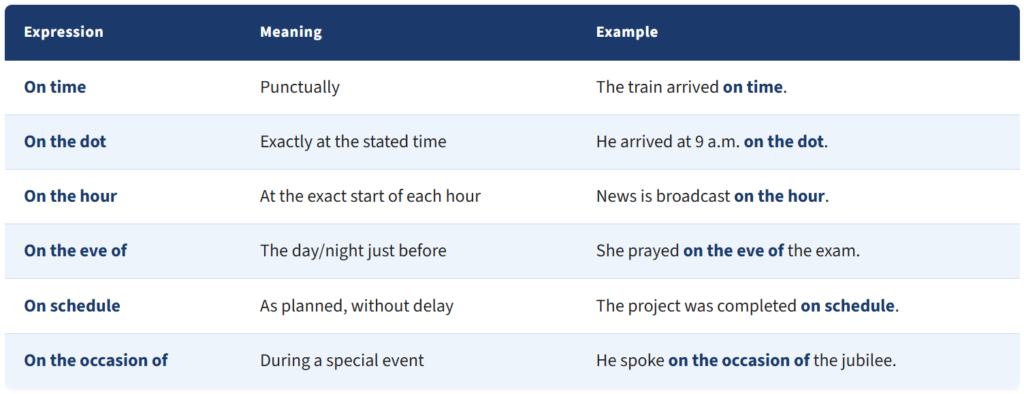
The preposition ON is used whenever time is expressed as a specific, named, identifiable point, a day, a date, a special occasion, or a fixed expression. Think of ON as placing a marker on a named point of the calendar.
Use 1: Days of the Week
Examples
- The CSS examination begins on Monday.
- She teaches English on Saturdays. (every Saturday — habitual)
- The weekly court session is held on Thursday.
Use 2: Named Special Days and Repetitive Occasions
Examples
- The nation celebrates on Independence Day.
- He always calls his mother on her birthday.
- Christians attend church on Christmas Day.
- They renewed their vows on their wedding anniversary.
Use 3: Parts of Specific Named Days
When morning, afternoon, evening, or night is attached to a named day, the preposition becomes ON — not IN.
Examples
- The earthquake struck on Tuesday morning at 4:17 a.m.
- She delivered her best speech on Friday afternoon.
- The attack occurred on Thursday night without warning.
Use 4: Specific Dates
Examples
- Pakistan was created on the 14th of August, 1947.
- She was appointed Director General on 1st April this year.
- The results were declared on June 18th.
Use 5: Fixed Expressions with ON
Preposition AT: Uses for Time
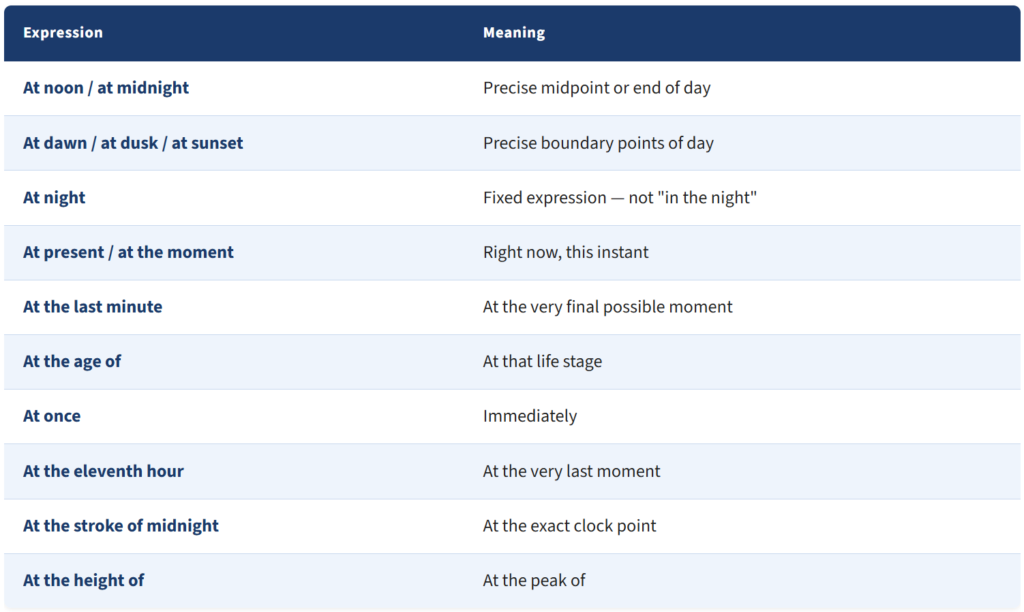
The preposition AT is the preposition of precision and exactness. It marks a single, sharp point in time, not a period, not a stretch, not a named day, but an exact moment or fixed boundary point.
Clock Times and Precise Boundary Points
- The examination begins at nine o’clock.
- The curfew was lifted at midnight.
- The ambassadors met at dawn in a secure location.
- He studies most productively at night.
- She arrived at the last minute.
- At present, the committee is reviewing the proposals.
- She graduated with distinction at the age of twenty.
Preposition IN: Uses for Location
For location, IN expresses the idea of being enclosed within boundaries. The boundaries may be the walls of a room, the borders of a country, or the surface of a container. What unites all uses of IN for place is the concept of enclosure.
Use 1: Large Geographical Areas
Countries, Continents, Regions, Provinces, Cities
- She has been serving as a diplomat in France for eight years.
- The highest mountain range in the world is the Karakoram.
- The ruins of Mohenjo-daro are situated in Sindh.
- He was born in Multan, the city of saints.
- Oil reserves are concentrated in the Middle East.
Use 2: Specific Area Inside a Larger Area
Examples
- There is a rare bookshop in the shopping centre on Mall Road.
- The principal’s office is in the east wing of the building.
- A rare eagle was spotted in the dense forests of KPK.
Use 3: Inside Vehicles, Rooms, and Containers
Examples
- She is waiting in the car outside the gate.
- He left his wallet in the taxi and could not retrieve it.
- Alia was sleeping in her room when the earthquake struck.
- All classified documents are locked in the safe.
- She found an old letter in the pocket of her grandfather’s coat.
Exam Trap
- IN the car (private, enclosed vehicle) vs. ON the bus / train / plane (public transport).
- IN the hospital (as a patient, physically inside) vs. AT the hospital (works there, purpose/activity).
Preposition ON: Uses for Location
For location, ON expresses contact with a surface, movement along a line, or attachment to something. Whether the surface is a floor, a road, a riverbank, or the skin of the body, the idea of contact and connection governs the use of ON.
Floors, Surfaces, Public Transport, Roads, Islands, Attached Objects
- The director’s office is on the fourth floor.
- She met her husband on a flight from Dubai to Islamabad.
- The protest march began on The Mall.
- Napoleon spent his exile on the island of Saint Helena.
- Edmund Hillary planted his flag on the summit of Everest.
- A camera is mounted on the ceiling of every entrance.
- Lahore is built on the bank of the River Ravi.
- She noticed a bruise on his forehead.
Preposition AT — Uses for Location
For location, AT marks a precise, specific point on the map, an address, a service point, a counter, an event, or an institution treated as a destination rather than a physical interior.
Examples
- The family gathered at the airport to receive the scholar.
- She was waiting at the bus stop for forty minutes.
- He was seated at his desk reviewing the dossier.
- I saw an old friend at the conference on climate change.
- She and her husband stayed at the Pearl Continental Hotel.
- The cat sat at the window all afternoon.
- Someone is knocking at the door.
- She is at home. He is at work. The children are at school.
Critical Contrasts That Exams Always Test
Contrast 1: IN the morning vs. ON Monday morning vs. AT night
Contrast 2: ON time vs. IN time
Most Tested Contrast in CSS, IELTS, and GMAT
- The train arrived on time. (Punctually – neither early nor late)
- She arrived in time to catch the train. (Early enough, before it was too late)
Contrast 3: IN a vehicle vs. ON public transport
Examples
- She is waiting in the car. (Private, enclosed vehicle → IN)
- He met her on the bus. (Public transport → ON)
- She read the report on the plane. (Public transport → ON)
She is waiting on the car.He met her in the bus.
Contrast 4: IN a building vs. AT a building
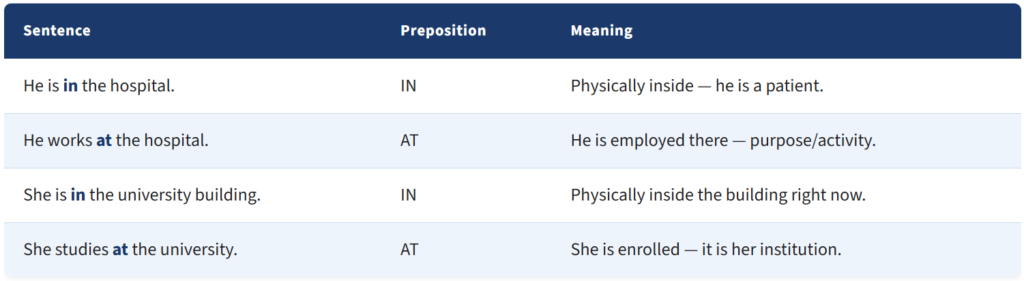
Contrast 5: IN a city vs. AT a spot inside a city
Examples
- She lives in Lahore. (General residence within the city boundaries)
- She is at the airport in Lahore. (Precise spot inside the city)
- He grew up in Karachi.
- He is waiting at a cafe in Karachi.
Practice MCQs
The following 30 MCQs are drawn from our bank of 500 practice questions. They are designed to the standard of CSS, PMS, GMAT, GRE, UPSC, and IELTS examinations. The complete 500-MCQ set is available as a free Word document download below.
Q1 The Lahore Resolution, a watershed moment in history, was adopted ___ March 1940.
- (A) on
- (B) at
- (C) in
- (D) by
Answer: C — IN + month + year (broad period container).
Q2 The Renaissance began ___ the 14th century in the city-states of Italy.
- (A) at
- (B) on
- (C) during
- (D) in
Answer: D — IN + century (named broad period).
Q3 ___ future, every student arriving late will be refused entry to the examination hall.
- (A) At
- (B) In
- (C) On
- (D) By
Answer: B — IN future (no article) = henceforth, from now on — a directive.
Q4 She completed the five-hundred-word précis ___ thirty minutes, impressing the examiner.
- (A) within
- (B) at
- (C) in
- (D) on
Answer: C — IN + time taken = after that period elapsed.
Q5 Great empires rose and fell ___ ancient times along the banks of mighty rivers.
- (A) on
- (B) at
- (C) in
- (D) by
Answer: C — IN ancient times = general long historical period.
Q6 Pakistan gained independence from British colonial rule ___ the 14th of August, 1947.
- (A) in
- (B) at
- (C) on
- (D) by
Answer: C — ON + specific date.
Q7 The earthquake struck the northern regions ___ Tuesday morning at precisely 4:17 a.m.
- (A) in
- (B) at
- (C) on
- (D) by
Answer: C — ON + specific named day + part of day.
Q8 She arrived at the airport ___ time to catch the connecting flight by just five minutes.
- (A) on
- (B) in
- (C) at
- (D) by
Answer: B — IN time = early enough, before it was too late. NOT on time (which means punctually).
Q9 He prayed throughout the night ___ the eve of his Civil Services examination.
- (A) in
- (B) at
- (C) on
- (D) by
Answer: C — ON the eve of = the day/night just before (fixed expression).
Q10 ___ the occasion of the Diamond Jubilee, the President addressed the entire nation.
- (A) In
- (B) At
- (C) On
- (D) By
Answer: C — ON the occasion of = during that special event (fixed expression).
Q11 The ceasefire came into effect ___ the stroke of midnight on New Year’s Eve.
- (A) in
- (B) on
- (C) at
- (D) by
Answer: C — AT the stroke of midnight = at that exact clock point.
Q12 She graduated with the highest distinction ___ the age of twenty.
- (A) in
- (B) on
- (C) at
- (D) by
Answer: C — AT the age of = fixed expression.
Q13 He studies most effectively ___ night and takes rest in the early morning hours.
- (A) in
- (B) on
- (C) at
- (D) by
Answer: C — AT night is a fixed expression. “In the night” is non-standard.
Q14 The ruins of Mohenjo-daro, a wonder of the ancient world, are located ___ Sindh.
- (A) at
- (B) on
- (C) in
- (D) by
Answer: C — IN + province (geographical area with boundaries).
Q15 She is waiting for you ___ the car outside the main gate of the examination centre.
- (A) at
- (B) on
- (C) in
- (D) by
Answer: C — IN + private enclosed vehicle (car).
Q16 He is currently ___ the hospital recovering from the surgery performed last Tuesday.
- (A) at
- (B) on
- (C) in
- (D) by
Answer: C — IN the hospital = physically inside as a patient. AT the hospital = works there.
Q17 The director’s office is located ___ the fourth floor of the Federal Secretariat.
- (A) in
- (B) at
- (C) on
- (D) by
Answer: C — ON + floor of a building.
Q18 She met her future husband ___ a flight from Dubai to Islamabad.
- (A) in
- (B) at
- (C) on
- (D) by
Answer: C — ON + public transport (plane/flight).
Q19 The ancient city of Lahore is built ___ the banks of the River Ravi.
- (A) in
- (B) at
- (C) on
- (D) by
Answer: C — ON the banks = on that surface/edge of the river.
Q20 The entire family gathered ___ the airport to receive the scholar returning from Harvard.
- (A) in
- (B) on
- (C) at
- (D) by
Answer: C — AT + specific destination/location point.
Q21 She was waiting anxiously ___ the bus stop for over forty minutes.
- (A) in
- (B) on
- (C) at
- (D) by
Answer: C — AT + precise waiting point (bus stop).
Q22 He was seated ___ his desk reviewing the classified dossier when the director arrived.
- (A) in
- (B) on
- (C) at
- (D) by
Answer: C — AT + desk/counter (functional point of activity).
Q23 I saw the Director General ___ Rick’s farewell dinner at the club last night.
- (A) in
- (B) on
- (C) at
- (D) by
Answer: C — AT + event/gathering (dinner).
Q24 She is ___ home and cannot take official calls after eight in the evening.
- (A) in
- (B) on
- (C) at
- (D) by
Answer: C — AT home = fixed expression.
Q25 He stood ___ the top of the staircase and called out for his assistant below.
- (A) in
- (B) on
- (C) at
- (D) by
Answer: C — AT the top of = at that precise point.
Master Summary Table
| Prep. | For TIME | For LOCATION |
|---|---|---|
| IN | Parts of day (morning/afternoon/evening) · Months · Years · Decades · Centuries · Eras · Epochs · Seasons · The past/present/future · In future (= henceforth) · Lengths of time (in 10 minutes) | Countries · Continents · Regions · Provinces · Cities · Rooms (physically inside) · Enclosed vehicles (car, taxi) · Containers, pockets, safes · Specific area inside a larger area |
| ON | Days of week · Named special days · Specific dates · Day + part of day · On time · On the dot · On the hour · On the eve of · On schedule · On the occasion of | Floors of a building · Surfaces (table, wall, ceiling) · Public transport (bus/train/plane) · Roads and streets · Islands · Riverbanks and coasts · Hilltops and summits · Attached objects |
| AT | Clock times · Noon · Midnight · Dawn/dusk/sunset · At night · At present · At the moment · At the last minute · At the age of · At once · At the stroke of · At the height of | Exact address · Events and gatherings · Desks and counters · Service points (bank/airport) · Institutions as destinations · At home/at work/at school · At the door/window · At the corner/entrance/exit |
Sir Syed Kazim Ali
Senior English Language Teacher for CSS, PMS & International Examinations
Sir Kazim Ali is widely regarded as Pakistan’s foremost CSS and PMS English essay and precis teacher, with over 12 years of experience and approximately 15,000 students taught. He teaches at Cssprepforum and Howtests and is the author of several published grammar and vocabulary books used by competitive examination aspirants across South Asia.