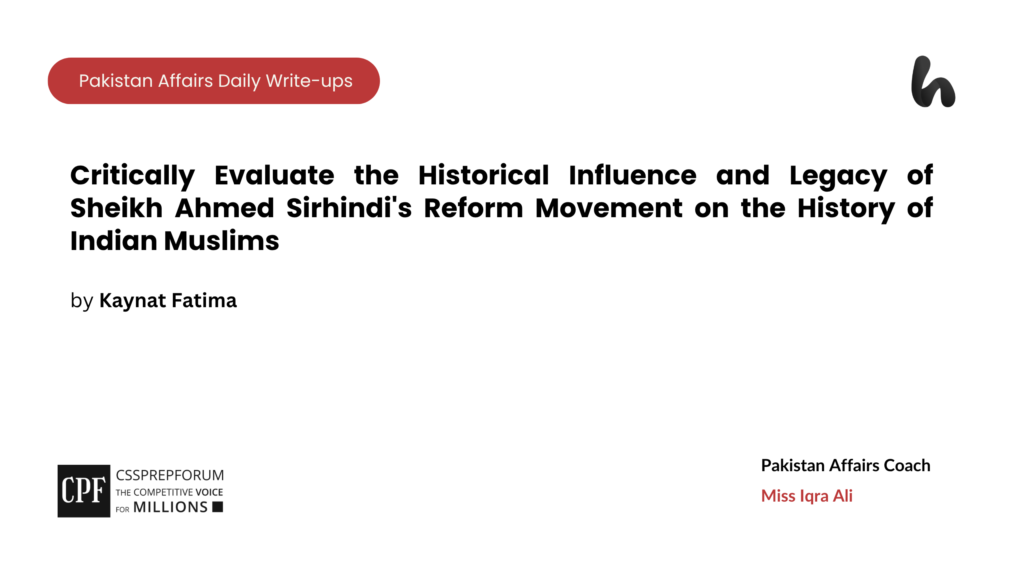
CSS Pakistan Affairs | Influence and Legacy of Sheikh Ahmed Sirhindi’s Reform
This article critically evaluates the historical influence and legacy of Sheikh Ahmed Sirhindi’s reform movement, its impact on Islamic revival, Muslim identity, and South Asian history.

Introduction
The history of Muslim India is marked by the contributions of numerous scholars, reformers, and spiritual leaders who sought to preserve Islamic identity and values during periods of political and social transformation. Among them, Sheikh Ahmad Sirhindi (1564–1624), widely known as Mujaddid Alf-i-Sani (Reviver of the Second Millennium), occupies a unique position. Emerging during the reign of Mughal Emperor Akbar, when religious syncretism and heterodox practices were gaining prominence, Sirhindi launched a comprehensive reform movement aimed at reviving Islamic orthodoxy and restoring the centrality of the Quran and Sunnah. Moreover, through his intellectual writings, spiritual guidance, and engagement with political elites, he revitalized Islamic orthodoxy and inspired subsequent generations of Muslim reformers. His movement played a vital role in safeguarding Islamic beliefs, reforming Sufi practices, strengthening Muslim consciousness, and ensuring the continuity of Islamic civilization in South Asia. Therefore, Sheikh Ahmed Sirhindi’s reform movement remains one of the most influential and beneficial developments in the history of Indian Muslims.
Historical Context before Sheikh Ahmed Sirhindi’s Reform Movement
- Religious Degeneration among Muslims
Before the emergence of Sirhindi, many Muslim scholars believed that Islamic teachings in India had become weakened due to the spread of innovations (Bid‘at) and un-Islamic customs. A significant segment of the Muslim population had adopted local cultural practices that were not rooted in Islamic teachings. Adherence to Shariah weakened as mystical interpretations and folk traditions increasingly overshadowed orthodox religious practices. Furthermore, some Sufi circles emphasized spiritual experiences at the expense of strict observance of Islamic law. Practices such as excessive saint veneration, ritual innovations, and syncretic customs became widespread. Many contemporary Sufi groups promoted practices that Sirhindi regarded as inconsistent with the teachings of the Quran and Sunnah, prompting him to initiate a movement for religious purification. Thus, he considered these trends harmful to the purity of Islam and viewed them as a major threat to Muslim society.
- Akbar’s Religious Policies
Moreover, the reign of Emperor Akbar witnessed unprecedented religious experimentation. Seeking political stability and imperial unity, Akbar introduced the policy of Sulh-i-Kul (Universal Peace), which promoted tolerance and equal treatment of all religious communities. While politically beneficial, these policies alarmed orthodox Muslim scholars. Similarly, Akbar’s most controversial initiative was Din-i-Ilahi, a syncretic belief system that attempted to combine elements from Islam, Hinduism, Christianity, Zoroastrianism, and other religions. Akbar also established the Ibadat Khana at Fatehpur Sikri, where scholars from different faiths engaged in religious debates, reflecting his broader vision of creating a composite imperial culture transcending traditional religious boundaries. Thus, many Muslim scholars interpreted these experiments as a direct challenge to Islamic teachings.
- Rise of Bhakti and Hindu Cultural Influence
Similarly, the Bhakti movement significantly influenced the religious landscape of India. Increased interaction between Hindus and Muslims encouraged cultural exchange and social integration. While this interaction fostered harmony, many Muslim scholars feared that it could weaken Islamic identity. Moreover, as Muslims became more integrated into local society, some adopted customs and traditions associated with Hindu culture. Interfaith marriages, participation in local festivals, and the adoption of regional customs became increasingly common, leading reformers like Sirhindi to advocate for a clearer distinction between Islamic and non-Islamic practices. This trend raised concerns regarding the preservation of distinct Muslim religious and cultural values.
Major Components of Sheikh Ahmed Sirhindi’s Reform Movement
- Revival of Shariah
The cornerstone of Sirhindi’s reform movement was the revival of Shariah. He argued that the Quran and Sunnah should serve as the ultimate sources of guidance for Muslims. In his view, the decline of Muslim society stemmed largely from neglecting Islamic law and embracing innovations. Sirhindi urged Muslims to strictly follow religious obligations and reject practices lacking a clear foundation in Islamic teachings. Thus, this commitment is clearly reflected in his famous collection of letters, known as Maktubat, in which he repeatedly emphasized adherence to Islamic law and warned against innovations that distorted the faith. He believed that genuine spirituality could not exist independently of Shariah.
- Reform of Sufism
Likewise, unlike some orthodox scholars who opposed Sufism altogether, Sirhindi sought to reform rather than abolish it. He recognized the spiritual value of Sufism but insisted that mystical experiences must remain subordinate to the Quran and Sunnah. Furthermore, he criticized those Sufis who elevated personal spiritual experiences above religious law. For instance, he challenged interpretations of Ibn Arabi’s doctrine of Wahdat-ul-Wujood when they appeared to blur the distinction between God and creation. According to Sirhindi, true Sufism complemented rather than replaced Islamic teachings.
- Introduction of Wahdat-ul-Shuhud
Similarly, one of Sirhindi’s most significant intellectual contributions was the development of the doctrine of Wahdat-ul-Shuhud (Unity of Witnessing). This concept served as an alternative to Wahdat-ul-Wujood (Unity of Being). According to Sirhindi, mystical experiences that suggest unity with God are subjective perceptions rather than objective realities. He maintained a clear distinction between the Creator and His creation, thereby preserving the core principles of Islamic monotheism. As a result, the doctrine gained considerable influence within the Naqshbandi order and spread throughout South and Central Asia, becoming a defining feature of the Naqshbandi-Mujaddidi tradition.
- Political Engagement
Furthermore, unlike many spiritual leaders who remained detached from politics, Sirhindi actively engaged with Mughal officials and influential nobles. He believed that political authority played a crucial role in shaping religious life and sought to influence state policies accordingly. Through extensive correspondence, he encouraged rulers and administrators to uphold Islamic principles and reverse policies that undermined Muslim identity. Thus, his letters to Mughal nobles, in particular, advocated the restoration of Islamic institutions and challenged aspects of Akbar’s religious experiments, demonstrating his active involvement in political affairs.
Historical Influence of Sirhindi’s Reform Movement
Religious Influence
- Revival of Islamic Orthodoxy
Sirhindi’s greatest achievement was the revival of Islamic orthodoxy among Indian Muslims. At a time when many feared the erosion of Islamic identity, he restored confidence in traditional Islamic teachings and reaffirmed the authority of Shariah. Moreover, it encouraged Muslims to return to authentic religious sources and strengthened the role of scholars in guiding society. Consequently, mosque-centered religious activities, Islamic education, and adherence to orthodox practices experienced renewed emphasis across many Muslim communities.
- Purification of Sufi Practices
Likewise, Sirhindi successfully redirected Sufism toward greater conformity with Islamic teachings. His efforts helped reduce the influence of practices considered inconsistent with orthodox Islam. As a result, Sufism continued to flourish while remaining closely linked to religious law and theological orthodoxy. The expansion of the Naqshbandi-Mujaddidi order throughout the subcontinent serves as a clear example of the lasting impact of his reforms.
Social and Cultural Influence
- Preservation of Muslim Identity
Moreover, a major consequence of Sirhindi’s movement was the preservation of Muslim identity in a culturally diverse environment. By emphasizing adherence to Islamic principles, he reinforced a distinct sense of Muslim community consciousness. His efforts helped prevent the complete assimilation of Muslims into the broader cultural milieu of the subcontinent. His strong opposition to Din-i-Ilahi and religious amalgamation, for example, strengthened awareness of Islamic distinctiveness among Indian Muslims.
- Moral Reformation
Furthermore, Sirhindi’s teachings emphasized personal piety, ethical behavior, and social discipline. He encouraged Muslims to cultivate strong moral character and fulfill their religious obligations. This moral reform strengthened communal cohesion and contributed to the development of a more disciplined religious culture. His disciples further reinforced this objective by establishing educational and spiritual networks that promoted Islamic learning and ethical conduct.
Political Influence
- Influence on Later Mughal Policies
Although Sirhindi did not directly control state affairs, his ideas influenced influential nobles and scholars who shaped Mughal policies after Akbar’s reign. Subsequent rulers adopted a more orthodox religious outlook and gradually moved away from some of Akbar’s controversial experiments. This trend became particularly evident during the reigns of Jahangir and later Aurangzeb, when greater emphasis was placed on Islamic institutions and legal traditions.
- Foundation of Muslim Political Consciousness
Accordingly, Sirhindi’s insistence on preserving Muslim identity contributed to the development of a distinct political consciousness among Indian Muslims. He highlighted the importance of maintaining religious and cultural boundaries in a pluralistic society. Although he did not advocate modern nationalism, his ideas later influenced discussions about Muslim communal identity. Several later Muslim reformers and political thinkers regarded Sirhindi as a precursor to movements aimed at safeguarding Muslim interests, illustrating the enduring political relevance of his thought.
Legacy of Sheikh Ahmed Sirhindi in Subsequent Muslim Reform Movements
- Influence on Shah Waliullah’s Movement
The reform movement initiated by Sirhindi significantly influenced Shah Waliullah, one of the most important Muslim scholars of the eighteenth century. Like Sirhindi, Shah Waliullah sought to restore Islamic vitality and address the challenges facing Muslim society by emphasizing Quranic studies, Hadith scholarship, and social reform.
- Influence on Jihad and Revivalist Movements
Likewise, Sirhindi’s emphasis on Islamic purification inspired later revivalist movements that sought to strengthen Muslim religious commitment. A notable example is the movement led by Syed Ahmed Barelvi, which reflected many themes associated with Sirhindi, including opposition to innovations and a commitment to Islamic reform.
- Influence on Muslim Separatist Thought
Although Sirhindi lived centuries before the emergence of modern nationalism, his emphasis on preserving Muslim distinctiveness contributed indirectly to later political developments. The idea that Muslims constituted a unique religious and cultural community became a recurring theme in South Asian Muslim political thought. Some historians even trace intellectual connections between Sirhindi’s emphasis on Muslim identity and the ideological foundations that eventually contributed to the Pakistan Movement.
- Influence on Allama Iqbal
The philosopher-poet Allama Muhammad Iqbal held Sirhindi in high regard and considered him one of the most significant figures in Muslim intellectual history. Iqbal admired Sirhindi’s efforts to preserve Islamic monotheism and resist religious syncretism. In fact, he praised Sirhindi as a defender of Islamic civilization who safeguarded the spiritual foundations of Muslim society in India, highlighting the enduring significance of his legacy.
Critical Analysis
A balanced evaluation of Sheikh Ahmed Sirhindi’s reform movement reveals both its strengths and limitations. On the positive side, he successfully revived Islamic orthodoxy at a time when many Muslims feared the loss of their religious identity. His efforts restored the authority of Shariah, reformed Sufism, and inspired generations of Muslim scholars and reformers. His intellectual contributions helped preserve Islamic beliefs and practices in a complex and pluralistic environment. Moreover, his influence extended far beyond his lifetime. From Shah Waliullah to Allama Iqbal, many leading Muslim thinkers drew inspiration from his ideas. His movement strengthened Muslim self-awareness and contributed to the continuity of Islamic civilization in South Asia. However, critics argue that Sirhindi’s emphasis on religious distinctiveness may have widened communal divisions between Muslims and non-Muslims. Some historians have interpreted his opposition to religious synthesis as limiting opportunities for interfaith accommodation and cultural integration. Others contend that his movement focused primarily on religious issues while neglecting broader socioeconomic and administrative reforms. Nevertheless, judging Sirhindi solely through the lens of modern secular values would be historically inappropriate. His primary objective was not political exclusion but religious revival. Viewed within the context of his time, his efforts represented a response to what he perceived as threats to Islamic faith and identity.
Conclusion
Sheikh Ahmed Sirhindi’s reform movement occupies a central place in the history of Indian Muslims. Through the revival of Shariah, the reform of Sufism, the articulation of Wahdat-ul-Shuhud, and active engagement with political elites, he reshaped the religious and intellectual landscape of Muslim India. His influence extended across centuries, inspiring major reformers such as Shah Waliullah, Syed Ahmed Barelvi, and Allama Iqbal. Although aspects of his legacy remain debated, particularly regarding communal relations and religious exclusivity, his role in preserving Islamic identity and revitalizing Muslim religious consciousness is undeniable. Consequently, Sheikh Ahmed Sirhindi remains one of the most influential reformers in the history of South Asian Islam, whose impact continues to resonate in contemporary discussions of Muslim identity, revival, and reform.
References
The following are the references that can be useful for further study about “Sheikh Ahmed Sirhindi”.
- Contribution of the Religious Reformers in South Asia – CSS Prep Forum
https://cssprepforum.com/contribution-of-the-religious-reformers-in-asia/ - Sheikh Ahmad Sirhindi (Mujaddid Alf Sani) – Encyclopaedia Britannica
https://www.britannica.com/biography/Shaykh-Ahmad-Sirhindi - The Cambridge History of India, Volume IV: The Mughal Period
https://archive.org/details/in.ernet.dli.2015.276999 - Maktubat-i-Imam Rabbani
https://archive.org/details/MaktubatRabbaniUrdu/Maktubat-Rabbani-1 - Sheikh Ahmed Sirhindi and the Revival of Muslim Identity
https://www.howtests.com/articles/sheikh-ahmed-sirhindi-and-the-revival-of-muslim-identity - Sirhindi’s Reforms and the Preservation of Muslim Identity
https://www.howtests.com/articles/sirhindis-reforms-and-the-preservation-of-muslim-identity - Shaikh Ahmad Sirhindi: Orthodoxy and Political Reawakening
https://www.howtests.com/articles/shaikh-ahmad-sirhindi-orthodoxy-and-political-reawakening

Important Note for CSS and PMS Aspirants
For aspirants preparing for competitive examinations, exploring solved past papers is essential to understand examiner expectations, analytical answer writing, and paper trends. Therefore, candidates are strongly encouraged to read the following comprehensive solved papers available on CSSPREPFORUM.
- CSS Solved Pakistan Affairs Past Papers
- CSS Solved Current Affairs Past Papers
- CSS Solved Islamiat Past Papers
- CSS Solved General Science and Ability Past Papers
Moreover, aspirants searching for the most credible and result-oriented teachers for CSS and PMS preparation can benefit from the following detailed guidance articles
- Who is the Best CSS PMS Islamiat Teacher in Pakistan?
- Who is the Best CSS PMS Pakistan Affairs Teacher in Pakistan?
- Who is the Best CSS Current Affairs Teacher in Pakistan?
- Who is the Best CSS GSA Teacher in Pakistan?
- Who is the Best CSS PMS English Essay and Precis Teacher in Pakistan?
- Who is the Best English Grammar Teacher in Pakistan?