CSS Current Affairs | Ruling of the Philippines v. China Case in Permanent Court of Arbitration
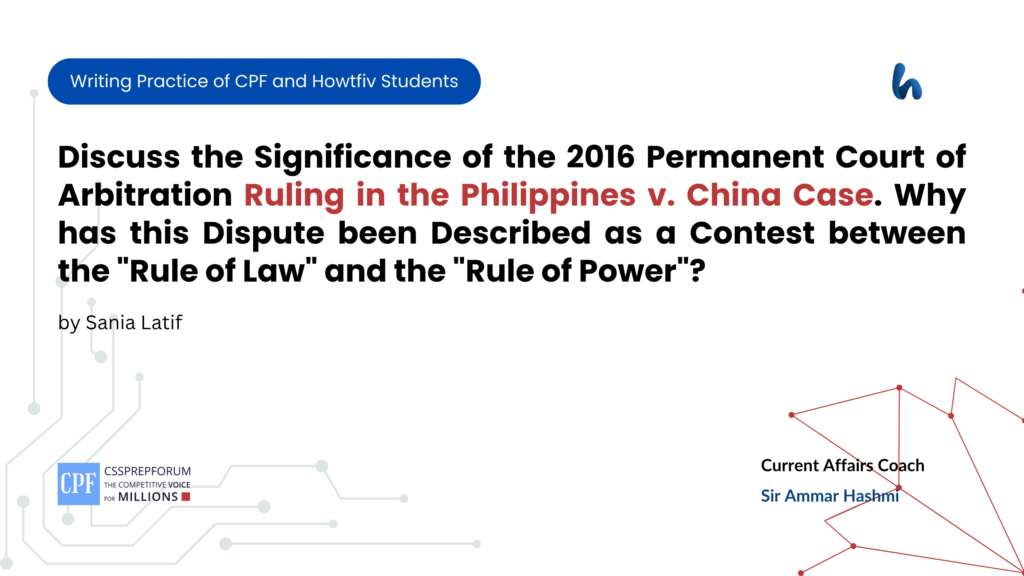
The following question of CSS Pakistan Affairs is solved by Sania Latif under the supervision of Howfiv’s Pakistan Affairs and Current Affairs Coaches: Miss Iqra Ali and Sir Ammar Hashmir. She learnt how to attempt 20 marks question and essay writing from Sir Syed Kazim Ali, Pakistan’s best CSS and PMS English essay and precis teacher with the highest success rate of his students. This solved question is attempted on the pattern taught by Sir to his students, scoring the highest marks in compulsory and optional subjects for years.

Outline
1-Introduction
2-The Genesis of the Permanent Court of Arbitration and its Jurisdiction under UNCLOS
3-Significance of the 2016 Permanent Court of Arbitration Ruling in the Philippines v. China Case
- 3.1-Invalidation of China’s 9-Dash Historic Claim
- 3.2-Legal Status of Maritime Features and Habitation
- 3.3-Protection of the Philippines Sovereign Rights
- 3.4-Censure and Accountability for Environmental Degradation
4- Why has this Dispute been Described as a Contest between the “Rule of Law” and the “Rule of Power”?
- 4.1-International Law vs. Great Power Exceptionalism
- 4.2-Peaceful Dispute Mechanisms vs. De-Facto Gray Zone Tactics
- 4.3-The Paradox of Legal Legitimacy vs. the Realpolitik of Fait Accompli
5-Geopolitical Implications
6-Critical Analysis: Law-Power Asymmetry
7-Conclusion

Answer to the Question
Introduction
The South China Sea has emerged as a prime geopolitical flashpoint of the 21st century, serving as a critical artery for global trade and a primary theatre for great power competition. In 2013, Manila unilaterally initiated compulsory arbitration under the framework of the United Nations Convention on Law of the Sea (UNCLOS), challenging Beijing’s ambiguous territorial assertion. The unanimous award altered the legal geography of the region by dismantling the legal basis of China’s maritime claims. Beyond its legal mechanics, this dispute is internationally categorized as a contest between the rule of law and the rule of power. While the Philippines leveraged multilateral treaty architectures to level the power balance, China responded with institutional boycotts, gray-zone tactics, and a reliance on geopolitical might. Thus, this analysis demonstrates the multifaceted legal significance of the 2016 PCA ruling and how the dispute exposes the friction between international legal liberalism and realpolitik offensive realism.
The Genesis of the Permanent Court of Arbitration and its Jurisdiction under UNCLOS
Historically, the PCA is the oldest global institution for resolving international disputes, operating as an administrative framework designed to support ad hoc arbitral tribunals. Its relevance was fundamentally modernized with the entry into force of UNCLOS in 1994, often referred to as the “Constitution of the Oceans.” Under UNCLOS Article 287, member states can trigger compulsory, binding arbitration when bilateral negotiations fail to resolve the maritime conflict. Crucially, Article 9 dictates that if one party refuses to participate or defend its case, the tribunal must still proceed and render a binding decision. When the Philippines filed a case, China adopted a strict policy of “no acceptance” and “no participation.” However, the PCA established its jurisdiction by clarifying that the case did not seek to award sovereignty over land features, but rather to determine the maritime zones those features could legally generate under treaty.
Significance of the 2016 Permanent Court of Arbitration Ruling in the Philippines v. China Case
- Invalidation of China’s 9-Dash Historic Claim
The foremost legal breakthrough of the award was the invalidation of China’s “Nine-Dash Line”, a cartographic boundary encompassing roughly 80% of the South China Sea. Beijing asserted that its claim was rooted in “historic rights” predating modern maritime law. The tribunal ruled unanimously that whatever historic rights China may have possessed regarding resources were fully extinguished upon its ratification of UNCLOS. The court declared that the treaty created a comprehensive, universal legal order for the oceans, and that claims to historic rights within another state’s Exclusive Economic Zone (EEZ) are fundamentally incompatible with modern international law.
- Legal Status of Maritime Features and Habitation
The tribunal provided the judicial interpretation of UNCLOS Article 121, which distinguishes between fully formed “islands” and mere “rocks.” Under the treaty, islands generate a 200-nautical-mile EEZ and a continental shelf, while rocks generate a narrow 12- nautical-mile territorial sea. The PCA ruled that none of the maritime features in the Spratly Islands, including the largest naturally occurring feature, possess the capacity to sustain stable human habitation or an independent economic life of their own. However, any human presence on these features was dependent on external supplies. Consequently, the court classified them as “rocks” or “low tide elevations,” meaning they cannot generate overlapping EEZs capable of swallowing the Philippines’ maritime zones.
- Protection of the Philippines Sovereign Rights
Moreover, by stripping the Spratly features of their ability to generate massive EEZs, the court effectively mapped out a clear, unobstructed 200-nautical-mile EEZ for the Philippines. The tribunal found that China had actively violated Manila’s sovereign rights within this zone. Specific infractions included: Interfering with Philippine petroleum exploration at Reed Bank, banning Philippine fishermen from operating around Scarborough Shoal, constructing artificial islands at Mischief Reef without Manila’s consent. Therefore, the ruling formally certified the sovereign rights of the Philippines and declaring China’s unilateral action as outright violations of established maritime zones rules.
- Censure and Accountability for Environmental Degradation
Additionally, the ruling delivered a devastating critique of China’s environmental track record. Under UNCLOS, states are legally obligated to preserve and protect the marine environment. The tribunal formally censured China for its massive land reclamation activities. The court ruled that Beijing’s large-scale dredging and artificial island construction caused permanent, irreparable harm to the fragile coral reef ecosystem of the Spratly. Furthermore, the court held that Chinese authorities had failed to stop their domestic fishing fleets from harvesting endangered sea turtles, giant clams, and sharks on a destructive commercial scale. Hence, China must protect and preserve the marine environment.
Why has this Dispute been Described as a Contest between the “Rule of Law” and the “Rule of Power”?
- International Law vs. Great Power Exceptionalism
Moving down the ladder, the legal battle reflects a clash between liberal institutionalism and great power Exceptionalism. The “rule of law” operates on the premise that all sovereign states, regardless of geographic size or economic wealth, are equal before the law. The Philippines’ reliance on UNCLOS was a calculated attempt to use a multilateral treaty shield to counter a severe power asymmetry. Conversely, China’s total rejection of the court’s authority demonstrates the “rule of power.” Beijing acted on the realist assumption that a great power should not have its core national security and territorial interests dictated by an external committee of international jurists. Hence, China followed the principle of “Might is Right,” meaning the strong can do what they want and the weak suffer.
- Peaceful Dispute Mechanisms vs. De-Facto Gray Zone Tactics
Likewise, the conflict juxtaposes the structured, peaceful conflict resolution mechanisms of international law against coercive, non-military pressure tactics. Manila adhered to the rules-based order by submitting evidence and waiting years for a peaceful legal verdict. On the other hand, China countered this legal approach on the water using “gray-zone” tactics, coercive actions that stop just short of triggering an open military conflict. Beijing deployed its vast Chinese Coast Guard (CCG) and a shadowy “maritime militia” comprised of armed fishing vessels. These forces swarmed contested waters, using high-power water cannons, and employed paramilitary force to enforce control, ultimately bypassing international legal restrictions and without provoking a conventional military response.
- The Paradox of Legal Legitimacy vs. the Realpolitik of Fait Accompli
Last but not least, the “rule of law” achieved a total moral and normative victory in the courtroom, stripping China of its legal justifications and branding it a lawbreaker on the global stage. Yet, the “rule of power” dominated physical reality. Because UNCLOS features no international police force or military enforcement mechanism, China successfully executed a strategy of fait accompli (a done deal). Beijing fast-tracked the transformation of submerged reefs into heavily fortified military strongholds, complete with radar domes, anti-ship missiles, and aviation runways. China successfully altered the physical geography of the sea faster than the court could issue its ruling, demonstrating that while law controls the narrative, power still controls the water.
Geopolitical Implications
The 2016 ruling amplified the broader geopolitical rivalry between the United States and China in the Indo-Pacific. Although the US is not a signatory to UNCLOS, it has adopted the 2016 award as the cornerstone of its regional maritime policy. Washington routinely conducts Freedom of Navigation Operations (FONOPs) by sailing naval warships through China-claimed waters, using the PCA ruling as legal justification. Furthermore, the escalation has deepened regional security alliances, pushing the Philippines to revitalize its Enhanced Defense Cooperation Agreement with the US while simultaneously using its rotating ASEAN Chairmanship to build a centralized maritime policy repository. While front-line littoral claimant states increasingly leverage the 2016 award to defend their own EEZs, landlocked and economically dependent members remain vulnerable to Chinese economic statecraft and diplomatic pressure, preventing a unified regional front against Beijing’s expansionism.
Critical Analysis: Law-Power Asymmetry
From the critical perspective, the Philippines vs. China case reveals a fundamental truth about the international rules-based order: international law is highly effective at resolving technical disputes between states of equal stature, but it undergoes severe strain when applied to a nuclear-armed superpower holding a permanent veto on the United Nations Security Council. The asymmetry is not merely military; it is structural. China has successfully engaged in “legal warfare” to build a parallel legal framework that competes directly with Western interpretations of international law. However, dismissal of the ruling as a completely useless piece of paper is an analytical error. The award permanently altered the cost-benefit calculus for Beijing. China suffers from reputational damage, limiting its soft-power ambitions and driving its neighbours directly into defensive security pacts with Western powers. The ruling proved that international law cannot always stop an aggressive state, but it possesses the absolute authority to deny that state the international legitimacy it craves.
Conclusion
In conclusion, the 2016 PCA ruling remains a pivotal milestone in maritime history. By systemically invalidating the Nine-Dash Line and defining the strict legal limits of maritime features, the tribunal provided a clear legal victory for the Philippines and a definitive interpretation of the UNCLOS. Nevertheless, the chronic lack of an enforcement mechanism leaves the South China Sea locked in an unresolved struggle between the “rule of law” and the “rule of power.” While the legal framework provides a vital standard of legitimacy for the global community, realpolitik, and physical force continue to dictate the security dynamics on the open water. The ultimate legacy of Philippines v. China will be determined by whether the international community possesses the collective diplomatic and strategic will to uphold a rules-based ocean order, or whether it will allow the region to slide into an archaic system where raw power overrides the treaty.

CSS Solved Past Papers’ Essays
Looking for the last ten years of CSS and PMS Solved Essays and want to know how Sir Kazim’s students write and score the highest marks in the essays’ papers? Then, click on the CSS Solved Essays to start reading them.
CSS Solved Essays
CSS Solved Islamiyat Past Papers
Want to read the last ten years’ Islamiyat Solved Past Papers to learn how to attempt them and to score high? Let’s click on the link below to read them all freely. All past papers have been solved by Pakistan’s top CSS Islamiyat coaches having the highest score of their students.
CSS Solved Islamiyat
CSS Solved General Science & Ability Past Papers
Want to read the last ten years’ General Science & Ability Solved Past Papers to learn how to attempt them and to score high? Let’s click on the link below to read them all freely. All past papers have been solved by Pakistan’s top CSS GSA coachez having the highest score of their students.
CSS Solved General Science & Ability
CSS Solved Pakistan Affairs Past Papers
Want to read the last fifteen years’ Pakistan Affairs Solved Past Papers to learn how to attempt them and to score high? Let’s click on the link below to read them all freely. All past papers have been solved by Pakistan’s top CSS Pakistan Affairs coaches having the highest score of their students.
CSS Solved Pakistan Affairs
CSS Solved Current Affairs Past Papers
Want to read the last fifteen years’ Current Affairs Solved Past Papers to learn how to attempt them and to score high? Let’s click on the link below to read them all freely. All past papers have been solved by Pakistan’s top CSS Current Affairs coaches having the highest score of their students.
CSS Solved Current Affairs