CSS Pakistan Affairs | Political Instability in Pakistan and Parliamentary System
The following assignment question for CSS Pakistan Affairs is solved by Luqman Naeem under the supervision of Howfiv’s Pakistan Affairs and Current Affairs Coaches: Miss Iqra Ali and Sir Ammar Hashmi. She learnt how to attempt 20 marks question and essay writing from Sir Syed Kazim Ali, Pakistan’s best CSS and PMS English essay and precis teacher with the highest success rate of his students. This solved question is attempted on the pattern taught by Sir to his students, scoring the highest marks in compulsory and optional subjects for years.

Outline
1-Introduction
2-Brief Overview of Pakistan’s Political History
3-Socio-Political Realities of Pakistan
4-Understanding the Difference Between the Presidential and the Parliamentary System
5-Deciphering the Statement
6-Arguments in Favour of the Parliamentary System in Pakistan
- Parliamentary inclusiveness in the presence of a diverse society
- Shared power vs over-centralization
- Possibilities of authoritarianism in political historical view
- Extreme centralization led to weak federalism
- Untouchable inclinations vs answerable to the public
- Flexibility and consensus during crises vs one-man show
- Lessons from Pakistan’s Presidential Experiments
- Landmark alignment with the 18th Amendment
7-Suggestions for a Strong Parliamentary System in Pakistan
- Democratic and ideological culture in parties rather than electable
- Strengthening the Charter of Democracy and impeding the use of the establishment as a reference
- Developing consensus on economy, education and democracy rather than ad hoc practices
- Mandated local governance system under Article 140(a)
8-Conclusion
Answer to the question
Introduction
Pakistan’s political history, characterized by recurrent military interventions and civil-military imbalances, reflects a persistent struggle to establish stable democracy since 1947. Deep-seated socio-economic issues, including a significant youth bulge, financial instability, and regional disparities, shape this volatile landscape. The resulting political environment is marked by deep polarization and a hybrid governance model in which elected civilian administrations often struggle against an established, powerful, and persistent institutional influence. The given statement raises a question regarding Pakistan’s governance structures: whether the country’s inherent instability stems from a parliamentary system ill-suited to its fractured political landscape, or from weak institutions and external interventions. While proponents of a presidential system argue it offers greater stability through a direct, empowered executive, supporters of the parliamentary model emphasize its capacity for inclusiveness and representation in a diverse, multi-ethnic, and multi-cultural society. Ultimately, the political and socio-economic challenges are intertwined with a deeply entrenched power dynamic that continues to define the nation’s fragile democratic landscape.
Brief Overview of Pakistan’s Political History
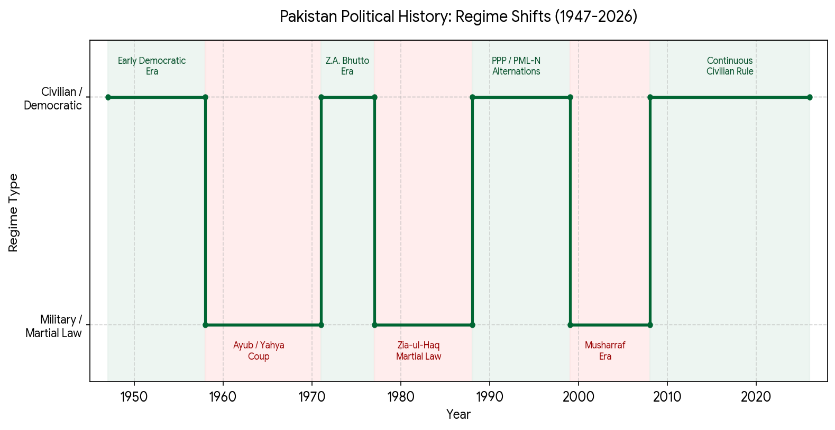
The country has faced political turmoil in the form of successive changes in government and military coups, which strengthened the military role rather than solidifying democratic values due to underdeveloped institutions. Since breaking away from British rule in 1947, the country has struggled to find its footing. It took nine years just to pass a constitution, only for a military coup to throw it out shortly after. The coup consisted of President Ayub Khan and was then taken over by Yahya Khan. This internal friction shattered the nation in 1971, leading to the painful secession of East Pakistan. After this unfortunate event, leadership shifted back to civilians. In 1973, a new constitution laid down a parliamentary framework that still serves as the country’s legal backbone. Yet, stability remained out of reach. The 1980s and 1990s saw a constant tug-of-war, with elected prime ministers repeatedly dismissed before finishing their terms, often due to backroom manoeuvring or direct imposition of martial law. The two decades were marked by the dominance of Zia ul Haq and a musical chair between Benazir Bhutto and M. Nawaz Sharif. By the end of 1999 to 2007, a military coup was led by Gen. Musharraf after severe mistrust between civil and military domains. Democracy was restored in 2007, and a bright spot came in 2013 with Pakistan’s first-ever peaceful democratic transition from one civilian government to another. After this transition onward, every assembly has completed its tenure despite the fact that in-house changes have been inflicted upon parliament by external forces. Still, true stability feels distant today. The political theater remains highly polarized, economic challenges are deep, and the ultimate hybrid regime struggle between the civilian leadership and the powerful establishment continues, hovering above the constitutional realm.
Socio-Political Realities of Pakistan
Before moving ahead, it is important to understand the socio-political realities of Pakistan. Pakistan’s socio-political landscape is shaped by a complex interaction of institutional tensions, economic vulnerabilities, and deep-rooted societal divisions, all of which continue to influence the country’s governance and development. At the core of its political reality is a persistent civil-military imbalance, where the military establishment maintains a powerful role in national governance, often overshadowing elected civilian administrations in matters of foreign policy and national security. This structural tension is mirrored by a domestic political system largely dominated by dynastic political families and patronage networks, which often prioritize local resource distribution over cohesive ideological platforms. Furthermore, hyper-partisanship and digital polarization have increasingly fragmented public discourse, turning political rivalries into deeply personalized standoffs that stall meaningful legislative reform. Socially and economically, Pakistan faces compounding structural crises. The country has a massive youth bulge, with over 60 percent of its population under 30; the state is unable to generate enough jobs, quality education, or technical training to harness this potential. This demographic strain is worsened by chronic economic instability, forcing the country into a cycle of structural inflation and recurring financial bailouts from international lenders. These hardships are not felt equally; deep-seated provincial disparities fuel a sense of marginalisation in smaller provinces over resource distribution, while acute climate vulnerabilities routinely devastate the agrarian sector and fragile infrastructure. Intertwined with these challenges is a highly conservative societal fabric influenced by religious and sectarian undercurrents, creating a volatile environment where the state must constantly navigate the demands of powerful religious factions alongside urgent modern developmental needs.

Understanding the Difference Between the Presidential and the Parliamentary System
After comprehending the realities, it is essential to understand that the difference between a presidential and a parliamentary system lies in how power is distributed and how the executive and legislative branches interact. In a presidential system, such as that of the United States, there is a strict separation of powers. The president is elected directly by the people for a fixed term and serves as both the head of state and the head of government. Because the executive branch operates independently of the legislature, the president cannot be easily removed by a legislative vote of no confidence, ensuring high executive stability. However, this independent structure can lead to severe political gridlock if the president and the majority of the legislature belong to opposing political parties, as neither side is forced to cooperate to keep the government running. Conversely, a parliamentary system, like those found in the United Kingdom or Pakistan, is built on the principle of executive-legislative fusion. In this framework, citizens elect only the legislature, which then selects the Prime Minister (PM), considered the head of government, from among its own members, while a separate figure serves as the ceremonial head of state, known as the president. This structure ensures that the executive always holds a working legislative majority, making lawmaking highly efficient. However, this efficiency comes at the cost of executive stability; the PM serves only as long as they maintain the confidence of parliament and can be removed at any time through a vote of no confidence or a collapse of a ruling coalition. Therefore, both systems are varied forms of democracy that differ on the basis of operational framework.
Deciphering the Statement
The argument that Pakistan’s recurring political instability is a direct by-product of a parliamentary system ill-suited for a fractured polity highlights a fundamental structural mismatch in the country’s governance. A parliamentary system relies entirely on cohesive political parties, ideological consensus, and stable legislative majorities to function effectively. However, in Pakistan, the socio-political reality is deeply fragmented along ethnic, regional, dynastic, and sectarian lines. When this high level of societal division is channelled through a parliamentary framework, it frequently produces fragile, multi-party coalitions. Furthermore, these governments are highly vulnerable to blackmail from smaller political factions and are prone to shifting loyalties. This fragile dynamic prevents PMs from completing their constitutional terms, as their focus is consistently diverted from long-term policymaking to survival tactics, such as dodging votes of no confidence. Nevertheless, blaming institutional instability solely on the parliamentary system overlooks the deeper, historical structural forces at play. Critics who advocate for a presidential system argue that a directly elected executive would provide the stability and decisive decision-making needed to bypass legislative deadlock and patronage politics. Yet, critics of this view point out that Pakistan’s brief experiments with centralized executive power, which were adopted under military-led presidential regimes, historically exacerbated provincial alienation, particularly in smaller provinces that feared the concentration of power in a Punjab-dominated center. The parliamentary system, despite its inherent volatility, remains favoured by many because its consensus-based model provides a vital platform for regional representation. Ultimately, Pakistan’s chronic political instability may not simply be a flaw of the parliamentary design itself, but rather a symptom of weak democratic institutions, weak political parties, and persistent extra-constitutional interventions that prevent any governing system from taking deep root.
Arguments in Favour of the Parliamentary System in Pakistan
- Parliamentary Inclusiveness in the Presence of a Diverse Society
The preference for a parliamentary system over a presidential model in Pakistan is rooted in the country’s intense multi-ethnic and regional diversity. Across provinces, a centralized presidential system poses a structural risk of majoritarian tyranny. Because a presidential model relies on taking most national votes among each other, it would inherently favor the most populous province, permanently alienating smaller peripheral regions. By contrast, Pakistan’s parliamentary framework forces power-sharing. It ensures that the federal executive cannot rule without building a broad coalition that includes regional political parties. The historic 1973 Constitution reinforced this inclusive architecture to heal deep regional divides following the separation of East Pakistan. By making the PM dependent on the continuous confidence of a diverse National Assembly (NA), the system structurally mandates the inclusion of smaller provinces. While critics argue this produces fragile coalitions, this institutional friction is a necessary price for national cohesion, providing the broad-based legitimacy required to hold a fractured federation together.
- Shared Power Vs Over-Centralization
The debate between shared power and over-centralization is central to Pakistan’s constitutional survival. A centralized presidential system consolidates authority within a single executive, a dynamic that historically led to authoritarian overreach and the dangerous alienation of smaller provinces under military regimes. By concentrating decision-making in the federal center, centralization inevitably exacerbates ethnic and regional grievances, pushing peripheral territories toward deep political resentment. In contrast, Pakistan’s parliamentary framework structurally prioritizes shared power through institutional collaboration and federalism. By distributing authority across the cabinet and a diverse legislature, the system prevents any single province or institution from dominating the national agenda. This shared model ensures that governance is a process of continuous negotiation, consensus-building, and provincial representation. While critics frequently claim that decentralization slows policy implementation and dilutes federal control, it remains the only viable mechanism for safeguarding national unity. In a fragmented polity, distributing power across regional lines is not a structural weakness, but an essential barrier against state fragmentation.
- Possibilities of Authoritarianism in Political-Historical View
A political-historical view of the country reveals that a centralized presidential system significantly elevates the possibilities of authoritarianism. Historically, whenever Pakistan shifted away from parliamentary consensus toward a concentrated executive model, notably under the presidential frameworks of military rulers like Ayub Khan, Zia-ul-Haq, and Pervez Musharraf, the institutional checks on absolute power collapsed. By placing supreme authority within a single office, the presidential setup removes the requirement for continuous legislative negotiation, making it remarkably easy for an ambitious executive to bypass political opposition, muzzle judicial independence, and rule through unilateral decree. On the other hand, the nation’s preferred parliamentary system acts as a structural defence against authoritarian overreach. Because a PM must constantly maintain a working majority among diverse parliamentary factions, power remains inherently diffused and transactional. Any attempt to enforce autocratic control risks fracturing the ruling coalition and triggering a sudden vote of no confidence.
- Extreme Centralization Led to Weak Federalism
Historically, extreme centralization has directly led to weak federalism in Pakistan, severely destabilizing the country’s governance. Whenever the federal center attempted to consolidate absolute authority, it eroded the constitutional identity of the provinces. Furthermore, by stripping local administrations of administrative and financial independence, centralization transformed the provinces into weak dependencies of Islamabad. This top-down control systematically undermined federalism by ignoring local governance needs and replacing genuine provincial representation with dictated, bureaucratic decrees from a dominant federal government. Conversely, the nation’s parliament offers a vital institutional corrective to this imbalance by anchoring federalism in shared power. By forcing the central government to negotiate with diverse provincial leadership within the NA, the system protects regional autonomy from being erased by federal overreach. This collaborative structure was crucial in passing the 18th Constitutional Amendment, which actively dismantled decades of extreme centralization by devolving key ministries to the provinces. Therefore, parliament is the viable and existing option to counter over-centralization in a diverse socio-political landscape, which the presidential system preserved historically.
- Untouchable Inclinations Vs Answerable to the Public
The tension between untouchable inclinations and public accountability highlights the core structural advantage of a parliamentary system over a presidential model in Pakistan. A presidential framework can foster untouchable inclinations within the executive, as a directly elected president enjoys a fixed constitutional tenure. Safe from the immediate threat of legislative removal, a centralized leader is insulated from daily political scrutiny, which often breeds an imperial presidency that ignores public dissent and bypasses institutional checks. Conversely, a parliamentary system ensures that the executive remains continuously answerable to the public through their elected representatives. A PM enjoys no fixed term and can be removed instantly through a vote of no confidence if they lose the legislature’s support. This structural dependence forces the cabinet to remain deeply sensitive to shifting public grievances and political alliances. Therefore, a system of accountability and question hour compels the PM to stay in parliamentary lines; however, in the case of a presidential system, it takes a hard and tedious process to make him answerable to the public and the system.
- Flexibility and Consensus during Crises vs One-Man Show
The choice between a flexible, consensus-based model and a ‘one-man show’ highlights how different governance systems handle national crises in Pakistan. A presidential system relies on a centralized, single executive to make rapid, top-down decisions. While this structure offers immediate operational speed, it frequently morphs into exclusionary solo decision-making that ignores regional input. In a highly diverse and ethnically fractured polity, unilateral crisis management from the federal center risks alienating smaller provinces, turning a national emergency into an intense political dispute over state authority. Conversely, parliament excels during crises by structurally mandating flexibility and consensus. Because the PM leads through a multi-party coalition, managing a national emergency requires continuous negotiation and collaboration with diverse regional leaders. This inclusive framework ensures that crisis policies carry broad-based political ownership from all provinces. For instance, during the peak of the Saudi-Houthi conflict, parliament, under pressure from friendly countries, avoided being part of the sectarian-based conflict. Resultingly, parliament has always had the upper hand in the situation of crisis
- Lessons from Pakistan’s Presidential Experiments
The history of Article 58(2)(b) defines a dark presidential era marked by severe institutional instability in Pakistan. Inserted in 1985 by military dictator General Zia-ul-Haq, this controversial provision granted the President unilateral authority to dissolve the NA. This mechanism effectively created an imperial presidency, transforming a ceremonial head of state into an untouchable executive that completely overshadowed the elected PM. Throughout 1985 -1999, Article 58(2)(b) was repeatedly used as a political weapon, abruptly cutting short the lifespans of multiple democratically elected administrations. It was invoked to dismiss the governments of Muhammad Khan Junejo, Benazir Bhutto, and Nawaz Sharif. This continuous threat of dismissal stripped the parliamentary system of its stability, forcing PMs to focus entirely on political survival rather than long-term policymaking. By allowing a single individual to erase the democratic mandate of millions, the article served as a legal cover for authoritarian overreach. This disruptive presidential power was only permanently purged through the landmark 18th Constitutional Amendment in 2010. By removing it, Pakistan restored pure parliamentary supremacy, ensuring that the chief executive remains answerable exclusively to the legislature and the public. In a nutshell, presidential practices do not have any applications and practicality for the diverse federal state of Pakistan.
- Landmark Alignment with 18th Amendment
The landmark alignment between Pakistan’s parliamentary system and the 18th Amendment represents the definitive consolidation of federal democracy in the country. Passed in 2010, the 18th Amendment was specifically designed to dismantle the lingering remnants of presidential centralization left behind by past military regimes. By abolishing the President’s unilateral power to dissolve assemblies, it restored ultimate constitutional authority to the Prime Minister and the parliament, successfully synchronizing the structure of the state with pure parliamentary principles. This alignment permanently reshaped Pakistan’s federal design by devolving seventeen federal ministries directly to the provinces. It anchored provincial autonomy through a mandatory fiscal framework, ensuring that the regional governments possess the financial independence needed to manage their own development. Consequently, the amendment represents the choice of a system in which a parliamentary framework is superior to solve the country’s unique issues.
Suggestions for a Strong Parliamentary System in Pakistan
- Democratic and Ideological Culture in Parties rather than Electability
A major flaw in Pakistan’s parliamentary system is that political parties operate like dynastic family businesses rather than actual democratic institutions. Instead of focusing on shared ideologies or public policy, they rely heavily on wealthy, influential local “electables” to win seats. These electables change their loyalties whenever the political wind shifts, which forces PM into weak, unstable coalitions and leaves them vulnerable to constant political blackmail. To truly strengthen parliament, this culture must change from the ground up. Political parties need to introduce genuine internal democracy by holding fair, regular elections for their own leadership roles. This would break the grip of dynastic control and allow talented, educated young leaders from ordinary backgrounds to rise through the ranks based on merit rather than family names or deep pockets. When parties are built on clear public manifestos and institutional loyalty rather than personal relationships, lawmakers become accountable to their voters and their party’s principles. Shifting toward an ideological culture creates a much more disciplined parliament, ensuring that elected representatives focus on passing meaningful laws for the country rather than playing survival tactics or switching sides for personal gain.
- Strengthening the Charter of Democracy and Impeding the Use of the Establishment as a Reference
To safeguard Pakistan’s parliamentary system, political parties must renew and expand the spirit of the 2006 Charter of Democracy. For decades, a major vulnerability in civilian governance has been the tendency of rival political factions to invite or weaponize the military establishment to undermine elected governments. This short-sighted political warfare creates an institutional vacuum, allowing external forces to dictate national policies and orchestrate backroom shifts in power. To halt this cycle, political leaders must establish a binding, cross-party consensus that strictly forbids appealing to non-political actors for political leverage. Rival parties must commit to resolving their disputes, electoral grievances, and transitions of power entirely within the halls of parliament and established legal frameworks, rather than running to institutional arbiters. By fortifying the Charter of Democracy, civilian leaders can create a unified front that effectively insulates the democratic process from extra-constitutional engineering. When politicians refuse to act as pawns in institutional power games, the parliament naturally regains its status as the supreme decision-making body of the state. This unified resilience is essential to shifting the civil-military balance permanently back toward constitutional supremacy and public accountability.
- Developing Consensus on Economy, Education and Democracy rather than ad Hoc Practices
A fatal flaw in Pakistan’s governance is its chronic reliance on ad hoc, short-term policies that shift disruptively with every change in government. Prime ministers routinely prioritize immediate, populist fixes to ensure survival, derailing vital national projects and locking the state into a volatile cycle of economic and social crises. To transform parliament into an effective institution, political parties must build a binding, cross-party national consensus on the country’s most critical pillars: the economy, education, and democratic continuity. This requires the collective adoption of legally protected, long-term frameworks that remain completely insulated from political transitions. For instance, core strategies regarding tax reform, debt management, vocational training, and curriculum modernization must be locked in for 15-to-20-year horizons, regardless of which party is in power. Transitioning from impulsive fire-fighting to institutional continuity ensures that national development is never held hostage by political polarization. When the parliament establishes a stable, predictable trajectory for development, it regains public trust and proves that a democratic system can deliver sustainable prosperity for its citizens.
- Mandated Local Governance System under Article 140(a)
A major structural weakness in Pakistan’s parliamentary practice is that Members of the National Assembly (MNAs) and Provincial Assemblies (MPAs) spend most of their time acting as municipal managers. Because the country lacks a functional local government system, legislators are forced to chase development budgets for local roads, sewage lines, and streetlights to secure their re-election. This creates a severe conflict of interest, turning lawmakers into contract distributors instead of national policy creators. To rectify this, Pakistan must implement a permanently mandated, financially empowered local government system across all provinces. By strictly enforcing Article 140(a) of the constitution, administrative and financial powers must be legally devolved to elected district and town councils. Stripping lawmakers of direct development funds and handing those resources to local mayors and counselors ensures that grassroots issues are resolved directly by the community. This structural separation relieves the parliament of local municipal burdens. Free from the daily pressures of constituency maintenance, parliamentarians can finally focus entirely on their constitutional duties: macro-level lawmaking, national budget scrutiny, and robust executive oversight.
Conclusion
In conclusion, Pakistan’s chronic political instability is not merely a failure of the parliamentary design, but a deeper reflection of its highly fractured socio-political landscape and weak democratic institutions. While a centralized presidential system is often presented as a solution for executive stability, historical precedent warns that abandoning the parliamentary model risks worsening regional alienation and disrupting the delicate multi-ethnic federation. The path forward lies in strengthening, rather than replacing, the existing constitutional framework. To achieve genuine stability, Pakistan must transition from ad-hoc political engineering toward deep-rooted structural reforms. This requires fostering internal democracy within political parties to dismantle dynastic patronage networks, establishing a robust and constitutionally mandated local government system to separate macro-level lawmaking from local development, and solidifying a cross-party consensus on economic and social roadmaps. Most importantly, state institutions must strictly operate within their constitutional bounds to permanently balance the civil-military dynamic. Ultimately, the survival of Pakistan’s democratic polity depends on the collective resilience of its civilian leadership to prioritize long-term, policy-driven governance over immediate survival tactics, proving that a consensus-based parliamentary system remains the most inclusive vehicle for national unity and sustainable progress.

CSS Solved Past Papers’ Essays
Looking for the last ten years of CSS and PMS Solved Essays and want to know how Sir Kazim’s students write and score the highest marks in the essays’ papers? Then, click on the CSS Solved Essays to start reading them.
CSS Solved Essays
CSS Solved Islamiyat Past Papers
Want to read the last ten years’ Islamiyat Solved Past Papers to learn how to attempt them and to score high? Let’s click on the link below to read them all freely. All past papers have been solved by Pakistan’s top CSS Islamiyat coaches having the highest score of their students.
CSS Solved Islamiyat
CSS Solved General Science & Ability Past Papers
Want to read the last ten years’ General Science & Ability Solved Past Papers to learn how to attempt them and to score high? Let’s click on the link below to read them all freely. All past papers have been solved by Pakistan’s top CSS GSA coachez having the highest score of their students.
CSS Solved General Science & Ability
CSS Solved Pakistan Affairs Past Papers
Want to read the last fifteen years’ Pakistan Affairs Solved Past Papers to learn how to attempt them and to score high? Let’s click on the link below to read them all freely. All past papers have been solved by Pakistan’s top CSS Pakistan Affairs coaches having the highest score of their students.
CSS Solved Pakistan Affairs
CSS Solved Current Affairs Past Papers
Want to read the last fifteen years’ Current Affairs Solved Past Papers to learn how to attempt them and to score high? Let’s click on the link below to read them all freely. All past papers have been solved by Pakistan’s top CSS Current Affairs coaches having the highest score of their students.
CSS Solved Current Affairs