CSS Pakistan Affairs | 1962 Constitution and Debates on Extreme Centralization of Power
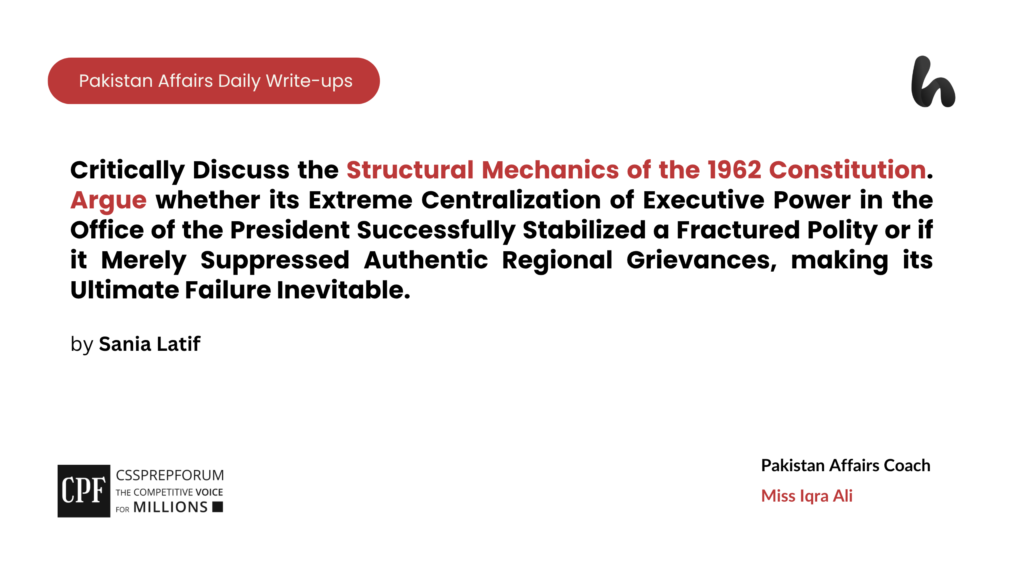
The following assignment question for CSS Pakistan Affairs is solved by Sania Latif under the supervision of Howfiv’s Pakistan Affairs and Current Affairs Coaches: Miss Iqra Ali and Sir Ammar Hashmi. She learnt how to attempt 20 marks question and essay writing from Sir Syed Kazim Ali, Pakistan’s best CSS and PMS English essay and precis teacher with the highest success rate of his students. This solved question is attempted on the pattern taught by Sir to his students, scoring the highest marks in compulsory and optional subjects for years.

Outline
1-Introduction
2-Historical Background: The Genesis of Constitutional Authoritarianism
3-Structural Mechanics of the 1962 Constitution
- 3.1-Imperial Presidency
- 3.2-The Marginalization of the Legislature
- 3.3-Subordination of the Courts and Judiciary
- 3.4-Centralized Federalism
4-How Extreme Centralization of Executive Power in the Office of the President Suppressed Authentic Regional Grievances?
- 4.1-Political Marginalization of East Pakistan
- 4.2-Economic Polarization
- 4.3-The Institutionalization of “One Unit” Scheme
- 4.4-Disenfranchisement of the Masses and the Erosion of Adult Suffrage
5-How did Centralization Temporarily Stabilize a Fractured Polity?
- 5.1-Streamlined Decision-Making and Long-Term Planning
- 5.2-Mitigation of Legislative Deadlocks through Presidential Order
6-Critical Analysis: The Inevitability of Failure
7-Conclusion
Answer to the Question
Introduction
The 1962 constitution was introduced by Field Marshal Ayub Khan as an antidote to institutional chaos. Its structural mechanics set up an imperial presidency. The design gave almost all executive, law-making, and financial powers to the president, while systematically neutralizing the parliament and stripping provinces of their autonomy. Proponents of this framework argue that extreme centralization brought much-needed stability and allowed the government to plan long-term economic reforms without political interference. However, critical evaluation reveals that the stability was entirely illusory. The centralized system ignored the grievances of East Pakistan, and the constitution took away the voting rights of the public through the Basic Democracy system. Consequently, the extreme centralization did not stabilize Pakistan; it merely crushed the regional voices, making the total collapse of the 1962 constitution inevitable.
Historical Background: The Genesis of Constitutional Authoritarianism
Historically, after independence, the protracted delay in framing the permanent Constitution (1947-1956) created a constitutional vacuum, and the structural fragility of early state institutions halted the progress of the country. Moreover, the institutional instability between 1947and 1958, characterized by shifting political coalitions, chronic floor-crossing, and the rapid rise and fall of seven prime ministers, fractured the entire parliamentary system. The abrogation of the 1956 Constitution and declaration of Martial Law by President Iskander Mirza and Ayub Khan framed the Western parliamentary model as inherently unsuited to Pakistan’s sociopolitical realities. In 1960, Ayub Khan established the constitution commission. Headed by Justice Shahabuddin, the commission recommended a balanced presidential system with direct elections. However, Ayub Khan rejected these findings and inclined toward a radically centralized, absolutist system of authority. Ayub Khan’s governance followed the ideology of “Controlled Democracy,” preaching that a developing, multi-ethnic, and low-literacy nation required strong, centralized executive stewardship over chaotic public participation.
Structural Mechanics of the 1962 Constitution
- Imperial Presidency
Primarily, the 1962 Constitution was the creation of a monolithic, omnipotent executive, commonly termed by constitutional historians as an imperial presidency. Field Marshal Ayub Khan designed the office to serve as the supreme center of the Pakistani state, intentionally insulating it from legislative and public accountability. Under the constitution, the President was the Head of State, the Head of Government, and the Supreme Commander of the Armed Forces, wielding unchecked authority to appoint provincial governors, federal ministers, and Supreme Court judges without requiring parliamentary confirmation. This extreme centralization was further cemented by absolute legislative veto mechanisms and expansive emergency powers under Articles 29 and 30. These provisions allowed the president to bypass the legislature entirely and rule by ordinance whenever he deemed an immediate emergency existed. Hence, the 1962 Constitution did not just create a presidential system; it effectively institutionalized the constitutional dictatorship that reduced all other organs of the state to mere appendages.
- The Marginalization of the Legislature
Furthermore, under the 1962 Constitution, the National Assembly was stripped of real authority and turned into a powerless rubber stamp. The biggest blow to the legislature was losing its control over the national budget. Articles 40 to 48 divided state finances into “new” and “recurring” expenditures. The Assembly could vote on new spending, while the vast majority of the budget, the recurring expenses, was passed without their approval. This meant the Assembly could never freeze the government’s funds to check presidential power. On top of this financial weakness, the President had the unilateral power to dissolve the Assembly at any time. By taking away the parliament’s control over money and giving the President the power to send lawmakers home, the constitution ensured that the legislature could never act as a real check on executive overreach.
- Subordination of the Courts and Judiciary
In addition, the 1962 Constitution heavily weakened the judiciary to ensure it could not challenge presidential power. In its original form, the Constitution stripped the courts of the power of “judicial review” regarding Fundamental Rights. This meant citizen could not ask the courts to protect their basic freedoms if the government violated them. Moreover, the President held total control over the superior courts by maintaining the sole authority to appoint and transfer judges. He also retained the leverage to remove judges through a handpicked Supreme Judicial Council, ensuring the bench remained compliant. Consequently, the highest courts were effectively blocked from striking down unconstitutional presidential decrees. By taking away the court’s power to protect fundamental rights and making the judges dependent on executive approval, the constitution turned the judiciary from an independent branch of the state into a subordinate tool of the presidency.
- Centralized Federalism
Although the 1962 Constitution called Pakistan a “federation,” it actually set up a highly centralized system that crushed provincial autonomy. The provinces had no real independence because the provincial Governors were directly appointed by the President and could be dismissed by him at any moment. These Governors acted as the President’s personal agents, ensuring absolute central control over provincial matters. Furthermore, if a provincial assembly passed a law that clashed with a federal law, the central law automatically won under the excuse of “national interest.” Financially, the provinces were also left entirely at the mercy of the center, which controlled the collection and distribution of all revenues. By controlling the Governors and giving the center the final say over all legislation, the Constitution stripped the provinces of their identity and turned a diverse federation into a unitary state managed entirely from the capital.
How Extreme Centralization of Executive Power in the Office of the President Suppressed Authentic Regional Grievances?
- Political Marginalization of East Pakistan
Beyond the structural mechanics of the state, the extreme centralization of the 1962 Constitution directly resulted in the intense political marginalization of East Pakistan. Even though the East Pakistan population made up the actual majority of the country, the constitution intentionally diluted their political weight by enforcing the principle of “parity,” giving both wings an equal number of seats in the National Assembly. This arrangement completely erased East Pakistan’s rightful democratic advantage. Combined with the Basic Democracies system, which replaced direct voting with a small, easily co-opted Electoral College, genuine regional political leadership was systematically locked out of national decision-making. By denying the majority population its rightful political voice, this centralized framework turned the state apparatus into an instrument of West Pakistani domination, transforming regional frustration into permanent alienation. Ultimately, this systemic exclusion planted the seeds for Sheikh Mujibur Rahman’s radical demand for provincial autonomy through the six-point Movement.
- Economic Polarization
Additionally, the centralized mechanics of the 1962 Constitution triggered severe economic polarization between the two wings. Because all financial planning and resource distribution were controlled entirely by the central government based in West Pakistan, the state’s wealth was systematically diverted away from the East. Foreign exchange earned from East Pakistan’s lucrative jute exports was repeatedly used to fund the industrialization of West Pakistan, while the majority of foreign aid was diverted into Western development projects like the Indus Basin works. This highly centralized arrangement starved the East Pakistan economy of capital, directly fueling an extreme concentration of wealth. This polarization was starkly captured by the chief economist of the era, who revealed that just 22 families, almost exclusively based in West Pakistan, had monopolized 66% of the country’s industrial assets. By stripping the Eastern wing of its fiscal autonomy, the constitution effectively institutionalized a form of internal colonialism that made regional economic breakdown inevitable.
- The Institutionalization of “One Unit” Scheme
Not only this, but also the 1962 Constitution institutionalized the highly controversial One Unit scheme, which officially merged the distinct provinces of West Pakistan into a single political entity. Initially introduced in 1955, this arrangement was permanently locked into place by the 1962 framework to create an artificial balance of power against East Pakistan’s population majority. While it successfully neutralized the demographic advantage of the eastern wing, it simultaneously crushed the historical and political identities of smaller Western provinces like Sindh, Balochistan, and Khyber Pakhtunkhwa (NWFP). By erasing provincial borders, the central regime concentrated all administrative and financial authority in Lahore and Islamabad, leaving smaller provinces completely sidelined. Consequently, rather than creating national unity as the regime claimed, the constitutional enforcement of the One Unit scheme deeply alienated both the eastern majority wing and western ethno-nationalist wing of Pakistan.
- Disenfranchisement of the Masses and the Erosion of Adult Suffrage
Last but not least, the 1962 Constitution completely disenfranchised the general public by abolishing universal adult suffrage, the right of every adult citizen to vote directly for their leaders. Instead, the framework introduced the Basic Democracy system, an indirect voting method that reduced the entire national electorate to a tiny college of just 80,000 local councilors, known as Basic Democrats. Because this small group was highly dependent on state funds and easily manipulated by civilian bureaucrats, the central government effectively pressured its way into power, making true public accountability impossible. This structural shift stripped ordinary citizens of their democratic agency and reduced elections to an elite-driven ritual. Consequently, by choking off the population’s direct participation in the political process, the regime destroyed the state’s legitimacy and left public agitation as the only remaining avenue for political expression.
How did Centralization Temporarily Stabilize a Fractured Polity?
- Streamlined Decision-Making and Long-Term Planning
Conversely, the concentration of power stabilized Pakistan’s chaotic political landscape by enabling highly streamlined decision-making. By eliminating the parliamentary deadlocks and frequent changes of government, the 1962 Constitution allowed the executive to bypass political squabbles and enact long-term developmental plans with absolute authority. This stability was central to the success of the Second Five-Year Plan and the Green Revolution, both of which triggered a massive surge in industrial and agricultural productivity. However, this economic progress was structurally lopsided. By forcing through development plans from a highly centralized center, the regime prioritized top-down growth while entirely ignoring the widening regional disparities and public grievances. Ultimately, the regime’s economic success story was built on a fragile foundation; it created a veneer of stability that masked the deep-seated frustration boiling underneath the surface.
- Mitigation of Legislative Deadlocks through Presidential Order
Likewise, the 1962 Constitution stabilized the state by using absolute presidential authority to eliminate the legislative deadlocks of the past. Under this constitution, the president held supreme power to issue ordinances, override parliamentary opposition, and control the national budget without legislative approval. This framework effectively insulated the government from the shifting political alliances and floor-crossing that had crippled Pakistan’s democracy in the 1950s. While this setup successfully maintained policy continuity and administrative stability, it ultimately acted as a tool for the suppression of regional and public grievances. By closing off the legislature as a forum for genuine political debate, the regime ensured that when these unaddressed tensions were exacerbated, they would shatter the constitutional framework.
Critical Analysis: The Inevitability of Failure
From the critical perspective, the collapse of the 1962 Constitution was not an accidental byproduct of political mismanagement, but a structural inevitability built into the framework itself. By dismantling the federal principle and concentrating all political, financial, and legislative authority within a singular executive office, the constitution created a rigid political system that could neither accommodate regional diversity nor absorb public discontent. When the masses were stripped of direct suffrage, and the provinces were denied fiscal autonomy, the state effectively closed all institutional doors to genuine political participation. Consequently, without a representative parliament to act as a safety valve for public grievances, the constitutional structure left the population with no alternative but to take to the streets. The massive public agitation of 1968-1969 proved that this stability was maintained by suppressing grievances; therefore, the system was destined to fracture under the weight of its own authoritarian design.
Conclusion
In conclusion, the 1962 Constitution proves that an authoritarian government cannot force national unity on a diverse country. While the system temporarily stabilized Pakistan through long-term economic planning, it achieved this by taking away the basic rights of people. By concentrating all power in the presidency, ignoring the smaller provinces through the One Unit scheme, and allowing wealth to accumulate among the 22 families, the regime deeply angered both East Pakistan and the smaller western provinces. Ultimately, by taking away the right to vote directly and weakening the parliament, the constitution left the public with no peaceful way to protest. The collapse of the 1962 Constitution proved that stability built on suppressing public grievances was therefore destined to fail. Hence, national unity can only be achieved through democracy, provincial autonomy, and fair power-sharing.

CSS Solved Past Papers’ Essays
Looking for the last ten years of CSS and PMS Solved Essays and want to know how Sir Kazim’s students write and score the highest marks in the essays’ papers? Then, click on the CSS Solved Essays to start reading them.
CSS Solved Essays
CSS Solved Islamiyat Past Papers
Want to read the last ten years’ Islamiyat Solved Past Papers to learn how to attempt them and to score high? Let’s click on the link below to read them all freely. All past papers have been solved by Pakistan’s top CSS Islamiyat coaches having the highest score of their students.
CSS Solved Islamiyat
CSS Solved General Science & Ability Past Papers
Want to read the last ten years’ General Science & Ability Solved Past Papers to learn how to attempt them and to score high? Let’s click on the link below to read them all freely. All past papers have been solved by Pakistan’s top CSS GSA coachez having the highest score of their students.
CSS Solved General Science & Ability
CSS Solved Pakistan Affairs Past Papers
Want to read the last fifteen years’ Pakistan Affairs Solved Past Papers to learn how to attempt them and to score high? Let’s click on the link below to read them all freely. All past papers have been solved by Pakistan’s top CSS Pakistan Affairs coaches having the highest score of their students.
CSS Solved Pakistan Affairs
CSS Solved Current Affairs Past Papers
Want to read the last fifteen years’ Current Affairs Solved Past Papers to learn how to attempt them and to score high? Let’s click on the link below to read them all freely. All past papers have been solved by Pakistan’s top CSS Current Affairs coaches having the highest score of their students.
CSS Solved Current Affairs