PMS 2025 Solved Pakistan Affairs Past Papers | Implications of India Holding the IWT in Abeyance.
The following question of PMS Pakistan Affairs 2025 is solved by Ronra Kasi, the student of Miss Iqra Ali, the best Pakistan Affairs Coach, on the guided pattern of Sir Syed Kazim Ali, which he taught to his students, scoring the highest marks in compulsory subjects for years. This solved past paper question is uploaded to help aspirants understand how to crack a topic or question, how to write relevantly, what coherence is, and how to include and connect ideas, opinions, and suggestions to score the maximum.

Outline
1-Introduction
2-A Panoramic View: Indus Waters Treaty
3- Implications of India Holding the Indus Waters Treaty in Abeyance to Pakistan
- ✓3.1- Strategic Vulnerability: The Data and Notification Blackout
- Case in Point: India halted hydrological data sharing, technical meetings, and inspection rights, a coercive information weapon independent of physical diversion
- ✓3.2 Agriculture and Food Security Under Existential Threat
- Case in Point: According to ISSI (June 2025), agriculture alone accounts for 24% of GDP, 24.4% of total exports, and 37.4% of employment, and over 90% of cultivated land is irrigated by the Indus system. ISSI (June 2025)
- ✓3.3 Intensifying Inter-Provincial Tensions
- Case in Point: WAA 1991 based on 114.35 MAF with no shortage-period mechanism; IWT abeyance reduces total western river inflow, triggering Sindh-Punjab disputes over residual flows: a fault line the treaty had historically suppressed
- ✓3.4 Water Scarcity: From Crisis to Catastrophe
- Case in Point: Pakistan’s water storage capacity is critically limited; declining groundwater and erratic surface flows have pushed the country toward “absolute water scarcity.”Pakistan already ranks among the world’s top 40 most water-stressed nations
- ✓ 3.5 Energy Security and Economic Stability
- Case in Point: A 2023 World Bank study estimated that a 20% reduction in Indus flows could reduce Pakistan’s GDP by 5–7% over a decade; India’s approval of the Dulhasti Stage-II project (January 2026) signals accelerated upstream infrastructure development under the cover of abeyance
4- Implications of India Holding the Indus Waters Treaty in Abeyance to the Region
- ✓4.1 Kashmir Conflict: Water as a Permanent Coercive Lever
- Case in Point: Abeyance links the unresolved Kashmir dispute directly to water security; every militant incident now carries the potential to trigger downstream water consequences for 250 million Pakistanis, institutionalizing hydro-coercion as a geopolitical instrument
- ✓4.2 Destabilizing Pakistan Aggravates Regional Risk
- Case in Point: The Eurasia Group’s Top Risks 2026 report identified Indus weaponization as a top global political risk, projecting cascading humanitarian crises (malnutrition, mass displacement) from a water-stressed Pakistan; a fractured nuclear-armed state is a regional catastrophe
- ✓4.3 A Dangerous Precedent for Bangladesh and Nepal
- Case in Point: Bangladeshi water expert Aninun Nishat warned that India’s abeyance jeopardizes renewal of the 1996 Ganges Treaty; if India can weaponize water against Pakistan, Bangladesh has reason to doubt all bilateral water assurances from New Delhi potentially driving it toward Chinese-financed water infrastructure
- ✓4.4 China’s Hydro-Hegemony: Normalizing Upstream Coercion
- Case in Point: China’s $167 billion Motuo Dam on the Yarlung Tsangpo will give Beijing uncontested upstream control over the Brahmaputra, which supplies ~30% of India’s freshwater and ~44% of its hydropower potential; India’s precedent of upstream coercion can now be mirrored by China against India itself, with no treaty mechanism to prevent it
5-The Policy Road-map To Arbitrate The Water Dispute
- ✓5.1 Leverage the PCA Ruling and Escalate to the ICJ
- Pakistan’s primary legal forum is the existing PCA Court of Arbitration, which in June 2025 confirmed the IWT cannot be unilaterally held in abeyance and reaffirmed its jurisdiction. Pakistan should build on this ruling and, as a parallel track, invoke the ICJ under the UN Charter citing violations of customary international law (Articles 60 and 62 of the Vienna Convention, which reflect customary norms binding on India even as a non-VCLT signatory).
- ✓5.2 Re-engage the World Bank: With Realistic Expectations
- The World Bank remains the treaty’s guarantor in reputational terms, but its president has confirmed its role is limited to facilitation. Pakistan should use World Bank engagement for international legitimacy and norm-reinforcement, not as a primary enforcement mechanism.
- ✓5.3 Accelerate Strategic Dam Construction
- Diamer-Bhasha and Mohmand Dams must be treated as national security infrastructure. Every year of delay deepens dependence on Indian-controlled upstream flow.
- ✓5.4 Overhaul Pakistan’s Domestic Water Governance
- Pakistan’s internal water crisis: provincial disputes, inefficient irrigation, and groundwater depletion, predates the abeyance and amplifies its impact. Robust domestic water governance is both a resilience measure and a condition of credible international advocacy.
6- Conclusion

Answer to the question
Introduction
Water has always been central to the India-Pakistan rivalry, but India’s decision in April 2025 to hold the Indus Waters Treaty in abeyance following the Pahalgam attack marked a historic rupture. Signed in 1960 after nine years of World Bank-mediated negotiations, the IWT survived three wars and decades of hostility, earning its reputation as one of the world’s most resilient water-sharing frameworks. However, by placing it unilaterally in abeyance, India has weaponized water as a geopolitical instrument, generating consequences that stretch far beyond bilateral diplomacy to threaten Pakistan’s food security, economy, and regional stability.
A Panoramic: The Indus Waters Treaty
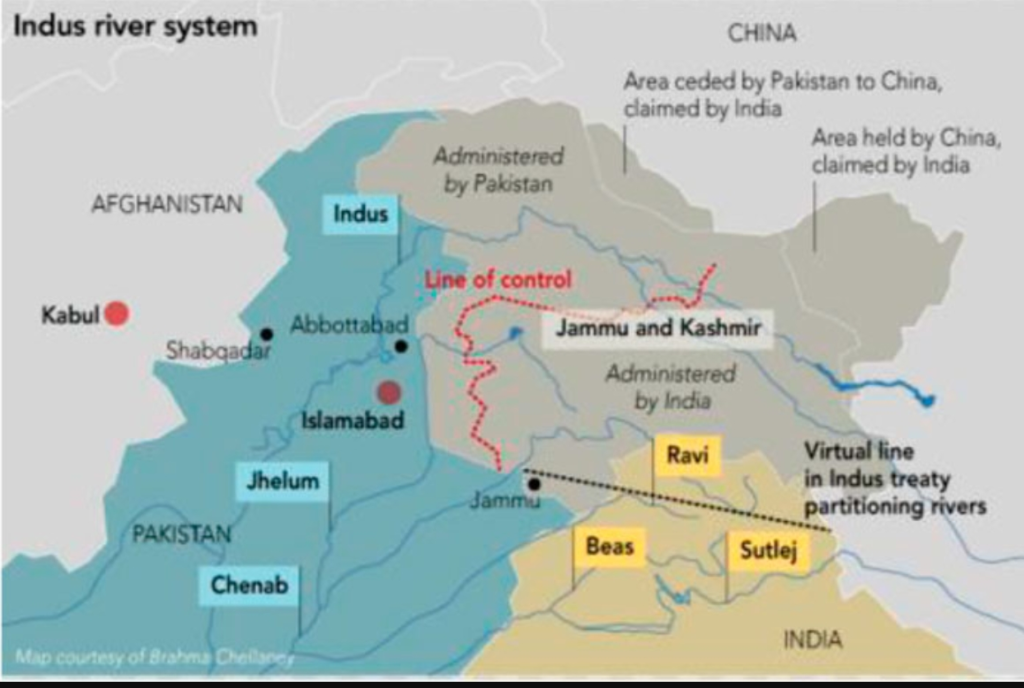
It is imperative to recognize that the IWT, signed on September 19, 1960, between Prime Minister Jawaharlal Nehru and President Ayub Khan, allocated the three eastern rivers (Ravi, Beas, Sutlej) to India and the three western rivers (Indus, Jhelum, Chenab) to Pakistan, giving Pakistan roughly 80% of total basin flows. What made the treaty remarkable was not just its technical detail but its political durability, having held firm through three wars, nuclear standoffs, and years of diplomatic hostility. It also established the Permanent Indus Commission for data exchange and dispute resolution. At this juncture, this framework survived wars and nuclear crises, earning its status as one of international law’s most durable water agreements. Thus, India’s April 2025 abeyance marks an unprecedented departure from 65 years of treaty compliance.
India Holding IWT in Abeyance: Implications for Pakistan
Implications of India holding the Indus Waters Treaty in abeyance for Pakistan are as follows:
- Strategic Vulnerability: The Data and Notification Blackout
Stemming from the reality, India’s abeyance has created a dangerous information vacuum for Pakistan’s water management apparatus. This effectively strips Pakistan of the early-warning intelligence it needs to manage one of the world’s most complex irrigation systems. Along with formally suspending the treaty, India halted hydrological data sharing, canceled scheduled technical meetings, and blocked Pakistan’s inspection rights. It bears emphasis that this information blackout functions as a coercive weapon entirely independent of any physical diversion of water. Contingent upon this, without real-time flow data, Pakistan’s irrigation authorities cannot plan seasonal releases, anticipate flood events, or manage reservoir levels, leaving the entire downstream water management system structurally blind and exposed.
- Agriculture and Food Security Under Existential Threat
Equally significant is Pakistan’s agriculture and water storage systems that depend heavily on the flow of western rivers allocated under the historic treaty, and the international community, including India, had accepted Pakistan’s right on the water of western rivers. In particular, according to ISSI (June 2025), agriculture contributes 24% to GDP, 24.4% to total exports, and employs 37.4% of the workforce, with over 90% of cultivated land irrigated by the Indus system. The scale of this dependency means that water and food security in Pakistan are not separate policy domains but two sides of the same coin. This effectively strips Pakistan of the early-warning intelligence it needs to manage one of the world’s most complex irrigation systems. Any sustained disruption in western river flows, in turn, can lead to the collapse of crop yields, displace millions of rural workers, and deepen food insecurity across an already strained economy. The abeyance, therefore, is not merely a diplomatic dispute but a direct attack on Pakistan’s economic survival and the livelihoods of its rural majority.
| Indicator | Figure |
| Agriculture’s share of GDP | 25% |
| Share of national export | 24.4% |
| Labour force in agriculture | 37.4% |
| Water withdrawal for agriculture | 90% + |
| Pakistan’s water storage capacity | 94% |
- Intensifying Inter-Provincial Tensions
Moreover, India’s abeyance threatens to inflame Pakistan’s existing fault lines over internal water distribution. Historically, inter-provincial water disputes in Pakistan have been among its most politically volatile domestic conflicts, and abeyance now removes the one external guarantee that kept them manageable. To illustrate, the Water Apportionment Accord of 1991 was negotiated on the basis of 114.35 MAF of inflows and contains no formal mechanism for shortage periods. Any reduction in total inflow triggers a zero-sum contest between provinces, particularly between Sindh and Punjab, over residual flows. The IWT had historically suppressed this conflict by guaranteeing a stable total volume. Hence, abeyance removes that guarantee and risks opening a dangerous domestic political front at the worst possible time.
| Province | MAF Allocation | % Share | Raparian position |
| Punjab | 55.94 MAF | 48% | Upper |
| Sindh | 48.76 MAF | 42% | Lower |
| KPK | 6.78 MAF | 7% | Upper (Enterypoint) |
| Balochistan | 3.87 MAF | 3% | Lowest downstream |
| Total | 1144.35 MAF | 100% |
- Water Scarcity: From Crisis to Catastrophe
With far-reaching consequences, Pakistan was already approaching a water catastrophe before India’s suspension, and the abeyance threatens to accelerate this trajectory. The abeyance arrives at precisely the worst moment, when Pakistan’s internal water buffers are at their thinnest and its capacity to absorb external shocks at its lowest. Pakistan’s storage capacity is critically limited, groundwater reserves are being depleted at alarming rates, and erratic surface flows have brought the country toward absolute water scarcity. As an illustration, Pakistan already ranks among the world’s top 40 most water-stressed nations. Disrupting the Indus system under these pre-existing conditions is not merely damaging but potentially catastrophic, threatening the survival of hundreds of millions who depend on this system for daily needs.
- Energy Security and Economic Stability
Beyond agriculture, the abeyance directly threatens Pakistan’s energy infrastructure and macroeconomic stability. What makes this particularly alarming is that the economic damage compounds over time, meaning a delayed diplomatic resolution translates directly into accumulated and irreversible economic loss. In particular, the 2023 World Bank study estimated that a 20% reduction in Indus flows could reduce Pakistan’s GDP by 5 to 7 percent over a decade. Simultaneously, India’s approval of the Dulhasti Stage-II project in January 2026 signals that New Delhi is using the cover of abeyance to accelerate upstream dam construction. This dual strategy of withdrawing treaty protections while expanding upstream infrastructure structurally deepens Pakistan’s long-term energy and economic vulnerability.
India Holding IWT in Abeyance: Regional Implications
The implications of India holding the Indus Waters Treaty in abeyance for the region are as follows:
- Kashmir Conflict: Water as a Permanent Coercive Lever
In the first instance, India’s abeyance has institutionalized the linkage between the unresolved Kashmir dispute and Pakistan’s water security, creating a dangerous new geopolitical reality. In practical terms, this means India has acquired a ready-made pressure valve it can activate at any point of bilateral tension without firing a single shot. Every future militant incident in Kashmir now carries the potential to trigger downstream water consequences for 250 million Pakistanis, effectively making water a permanent coercive instrument tied to an unresolved territorial conflict. This transforms the IWT from a cooperative framework into a hostage mechanism, directly undermining the foundational principle that water cooperation must remain insulated from security politics.
- Destabilizing Pakistan Aggravates Regional Risk
In the long run, a water-stressed, economically weakened Pakistan is not merely a bilateral concern but a global security risk. History consistently shows that resource-stressed nuclear states do not become more cautious; they become more unpredictable. The Eurasia Group’s Top Risks 2026 report identified Indus weaponization as a top global political risk, projecting cascading humanitarian consequences, including malnutrition and mass displacement from a water-stressed Pakistan. A nuclear-armed state experiencing acute resource stress and institutional pressure represents a scenario that no regional or global power can afford to ignore. Destabilizing Pakistan through water coercion ultimately threatens the entire South Asian security architecture.
- A Dangerous Precedent for Bangladesh and Nepal
As the situation unfolded, India’s suspension sent a deeply troubling signal to other downstream neighbors who depend on bilateral water arrangements with New Delhi. The damage to India’s credibility as a water-sharing partner is therefore not limited to Pakistan but extends across the entire region. For instance, Bangladeshi water expert Aninun Nishat has warned that India’s abeyance jeopardizes the renewal of the 1996 Ganges Treaty. If India can unilaterally weaponize water against Pakistan, Bangladesh has rational grounds to doubt all water assurances from New Delhi, potentially driving Dhaka toward Chinese-financed water infrastructure and deepening Beijing’s strategic foothold in South Asia. Last but not least, India’s behavior establishes a precedent that China is fully positioned to exploit against India itself. In establishing that upstream states can legally hold treaties in abeyance during security disputes, India has handed China a ready-made justification for doing exactly the same on the Brahmaputra. As an illustration, China’s $167 billion Motuo Dam on the Yarlung Tsangpo will give Beijing uncontested upstream control over the Brahmaputra, which supplies approximately 30% of India’s freshwater and 44% of its hydropower potential. By normalizing upstream coercion as a geopolitical instrument, India has effectively surrendered any principled objection to China doing the same. Ultimately, the precedent India has set may harm India far more than it harms Pakistan.
The Policy Roadmap for Pakistan to Arbitrate the Water Dispute
- Leverage the PCA Ruling and Escalate to the ICJ
First and foremost, Pakistan’s strongest immediate legal tool is the June 2025 PCA ruling, which confirmed that the IWT cannot be unilaterally held in abeyance and reaffirmed the court’s jurisdiction. The legal architecture already exists; what Pakistan needs now is the political will and diplomatic coordination to use it at full scale. Pakistan must build on this foundation through a parallel track at the International Court of Justice, invoking the UN Charter and citing violations of customary international law under Articles 60 and 62 of the Vienna Convention, norms that bind India even as a non-VCLT signatory.
- Re-engage the World Bank: With Realistic Expectations
Second, Pakistan must re-engage the World Bank as treaty guarantor while maintaining realistic expectations about the limits of its role. Used correctly, World Bank engagement keeps the treaty’s violation visible on the international stage and prevents India from quietly normalizing abeyance as an acceptable state of affairs. The Bank’s own president has confirmed that its function is limited to facilitation rather than enforcement. Pakistan should use this engagement strategically for international legitimacy and norm-reinforcement, particularly to signal to the global community that a major water-sharing treaty is being violated, while pursuing binding remedies through the PCA and ICJ.
- Accelerate Strategic Dam Construction
Third, Pakistan must treat its major water infrastructure projects as national security priorities rather than development aspirations. Strategic water sovereignty cannot be achieved through diplomacy alone; it requires physical infrastructure that reduces Pakistan’s structural exposure to upstream decisions. Diamer-Bhasha Dam and Mohmand Dam must be fast-tracked on a war footing, as every year of delay deepens Pakistan’s structural dependence on Indian-controlled upstream flows. Domestic water storage is the only reliable long-term buffer against the risk of India using abeyance or future treaty modifications to control Pakistan’s effective water supply.
- Overhaul Pakistan’s Domestic Water Governance
Ultimately, Pakistan’s internal water crisis, shaped by provincial disputes, inefficient irrigation, and severe groundwater depletion, predates India’s abeyance and significantly amplifies its consequences. Ultimately, Pakistan’s credibility in demanding treaty compliance from India will always be undermined if it cannot demonstrate responsible stewardship of the water it already receives. Compounding this further, robust domestic governance reform is therefore not merely a developmental priority but a condition of credible international advocacy. A country that mismanages its existing water supply weakens its own legal and moral standing in international forums. Reforming the Water Apportionment Accord, modernizing irrigation infrastructure, and regulating groundwater extraction are steps Pakistan cannot afford to delay.
Conclusion
To put it succinctly, India’s decision to hold the Indus Waters Treaty in abeyance is not a temporary diplomatic maneuver but a structural shift with consequences that will define South Asia’s trajectory for decades. The road ahead demands not reactive diplomacy but a coordinated, multi-track strategy that combines legal assertion, infrastructure investment, and domestic reform into a single coherent national response. The implications range from immediate threats to Pakistan’s agriculture, energy security, and internal cohesion to the broader dangers of normalizing water as a geopolitical weapon. Pakistan’s response must be equally strategic: building on the PCA ruling, engaging the World Bank for legitimacy, accelerating dam construction, and reforming domestic water governance. In the 21st century, water security and national security have become one and the same.
PMS 2025 Solved Pakistan Studies
| 1- | Pakistan is suffering from a crisis of governance at the institutional level. Suggest remedies to mitigate this situation. |
| 2- | What relevance did the religious revivalist movements have with the needs of the time in post 1857 colonial India? What new trends had been introduced by such movements? Discuss. |
| 3- | Examine ever-conflicting relations between Pakistan and Afghanistan. How can the conflicts be resolved? Discuss |
| 4- | What fundamental rights have been granted to minorities in Pakistan? What are the hindrances to the application of the constitutional rights in this regard? Suggest remedies |
| 5- | How has the war on terrorism shaped the new dimensions of civil-military relations in Pakistan? Elaborate with examples & highlight its implications. |
| 6- | Critically examine the implications of India holding the Indus Waters Treaty in abeyance. |
CSS Solved Past Papers’ Essays
Looking for the last ten years of CSS and PMS Solved Essays and want to know how Sir Kazim’s students write and score the highest marks in the essays’ papers? Then, click on the CSS Solved Essays to start reading them.
CSS Solved Essays
CSS Solved General Science & Ability Past Papers
Want to read the last ten years’ General Science & Ability Solved Past Papers to learn how to attempt them and to score high? Let’s click on the link below to read them all freely. All past papers have been solved by Pakistan’s top CSS GSA coach having the highest score of their students.
General Science & Ability Solved Past Papers