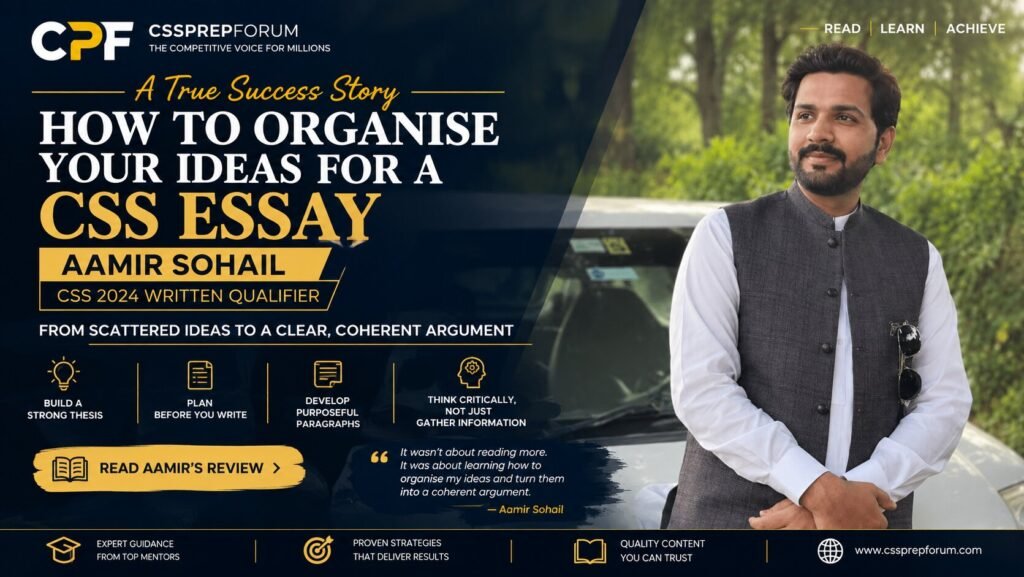
Having plenty of ideas doesn’t guarantee a coherent CSS essay. Drawing on CSS 2024 written qualifier Aamir Sohail’s experience, this article shows how to organise scattered knowledge into a clear, convincing argument by building a strong thesis, deliberate planning, purposeful paragraphs, and critical thinking.
You can know a subject inside out and still write a bad essay about it. That surprises a lot of aspirants, and it shouldn’t, because writing and knowing are simply two different skills that happen to get tested on the same paper.
Picture the fairly typical CSS candidate: months of reading behind them, a genuine grasp of the topic in front of them, and every intention of doing it justice. What lands on the page often doesn’t match that preparation. Arguments start bleeding into each other; a paragraph opens with one point and quietly ends up somewhere else. And by the third page, it’s hard to say what the essay was actually trying to prove. None of this happens because the aspirant lacks material. It happens because nobody ever taught them how to arrange it.
That distinction gets lost in most CSS preparation, where success is measured by how much you’ve read rather than how well you can use it. Two aspirants can walk into the exam with roughly the same command of a topic and come out with very different scripts, and the gap between them usually has less to do with intelligence than with a much plainer skill: knowing what to keep, what to cut, and what order to put things in.

Aamir Sohail, an ACCA member, an Accounts Officer at a public-sector organisation, and a CSS 2024 Written Qualifier, ran into this problem. In his review, “Sir Syed Kazim Ali: The Master,” he talks about what changed once he joined Sir Syed Kazim Ali’s course, and it wasn’t primarily his vocabulary or his grammar. It was how he learned to structure his thoughts, build a thesis that could actually hold an essay together, plan before writing a single line, and give each paragraph a flow that didn’t need to be second-guessed.
If you’ve ever finished an essay knowing the ideas were good but sensing something about the shape was off, his experience is worth following closely. What comes next isn’t a checklist so much as a different way of looking at the essay before you’ve written a word of it.
Why do ideas become disorganised in an essay?
Usually, the problem starts before the pen touches paper.
An aspirant reads the topic, and the mind does what minds naturally do with an open prompt, i.e., it starts free-associating. One idea calls up another, which calls up a third, and within a few minutes there’s a fairly large pile of points connected to the topic in only the loosest sense. Nothing is holding them together yet. What eventually gets written is often full of information and strangely empty of direction: pages of facts that could belong to several different essays, set down more or less in the order they occurred to the writer.
It’s worth saying plainly that this isn’t a sign of weak intelligence. If anything, it’s what happens to people who’ve read widely and remembered what they read. The aspirants who struggle here rarely know too little. Usually they know quite a lot, and simply haven’t been shown how to make all of it answer to one argument instead of just sitting next to it on the page.
Getting organised means choosing rather than gathering. Nobody is obligated to include every relevant thought they happen to own; the obligation runs the other way: you decide, before you write, which ideas actually serve the argument you’re making. And that decision has to happen at the planning stage, because an essay drafted without it tends to read like a transcript of the writer’s thinking rather than a considered answer to a question.
Aamir Sohail names this directly as one of the clearest changes in his own preparation: real planning and a structure sturdy enough to hold its own weight instead of one propped up by sheer volume.
Begin by understanding the demand of the topic
Before any of that sorting can happen, you need to know precisely what the essay is asking of you. And topics have a habit of looking roomier than they actually are.
Take a hypothetical prompt on whether artificial intelligence will transform employment. A writer in a hurry might dive straight into AI’s history, its technological trajectory, automation, education, robotics, unemployment, productivity, economic growth, material that isn’t wrong so much as unfocused. Each paragraph, read on its own, could be perfectly competent. The essay as a whole would still fall apart, because none of those paragraphs would actually be answering the same question.
So the first job is narrower than it feels: pin down the exact relationship the topic wants examined. Is it asking whether jobs disappear outright, or whether they transform? Is it weighing opportunity against risk, or asking you to judge a specific claim? “Transform” and “threaten” are not the same word, and an essay that treats them as interchangeable will lose marks on relevance no matter how much the writer actually knows.
Everything downstream, i.e., the thesis, the outline, the paragraphing, depends on getting this part right first. Miss it, and no amount of structural discipline later can fully make up the difference.
Write the central position before collecting endless arguments
Aamir keeps coming back to the thesis in his review, and it’s easy to see why once you notice the pattern. He describes learning to build a genuinely strong one and construct the essay outward from it, and this single habit does more to hold an essay together than almost any other tool a writer has.
Think of the thesis as the essay’s centre of gravity. Once it’s in place, every argument you’re tempted to add can be tested against one question: does this actually help prove my thesis? If the honest answer is no, it doesn’t belong, however interesting or however true it happens to be. A thesis, in that sense, isn’t just a well-turned sentence sitting in the introduction for effect. It quietly decides which statistic makes the cut and which example gets left out.
Some aspirants resist this because cutting a fact they worked to find feels like wasted effort. But an essay isn’t meant to display everything you know about a subject; it’s meant to argue something, and an argument is defined as much by what it leaves out as by what it keeps in. The thesis is what gives a writer permission to leave things out.
Do not confuse an outline with a list of topics
A good outline should show the essay’s intellectual skeleton. Too often, what gets written down is just a list of categories
- Education
- Economy
- Politics
- Technology
- Society
These are rooms, not a building. They tell you where the essay is going to wander, but say nothing about what it’s trying to establish once it gets there, and an examiner reading a list like this learns the essay’s territory without ever learning its argument.
A sturdier outline states an actual claim. Instead of writing “Education,” you’d write something closer to: unequal access to quality education reinforces existing socioeconomic inequalities.
Now there’s something to explain, something to support with evidence, something to tie back to the thesis. Writing an outline this way pays off later, because by the time you start the full essay, you already know what each section is meant to prove: you’re articulating an argument you’ve already sketched, not discovering one as you go.
One trap worth naming here: dressing up a bland outline heading in impressive language doesn’t make it a claim. A heading is only doing its job once someone could reasonably argue against it. If nobody could, it’s still just a category wearing better clothes.
Plan before you start writing paragraphs
Strategic planning, rough drafts, thesis construction, and paragraph development- these are the words Aamir uses to describe what shifted in his preparation, and they’re worth taking at face value rather than as buzzwords.
Writing straight from the first thought that arrives asks a single pass through the material to do three jobs at once: thinking, arguing, and expressing. Something usually gives under that kind of pressure. A rough plan spreads the load. It lets you catch problems while they’re still cheap to fix: two arguments quietly making the same point, a point that turns out irrelevant once you look closely, a strongest argument buried where it should be leading, and a thesis that’s drifted from the very arguments meant to support it.
Fixing any of that on a planning page takes minutes. Fixing it after three finished pages takes considerably longer, and not just in time; there’s also the reluctance to cut work you’ve already put effort into. Ten or fifteen minutes spent planning under time pressure tends to feel expensive in the moment, but it’s usually cheaper than the alternative: untangling a half-written essay that’s gone in the wrong direction.
Give every paragraph a clear job
Once you’ve settled on your arguments, every paragraph owes the reader a reason for being there. One might introduce a major argument. Another might trace its consequences. A third supplies evidence; a fourth takes on a counterargument. The exact lineup will shift from essay to essay, but the reader should never have to guess why a given paragraph made the cut.
A useful test: try summarising each paragraph in a single sentence. If you can’t, it’s probably carrying more than it should. And if two paragraphs land on the same summary, you’ve made the same point twice without noticing. Neither problem is easy to spot mid-draft, but this small habit tends to surface both.
There’s a side benefit too, one that surprises a lot of aspirants: a paragraph with a clear job is simply easier to write. Half of what makes writing feel slow is not knowing what a paragraph is actually for. Once that’s settled, the sentences tend to suggest themselves.
Keep the logical flow visible
A coherent essay reads like each point earned its place. That doesn’t require a transition word bolted onto the start of every paragraph. The connection should come from the reasoning itself, not from decoration stitched on afterwards.
Say your opening paragraph establishes that unemployment is rising among graduates. The next paragraph might reasonably turn to the economic fallout, and the one after that to the social fallout. That movement feels inevitable, because the ideas genuinely relate to each other. But jump from graduate unemployment straight to social media with no explanation, and the reader is left doing work that was really the writer’s job, which weakens the essay regardless of how good either idea is on its own.
This is one of the things Aamir credits his training with sharpening: a respect for logical flow, and a habit of looking at a topic from more than one angle so the arguments end up rounded instead of one-note. An essay with genuine flow doesn’t need to announce its own coherence. The reader simply never notices the seams, because there aren’t any to notice.
Critical thinking helps you organise ideas
Organisation, underneath it all, is a thinking skill that happens to show up in writing.
A writer who thinks critically doesn’t settle for the first idea that shows up. They push on it a little. Is this claim always true? What actually explains it? What follows from it if it’s right? Are there exceptions worth mentioning? What would someone who disagrees say back? What evidence genuinely holds this position up? Questions like these don’t just add depth; they’re how you work out which ideas deserve a place in the essay to begin with.
Aamir names critical thinking as one of the clearest outcomes of his own training, crediting it with helping him examine issues from several angles and build arguments that feel considered rather than one-sided. That distinction matters a great deal in CSS, where examiners read hundreds of essays on the same handful of topics each season. The ones that stay with them are rarely the ones simply repeating a popular opinion with more confidence than the last script.
Use different perspectives without losing your position
Acknowledging another perspective doesn’t mean giving up your own.
Say your essay argues that digital technology has improved education. You can still admit that unequal internet access creates real disadvantages, and that admission doesn’t have to weaken your case. Handled well, it can actually strengthen it, provided you go on to explain how that limitation bears on your overall position rather than mentioning it once and quietly changing the subject.
The rule worth remembering: every perspective you bring in should be doing something. Don’t add an opposing view just to look balanced. Explain why it matters, and let the reader see how it shapes your argument. Remember, a counterargument raised and then abandoned is often worse than no counterargument at all, since it signals awareness of the problem without offering any resolution, and examiners tend to notice that gap.

Your evidence should have a clear connection to the argument
Essays also fall apart through evidence that isn’t really doing anything, like a statistic, a quotation, a historical example, a current event, included because it sounds relevant rather than because it proves anything in particular.
Evidence isn’t decoration; it’s testimony called in to support a specific claim. Before you use a piece of it, ask yourself plainly what it actually proves. If you can’t answer that, it probably doesn’t belong. And once it’s on the page, don’t just leave it sitting there; explain its significance. Cite a statistic on youth unemployment, and the very next sentence should tell the reader what that number reveals about the argument at hand, rather than leaving them to work it out on their own.
This habit of interpreting evidence rather than simply displaying it is often the real line between an essay that reads as informed and one that reads as analytical. The first one impresses briefly, while it is the second one that actually persuades.
Learn to write a concise thesis
Thesis construction is one of the strategies Aamir says he still relies on well outside the examination hall. A strong thesis gives the reader an unmistakable sense of where the essay is headed. It doesn’t need to house every argument you plan to make; it doesn’t need to sound impressive; and it should never simply repeat the topic back in slightly different words.
Take a topic asking whether economic development can happen without environmental damage. A weak thesis statement might read,
Economic development and environmental protection are both important.
It’s hard to disagree with that sentence, mostly because it doesn’t commit to anything. A more considered version might argue that economic development remains necessary but can’t be called sustainable while environmental costs go unaccounted for, and that responsible regulation paired with cleaner technology is what actually reconciles the two goals.
The second version gives the essay somewhere to go whereas the first leaves it standing in place. One useful habit once you’ve drafted a thesis: ask whether a reasonable, informed person could disagree with it. If nobody could, it isn’t doing its job yet.
Rough drafts are useful even when you have limited time
It’s tempting to treat a rough draft as something only beginners need. In practice, a short planning draft keeps paying off for experienced writers too, and it doesn’t mean writing the essay twice.
All a rough draft really needs is the thesis, the major arguments, the supporting evidence, and the order you plan to present them in. That’s a map, and having one before the full response begins tends to save more time than it costs. Skip it, and aspirants often discover halfway through the essay that their strongest argument belongs earlier, or that two points quietly contradict each other. By then, restructuring costs far more than a single planning page ever would have.
Aamir describes strategic planning and rough drafts as part of what gave him real confidence writing structured essays, not because the draft itself looked polished, but because it let him find the essay’s shape before committing to a final version.
Feedback can reveal problems you cannot see yourself
One of the strongest threads in Aamir’s review is personalised feedback. He describes Sir Kazim going through individual lines of his essays and precis, flagging what wasn’t working, and suggesting sharper ways to say the same thing: a process he also credits with helping him pick up difficult grammar and writing conventions faster than he expected.
Writers get used to their own habits without quite noticing them, which is exactly why this matters. You might not catch that your paragraphs repeat themselves. Similarly, you might not realise your thesis has grown too broad to be useful, or you might believe two sentences are logically connected when an outside reader can’t find the connection at all. External evaluation is what makes weaknesses like these visible, and the real value isn’t the correction itself. Instead, it’s understanding why the mistake happened, so it stops showing up in the next essay.
There’s a quieter benefit too, one aspirants tend to underestimate: sustained feedback recalibrates a writer’s own sense of what’s good enough. A paragraph that felt strong in week one often looks noticeably weaker by week ten, not because the paragraph changed, but because the writer’s judgment sharpened along the way. That kind of sharpening is hard to manage alone.
Learn to evaluate your own essay
At some point, every serious aspirant has to learn to check their own work without waiting for someone else to do it for them.
Once an essay is finished, resist the urge to glance at the word count and call it done. Read it the way an examiner would. Start with the thesis: is the position unmistakable? Move through each major paragraph: does it develop one distinct argument, or a few half-finished ones? Look at the connections: can you actually see why one idea leads to the next? Then drop down to the sentence level: is it precise, free of clutter, free of vague claims nobody backed up?
Going through this routine again and again is what eventually frees a writer from needing someone else to catch every flaw. It’s also, practically speaking, what the exam hall demands of you anyway; there’s no evaluator sitting beside you on the day, only whatever habits you’ve built beforehand.
What if I have many ideas but cannot decide which ones to use?
This is exactly the problem a thesis is there to solve.
Take each major idea and hold it against your central argument. If a few ideas are quietly making the same point, merge them. If an idea is interesting but doesn’t answer the question, cut it without sentiment. If something genuinely important about the topic is missing from your outline, go back and account for it. The goal was never to pack in the greatest possible number of ideas, but always the most useful ones, arranged as clearly as you can manage.
Aspirants sometimes worry that trimming will make an essay feel thin. Usually the opposite happens. Five well-developed arguments tend to read as far more substantial than twelve that each get a single sentence, because depth is what convinces an examiner you’ve actually thought about the question itself rather than the headcount.
A simple practice exercise for CSS aspirants
Pick a topic you’ve never prepared before, and resist the urge to start with the introduction.
Spend a limited amount of time first understanding the topic and jotting down your initial ideas. Narrow those down to a handful of major arguments, and then write a provisional thesis. Arrange the arguments in whatever order genuinely makes sense to you. It helps at this stage to look through a bank of CSS solved essays and see how other writers have handled similarly shaped topics. Only then start the actual writing.
Once you’re done, lay the finished essay next to your original plan. Which ideas made it through? Which ones turned out unnecessary once you actually wrote them down? Where did the essay quietly wander off from its thesis? Which paragraph is hardest to follow, and why? Do this often enough and planning stops feeling like an extra chore. It starts feeling like the obvious first step it should have been all along.

What Aamir Sohail’s experience shows
Aamir’s review, read closely, is about more than just passing the CSS written exam. It describes a real shift in how he approaches writing as an act in itself.
Before joining the course, CSS English essay preparation was, in his own words, a struggle. Through structured teaching, planning, thesis development, paragraph construction, personalised feedback, and critical-thinking practice, all built on Sir Kazim’s English Essay and Precis Course, he became noticeably more capable of presenting his thoughts logically and coherently. He went on to pass the written portion of CSS 2024.
There’s a smaller, more personal detail in his review too: he credits his precis training specifically with sharpening his workplace communication, since the discipline of cutting away the unnecessary turned out to matter just as much in office writing as it ever did in the exam hall. It makes a certain sense for an accountant, a profession that rewards precision and has little patience for padding, that the same instinct trimming a passage down to its essential arguments would also trim a report down to what a manager actually needs to know.
Taken as a whole, his story speaks to any aspirant whose real difficulty isn’t a shortage of knowledge, but something more ordinary: turning that knowledge into an argument someone else can actually follow.
Final Takeaway
A CSS essay gets easier to organise the moment you stop treating writing as the act of emptying every thought you own onto the page.
Your ideas need direction, and a clear thesis is what gives it to them. Planning helps you decide which arguments have earned their place. Paragraph structure gives each idea a purpose of its own, and logical connections let the reader follow the larger argument without having to reconstruct it themselves.
Aamir Sohail’s experience shows how deliberately this shift can be built: through structured practice, honest evaluation, and a discipline that carries over just as naturally into precis writing, where deciding what to leave out matters as much as deciding what to keep. He came into his preparation struggling with CSS essay writing, and it was learning to plan, build a thesis, organise paragraphs, examine issues critically, and revise without flinching that eventually let him present his thinking with real coherence and real confidence.
For the aspirant still thinking, “I have the ideas, but I don’t know how to arrange them,” the answer is rarely more information. It’s learning to give the information you already have a shape worth reading, something a mentor like Sir Syed Kazim Ali, the Founder of Howfiv, CPF, and Howtests, has spent years teaching aspirants across Pakistan to do.
Frequently Asked Questions
How do I organise my ideas before writing a CSS essay?
Start by understanding exactly what the topic demands. Develop a clear thesis; select arguments that support it; arrange those arguments logically; and identify relevant evidence before beginning the full essay.
What should a CSS essay outline contain?
An outline should contain the central thesis and the major arguments you intend to develop. It should help you understand the direction of the essay rather than simply list broad subjects.
Why do my CSS essays contain good ideas but still feel weak?
Your ideas may not be arranged logically, or individual paragraphs may contain too many unrelated points. Weak connections between arguments can make a knowledgeable essay difficult to follow.
How important is the thesis statement in a CSS essay?
The thesis provides the central position around which the essay is built. A clear thesis helps you decide which arguments are relevant and prevents the discussion from becoming too broad.
Should I consider opposing views in a CSS essay?
Where relevant, yes. Examining another perspective can demonstrate critical thinking, provided that the discussion remains connected to the question and your overall argument.
Can feedback improve essay structure?
Yes. Detailed feedback can reveal problems with thesis development, paragraph organisation, logical flow, sentence construction, and relevance that a writer may not notice independently, and structured practice tests, like those available on Howtests, can help confirm whether those corrections actually hold up once the clock is running.