CSS Pakistan Affairs | Hindutva Ideology and India’s Policy Towards Kashmir
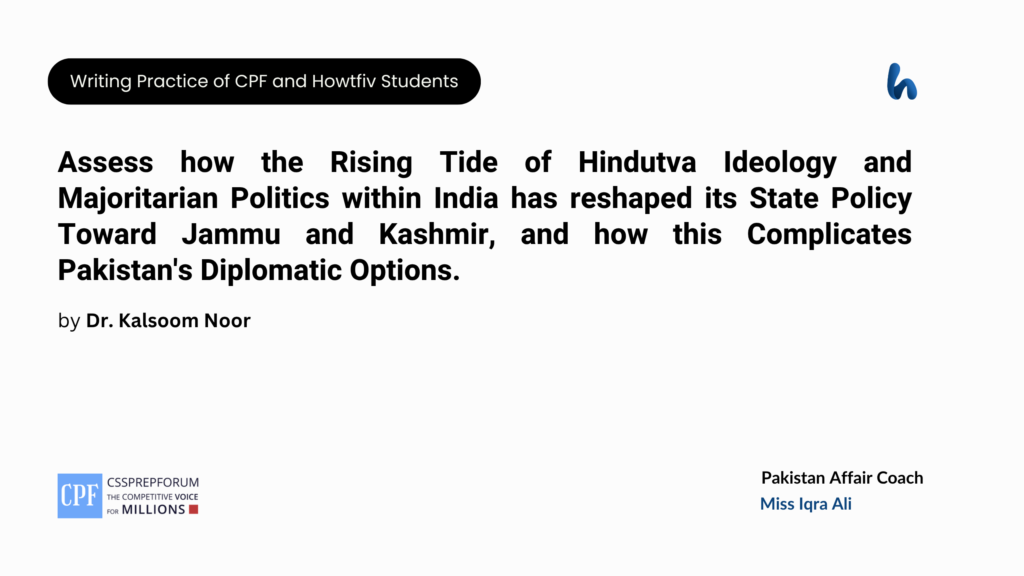
The following question of CSS Pakistan Affairs is solved by Dr. Kalsoom Noor under the supervision of Howfiv’s Pakistan Affairs and Current Affairs Coaches: Miss Iqra Ali and Sir Ammar Hashmir. She learnt how to attempt 20 marks question and essay writing from Sir Syed Kazim Ali, Pakistan’s best CSS and PMS English essay and precis teacher with the highest success rate of his students. This solved question is attempted on the pattern taught by Sir to his students, scoring the highest marks in compulsory and optional subjects for years.

Outline
1-Introduction
2-The Rise of Hindutva Ideology and Majoritarian Politics in India
3-How has the Rising Tide of Hindutva Ideology and Majoritarian Politics within India Reshaped its State Policy Towards Jammu and Kashmir
- ✓Constitutional Integration of Jammu and Kashmir into the Indian Union
- Evidence: Abrogation of Articles 370 and 35A
- ✓Centralization of Political and Administrative Authority
- Evidence: Jammu and Kashmir Reorganization Act, 2019
- ✓Institutionalization of a Security-Centric Governance Framework
- Evidence: Complete lockdown and massive deployment of Indian Armed Forces in August 2019
- ✓Restriction of Civil Liberties and Democratic Freedoms
- Evidence: Media Policy 2020
- ✓Legal Consolidation of India’s New Kashmir Policy
- Evidence: Supreme Court Judgment (2023) upholding the abrogation of Article 370
4-How India’s New Kashmir Policy Has Complicated Pakistan’s Diplomacy
- ✓Weakening Pakistan’s Efforts to Internationalize the Kashmir Dispute
- ✓Narrowing the Scope for Bilateral Dialogue
- ✓Strengthening India’s Diplomatic Narrative on Kashmir
- ✓Reducing the Effectiveness of Pakistan’s International Advocacy
- ✓Compelling Pakistan to Recalibrate Its Diplomatic Strategy
5-Critical Analysis
6-Conclusion
Answer to the question
Introduction
The Kashmir dispute has remained one of the most sensitive issues in South Asia since the partition of the subcontinent. However, the rise of Hindutva ideology and majoritarian politics under the Bharatiya Janata Party (BJP) has brought a significant change in India’s approach towards Jammu and Kashmir. Through constitutional, administrative, judicial, and security-related measures, India has moved towards greater integration and central control over the region. These developments have not only transformed India’s state policy towards Jammu and Kashmir but have also created new diplomatic challenges for Pakistan by limiting its ability to effectively raise the Kashmir issue at the regional and international levels.
The Rise of Hindutva Ideology and Majoritarian Politics in India
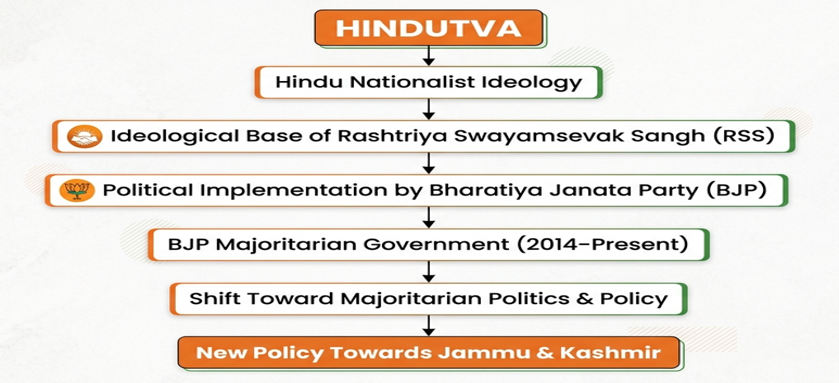
Hindutva is a political ideology that views India primarily as a Hindu nation and seeks to strengthen Hindu cultural and political identity. Over the last decade, the Bharatiya Janata Party (BJP), under Prime Minister Narendra Modi, has brought this ideology to the center of Indian politics through its electoral dominance. This rise has also encouraged majoritarian politics, where the preferences of the Hindu majority have increasingly shaped state policies. As a result, issues such as Jammu and Kashmir have been approached from the perspective of national integration, stronger central authority, and security rather than constitutional autonomy. This ideological shift has significantly influenced India’s policy towards Jammu and Kashmir.
How has the Rising Tide of Hindutva Ideology and Majoritarian Politics within India Reshaped its State Policy Towards Jammu and Kashmir
The rise of Hindutva ideology and majoritarian politics has significantly transformed India’s policy towards Jammu and Kashmir. This shift is reflected in a series of constitutional, administrative, judicial, and security measures aimed at strengthening the Union government’s control over the region.
- Constitutional Integration of Jammu and Kashmir into the Indian Union
First, India’s policy towards Jammu and Kashmir shifted from granting constitutional autonomy to pursuing complete constitutional integration with the Indian Union. The abrogation of Articles 370 and 35A on 5 August 2019 ended the region’s special constitutional status and brought it under the same constitutional framework as the rest of India. Hence, it marked a fundamental policy shift influenced by the rise of Hindutva ideology, replacing the earlier autonomous framework with complete constitutional integration.
- Centralization of Political and Administrative Authority
Following the constitutional change, India also restructured the political and administrative system of Jammu and Kashmir to strengthen the Centre’s control over the region. The Jammu and Kashmir Reorganization Act, 2019, bifurcated the former state into two Union Territories and placed them under the administration of the Union Government through a Lieutenant Governor. As a result, the Act significantly centralized political and administrative authority, reflecting India’s new policy of direct governance over Jammu and Kashmir.
- Institutionalization of a Security-Centric Governance Framework
Moreover, India adopted a security-driven approach to implement its new policy in Jammu and Kashmir. The complete lockdown and massive deployment of Indian Armed Forces in August 2019 were aimed at preventing unrest following the constitutional changes. This shows a security-centric governance framework, where maintaining order and asserting state authority became central features of India’s policy towards the region.
- Restriction of Civil Liberties and Democratic Freedoms
In addition to this, India also tightened its regulation of information and public discourse in Jammu and Kashmir. The Media Policy 2020 empowered the authorities to monitor media content and take action against what they considered false, anti-national, or unlawful reporting. Such measures narrowed the space for free expression and reinforced a governance model that placed state control above democratic freedoms.
- Legal Consolidation of India’s New Kashmir Policy
Finally, India’s revised approach towards Jammu and Kashmir received judicial backing, giving it greater constitutional legitimacy. The Supreme Court’s judgment of December 2023 upheld the abrogation of Article 370, validated the Presidential Orders, and affirmed Parliament’s authority during President’s Rule. By endorsing these constitutional changes, the Court reinforced the legal foundation of India’s new Kashmir policy and reduced the scope for challenging it through constitutional means.
How India’s New Kashmir Policy Has Complicated Pakistan’s Diplomacy
India’s policy changes in Jammu and Kashmir have extended beyond domestic governance and have significantly influenced the regional diplomatic environment. As a result, Pakistan has encountered new diplomatic challenges in pursuing its long-standing position on the Kashmir dispute at both the bilateral and international levels.
- Weakening Pakistan’s Efforts to Internationalize the Kashmir Dispute
India’s post-2019 policy has made it increasingly difficult for Pakistan to present the Kashmir dispute as an unresolved international issue. For example, despite Pakistan’s repeated appeals, the UN Security Council has not adopted any new resolution on Kashmir following the abrogation of Article 370, indicating the limited international response to Pakistan’s diplomatic efforts. Consequently, Pakistan has found it more challenging to mobilize broader global support for its position on the dispute.
- Narrowing the Scope for Bilateral Dialogue
At the bilateral level, India’s revised approach towards Jammu and Kashmir has further reduced the prospects for meaningful engagement with Pakistan. Since August 2019, India has consistently maintained that the constitutional changes are an internal matter, leaving little room for negotiations on Kashmir. This stance has made bilateral dialogue increasingly difficult by removing the dispute from the agenda of formal political engagement.
- Strengthening India’s Diplomatic Narrative on Kashmir
Meanwhile, India has increasingly projected Kashmir as a settled constitutional matter rather than a disputed territory. The Supreme Court’s 2023 judgment upholding the abrogation of Article 370 further reinforced India’s position by providing constitutional legitimacy to the changes introduced in 2019. This legal endorsement strengthened India’s claim that Kashmir is an internal matter, making Pakistan’s diplomatic narrative comparatively less persuasive in many international forums.
- Reducing the Effectiveness of Pakistan’s International Advocacy
Likewise, India’s diplomatic position has limited the impact of Pakistan’s advocacy in international forums. Although Pakistan has repeatedly raised the Kashmir issue at the United Nations General Assembly and the UN Human Rights Council, these efforts have not resulted in any major international initiative to reverse India’s constitutional measures. This reflects the difficulty Pakistan faces in translating diplomatic support into concrete international action.
- Compelling Pakistan to Recalibrate Its Diplomatic Strategy
Faced with these diplomatic constraints, Pakistan has been compelled to adjust its approach towards the Kashmir dispute. Rather than relying primarily on traditional bilateral diplomacy, it has increasingly focused on human rights advocacy, multilateral forums, and public diplomacy to sustain international attention on the issue. This shift illustrates Pakistan’s attempt to adapt its diplomatic strategy to a changing regional and international environment shaped by India’s post-2019 Kashmir policy.
Critical Analysis
Critically, India’s policy shifts towards Jammu and Kashmir present both arguments of national integration and concerns regarding democratic governance. While India argues that the abrogation of Article 370 has promoted uniformity, development, and stronger integration of the region with the Union, critics argue that the extensive use of security measures, restrictions on civil liberties, and reduced political autonomy have created concerns regarding democratic rights. Moreover, Pakistan views these developments as a unilateral alteration of the disputed territory’s status, while India’s firm constitutional position has complicated diplomatic engagement. Therefore, the post-2019 Kashmir policy represents a complex balance between India’s pursuit of integration and the broader challenges of maintaining democratic legitimacy and regional stability.
Conclusion
The rise of Hindutva ideology and majoritarian politics has significantly transformed India’s approach towards Jammu and Kashmir by replacing the earlier framework of special autonomy with greater constitutional integration, centralized governance, and a security-oriented policy. While India considers these measures essential for national unity and administrative effectiveness, they have created new political and diplomatic challenges, particularly for Pakistan’s efforts to internationalize the Kashmir dispute. Ultimately, the post-2019 developments have not only reshaped the internal governance of Jammu and Kashmir but have also altered the diplomatic dynamics of South Asia.
CSS Solved Past Papers’ Essays
Looking for the last ten years of CSS and PMS Solved Essays and want to know how Sir Kazim’s students write and score the highest marks in the essays’ papers? Then, click on the CSS Solved Essays to start reading them.
CSS Solved Essays
CSS Solved Islamiyat Past Papers
Want to read the last ten years’ Islamiyat Solved Past Papers to learn how to attempt them and to score high? Let’s click on the link below to read them all freely. All past papers have been solved by Pakistan’s top CSS Islamiyat coaches having the highest score of their students.
CSS Solved Islamiyat
CSS Solved General Science & Ability Past Papers
Want to read the last ten years’ General Science & Ability Solved Past Papers to learn how to attempt them and to score high? Let’s click on the link below to read them all freely. All past papers have been solved by Pakistan’s top CSS GSA coachez having the highest score of their students.
CSS Solved General Science & Ability
CSS Solved Pakistan Affairs Past Papers
Want to read the last fifteen years’ Pakistan Affairs Solved Past Papers to learn how to attempt them and to score high? Let’s click on the link below to read them all freely. All past papers have been solved by Pakistan’s top CSS Pakistan Affairs coaches having the highest score of their students.
CSS Solved Pakistan Affairs
CSS Solved Current Affairs Past Papers
Want to read the last fifteen years’ Current Affairs Solved Past Papers to learn how to attempt them and to score high? Let’s click on the link below to read them all freely. All past papers have been solved by Pakistan’s top CSS Current Affairs coaches having the highest score of their students.
CSS Solved Current Affairs