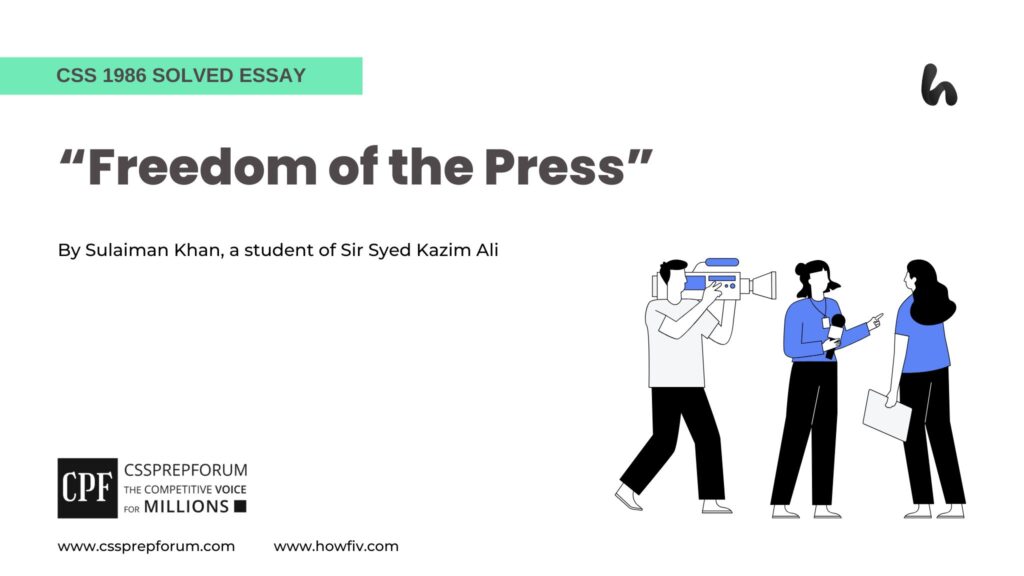
Looking for the CSS 1986 essay “Freedom of the Press”. Cssprepforum is Pakistan’s largest community with all CSS past paper essays and CSS solved essays. Continue reading!
Sulaiman Khan, a student of Sir Syed Kazim Ali, has attempted the CSS 1986 essay “Freedom of the Press” using Sir Kazim’s proven essay writing pattern and strategy. As Pakistan’s leading CSS and PMS English Essay and Precis coach, Sir Syed Kazim Ali has been the only English mentor with the highest success rate of his students in Essays and Precis for over a decade. The essay is uploaded to help other competitive aspirants learn and practice essay writing techniques and patterns to qualify for the essay paper.

Outline
1- Introduction
Although critics argue that an unrestricted press can spread misinformation and threaten national security, a free yet responsible press remains indispensable for ensuring democratic stability, accountability, and socio-economic development in Pakistan.
2- Understanding “Freedom of the Press”
3- Free Press vs Responsible Press
4- Current Status of Press Freedom in Pakistan
5- Why Responsible Press Freedom is Important for Pakistan
- ✓Ensures transparency in governance
- Evidence: The World Bank links press freedom with improved governance and reduced corruption.
- ✓Exposes corruption, “a watchdog role”
- Evidence: Studies published in SAGE Journals show countries with free media have significantly lower corruption levels.
- ✓Strengthens democratic processes
- Evidence: Research indicates free media increases voter awareness and participation, widely supported in democratic theory and electoral studies.
- ✓Creates awareness among the masses
- Evidence: Freedom House reports that free media enhances public access to information, essential for civic engagement.
- ✓Shapes public opinion
- Evidence: Media framing theory in Oxford University Press highlights how media influences public perception of issues.
- ✓Gives voice to marginalized groups
- Evidence: Reports by UNESCO emphasize the media’s role in promoting human rights and inclusion.
- ✓Promotes market transparency
- Evidence: The World Bank associates free press with improved economic governance and investor confidence.
- ✓Highlights economic issues (inflation, unemployment)
- Evidence: Independent media reporting helps shape economic policy debates and public accountability (widely observed in policy analysis).
- ✓Holds rulers, institutions, and elites accountable
- Evidence: Research in ScienceDirect confirms that press freedom reduces abuse of power and strengthens institutional accountability.
6- Critics’ Point of View on Press Freedom
- ✓Press spreads misinformation and fake news.
- Social media amplifies false narratives.
- Rebuttal: Responsible journalism, fact-checking mechanisms, and media literacy can control misinformation without suppressing press freedom.
- ✓Press freedom threatens national security.
- Sensitive information leaks may harm state interests.
- Rebuttal: “Reasonable restrictions”, as in Pakistan’s Constitution, can protect national security while preserving core press freedom.
8- Solutions for a Responsible Press
- ✓To strengthen legal protection of journalists
- ✓To promote ethical and professional journalism
- ✓To establish independent regulatory bodies
- ✓To combat fake news through media literacy and smart regulation
9- Conclusion
“Freedom of the Press”
When Arshad Sharif was killed in 2022, Pakistan did not merely lose a journalist. It lost the accountability journalism provides, the transparency democracy demands, and the voice millions of silenced citizens need. Pakistan ranks 158th out of 180 nations on the World Press Freedom Index. Not because its Constitution denies press freedom, but because its institutions systematically destroy it. Every silenced journalist is a corruption that goes unreported. Every suppressed story is a policy failure that goes unchallenged. Every threatened editor is a citizen whose voice is permanently extinguished. A free yet responsible press is not a luxury Pakistan can afford to suppress: it is the indispensable foundation of accountability, democratic stability, and socio-economic development. It ensures governance transparency, strengthens democratic participation, and builds the informed citizenry that functional democracy requires. It exposes corruption, holds rulers and institutions accountable, and amplifies the voices of communities that power deliberately ignores. It drives market transparency, shapes economic policy, and creates the public awareness that sustainable national development cannot exist without. However, critics argue that press freedom spreads misinformation and threatens national security, as digital platforms accelerate false narratives that destabilize societies. Nevertheless, Pakistan’s governance crisis was not created by journalists: it was created by the accountability vacuum that suppression produces. Misinformation thrives not in free media environments but in information vacuums that censorship creates. This essay investigates why a free and responsible press is Pakistan’s most urgent democratic necessity. It exposes what accountability, democracy, and development permanently lose without it. It argues how legal protection, ethical journalism, and independent regulation can build the media environment Pakistan desperately needs.
To fully comprehend the significance of this debate, it is essential to first understand the concept of freedom of the press in its true sense. Freedom of the press refers to the right of media institutions and journalists to gather, publish, and disseminate information without undue interference, censorship, or prior restraint from the state or other powerful actors. It is a fundamental component of the broader right to freedom of expression, enabling the press to inform the public, scrutinize authority, and facilitate open debate on matters of public interest. In democratic theory, a free press serves as a marketplace of ideas where diverse viewpoints can be expressed and contested, thereby allowing truth to emerge through rational discourse. In Pakistan, this freedom is constitutionally guaranteed under Article 19, albeit subject to reasonable restrictions in the interests of national security, public order, and morality. However, freedom of the press does not imply absolute liberty; rather, it encompasses both rights and responsibilities, requiring journalists to adhere to principles of accuracy, fairness, and ethical reporting. Thus, it is not merely the absence of censorship, but the presence of an independent, responsible, and credible media that truly defines press freedom in a modern democratic society.
While the concept of a free press emphasizes independence from censorship and external control, the idea of a responsible press underscores the ethical obligations that accompany such freedom. A free press allows journalists to report without fear, critique state institutions, and present diverse viewpoints; however, if left unchecked, it can also lead to the spread of misinformation, sensationalism, and biased narratives. Therefore, the notion of a responsible press becomes essential, requiring adherence to principles such as accuracy, impartiality, verification of facts, and respect for societal norms. In the contemporary digital era, where information spreads rapidly through traditional and social media, the distinction between freedom and responsibility has become increasingly significant. An irresponsible press can manipulate public opinion, incite unrest, and undermine national cohesion, whereas a responsible press contributes to informed discourse and social harmony. Hence, true press freedom does not lie in absolute liberty, but in a balanced framework where independence is exercised with accountability, ensuring that the media serves the public interest rather than narrow or harmful agendas.
However, the practical application of this balance between freedom and responsibility presents significant challenges, particularly in the context of Pakistan. Despite constitutional guarantees under Article 19, the practical state of press freedom in the country remains constrained by a combination of political pressure, institutional influence, and security concerns. Journalists frequently encounter censorship, harassment, and even threats to their lives, creating an environment where self-censorship becomes a survival strategy. High-profile cases, such as the killing of investigative journalist Arshad Sharif, underscore the grave risks associated with independent reporting and highlight the vulnerability of media professionals. Moreover, reports indicate that approximately 97 journalists have been killed in Pakistan over the past three decades, with an overwhelming majority of cases remaining unresolved, reflecting a persistent culture of impunity. In addition to physical threats, indirect methods of control, such as blocking television transmissions, restricting newspaper distribution, and pressuring media houses through regulatory and financial means, further limit journalistic independence. Consequently, Pakistan consistently ranks low in global press freedom indices, revealing a stark contrast between constitutional ideals and ground realities. This situation not only undermines the credibility of the media but also weakens democratic accountability, as a constrained press is unable to effectively perform its watchdog role.
A responsible and independent press plays a pivotal role in ensuring transparency in governance by bringing the actions and decisions of public officials into the public domain. Through investigative reporting, policy analysis, and continuous scrutiny of state institutions, the media exposes inefficiencies, mismanagement, and abuse of power that might otherwise remain concealed. This openness compels governments to act with greater accountability and discourages corrupt practices. Empirical evidence also supports this relationship, as the World Bank links press freedom to improved governance and reduced corruption, indicating that societies with a freer press tend to exhibit more transparent and responsive institutions. In the context of Pakistan, where governance challenges often stem from a lack of accountability, a responsible press can serve as a vital mechanism for promoting openness, strengthening public trust, and ensuring that state authority is exercised in the interest of the people.
Building upon its role in ensuring transparency, the press also performs a crucial watchdog function by exposing corruption and holding those in power accountable for their actions. Through investigative journalism, leaks, and in-depth reporting, the media uncovers financial irregularities, misuse of authority, and unethical practices that may otherwise remain hidden from public scrutiny. This exposure not only informs citizens but also creates pressure on institutions to take corrective action, thereby strengthening the rule of law. Empirical research supports this role, as studies published in SAGE Journals demonstrate that countries with greater media freedom tend to experience significantly lower levels of corruption. In Pakistan, where corruption has long undermined governance and public trust, an empowered and responsible press can act as a powerful deterrent against malpractice, ensuring that those in authority remain answerable to the people they serve.
Beyond ensuring transparency and exposing corruption, a free and responsible press plays a fundamental role in strengthening democratic processes by fostering an informed and politically aware citizenry. By providing accurate information about political parties, policies, and electoral procedures, the media enables citizens to make informed choices during elections, thereby enhancing the quality of democratic participation. It also offers a platform for debate and dissent, allowing diverse viewpoints to be expressed and contested, which is essential for a vibrant democracy. Empirical research supports this role, indicating that societies with a freer media environment experience higher levels of voter awareness and electoral participation, as widely affirmed in democratic theory and electoral studies. In the context of Pakistan, where political polarization and misinformation can influence public opinion, a responsible press is crucial in promoting informed voting behavior, strengthening electoral integrity, and ultimately ensuring that democratic institutions function effectively.
In addition to its political functions, a free and responsible press plays a vital role in creating awareness among the masses by disseminating timely and accurate information on social, political, and economic issues. Through news coverage, analysis, and public interest reporting, the media educates citizens about their rights, responsibilities, and the challenges facing society, thereby enabling them to engage meaningfully in civic life. This informational role is particularly significant in developing countries like Pakistan, where literacy gaps and limited access to formal education make the media a primary source of knowledge for many people. Supporting this view, Freedom House reports that free media enhances public access to information, which is essential for active civic participation. Consequently, by raising awareness and promoting informed discourse, a responsible press contributes to a more conscious, engaged, and empowered society.
Moving from awareness to influence, the press also plays a decisive role in shaping public opinion by framing issues, highlighting priorities, and influencing how citizens interpret political, social, and economic developments. Through editorials, talk shows, investigative reports, and analysis, the media does not merely report events but also provides context and interpretation that guides public understanding. In democratic societies, this agenda-setting function is essential because it helps citizens focus on matters of national importance and evaluate different policy options. Media framing theory, widely discussed in academic literature including publications by Oxford University Press, explains how the presentation of information can significantly influence public perception and attitudes. In Pakistan, where diverse political narratives and misinformation often compete for attention, a responsible press is crucial in ensuring that public opinion is formed on the basis of facts rather than manipulation, thereby contributing to a more informed and balanced national discourse.
Extending this societal influence further, the press strengthens inclusion by amplifying the voices of marginalized and underrepresented segments of society, ensuring that their concerns enter the national discourse. By highlighting issues faced by minorities, women, rural communities, and economically disadvantaged groups, the media helps integrate these populations into mainstream policymaking and public debate. This inclusive function strengthens social justice by exposing inequality, discrimination, and human rights violations that might otherwise remain ignored. In this regard, UNESCO reports emphasize that media freedom is essential to promoting human rights, inclusion, and equitable development. In the context of Pakistan, where social and economic disparities persist, a responsible press can act as a bridge between the state and marginalized communities, ensuring that their grievances are acknowledged and addressed, ultimately fostering a more inclusive and cohesive society.
Alongside its social responsibilities, the press also plays a vital economic role by improving transparency within markets and financial systems. It contributes significantly to economic stability by promoting market transparency and reducing information asymmetry between institutions, investors, and the general public. Through business reporting, financial analysis, and investigative journalism, the media highlights corporate practices, government economic policies, and potential irregularities in financial systems, thereby fostering a more accountable economic environment. This transparency is essential for building investor confidence and ensuring fair market competition. In this regard, the World Bank has consistently highlighted that press freedom is closely associated with improved economic governance and stronger investor trust in emerging economies. In Pakistan, where economic challenges such as inflation, fiscal mismanagement, and lack of transparency often undermine public confidence, a responsible press can play a key role in ensuring that markets remain open, accountable, and better regulated through informed public scrutiny.
Furthermore, this economic oversight extends to highlighting the everyday financial struggles faced by ordinary citizens, such as inflation, unemployment, poverty, and fiscal mismanagement, thereby keeping both the public and policymakers informed about the real state of the economy. Through continuous reporting, expert analysis, and data-driven journalism, the media brings attention to economic hardships faced by ordinary citizens and encourages informed public debate on policy responses. This function is particularly important in developing economies like Pakistan, where economic instability directly affects social welfare and living standards. By drawing attention to such issues, the press creates pressure on governments to adopt corrective measures and more effective economic policies. Moreover, independent media reporting contributes to evidence-based policymaking by ensuring that economic challenges are not ignored or misrepresented, but instead are addressed in a timely and transparent manner for sustainable national development.
Finally, all these roles ultimately converge into the most fundamental democratic function of the press: accountability, which is a powerful mechanism of continuously scrutinizing the actions of rulers, state institutions, and influential elites. Through investigative journalism, live reporting, and public interest disclosures, the media ensures that those in authority remain answerable to the people they serve. This watchdog role discourages the abuse of power, corruption, and policy mismanagement by increasing the likelihood of public exposure and institutional consequences. In fact, empirical research published in ScienceDirect confirms that press freedom is strongly associated with reduced abuse of power and improved institutional accountability. In Pakistan, where governance challenges are often linked to weak accountability structures, a responsible press becomes even more essential in maintaining checks and balances. By exposing wrongdoing and demanding explanations from powerful actors, the media strengthens democratic oversight and reinforces the principle that no individual or institution is above public scrutiny.
Critics argue that an unrestricted press can become a conduit for misinformation and fake news, particularly in the digital age, where social media platforms rapidly amplify unverified and sensational content. In such an environment, the speed of information dissemination often outweighs accuracy, leading to the spread of false narratives that can mislead the public, fuel polarization, and undermine trust in institutions. This concern is especially relevant in societies like Pakistan, where digital literacy remains uneven, and misinformation can easily influence public opinion. However, while these risks are real, they do not justify curbing press freedom altogether. Rather, the solution lies in promoting responsible journalism through rigorous fact-checking, editorial accountability, and adherence to professional ethics. Additionally, enhancing media literacy among citizens can enable individuals to critically evaluate information and resist manipulation. Therefore, instead of restricting the press, strengthening its responsibility and credibility offers a more effective and democratic way to combat misinformation.
Another major criticism is that excessive press freedom may pose risks to national security, as unrestricted reporting can lead to the disclosure of sensitive information related to defense, intelligence operations, or state strategy. Such leaks, whether intentional or inadvertent, can compromise national interests, endanger lives, and weaken a country’s strategic position, particularly in a security-sensitive state like Pakistan. Moreover, irresponsible reporting on conflict, terrorism, or institutional matters may create panic or be exploited by hostile actors. However, while these concerns are legitimate, they do not necessitate the suppression of press freedom. Instead, a balanced approach is required, where constitutional “reasonable restrictions” are applied to safeguard national security without undermining the core principles of a free press. In Pakistan, Article 19 already provides such a framework, allowing regulation in the interest of national integrity and public order. Therefore, rather than imposing blanket restrictions, the focus should be on ensuring that the press operates responsibly within clearly defined legal and ethical boundaries, preserving both national security and democratic freedoms.
To ensure a truly responsible and independent press, it is imperative to strengthen the legal protection of journalists, particularly in countries like Pakistan where media professionals often face threats, harassment, and violence. Without adequate security, journalists are compelled to self-censorship, which undermines the very essence of press freedom. Effective legal frameworks must not only safeguard journalists’ rights but also ensure swift investigation and prosecution of crimes against them, thereby ending the prevailing culture of impunity. In this regard, laws guaranteeing freedom of expression should be reinforced with practical enforcement mechanisms, including independent judicial oversight and protection programs for at-risk reporters. By creating a secure environment for media practitioners, the state can enable journalists to perform their duties without fear, thereby strengthening both accountability and democratic governance.
In addition to legal safeguards, promoting ethical and professional journalism is essential for maintaining the credibility and responsibility of the press. Freedom without responsibility can lead to sensationalism, bias, and misinformation, which ultimately erodes public trust. Therefore, media organizations must adopt strict codes of conduct emphasizing accuracy, impartiality, and verification of information. Training programs, professional development initiatives, and institutional accountability mechanisms can further enhance journalistic standards. Moreover, fostering a culture of self-regulation within media houses can reduce reliance on external control while ensuring responsible reporting. In the context of Pakistan, where media competition often prioritizes ratings over accuracy, strengthening ethical norms is crucial for ensuring that press freedom contributes positively to societal development.
Furthermore, the establishment of independent and transparent regulatory bodies is vital to maintaining a balance between press freedom and accountability. Such institutions should function autonomously, free from political or corporate influence, to ensure fair oversight of media practices. Their role should not be to censor content but to uphold professional standards, address complaints, and prevent the misuse of media power. Independent regulators can also facilitate dispute resolution and enforce ethical guidelines without undermining journalistic independence. In Pakistan, where regulatory mechanisms are often criticized for bias or political interference, reforming these institutions to ensure neutrality and transparency is essential. A credible regulatory framework can thus promote responsible journalism while preserving the fundamental right to freedom of expression.
Finally, combating the growing challenge of fake news requires a combination of media literacy and smart, balanced regulation. In the digital age, misinformation spreads rapidly through social media, making it difficult to distinguish between credible and false information. Therefore, educating citizens to critically evaluate news sources and verify information is crucial in building a resilient and informed society. At the same time, governments must adopt targeted regulations that address misinformation without resorting to censorship or suppression of dissent. This includes supporting fact-checking initiatives, encouraging transparency in digital platforms, and holding perpetrators of deliberate disinformation accountable. In Pakistan, where fake news has increasingly influenced public opinion and political discourse, a dual approach of public education and responsible regulation can effectively curb misinformation while safeguarding press freedom.

In conclusion, freedom of the press remains the lifeline of any democratic society, serving as a crucial instrument for transparency, accountability, and public awareness. In Pakistan, while constitutional provisions guarantee this freedom, its practical realization continues to face significant challenges, ranging from external pressures to internal weaknesses within the media itself. As discussed, a responsible press not only strengthens democratic processes, exposes corruption, and informs citizens but also contributes to social inclusion and economic stability. At the same time, concerns regarding misinformation and national security highlight the need for a balanced approach. Therefore, the true objective should not be to restrict press freedom, but to refine it through ethical journalism, legal protections, and institutional reforms. Ultimately, only a free yet responsible press can ensure that power remains accountable, citizens remain informed, and democracy continues to flourish in Pakistan.
CSS 1986 Solved Essays!
Interested in learning all the CSS 1986 Solved Essays? Click on any to continue reading. Each essay is meticulously attempted by Sir Syed Kazim Ali’s students, who have either qualified for CSS or PMS or secured the highest marks in the essay paper.
| Child is the father of man. |
| “Foreign Aid’ – Is it a blessing or a curse? |
| Dismemberment of Pakistan and its consequences. |
| ‘Nuclear Contamination” – Is the threat real or imaginary? |
| “Blessings and Joys of Adversity”. |
| Interest-Free banking is it fact or fiction? |
| Pakistan’s Health Problems – How would you propose to solve them? |
| What do you understand by the terms Agrarian Reforms and Land Reforms? Have they been launched in Pakistan, if so, to what effect? |
| “Freedom of the Press”. |
| “We have entered the Computer Age”. What are the dimensions and prospects of this modern technology? |

CSS Solved Past Papers’ Essays
Looking for the last ten years of CSS and PMS Solved Essays and want to know how Sir Kazim’s students write and score the highest marks in the essays’ papers? Then, click on the CSS Solved Essays to start reading them.
CSS Solved Essays
CSS Solved General Science & Ability Past Papers
Want to read the last ten years’ General Science & Ability Solved Past Papers to learn how to attempt them and to score high? Let’s click on the link below to read them all freely. All past papers have been solved by Miss Iqra Ali & Sir Ammar Hashmi, Pakistan’s top CSS GSA coach having the highest score of their students.