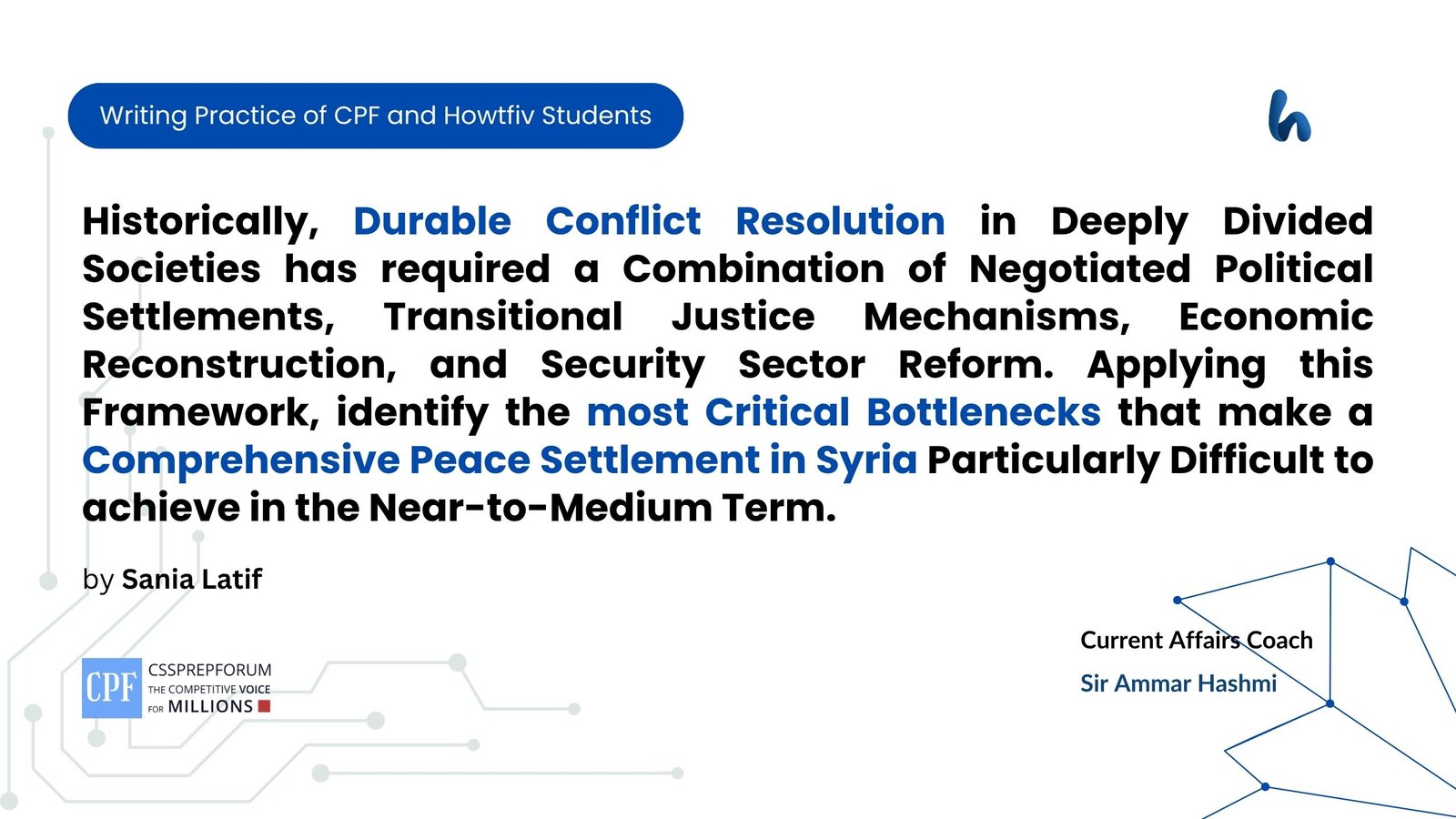
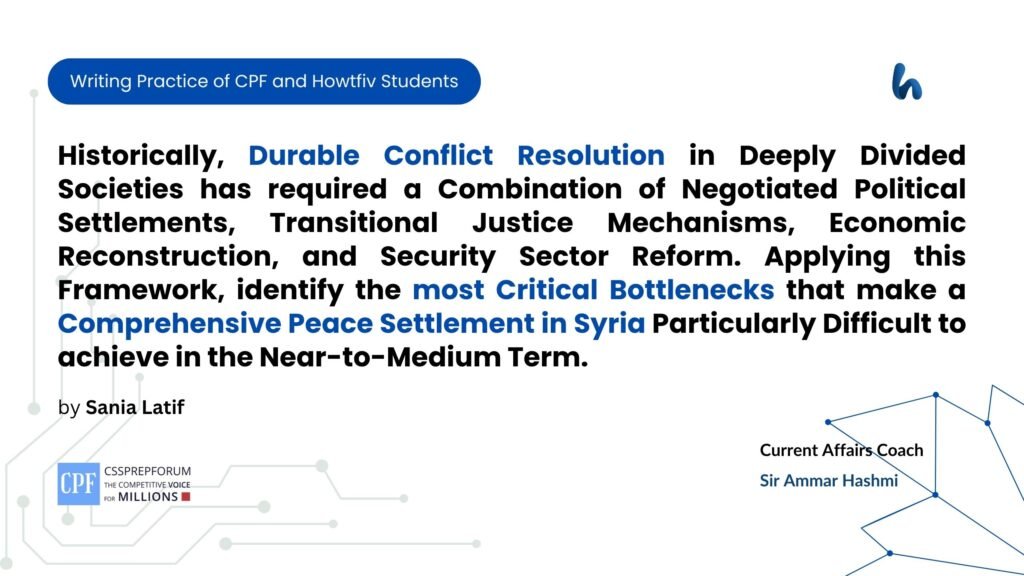
CSS Current Affairs | Comprehensive Peace Settlement in Syria in the Near-to-Medium Term
The following assignment question for CSS Current Affairs is solved by Sania Latif under the supervision of Howfiv’s Pakistan Affairs and Current Affairs Coaches: Miss Iqra Ali and Sir Ammar Hashmi. She learnt how to attempt 20 marks question and essay writing from Sir Syed Kazim Ali, Pakistan’s best CSS and PMS English essay and precis teacher with the highest success rate of his students. This solved question is attempted on the pattern taught by Sir to his students, scoring the highest marks in compulsory and optional subjects for years.

Outline
11-Introduction
2-Historical Overview of the Syrian Conflict: From Uprising to the 2024 Power Transition
3-Bottlenecks in Negotiated Political Settlements
- The Governance Model Rift
- The Institutional Paralysis and Executive Obstruction
4-Bottlenecks in Transitional Justice Mechanisms
- The Mass-Scale Human Rights Violations
- Dysfunctional Judiciary and the Rise of “Street Courts” and “Retaliation Threat”
5-Bottlenecks in Economic Reconstruction
- The Weaponization of Fighting as a Livelihood
- Massive Infrastructure Shortfall and the Sanctions Stranglehold
6-Bottlenecks in Security Sector Reform
- The Integration Dilemma
- Institutionalization of Foreign Proxies
7-Suggestions for Comprehensive Peace Settlements in Syria
8-Conclusion
Answer to the Question
Introduction
The fall of the Bashar-al-Assad dictatorship in December 2024 marked a monumental paradigm shift, yet it did not automatically translate into national stabilization. Indeed, the ongoing transition into 2026 shows that dismantling an autocracy is far easier than building a cohesive state from its ruins. Today, Syria remains a deeply polarized society where fundamental prerequisites for durable conflict resolution, political compromise, judicial accountability, economic revival, and centralized security remain intensely contested. Consequently, the prospects of achieving a comprehensive peace settlement are severely undermined by structural bottlenecks, ranging from peripheral regional clashes with the central government to a profound institutional vacuum.
Historical Overview of the Syrian Conflict: From Uprising to the 2024 Power Transition
Historically, in 2011, peaceful pro-democracy protests erupted across Syria, demanding political freedom and an end to authoritarian rule. The Assad regime deployed lethal force, arbitrary detentions, and military siege tactics against the civilian population. By late 2011, a group of defectors from the Syrian Arab Army (SAA) formed the Free Syrian Army (FSA) to protect the protesters. Ultimately, a security vacuum was created, and different extremist groups such as the Al-Nusra Front and ISIS seized vast Syrian territories. Moreover, on the verge of regime collapse, foreign countries (Russia and Iran) intervened and divided Syria into different control zones. In late 2024, Russia’s military distraction in Ukraine and the degradation of Hezbollah in Lebanon by Israel weakened the regime’s external security shield. Exploiting this vulnerability, opposition forces led by Hay’at Tahrir-al-Sham (HTS) launched a campaign from Idlib; as a result, Assad fled into exile, ending 54 years of family rule.
Bottlenecks in Negotiated Political Settlements
- The Governance Model Rift
Primarily, the newly ascendant Sunni opposition coalitions in Damascus, led by HTS and allied factions, seek to preserve a strong and centralized state apparatus. Their goal is to project nationwide legitimacy, control state institutions, and maintain Syria’s territorial integrity from the capital. Conversely, the Syrian Democratic Forces (SDF) guard the governance model developed during the war. They refuse to return to Damascus rule and demand a highly decentralized, federal system that permanently recognizes their political and military autonomy. In northern Syria, factions aligned with Turkey remain tied to Ankara’s localized security and administrative priorities. This creates a third layer that resists assimilation into a centralized authority in Damascus unless Turkish cross-border security conditions are met. Therefore, these clashing regional visions create deep policy inconsistencies across the territory.
- The Institutional Paralysis and Executive Obstruction
Furthermore, the absolute failure of the UN-led constitutional committee process before 2024 proved that Syrian factions view negotiations as a delaying tactic rather than a genuine platform. Factions have historically suffered from an absolute deficit of political will and trust, failing to agree even on basic principles of sovereignty, rule of law, or control of the military. This rigid, zero-sum political culture directly handicaps the current transitional frameworks. Today, the current transitional authorities are heavily preoccupied with consolidation and internal power struggles. Rather than building inclusive transitional governance, executive decisions remain opaque, non-representative, and heavily influenced by military commanders rather than civilian statesmen.
Bottlenecks in Transitional Justice Mechanisms
- The Mass-Scale Human Rights Violations
Likewise, over a decade of conflict has left Syria with hundreds of thousands of deaths, systemic torture networks, and an enforced disappearance crisis. According to the Syrian Network for Human Rights (SNHR), the database documents at least 231,000 civilians killed (with over 202,000 caused by former regime forces) and 157,000 cases of enforced disappearance. This immense scale of loss has destroyed traditional social safety nets and created demographic segregation along sectarian lines. Moreover, Human Rights Watch data highlights that even within the current transitional phase, armed groups are committing fresh violations, including arbitrary detentions, property confiscations, and targeted crackdowns. These ongoing abuses by transitional forces erode public trust, making community reconciliation nearly impossible to initiate.
- Dysfunctional Judiciary and the rise of “Street Courts” and “Retaliation Threat”
Additionally, due to a highly corrupt and politicized judiciary, combined with the widespread destruction of court infrastructure during the war, there is no legal framework to handle complex war crime trials. In the absence of formal state laws, various local factions and armed groups rely on informal, ad hoc tribunals or strict religious courts to administer rapid justice. These bodies lack international standards of due process and are frequently weaponized to settle political scores through extrajudicial revenge. According to data from SNHR, the lack of functioning, specialized hybrid courts creates a vacuum where “popular justice” or street courts threaten to spark an endless cycle of retaliatory violence. Consequently, the absence of a centralized transitional justice framework creates a climate of fear that blocks national reconciliation.
Bottlenecks in Economic Reconstruction
- The Weaponization of Fighting as a Livelihood
In the same vein, over the years, Syria transformed into a multi-billion-dollar narco-state. The illicit manufacturing and trafficking of Captagon became the primary source of revenue for the warlords, militia commanders, and corrupt elites. Consequently, for thousands of young men, joining an armed faction remains the only viable job in a collapsed economy. They possess no employable civilian skills. Demobilizing them without an immediate, massive capital injection to provide alternative livelihoods will inevitably push them into organized crime or back into radical insurgencies. Furthermore, the elites derive their wealth from illicit border-crossing, and they actively resist the centralized customs, formal banking systems, and state-regulated institutions.
- Massive Infrastructure Shortfall and the Sanctions Stranglehold
Moreover, chronic funding cuts by international donors have left transitional authorities unable to provide basic water, electricity, and health infrastructure, keeping the socio-economic environment highly volatile and fertile for ISIS recruitment. Simultaneously, Broad international sanctions, such as the US Caesar Act, remain fully in place as a primary roadblock to recovery. While designed to punish human rights abusers, these sanctions create a massive chilling effect on the entire economy. Specifically, they freeze the formal bank channels, discourage legitimate foreign investment, and block the import of critical dual-use construction material needed to repair public utilities.
Bottlenecks in Security Sector Reform
- The Integration Dilemma
Moving down the ladder, a stable post-conflict transition fundamentally depends on the state monopolizing the legitimate use of force through comprehensive security sector reform. However, in post-Assad Syria, integrating deeply fragmented armed factions and managing geopolitical actors present monumental structural barriers. The primary internal bottleneck is the extreme difficulty of implementing a unified Disarmament, Demobilization, and Reintegration (DDR) strategy across an exceptionally fractured security environment. Syria is saturated with ideologically diverse non-state armed groups, ranging from HTS to the US-backed SDF and localized rebel factions. These major transitional factions hold de facto political power; any attempt to disqualify their commanders from a unified military framework risks triggering immediate mutinies and secondary conflicts.
- Institutionalization of Foreign Proxies
Last but not least, various Syrian armed factions function as direct instruments of external interests. For instance, factions in the northern enclave rely heavily on Turkish financial, logistical, and political backing, while the SDF maintains a strategic partnership with the United States. True security sector centralization is obstructed as long as foreign patrons retain operational vetoes over their respective proxies. Turkiye will not allow the integration of Kurdish forces as they pose a national security threat, while the US focuses on managing the integration of the SDF to prevent a chaotic security vacuum. This external dependency ensures that Syrian armed actors prioritize the strategic agendas of their foreign sponsors over a unified national defense framework, leaving the country’s security architecture permanently fragmented.
Suggestions for Comprehensive Peace Settlements in Syria
To attain peaceful settlements in Syria, it is essential to establish an inclusive, pluralistic transition government. There must be a shift from authoritarian command to a transparent, multi-ethnic administrative council. This council must protect religious authorities and secular citizens to prevent retaliatory sectarian violence and lay the foundational framework for future democratic elections. Diplomatically, an international summit is urgently needed to establish clear rules of engagement. Regional and global powers must coordinate to ensure military facilities do not spark a direct conflict. Meanwhile, a guarantee must be given to Turkiye regarding its border security without green-lighting the eradication of Kurdish autonomous regions. Economically, global financial institutions and the UN must unblock humanitarian and reconstruction funds, which were previously frozen under the Assad regime. Strategically, the new Syrian army must maintain strong counter-terrorism intelligence sharing with international coalitions. Keeping security tight on prison facilities holding former extremists is paramount to ensuring ISIS cannot mount a resurgence amid the government transition.
Conclusion
In sum, achieving a durable conflict resolution in post-Assad Syria requires transforming these deep structural bottlenecks into pillars of institutional stability. True peace in the near-to-medium term cannot be achieved through military dominance alone; it depends on the transitional government’s ability to balance centralized state-building with inclusive regional autonomy, institute transparent judicial accountability rather than retributive street justice, unlock economic reconstruction capital, and successfully integrate fragmented security forces. Ultimately, navigating this fragile transition relies on harmonizing internal political pluralism with coordinated international diplomacy to prevent a descent back into systemic fragmentation.

CSS Solved Past Papers’ Essays
Looking for the last ten years of CSS and PMS Solved Essays and want to know how Sir Kazim’s students write and score the highest marks in the essays’ papers? Then, click on the CSS Solved Essays to start reading them.
CSS Solved Essays
CSS Solved Islamiyat Past Papers
Want to read the last ten years’ Islamiyat Solved Past Papers to learn how to attempt them and to score high? Let’s click on the link below to read them all freely. All past papers have been solved by Pakistan’s top CSS Islamiyat coaches having the highest score of their students.
CSS Solved Islamiyat
CSS Solved General Science & Ability Past Papers
Want to read the last ten years’ General Science & Ability Solved Past Papers to learn how to attempt them and to score high? Let’s click on the link below to read them all freely. All past papers have been solved by Pakistan’s top CSS GSA coachez having the highest score of their students.
CSS Solved General Science & Ability
CSS Solved Pakistan Affairs Past Papers
Want to read the last fifteen years’ Pakistan Affairs Solved Past Papers to learn how to attempt them and to score high? Let’s click on the link below to read them all freely. All past papers have been solved by Pakistan’s top CSS Pakistan Affairs coaches having the highest score of their students.
CSS Solved Pakistan Affairs
CSS Solved Current Affairs Past Papers
Want to read the last fifteen years’ Current Affairs Solved Past Papers to learn how to attempt them and to score high? Let’s click on the link below to read them all freely. All past papers have been solved by Pakistan’s top CSS Current Affairs coaches having the highest score of their students.
CSS Solved Current Affairs