CSS Current Affairs | Political, Economic, And Security Conditions Necessary For Large-Scale Refugee Repatriation
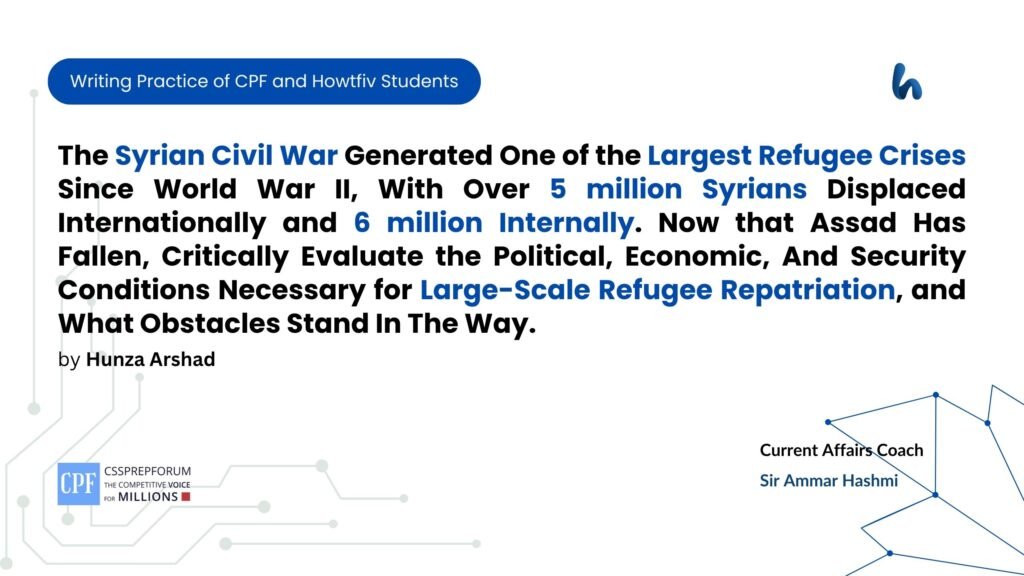
The following assignment question for CSS Current Affairs is solved by Hunza Arshad under the supervision of Howfiv’s Pakistan Affairs and Current Affairs Coaches: Miss Iqra Ali and Sir Ammar Hashmi. She learnt how to attempt 20 marks question and essay writing from Sir Syed Kazim Ali, Pakistan’s best CSS and PMS English essay and precis teacher with the highest success rate of his students. This solved question is attempted on the pattern taught by Sir to his students, scoring the highest marks in compulsory and optional subjects for years.

Outline
1-Introduction
2-Brief Overview of the Syrian Refugee Crisis After Assad
3-Prerequisites for large-scale refugee repatriation in Syria
- The requirement of Political Conditions to repatriate in Syria
- A durable Political Resolution and Peace Agreement
- Establishment of a Cohesive, inclusive Government
- International Mediation and Superpower Restraint
- The requirement of Economic Conditions to repatriate in Syria
- Stabilization of the Financial system and Lifting of Economic Constraints
- Extensive Infrastructure Reconstruction and Significant International Financial
- Assistance
- Creation of Employment and Livelihoods and Resolution of Property Rights
- The requirement of Security Conditions to repatriate in Syria
- Cessation of Ongoing Violence and Protection from Persecution and Retaliation
- Maintaining Law and Order while addressing Extremism and Militant Influence
- International Mediation and Superpower Restraint ensuring voluntary, safe, and dignified returns
4-The obstacles in repatriation of Syrian in their homeland
- Persistent Security Risks and Violence
- Threat of Persecution
- Ongoing Violence and Instability
- Militant Influence
- Legal and Social Hurdles
- Property Rights and Seizures
- Societal Divisions
- Destruction of infrastructure and absence of Essential Services
- Political and Governance Challenges
- Fragmented Government
- Lack of a Durable Political Resolution
- International Uncertainty
5-Critical Analysis
6-Conclusion
Answer to the question
Introduction
Following the monumental fall of the Bashar al-Assad regime, Syria entered a pivot era of transitional governance. Millions of international refugees and internally displaced persons(IDPs) have attempted to return to their homeland. However, transitioning from a rush of spontaneous, emotionally driven return to a structural, large-scale, and sustainable repatriation remains an incredibly complex hurdle. Addressing political, economic, and security-level conditions is a way to create possibilities to repatriate Syrians to their homeland.
Brief Overview of the Syrian Refugee Crisis After Assad
The fall of Bashar al-Assad opened the possibility of return for millions of Syrians displaced during more than a decade of conflict, but regime change alone has not made large-scale repatriation possible. Many refugees still face uncertainty over security, housing, employment, property ownership, basic services, and the political direction of the country. At the same time, Syria remains deeply affected by damaged infrastructure, weak institutions, armed factions, and social divisions created by years of war. Therefore, the refugee question has entered a new phase: the issue is no longer simply whether Syrians want to return, but whether the country can provide the political stability, economic opportunities, and security guarantees required for their voluntary, safe, and sustainable return.
Prerequisites for large-scale refugee repatriation in Syria
For repatriation to move past a temporary “check-in” phase and become a lasting reality, three structural pillars- political, economic, and security- must be built simultaneously.
- The requirement of Political Conditions to repatriate in Syria
- A durable Political Resolution and Peace Agreement
The vacuum left by the Assad regime cannot be filled by warlords. A formalized peace treaty signed by remaining regional authorities and rebel coalitions is necessary to officially declare the war over. It is a sustainable solution to the refugee crisis, and it is fundamentally dependent on achieving a formal, durable political resolution to the conflict. This transition from a wartime environment to a stable political framework will address the root cause of displacement.
- Establishment of a Cohesive, inclusive Government
The transitional government must represent Syria’s diverse ethnic and sectarian mosaic: Sunnis, Alawites, Kurds, Christian. If any large group is systematically excluded, it creates the perfect breeding ground for a secondary insurgency and stalling repatriation. As it has been witnessed in history, the coalition that toppled the Assad regime was comprised of factions with vastly different ideologies, such as Hayat Tahrir al-Sham (HTS), the Southern Front, and Kurdish groups. So the primary condition for stability and return is the ability to unite these diverse factions under a single, cohesive government capable of maintaining law and order.
- International Mediation and Superpower Restraint
For a stable political environment to emerge, coordinated international efforts are essential. This includes UN-led mediation to facilitate dialogue between rival factions and ensure an inclusive transition, as well as restraint from global powers like the USA, Iran, Turkey, and Russia to use Syrian territory as a zero-sum chessboard. They must respect the transition process rather than aiming to oppose client factions.
- The requirement of Economic Conditions to repatriate in Syria
- Stabilization of the Financial system and Lifting of Economic Constraints
Syria is heavily scarred by years of economic sanctions, and economic recovery is linked to a stable currency and banking system. In some areas, the collapse of the Syrian Pound led to the adoption of the Turkish Lira to manage instability, highlighting the need for a unified national financial framework for future growth. Long-term returnees cannot survive in a broken barter economy; hence, the international sanctions must continue to be systematically phased out to reintegrate Syria into global trade and stabilize the central banking system. Future economic viability for large-scale repatriation likely depends on how these sanctions are addressed or navigated in a post-conflict transition.
- Extensive Infrastructure Reconstruction and Significant International Financial Assistance
Millions of homes and entire cities, such as Aleppo and Homs, have been reduced to rubble. Returning families need a functional grid, running water, and safe schools. Large-scale return is impossible without a massive rebuilding effort to provide housing for millions of returning citizens. Meanwhile, the large scale of destruction requires billions of dollars in international aid to get repairs. So, it’s the basic requisite for repatriation of refugees that infrastructure reconstructed while the foreign aid is provide them
- Creation of Employment and Livelihoods and Resolution of Property Rights
Many refugees in host countries currently struggle with legal restrictions on work or exploitation in low-paying informal jobs. Moreover, a significant hurdle to return is the seizure of properties by various factions during the war. Hence, successful repatriation requires a viable job market within Syria that allows returnees to support themselves, along with the establishment of a clear legal framework to resolve property ownership.
- The requirement of Security Conditions to repatriate in Syria
- Cessation of Ongoing Violence and Protection from Persecution and Retaliation
A fundamental prerequisite is the total cessation of hostilities. A major fear for many refugees is the risk of state-sanctioned violence or retaliatory measures for perceived dissent. Refugees are deterred by the continued threat of conflict and the instability inherent in a nation still scarred by over a decade of civil war. So, the security conditions must include institutionalized protections that ensure returnees are not targeted by new or remaining factions.
- Maintaining Law and Order while addressing Extremism and Militant Influence
The power vacuum left by the collapse of the previous regime must be filled by a cohesive government capable of maintaining law and order. The current landscape features diverse groups with “vastly different ideologies” such as Hayat Tahrir al-Sham (HTS), the southern front, and Kurdish groups, making the establishment of a single, reliable security framework a monumental challenge. While HTS has attempted to rebrand itself as a moderate localized force and a partner in anti-terrorism efforts, it still possesses militant roots that pose a risk of perpetuating instability if not integrated or checked by a national framework.
- International Mediation and Superpower Restraint ensuring voluntary safe and dignified returns
For return to be viable, the international community, particularly through UN-led mediation, must play a role in ensuring an inclusive transition. Superpower restraint from nations like Russia and the U.S. is also required to prevent Syria from remaining a “proxy battlefield”, which would further jeopardize the safety of civilians. Human rights organizations emphasize that any repatriation must adhere to the three pillars of being voluntary, conducted in safety, and carried out with dignity. Without these guarantees, returns could lead to further humanitarian harm rather than resolution.
The obstacles in repatriation of Syrian in their homeland
- Persistent Security Risks and Violence
- Threat of Persecution
Human rights organizations emphasize that many refugees fear being targeted for perceived dissent or past opposition to various factions. Without institutionalized protections, the risk of retaliatory violence remains a major deterrent.
- Ongoing Violence and Instability
While the major conflicts have shifted, many parts of Syria remain unsafe due to ongoing violence and the presence of militant groups. The power vacuum left by the previous regime could lead to renewed chaos as rival factions vie for control.
- Militant Influence
Groups like Hayat Tahrir al-Sham (HTS), despite efforts to rebrand, retain militant roots that pose a risk of perpetuating instability if their influence is not integrated into a stable national framework.
- Legal and Social Hurdles
- Property rights and Seizures
During the war, the management of properties became a flashpoint for conflict. Many returnees face obstacles related to the seizure of homes and lands by various factions, making social and economic reintegration difficult.
- Societal Divisions
Years of wars have the nation scarred by societal divisions. The psychological toll of displacement and the trauma of violence make social integration a long-term risk for returnees, particularly children.
- Destruction of infrastructure and absence of Essential Services
Entire cities such as Aleppo and Homs have been destroyed, which clearly depicts that returnees have no home to return to. Rebuilding critical infrastructure like schools, hospitals, and a functional water system is essential for a viable return. Millions of Syrians remain dependent on humanitarian aid for survival, so the establishment of a functional internal economy is a must, which will provide a livelihood as a prerequisite.
- Political and Governance Challenges
- Fragmented Government
A “Fragmented Government” stands as a severe obstacle to repatriation because a decentralized, fractured state cannot provide the uniform safety guarantees or public services necessary for millions to return. Although Syria’s transitional government under President Ahmed al-Sharaa has pushed heavily for state re-centralization, authority remains deeply uneven across the country. Large pockets of territory, such as the Kurdish-majority northeast and minority Druze regions in the south, continue to negotiate fragile integration terms under pressure from competing external actors like Turkey, Israel, and the United States. Furthermore, because the central administration lacks complete operational control over its own loose coalition of forces, localized armed factions and remnants of the old order frequently act as spoilers. This creates outbursts of intercommunal violence and conflicting regional laws. For refugees, this systemic fragmentation means that entering a different province or city could expose them to entirely different security risks, arbitrary local regulations, or discriminatory judicial systems, turning their repatriation into a dangerous geographic gamble.
- Lack of a Durable Political Resolution
The “Lack of a Durable Political Resolution” is a massive hurdle because refugees require long-term stability, not temporary fixes, before uprooting their lives again. While Syria has entered a historic transitional phase following Assad’s fall, the current framework is inherently temporary and lacks a finalized, universally accepted constitution or permanent democratic institutions. Without a definitive, legally binding political settlement that guarantees long-term safety, protects minority rights, and secures the backing of meddling regional powers, the political landscape remains highly volatile; as a result, refugees will continue to view returning not as a safe homecoming, but as a dangerous gamble on an unpredictable future.
- International Uncertainty
“International Uncertainty” serves as a critical bottleneck for large-scale repatriation because it creates an atmosphere of global hesitation that directly affects the safety and financial viability of return. Even though the European Union has recently reinstated its cooperation agreement with Damascus to aid socio-economic recovery, immense global friction remains. Geopolitical alignment on Syria’s future is deeply fractured; while some international bodies and neighboring host countries are pushing for rapid repatriation arrangements to alleviate their own domestic pressures, the United Nations (UNHCR) and various human rights organizations continuously warn that parts of Syria remain volatile and underfunded. Consequently, because foreign governments and donors are deeply uncertain about the long-term stability of the transitional government, they heavily restrict or delay major reconstruction funding. This dynamic leaves refugees caught in a dangerous geopolitical limbo—unsure if they will receive international protection, basic humanitarian aid, or structural safety if they choose to return home.
Critical Analysis
The transition from conflict to sustainable refugee repatriation in a post-Assad Syria is fundamentally constrained by a paralyzing “chicken-and-egg” dilemma across its political and economic landscapes. While large-scale returns are structurally impossible without massive infrastructure reconstruction and financial stabilization, Western donors and international bodies refuse to lift heavy economic sanctions or provide comprehensive funding until a permanent, democratically validated political resolution is finalized. Conversely, the transitional government cannot establish the institutional legitimacy, unified national framework, or economic viability required to secure that very political stability without an immediate influx of capital. Furthermore, this internal gridlock is severely exacerbated by external pressures, as host nations experiencing domestic strains are tempted to conflate the mere physical feasibility of the regime’s collapse with actual structural safety. Forcing or rushing repatriation into an underfunded territory with fragmented local authorities, unresolved property rights, and active militant influences risks transforming an intended humanitarian homecoming into a secondary crisis of premature, unsustainable re-displacement.
Conclusion
The fall of the Bashar al-Assad regime represents the erasure of the primary political roadblock to Syrian repatriation, shifting the global humanitarian focus from endless crisis management to active state-building. However, as this framework demonstrates, the physical removal of a dictator does not automatically construct a viable nation-state.
Ultimately, large-scale refugee repatriation cannot be treated as an isolated logistical exercise; it is the ultimate stress test of Syria’s post-conflict transition. If the interim government fails to secure a permanent, inclusive constitutional agreement that legally protects property rights and guarantees immunity from reprisal, spontaneous returns will stall. Furthermore, if international superpowers fail to exercise restraint and instead treat the fragile nation as a zero-sum proxy field, Syria will fracture further. Sustainable repatriation will only be achieved when the international community transitions from sending short-term humanitarian aid to committing to long-term macro-economic reconstruction, and when the authorities in Damascus prioritize legal equity and localized inclusion over raw factional control.

CSS Solved Past Papers’ Essays
Looking for the last ten years of CSS and PMS Solved Essays and want to know how Sir Kazim’s students write and score the highest marks in the essays’ papers? Then, click on the CSS Solved Essays to start reading them.
CSS Solved Essays
CSS Solved Islamiyat Past Papers
Want to read the last ten years’ Islamiyat Solved Past Papers to learn how to attempt them and to score high? Let’s click on the link below to read them all freely. All past papers have been solved by Pakistan’s top CSS Islamiyat coaches having the highest score of their students.
CSS Solved Islamiyat
CSS Solved General Science & Ability Past Papers
Want to read the last ten years’ General Science & Ability Solved Past Papers to learn how to attempt them and to score high? Let’s click on the link below to read them all freely. All past papers have been solved by Pakistan’s top CSS GSA coachez having the highest score of their students.
CSS Solved General Science & Ability
CSS Solved Pakistan Affairs Past Papers
Want to read the last fifteen years’ Pakistan Affairs Solved Past Papers to learn how to attempt them and to score high? Let’s click on the link below to read them all freely. All past papers have been solved by Pakistan’s top CSS Pakistan Affairs coaches having the highest score of their students.
CSS Solved Pakistan Affairs
CSS Solved Current Affairs Past Papers
Want to read the last fifteen years’ Current Affairs Solved Past Papers to learn how to attempt them and to score high? Let’s click on the link below to read them all freely. All past papers have been solved by Pakistan’s top CSS Current Affairs coaches having the highest score of their students.
CSS Solved Current Affairs